
Need help with your project?

Oops! Something went wrong while submitting the form.


Choosing the right backend technology can define how fast your ecommerce business launches and how well it scales under pressure. Node.js has become a go-to choice for modern online stores thanks to its performance, flexibility, and rich ecosystem. But it’s not a silver bullet.
In this article, we explore when Node.js works best for ecommerce, where its limits are, and which practices help businesses avoid costly mistakes as they grow.
%20(1).png)
Key takeaways:
Node.js is a top choice for e-commerce founders. Startups and growing stores prefer it for speed, scalability, and efficient development that directly supports business goals — here’s why.
Node.js allows teams to build and launch e-commerce products quickly, without complex infrastructure. For founders, this means validating ideas, releasing MVPs, and starting sales sooner instead of spending months on heavy backend architecture that slows go-to-market.
Node.js handles high traffic and real-time operations efficiently, which is critical for ecommerce platforms during peak loads, promotions, and seasonal spikes. Businesses can scale without rewriting the backend, reducing long-term technical risk and cost.
Using a single language (JavaScript) across frontend and backend simplifies hiring, collaboration, and code maintenance. For founders, this means smaller teams, faster iterations, and lower total cost of ownership as the e-commerce platform grows.
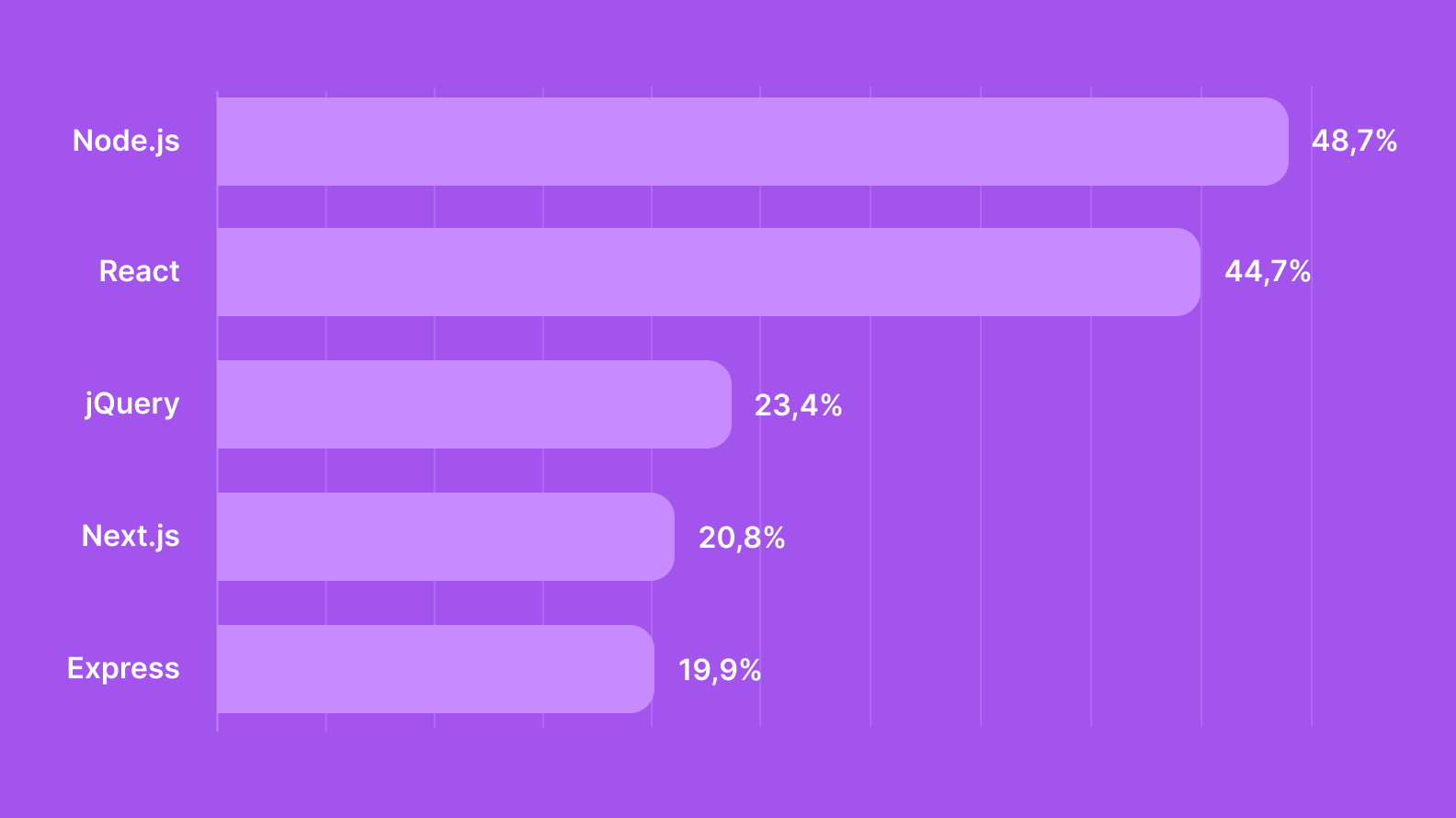
According to Statista, Node.js is the most used web framework among software developers in the world, chosen by 48.7% of respondents. In e-commerce projects, Node.js is popular because it offers fast performance, scalability, and quick development cycles. Let’s dive deeper.
Node.js is well-suited for ecommerce platforms where thousands of users browse products, add items to carts, and check out simultaneously. This helps businesses maintain a smooth user experience during traffic spikes without infrastructure overload.
E-commerce rarely works in isolation. Node.js has a rich ecosystem of libraries and APIs for payments, logistics, CRMs, analytics, and marketplaces. Integration takes less time, and businesses can launch full-featured platforms faster.
Features like live pricing, stock availability, order tracking, and notifications work especially well with Node.js.
Node.js works great with cloud platforms and microservice architectures. It comes in handy when there is a need to scale individual components or deploy updates independently.
When used correctly, Node.js is a strong foundation for scalable e commerce applications, but there are cases when this framework may not be the best choice for your product. Here are some of them.
Node.js performs best when the system is well-designed. For ecommerce businesses, this means investing time early in choosing the right architecture to avoid scalability or performance issues later. With proper planning, these risks are manageable and predictable.
If an e-commerce platform relies on complex calculations or CPU-heavy tasks, Node.js may need support from additional services. In practice, this is often solved by separating such workloads without impacting the core commerce flow.
The quality of a Node.js e-commerce platform strongly depends on the team’s experience. When built by an experienced development partner, Node.js delivers stable and scalable results. Without that expertise, technical debt can grow faster.
<div class="post_divider"></div>
⭐Our experience
We developed EnerGO — a power bank renting web application that works in the Moscow metro and cafés. Users can take one power bank from one station and return it at another.
The client got this idea after his trip to China, where he met manufacturers of big and small power banks. A big challenge of this project was that we had to decipher the original Chinese documentation and reverse-engineer the old code written in Java — that’s exactly where our Node.js expertise came in handy.

At first, the plan was to make just one app, for power bank users. But two additional apps came along the way: an app for advertisers and an app for maintenance.
We developed all three web applications and created designs for them. As of 2021, there were 730 stations in Moscow, 100 of them in the metro. EnerGO estimated its active users number at 2 million.
<div class="post_divider"></div>
There are no universal patterns for working with Node.js (mainly because everything depends on your business goals). However, some of the best Node.js
Ecommerce traffic is uneven by nature — promotions, Black Fridays, and marketing campaigns create sudden spikes. In Node.js projects, it’s best to design systems so they can handle peak loads from day one: queue-based order processing, async workflows, and horizontal scaling. This approach helps keep checkout flows stable during high-traffic launches in several retail and marketplace projects from our portfolio.
<div class="post_divider"></div>
⭐Our experience
We developed EyeBuy — a livestreaming shopping app, allowing you to watch a live stream and instantly order things that you like. We have never developed a similar project before, so it was a challenge. We used React for the frontend app development for web, and React Native for mobile development.
Node.js was the right choice for the backend part. Test streams quickly attracted big brands: Letoile, Mascott, and Decathlon. On the Mascotte stream, the number of unique viewers reached 500 (as opposed to 40 on the prototype stage). We had to make sure the livestreams didn’t crush at peak traffic.

In the first streams we used the Socket.io library and added every real-time user into a variable. The project is still in the pilot stage, so there are things we’re still working on: for example, making it possible to record streams automatically.
With Node.js, the platform will handle the load of even more users as the project grows.
<div class="post_divider"></div>
Monolithic backends slow down growth as the product evolves. In Node.js eCommerce projects, we usually separate core domains early: catalog, cart, payments, users, and integrations. This makes the platform easier to scale, update, and debug. This approach works best in multi-feature marketplaces where new business logic has to be shipped without breaking existing flows.
In real life, most revenue loss happens at checkout. Node.js works well for building fast, non-blocking payment pipelines, but they must be carefully optimized. At Purrweb, we focus on minimizing synchronous operations, handling third-party payment failures gracefully, and keeping checkout logic isolated — a practice we’ve used in subscription-based and transactional commerce products.
Product listings, prices, and availability are read far more often than they change. In Node.js e-commerce systems, caching and background jobs are essential. We use in-memory caches, queues, and async workers to reduce database load and keep response times low — especially in projects with large catalogs or frequent API integrations.
Modern ecommerce platforms depend on external systems: ERPs, CRMs, delivery services, analytics, and marketing tools. Ideally, integration layers should be designed as first-class components, not afterthoughts. This way, third-party services can be quickly connected to custom ecommerce platforms and adapted as business needs change.
Security is not something to ignore in e-commerce (or, frankly, anywhere else). Here are three factors you should pay attention to when building ecommerce applications with Node.js.
Ecommerce platforms process sensitive information — personal data, payment tokens, and order history. In Node.js projects, this means strict access control, secure API design, encryption at rest and in transit, and careful handling of third-party payment providers. When security is built into the backend logic, businesses reduce compliance risks and protect customer trust.
<div class="post_divider"></div>
⭐Our experience
We developed Accelerist, an online fundraising platform that helps non-profits raise money from commercial organizations. Basically, a Tinder for NPOs 😉
We removed the need for sponsors to register. Instead, their data is taken from the databases and presented as cards on Accelerist, and any NPO can e-mail them a potential pitch. For that, we integrated ZoomInfo.
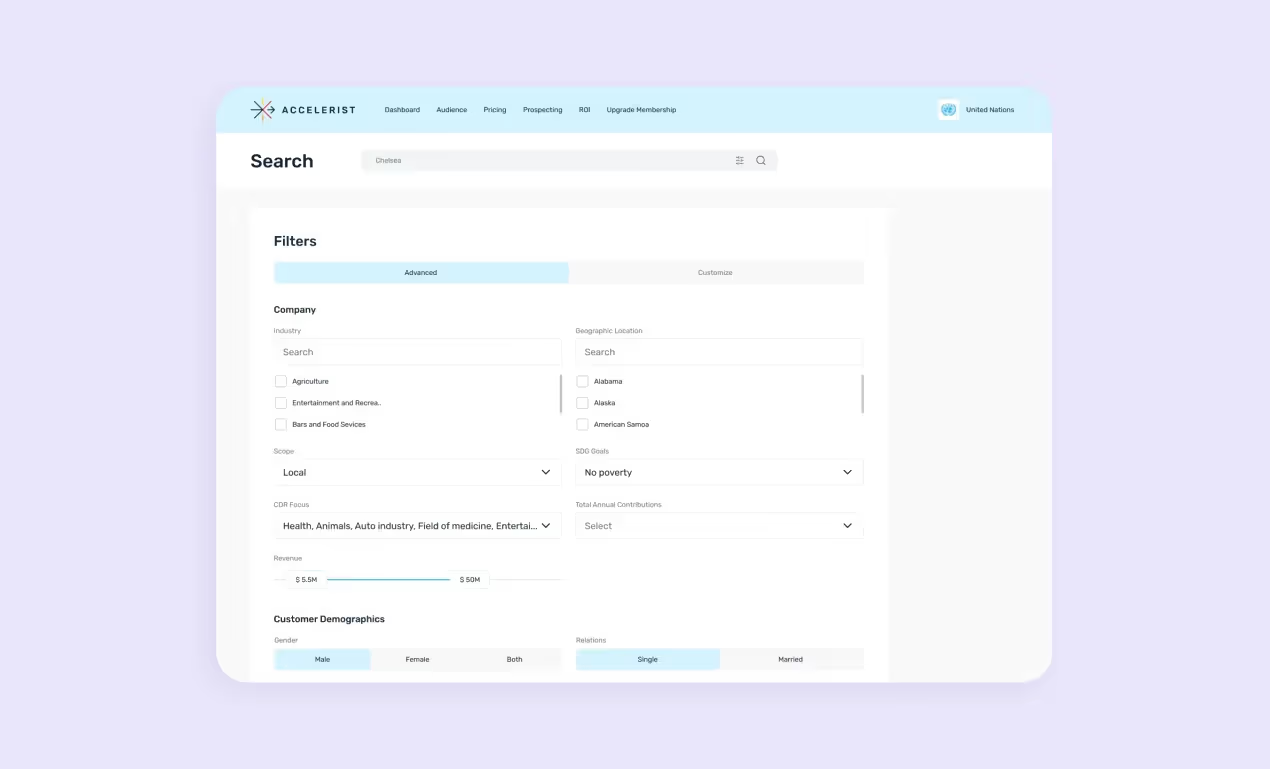
We used Node.js for the backend and React for the frontend — for this project, we needed reliable and tried tools. We created the app architecture, designed the flow for NPOs and admins, and included favorites, customized filters, as well as payment and subscription.
The development took 5 months, and the final cost for the client was $49,400.
<div class="post_divider"></div>
Node.js relies heavily on third-party packages, which can become a security risk if left unchecked. Regular dependency audits, controlled updates, and minimal package usage help prevent vulnerabilities. In real-world e-commerce projects, this practice significantly reduces exposure to known exploits without slowing down Node.js development.
E-сommerce systems are frequent targets for DDoS attacks, bot traffic, and fraud attempts — especially during sales. Node.js platforms must include rate limiting, request validation, and monitoring from day one. These measures keep the store available and protect revenue during critical business moments.
Making a final decision can be tough. Let’s run through all the pros and cons again — below is a quick checklist that can help you understand whether you chose the right framework. If you still have questions, consider booking a Node.js consulting session with us.
If your e-commerce platform plans to handle rapid traffic spikes, scale globally, or add new features quickly, Node.js provides the flexibility and performance to support growth without constant rewrites.
Node.js excels for real-time updates, chat, inventory syncing, and multiservice architectures. If your store requires CPU-heavy operations like complex analytics or AI-driven recommendations, you may need additional services alongside Node.js.
Node.js relies on JavaScript full-stack expertise. Consider whether your team (or development partner) has experience with async patterns, scalable architecture, and security best practices to avoid technical debt.
Modern stores interact with CRMs, ERP’s, marketplaces, and payment gateways. Node.js handles multiple API integrations efficiently, making it a strong choice for platforms that depend on external systems and microservices.
Node.js has proven itself as a strong foundation for modern e-commerce, especially for businesses that need speed, scalability, and flexibility without overengineering. When built with the right architecture and best practices, it supports rapid growth, complex integrations, and high-traffic scenarios while keeping development efficient.
➡️If you’re planning to launch or scale an e-commerce product with Node.js, working with an experienced partner makes the difference. At Purrweb, we design and build Node.js ecommerce platforms that grow with the business. We can make an MVP or a high-load system — <a class="blog-modal_opener">tell us about your project</a> and get a free estimation in 48 hours.

.svg)






.avif)
%20(1)%20(1).png)