Need help with your project?

Oops! Something went wrong while submitting the form.


Taxi app budgets depend on product scope and system architecture. A fleet app with basic booking and tracking requires a limited feature set. An Uber-like marketplace adds dispatch logic, real-time updates, payments, and separate apps for riders, drivers, and operators — which increases both development time and infrastructure costs.
This guide breaks down taxi app development costs in 2026, compares product formats, and shows how features, tech stack, and team structure affect the final budget.
%20(1)%20(1)%20(1)%20(1)%20(1)%20(1)%20(1).png)
The ride-hailing market continues to expand year after year, with more users, cities, and daily trips moving to mobile platforms. As demand grows, taxi apps evolve from simple booking tools into complex real-time systems with higher reliability, scalability, and compliance requirements — directly increasing development costs.
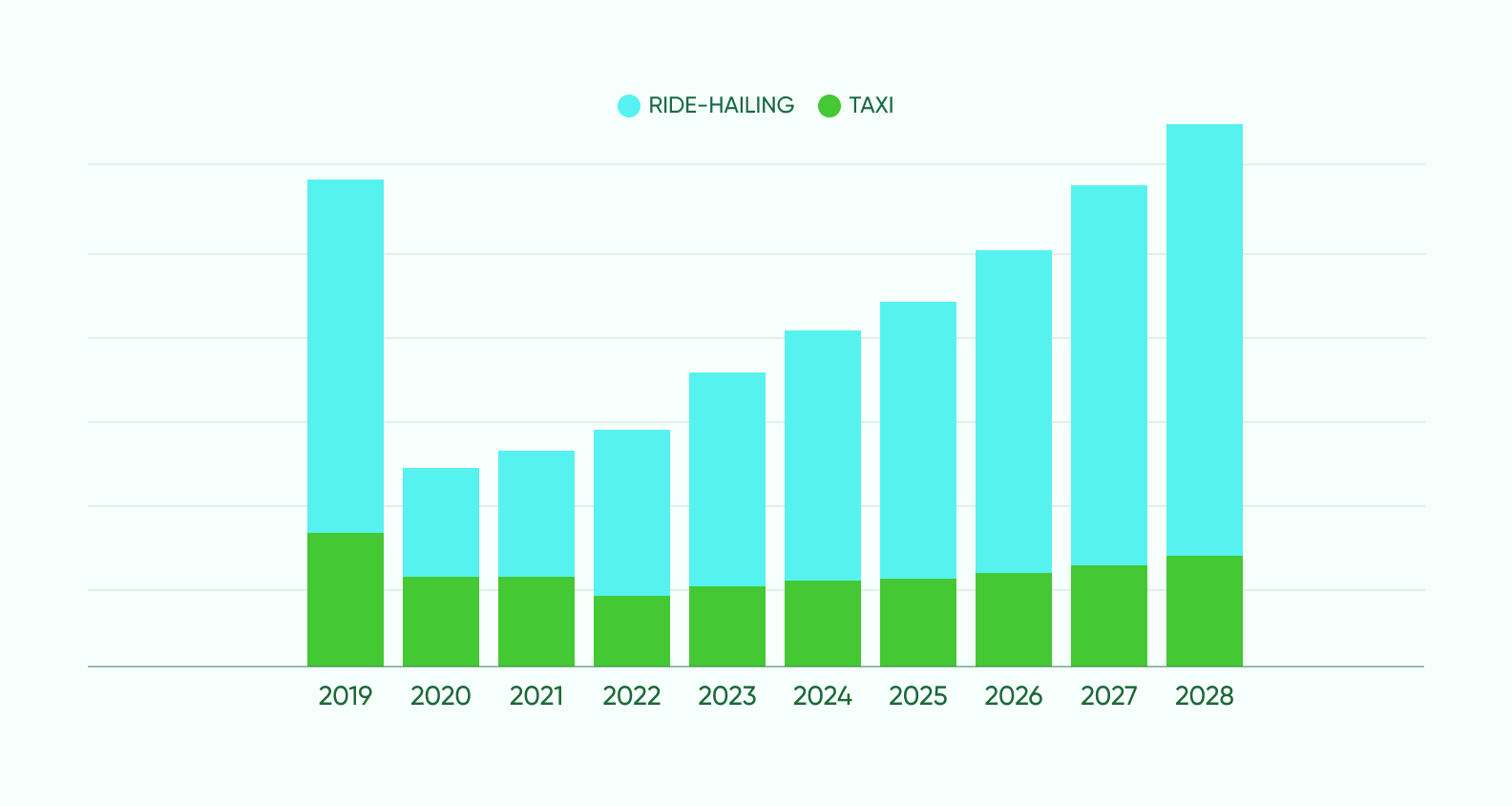
In 2026, taxi app development costs are mostly determined by product architecture, operational complexity, and user expectations. Ride-hailing is now a standardized service, and customers compare new apps to market leaders. Even early versions must deliver smooth onboarding and stable performance.
Feature scope is the main cost driver. A minimal product includes registration, ride booking, GPS tracking, payments, and basic driver management. Adding dispatch algorithms, dynamic pricing, in-app chat, analytics, or loyalty programs increases screens, integrations, and edge cases, raising development and testing time.
Platform choice affects cost. Native iOS and Android apps require separate codebases and QA, increasing expense but improving performance. Cross-platform solutions reduce initial investment and speed launch, though complex features may require extra work.
Backend infrastructure is another major cost. Taxi apps need continuous geolocation, instant notifications, and reliable payment processing, supported by scalable cloud architecture, monitoring, and DevOps. Hosting, third-party APIs, and security compliance add ongoing expenses.
Team structure also matters. Designers, mobile and backend engineers, QA specialists, and a product manager work in parallel, with hourly rates varying by region, seniority, and engagement model.
Taxi app development costs differ substantially depending on whether the product is designed for a local taxi fleet or built as a marketplace similar to Uber. While both fall into the ride-hailing category, their architecture, feature sets, and operational demands are not the same. These differences directly affect timelines, team size, and total budget.
A traditional taxi app usually serves a single company or a limited number of drivers. Core functionality includes ride booking, vehicle tracking, fare calculation, and payment processing. Dispatch logic is simpler because the fleet is fixed and centrally managed. This reduces backend complexity and keeps development and testing efforts more predictable.
An Uber-like app is a multi-sided marketplace. It must match riders with drivers, balance supply and demand, and support dynamic pricing. Driver onboarding, document uploads, background checks, ratings, and incentive programs add more workflows, increasing screens and business logic.
Infrastructure needs to grow too. Marketplace apps handle thousands of real-time updates at once, requiring scalable servers, load balancing, messaging queues, and constant monitoring. Hosting and third-party services make up a bigger share of ongoing costs.
The number of interfaces also multiplies expenses. Instead of one passenger app, the product typically includes separate applications for riders, drivers, and administrators, each with its own design, development, and QA cycles.
Taxi app development costs grow with system complexity. As the product evolves from a simple booking tool into a full-scale operational platform, requirements expand, architecture becomes heavier, and both engineering effort and maintenance increase. Budget and timelines largely depend on how ambitious the solution is from day one.
Separate native apps for iOS and Android require independent codebases, testing cycles, and ongoing maintenance. Additional interfaces such as driver tablets or web dashboards further expand the scope. Each extra device type increases design, QA, and release management efforts.
Taxi apps depend on continuous geolocation streaming and instant status updates. The system must process thousands of location signals, update maps in real time, and synchronize data between riders and drivers. This requires stable background tracking, push notifications, and low-latency servers.
Ride matching is more than assigning the nearest driver. Dispatch logic may consider traffic, driver ratings, vehicle types, and dynamic demand. As algorithms become more advanced, development shifts from simple rules to data-driven optimization. This increases engineering time and often involves additional testing and tuning.
Taxi apps must handle multiple currencies, local taxes, and regional rules. This makes payment processing more complex. Secure transaction storage, refunds, and automated payouts must follow these rules. Legal requirements may also need extra reporting and audits.
Most taxi solutions rely on external services such as maps, SMS providers, payment processors, and analytics tools. Each integration introduces dependencies and potential reliability risks. Ongoing API changes or usage fees also contribute to long-term operational expenses.
The platform must work across time zones, languages, and local policies. It also needs infrastructure that can handle higher traffic and provide regional redundancy. Localization and configuration tools add extra work for both development and maintenance.
Taxi apps process sensitive personal and financial information. Encryption, secure authentication, and fraud prevention mechanisms are mandatory. Compliance with data protection standards requires regular audits and additional safeguards.
Dashboards help teams manage drivers, disputes, pricing, and support requests. These tools have complex workflows and permission rules. Building and maintaining them takes a large part of development effort.
Operators rely on detailed analytics to track demand, driver performance, and revenue. Supporting this requires custom reports, dashboards, and data pipelines, which leads to extra backend complexity and storage needs. As reporting becomes more advanced, both infrastructure and engineering costs grow.
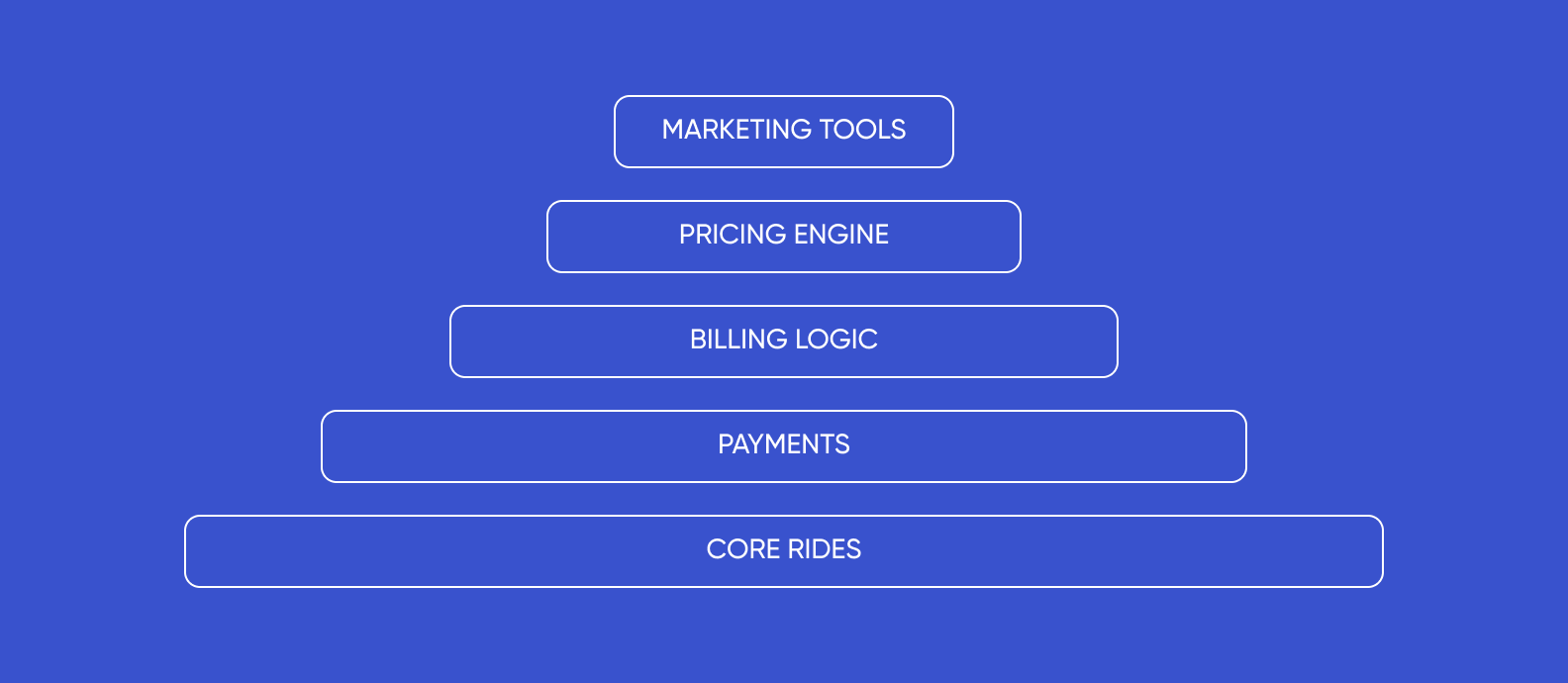
Revenue models directly shape product architecture, feature scope, and development costs. Monetization is embedded in core system logic, influencing backend workflows and user experience from the start.
The main revenue source is commissions from each ride. Apps like Uber and Lyft automatically deduct a percentage from every trip, requiring accurate fare calculation, real-time tracking, and secure payment processing.
Subscription or membership plans are another layer. Drivers may pay weekly or monthly fees for lower commissions, more orders, or priority placement. Implementing subscriptions requires recurring billing, account management, and automated checks, increasing screens and backend logic.
Dynamic pricing requires algorithms, real-time analytics, and continuous data from drivers and riders. Surge mechanisms adjust fares based on supply and demand, relying on scalable cloud infrastructure and monitoring.
Other options include cancellation fees, corporate accounts, white-label solutions, and in-app promotions. Each adds workflows, dashboards, and integrations. As monetization features grow, so do engineering effort, testing, and operational overhead.
A taxi app’s cost depends on its core modules: the passenger app, the driver app, and admin dashboards. Each contributes to complexity, integrations, and operational requirements that shape development time and budget.
The passenger app is the most visible part of a taxi platform and often takes a large share of the budget. Onboarding, registration, booking, and payment must be fast and intuitive, as even small friction points can reduce conversion. Real-time driver tracking, in-app chat, ride history, and ratings increase complexity. This requires backend connections, extra screens, and careful handling of maps and geolocation.
Supporting multiple languages, accessibility, and payment processing adds further challenges. As user flows grow, extensive testing is needed for edge cases like poor connectivity, canceled rides, or failed transactions, ensuring a smooth, reliable experience for all users.
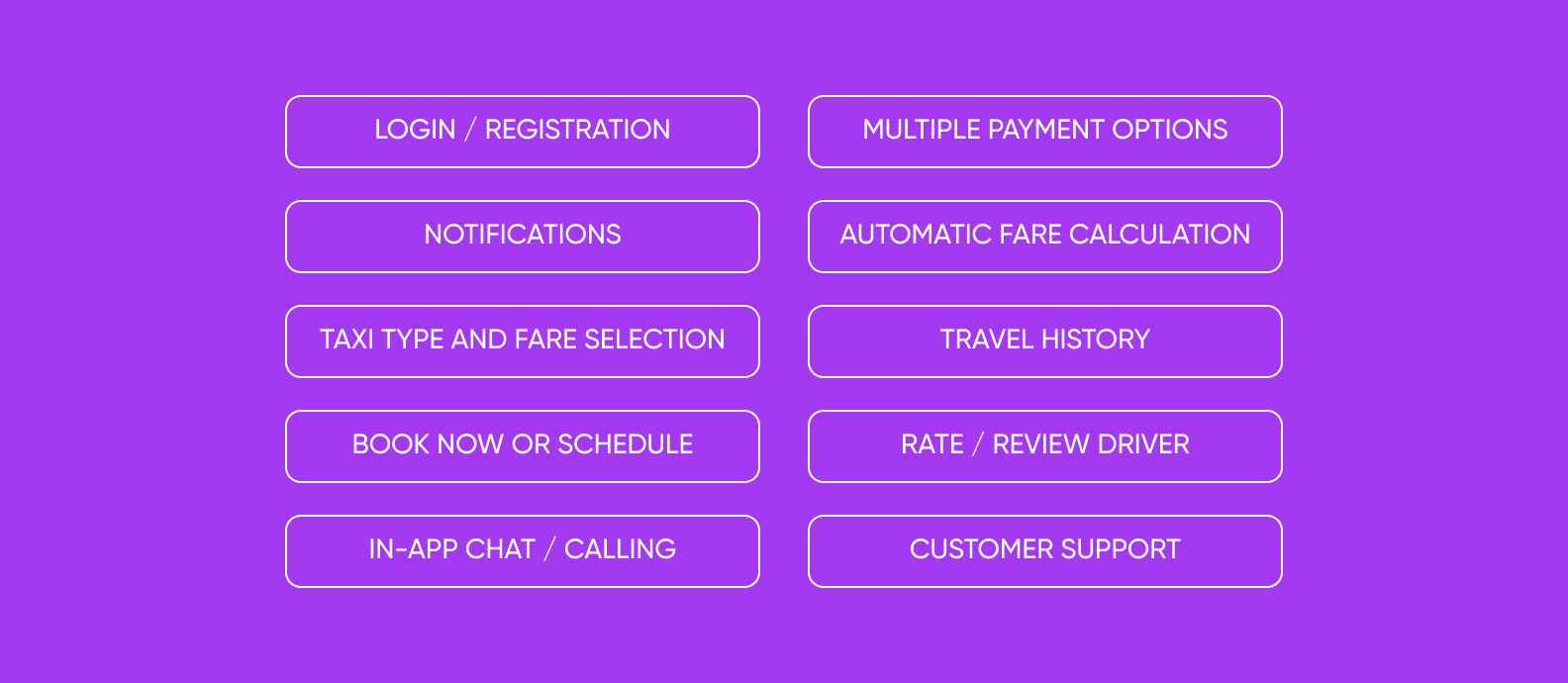
The driver app is an operational tool that must stay stable during long working hours. Core features include ride requests, navigation, trip status, earnings tracking, and payout management, all requiring reliable GPS and optimized background updates.
Meanwhile, data from IoT sensors in vehicles supports predictive maintenance and real-time analytics, as well as precise commission and bonus calculations. This shapes backend complexity.
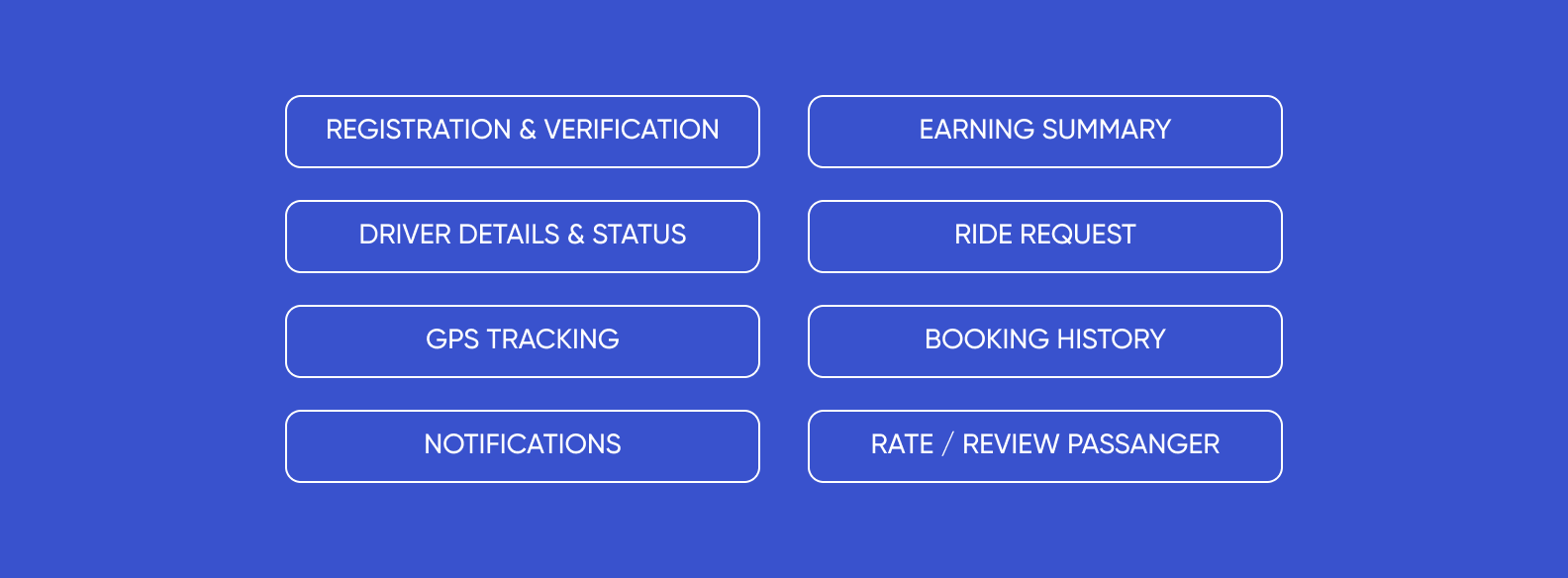
Administrative tools are often the most resource-intensive part of a taxi platform. Through web dashboards, operators coordinate drivers and vehicles, adjust pricing and service areas, and handle disputes, which turns this layer into the system’s operational control center.
Different teams rely on it simultaneously: dispatchers track trips in real time, support teams investigate issues and review ride history, and finance managers manage payouts and revenue analysis.
Although invisible to passengers, this functionality requires extensive backend logic, multiple integrations, and continuous maintenance, making the admin layer one of the most complex and costly modules to build.
As taxi apps evolve into platforms similar to Uber, development costs rise with complexity. Beyond basic booking, advanced features require stronger infrastructure and smarter logic. These additions turn a simple app into a large-scale system.
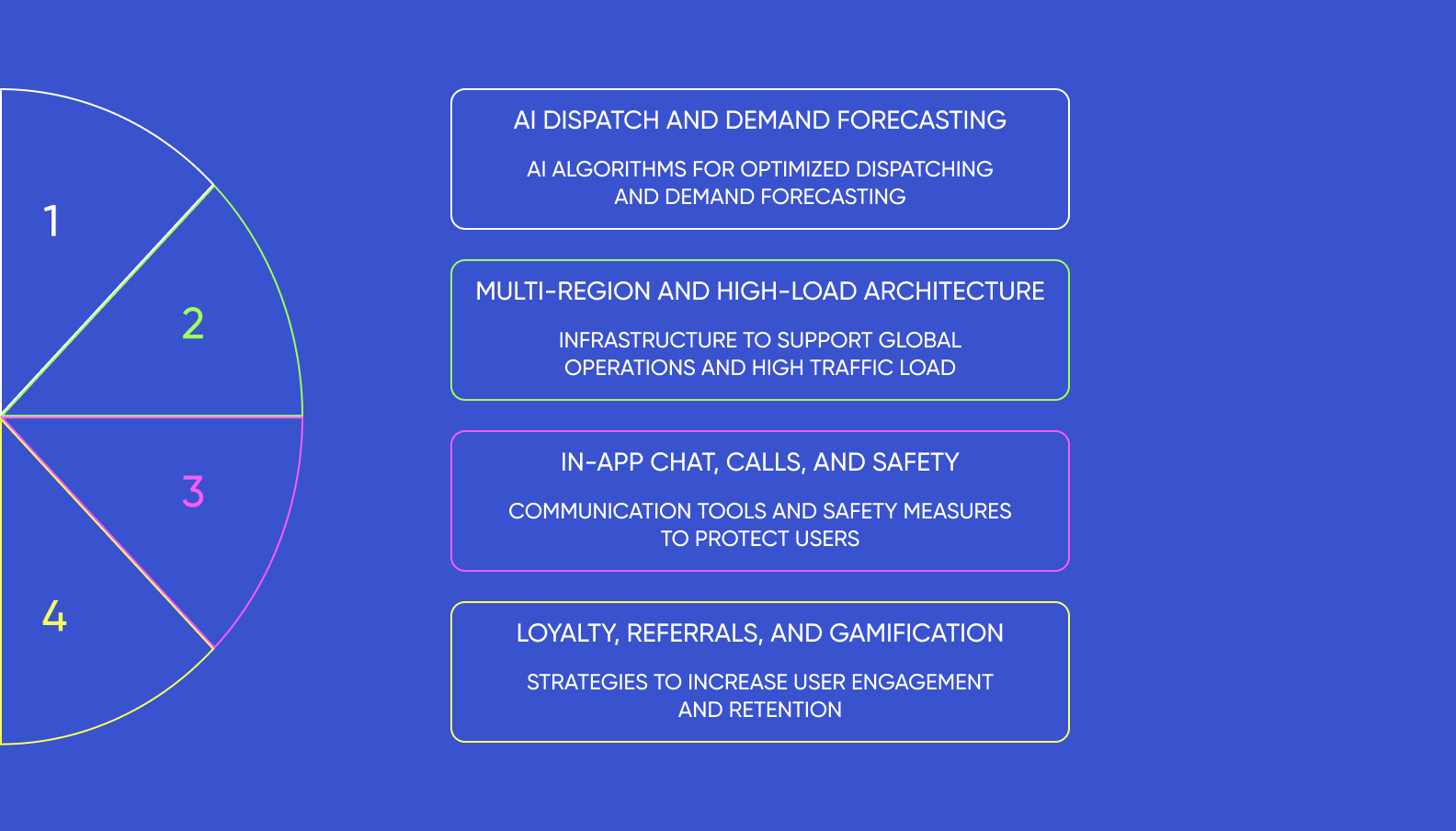
Advanced dispatch systems replace simple proximity rules with predictive logic. Instead of assigning the nearest driver, the platform continuously anticipates demand and adjusts supply to reduce wait times and improve fleet utilization. This turns dispatching from a basic matching task into a data-driven optimization problem.
To support this approach, teams must build a dedicated data layer and integrate models directly into real-time operations. It requires ongoing data collection, model training, and infrastructure maintenance.
Uber-like platforms often operate across multiple cities or countries, each with different pricing rules, currencies, languages, and legal requirements. The architecture must support flexible configuration without duplicating the system.
High-load scenarios result in technical challenges. Thousands of concurrent rides generate constant GPS updates, notifications, and payment events. To handle this traffic, the backend requires load balancing, distributed databases, caching, and failover.
Real-time communication features raise development and operational costs. In-app chat, voice, and masked calls require integration with messaging and VoIP services and must remain stable even on weak connections and older devices.
Safety tools introduce additional requirements that go far beyond basic ride functionality. Features like emergency assistance or trip sharing depend on continuous location tracking, secure data storage, and fast response mechanisms behind the scenes.
Privacy standards and regional regulations also require extra safeguards, monitoring, and audits. This increases development effort and makes the system more complex.
Retention mechanics may look simple on the surface, but they introduce some of the most complex business logic in the system. Instead of a straightforward ride flow, the platform must constantly evaluate user behavior, decide who qualifies for rewards, and calculate incentives in real time.
This logic must also be protected from abuse and fully automated, from eligibility checks to payouts and reporting. As campaigns and promotions multiply, the number of edge cases grows. As a result, loyalty features expand both technical scope and maintenance costs.
<div class="post_divider"></div>
⭐Our experience
Purrweb redesigned the mobile platform and landing page for Zeroney. The product offered online courses in Data Science, AI, and AR/VR, but the interface was outdated. Users trusted the platform less, and conversions were declining.
The team simplified the structure and rebuilt key flows. The dashboard became clearer, courses easier to browse, and progress more visible. Badges, ratings, and light animations supported motivation. The landing page got a modern look with bold visuals and 3D elements to attract new users.
Result: a cleaner interface, better usability, and improved conversion from visitors to registered users.

<div class="post_divider"></div>
The cost of a taxi app depends on the choices made at every stage — from shaping the product concept to building, testing, and launching it. Early decisions about features, user flows, and technical architecture set the tone for complexity, infrastructure needs, and long-term maintenance.
This phase includes market research, target audience analysis, user journey mapping, and feature prioritization for the initial release. Workshops, documentation, and wireflows clarify scope, technical constraints, integrations, and compliance requirements. At the end of discovery, the client receives a clear roadmap, defined MVP scope, and aligned expectations.
<div class="post_divider"></div>
⭐Our experience
Purrweb worked with Journey Verse, a travel planning app for independent travelers. The founder planned to launch an MVP quickly, but key decisions about features, pricing, and positioning were still based on assumptions.
The team clarified the product scope and tested the core idea with real users. Several scenarios were modeled to understand acquisition costs and unit economics. Based on the findings, the feature set was reduced and priorities were adjusted.
Result: a clearer strategy, validated demand, and a focused MVP plan that helped avoid extra features and save nearly $40,000 before development began.

<div class="post_divider"></div>
Design teams convert requirements into detailed interfaces and user flows for passengers, drivers, and admins. Wireframes evolve into interactive prototypes and visual systems, with special attention to real-time screens such as booking, ride status, and maps. This ensures clear feedback, consistent navigation, and multi-device support before development begins.
At this stage, engineering teams turn product requirements into working software by building the mobile applications and the server-side infrastructure. The focus is on implementation, stability, and performance under real-world conditions. As a result, the client receives a fully functional system: responsive mobile apps, reliable backend mobile app development services, and an architecture ready to handle real-time operations and growing traffic.
Quality assurance includes functional, regression, and performance testing across devices and network conditions. After release, monitoring tracks crashes, server load, and transaction errors. Regular updates, fixes, and small improvements ensure the product remains stable, secure, and optimized for real-world use.
<div class="post_divider"></div>
⭐Our experience
Purrweb assisted a New York City founder in validating a taxi aggregator concept focused on long-distance trips. The initial strategy relied on assumptions about demand, pricing, and a web-only launch, creating risks of unclear costs and weak unit economics. Discovery included user interviews and testing interest in pre-scheduled, long-distance rides.
Research confirmed steady demand, with some riders willing to pay more for comfort and reliability. Financial models showed profitability, providing a validated concept.
Result: clear positioning, confirmed demand, and a practical roadmap for development and budgeting.

<div class="post_divider"></div>
In complex mobile app development projects like taxi services, a team must define how the service will work from both business and user perspectives, considering target audiences, ride scenarios, workflows, and regional specifics such as payment habits or regulations.
Discovery includes:
User journey mapping is central. Designers outline step-by-step interactions for passengers, drivers, and administrators. Multiple user roles increase the number of screens and transitions that require careful planning and validation.
Prototyping and design include:
Map-based screens must stay simple and clear, especially during rides. Users need instant feedback, so the interface should highlight key actions and reduce distractions.
Finally, designers prepare specs, assets, and guidelines for engineers. Clear documentation speeds up development and prevents mistakes.
The backend is the core of any taxi app. It processes rides, handles location data, manages payments, and keeps the system in sync. As a normal automotive application, a taxi platform required real-time data streaming and operational reliability.
Backend and analytics components often rely on Python, which, according to Stack Overflow 2025, continues to grow in popularity thanks to its smooth integration with AI and ML modules.
Main backend functions include:
Designing the backend around these areas helps teams build a reliable, scalable taxi app that can handle real-time demand without unnecessary costs.
The choice of technology stack shapes both cost and performance. Native apps deliver high reliability and smooth real-time tracking, while cross-platform frameworks speed up development and allow shared code across platforms. Web and hybrid solutions handle internal operations efficiently, keeping costs lower. Let’s explore each approach in detail and how it impacts taxi app development.
Native development involves building separate applications for iOS and Android using platform-specific languages and tools. This approach provides direct access to device hardware, stable background geolocation, and smoother animations. For taxi apps that rely on maps, real-time tracking, and continuous updates, performance and reliability are critical.
Native apps typically offer better responsiveness and fewer limitations when integrating GPS, push notifications, and payment services. However, two independent codebases mean higher development hours, duplicated testing, and parallel maintenance. Any new feature must be implemented and validated twice, which increases both time-to-market and long-term costs.
Cross-platform frameworks allow teams to share a single codebase across platforms. Solutions such as Flutter and React Native reduce initial development time and simplify updates. A smaller team can deliver core functionality simultaneously on both iOS and Android.
This approach is often used for MVPs or early-stage products where speed and budget control are crucial. At the same time, complex features such as background tracking, real-time maps or device-specific behavior may require custom native modules. Additional workarounds can offset some of the initial savings and increase technical complexity.
Taxi platforms usually include web-based tools for dispatchers, support teams, and administrators. These panels are commonly built with modern web technologies and run in browsers, which reduces development costs compared to native desktop software. Updates can be deployed instantly without app store approvals.
Hybrid solutions may combine mobile apps for drivers and passengers with web dashboards for operations. This setup allows teams to allocate resources efficiently, focusing native or cross-platform development where mobility is essential while keeping internal tools more lightweight and cost-effective.
Development costs for a ride-hailing platform are driven primarily by labor: the number of specialists involved, the duration of their engagement, and regional rates.
Labor supply is large but highly competitive. Estimates from DQYDJ show that in 2015, between 3.36 and 4.19 million people in the United States worked in roles requiring software development — roughly 2–2.5% of the total workforce. Even at this scale, sustained demand keeps hiring expensive and slow.
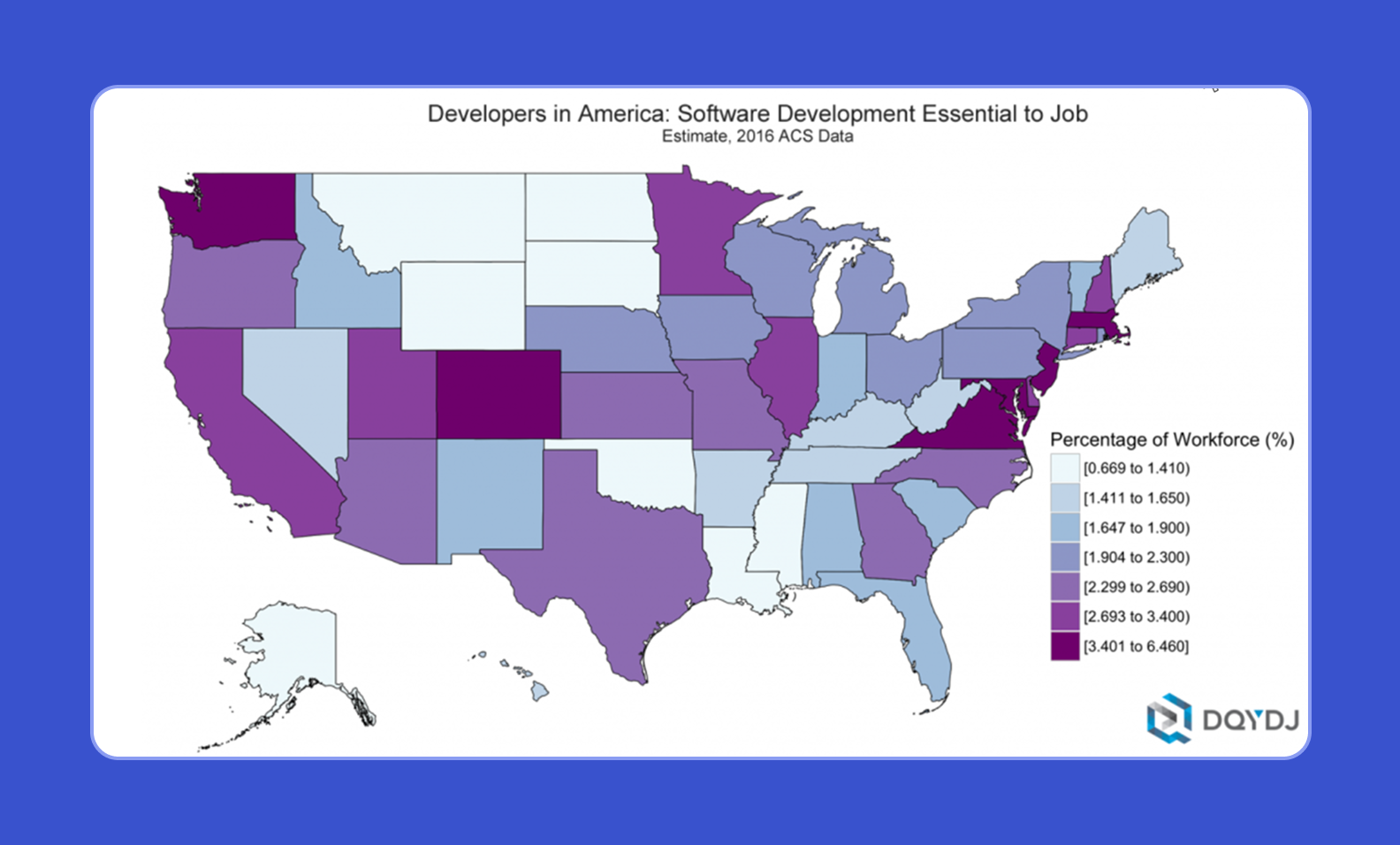
For complex, multi-component products like ride-hailing apps, this translates directly into higher budgets. The sections below outline the required team structure, realistic timelines, and regional rate differences that determine total cost.
Building a ride-hailing platform similar to Uber requires more than a small group of developers. The product typically includes several parallel workstreams: mobile apps, backend services, admin tools, and infrastructure. Each stream needs dedicated specialists to maintain quality and speed.
A standard team often includes a product manager to define scope and priorities, a UI/UX designer to create flows and interfaces, mobile engineers for iOS and Android or cross-platform development, backend developers for APIs and business logic, and QA engineers for testing.
DevOps specialists manage cloud infrastructure, deployments, and monitoring. Larger projects may involve data engineers and analysts supporting dispatch algorithms and reporting.
For interfaces like web dashboards or marketplaces, partnering with an automotive web design agency can ensure usability beyond generic templates.
The number of roles grows as features expand. Real-time systems, payments, and analytics introduce complexity that a small generalist team cannot handle efficiently.
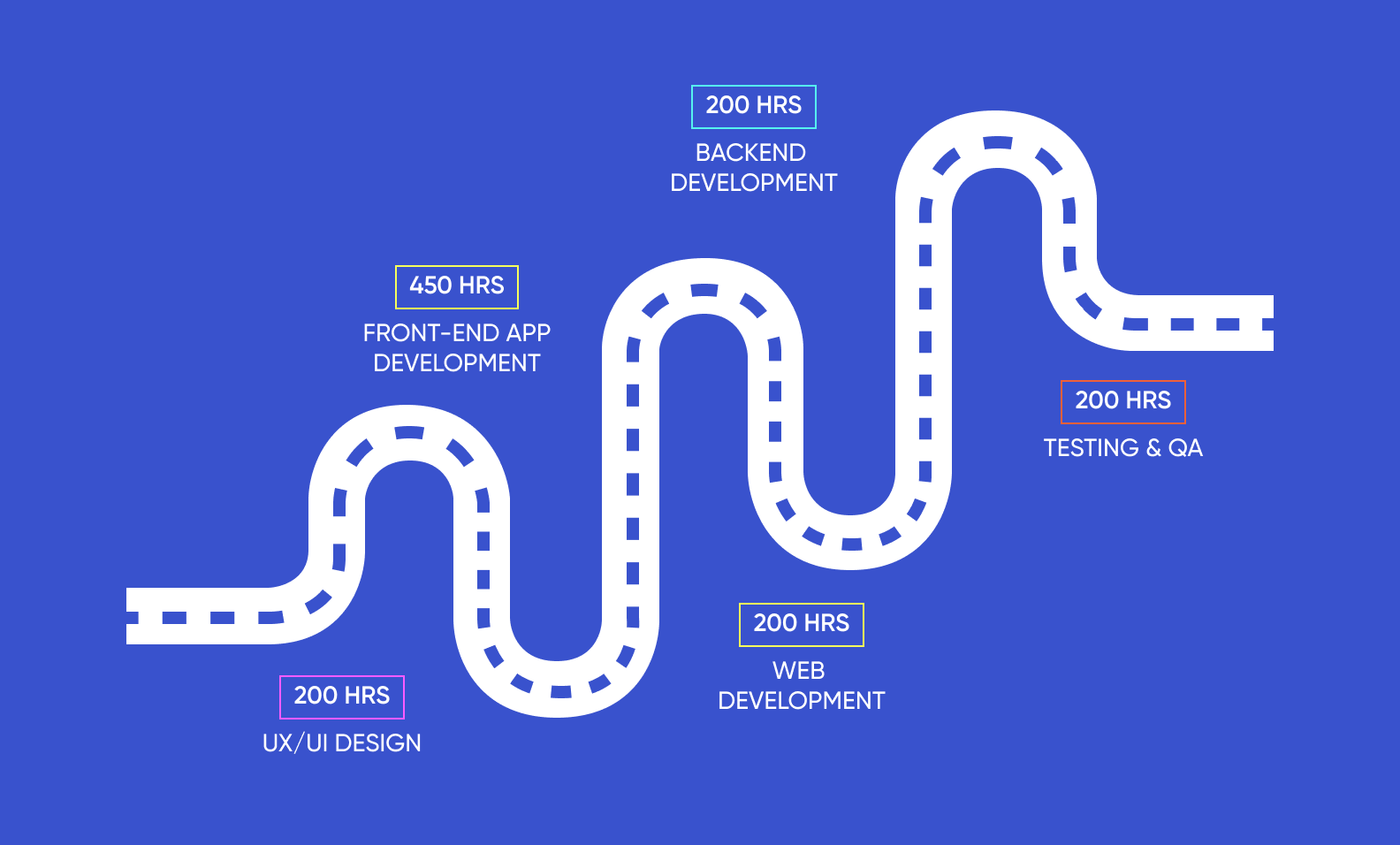
Timelines vary depending on product ambition and feature depth. A lean MVP usually focuses on core functionality such as registration, booking, matching, tracking, and payments. With a compact team and limited scope, development may take several months, including design and testing.
A full-scale product follows a different path. Once the platform must support multiple user roles, real-time operations, and stable performance at scale, the architecture becomes more complex, and releases require longer stabilization cycles. As a result, delivery usually extends to 8–12 months or more, depending on integrations and compliance requirements.
Hourly rates depend heavily on geography and engagement model. Teams in North America and Western Europe typically charge premium rates, while Eastern Europe, Latin America, and parts of Asia offer more moderate pricing. The difference can be two or three times for similar skill sets.
Companies may choose in-house hiring, dedicated external teams, or full outsourcing. In-house teams provide deeper product knowledge but involve recruitment and overhead costs. Outsourcing offers faster scaling and predictable budgeting, though it requires clear communication and structured management processes.
Companies that prefer predictable timelines and faster scaling often partner with external product teams instead of hiring in-house. Working with an experienced custom software development company helps reduce recruiting overhead and launch faster.
Even with a solid design and backend, unexpected expenses can quickly add up. These hidden costs often come from third-party services, legal requirements, and ongoing maintenance.
Taxi apps rarely run entirely on their own infrastructure. Instead, they rely on external providers for critical functionality such as navigation, transactions, and user communication. Services like Google supply mapping and geolocation, while Stripe and Twilio process payments and messaging.
This shift costs from one-time development to ongoing operational spending. Most providers charge per request, so expenses grow alongside ride volume. What looks cheap during early testing can turn into a significant monthly bill at scale, especially when higher limits or premium features are required.
Operating a ride-hailing service means working within local regulations. Before adding new features, teams often need to secure permits, align with transport and tax rules, and prove that user and payment data are handled safely. In many regions, these requirements become part of the core architecture.
As a result, development slows down and costs rise. Extra verification flows, documentation, and auditability must be built into the system, while legal reviews and certifications introduce both direct fees and additional time in the roadmap.
Early versions of taxi apps are often built quickly to test the market. Shortcuts in architecture or code quality can later create technical debt. As traffic grows, performance issues, crashes, or slow features may require refactoring parts of the system.
Maintenance includes bug fixes, OS updates, API changes, and infrastructure improvements. Over time, these activities consume a consistent share of the budget and require dedicated engineering resources.
Launching a taxi app is not the finish line. It is the start of ongoing expenses. The platform runs 24/7, so the system must stay online and stable at all times. This turns infrastructure into a fixed monthly cost.
Most apps run in the cloud using services like Amazon Web Services, Google Cloud, Microsoft Azure, or DigitalOcean. These providers charge based on usage — servers, bandwidth, and storage. Even small products typically spend around $300–$2,000 per month, and costs grow as traffic and ride volume increase.
Real-time operations add extra load. The system constantly processes locations, trip events, and payments. To avoid slowdowns, teams expand infrastructure, implement redundancy, and maintain backups, which further increases monthly bills.
Work also continues after release. Engineers fix bugs, ship updates, and monitor performance. Ongoing maintenance usually costs 15–20% of the initial development budget per year.
Finally, there are non-technical expenses. Launch and growth require marketing — ASO, ads, partnerships, and PR. Early-stage budgets often range from $5,000 to $50,000+.
Over time, hosting, maintenance, and scaling frequently cost more than the original build.
At Purrweb, cost estimation begins with a structured discovery process. As a mobile app development company, we carefully analyze your business model, target regions, and operational logic before defining scope and timelines.
We break requirements into modules — passenger and driver apps, backend services, and admin tools. Each module is detailed into features and user stories with clear acceptance criteria. This approach gives full transparency and prevents hidden functionality.
With a defined scope, our development team designs a technical architecture and selects the most suitable technology stack. Estimates are calculated in hours for design, development, testing, and DevOps. Timelines are planned in iterations, releases, and stabilization stages, so stakeholders can track the product’s evolution step by step.
We offer flexible delivery options. A lean MVP validates the market quickly with essential features, while a phased roadmap gradually introduces advanced capabilities. This method allows costs to be distributed over time and aligned with business priorities.
➡️ To receive a detailed cost breakdown and delivery plan, share your project details <a class="blog-modal_opener">in the form</a>. Purrweb will create a tailored, accurate estimate, reflecting both your business needs and our expertise in building scalable taxi solutions.

.svg)




%20(1)%20(1).avif)