Explore

Need help with your project?

Oops! Something went wrong while submitting the form.
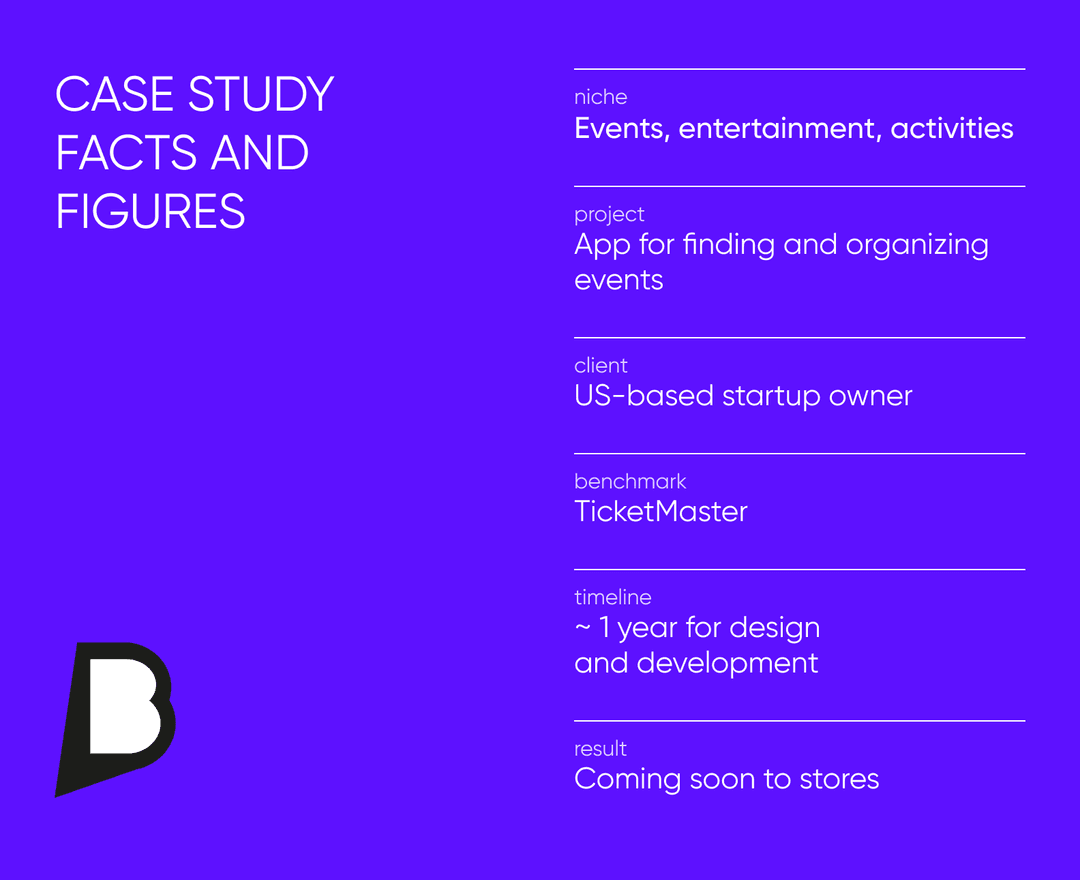
Often, clients come to us with just an app idea, without ready-made design or brand identity. We help transform those ideas into comprehensive solutions. That was the case with the US startup Buzz — an app for organizing events.
%20(1)%20(1)-1.avif)
.png&w=1080&q=75)
For this project, we wrote the code, created the logo, developed the brand identity, and designed visual solutions to help Buzz stand out in the market.
In this case study, we share how to create a brand identity from scratch for a new product while staying within a limited budget — without sacrificing important features.
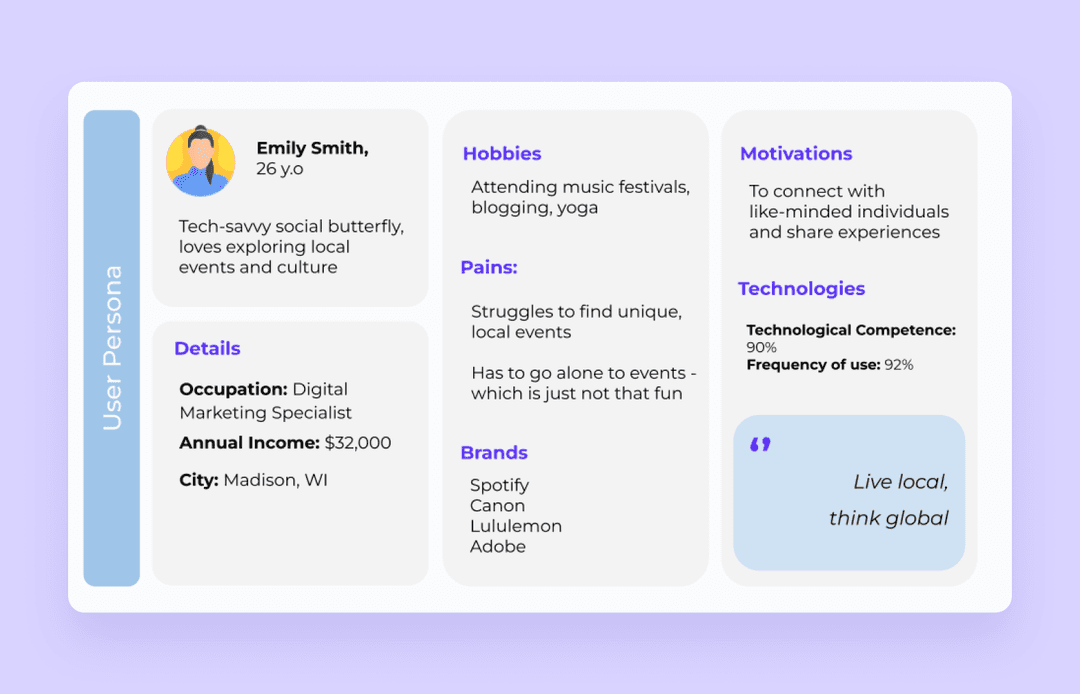
Matt, a US-based startup founder, contacted us. He wanted to launch an app where users from American towns could find interesting events in their area. The app would also allow anyone to organize an event and invite friends, or make the event open to a wider audience.
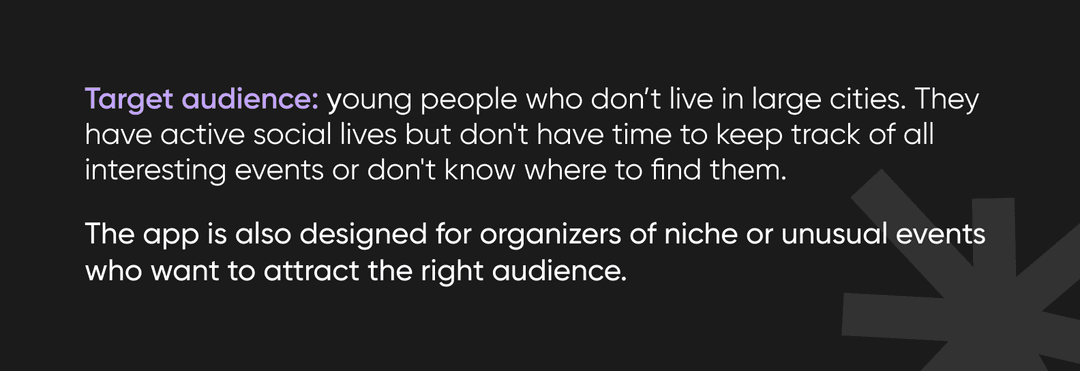
The project idea came from the client's personal experience: in a new place or even hometown, it can be difficult to find truly interesting events. Sometimes there's so much information scattered across different sources that it's easy to miss something worthwhile.
When we were first discussing the project idea, the client appreciated our involvement — we immediately tried to gather as much context as possible to make a more accurate project estimate. We talked with the client about his vision for the product's future and his plans for its development. It was a perfect match 🔥
The client also wanted us to take on the entire development cycle — from design and branding to app development. The new product didn't have a brand identity, so we had to create it from scratch.
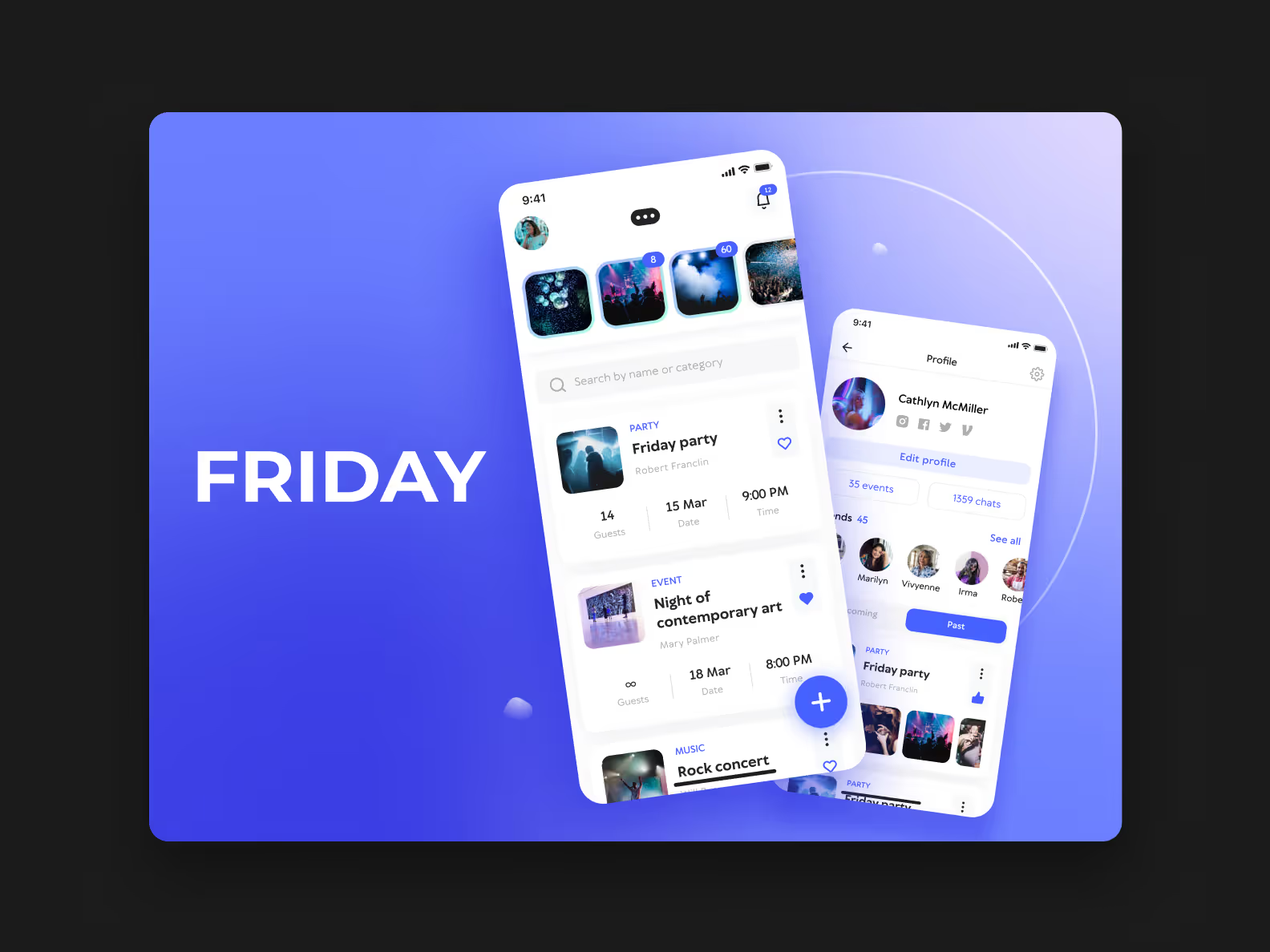
Our portfolio also played a significant role: we already had experience developing a similar app — Friday, a service for organizing parties and sharing events. Its concept overlapped with the client's idea in many ways.
The client came specifically for MVP development: he understood that first he needed to release a product with core features, and then, after entering the market, get user feedback and improve the app. The app was named Buzz.
Within the project, we needed to:
Let's elaborate on that last point 🙂
💰 How we solved the budget challenge
The client invested their own money in the project, and the budget was limited — a common scenario for startups. In these cases, we suggest postponing secondary features to the backlog. However, in this case, we were working on an MVP from the very beginning — there was nothing left to cut.
We found a solution through optimization:
In the end, we not only stayed within budget but also preserved a time buffer for refinements and bug fixes.
The app offers the following features:
Buzz has two roles: host and guest. Both can create events, but there's an important difference: Hosts can create both public and private events, while guests can only create private events accessible to friends.
To create public events, hosts must verify their account — this provides additional benefits.
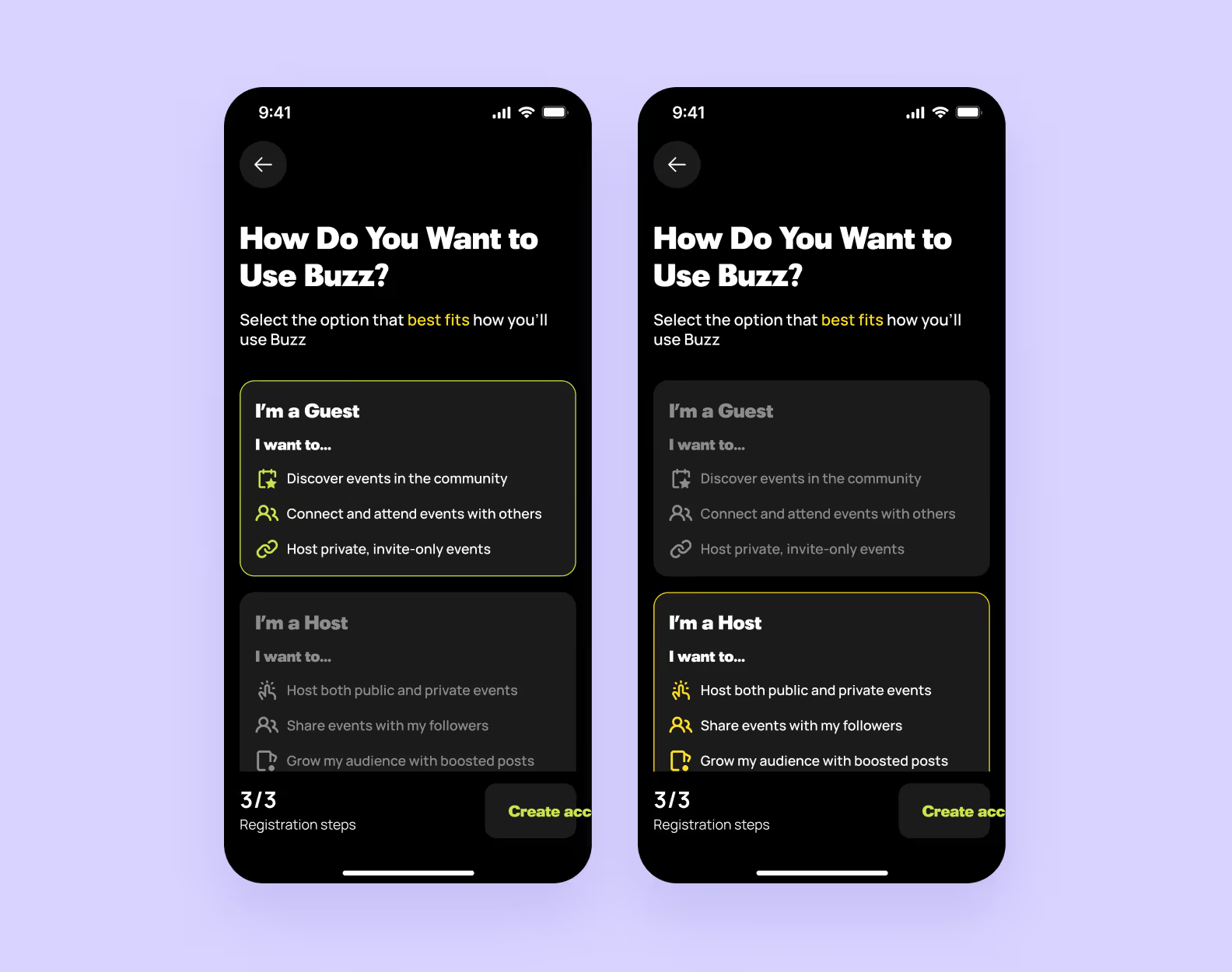
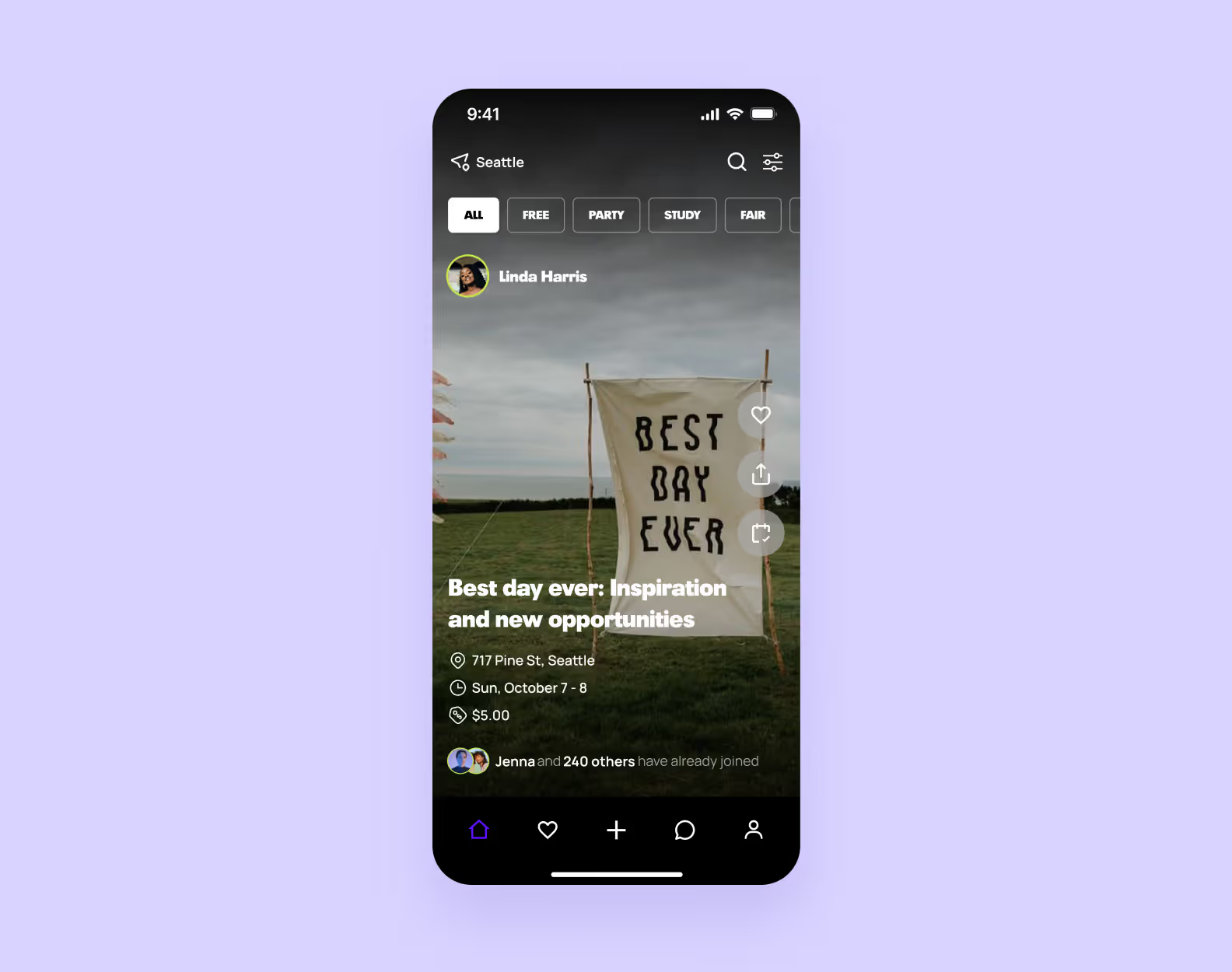
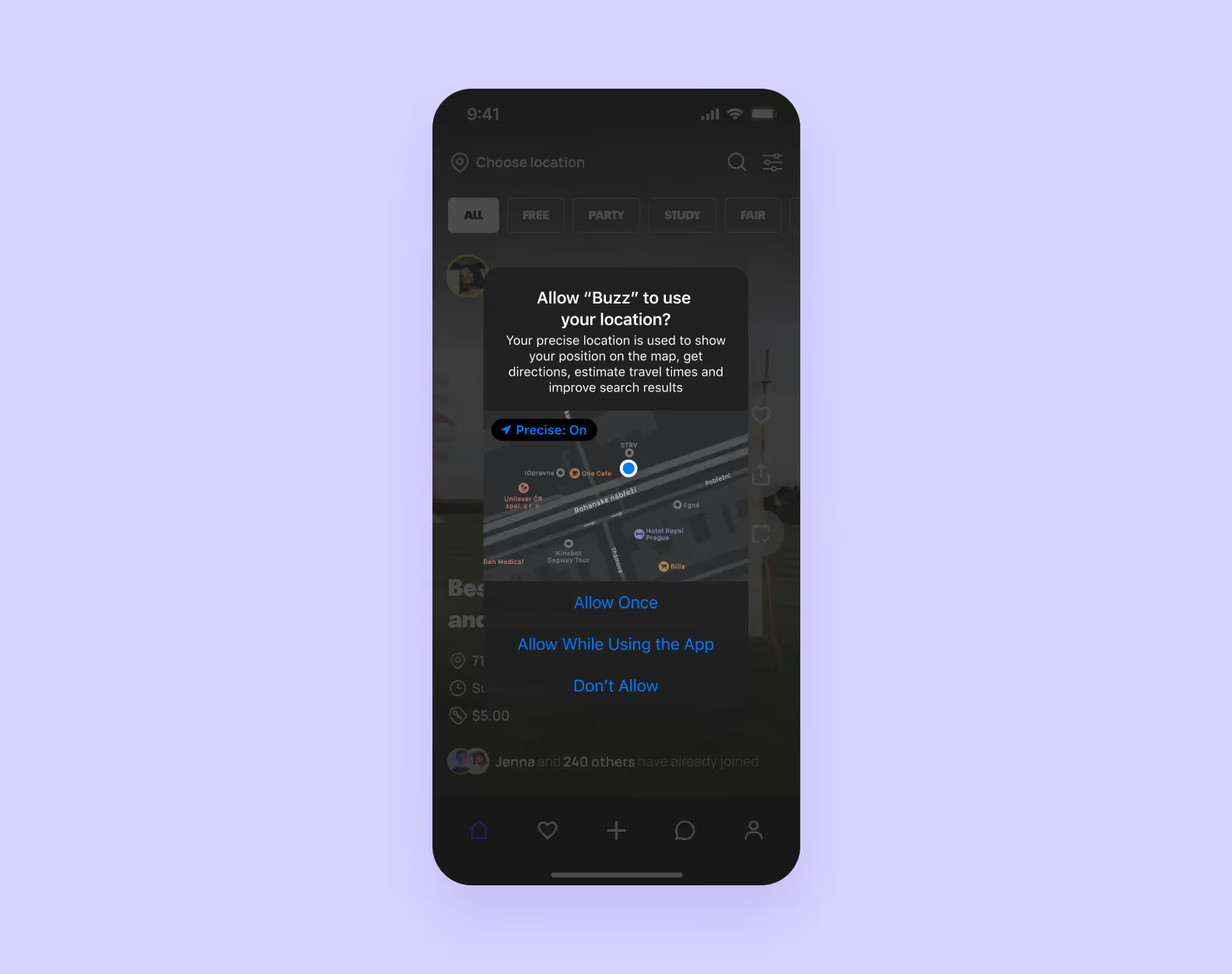
One of the app's key features is the event feed. For accurate recommendations, users need to grant Buzz access to their location.
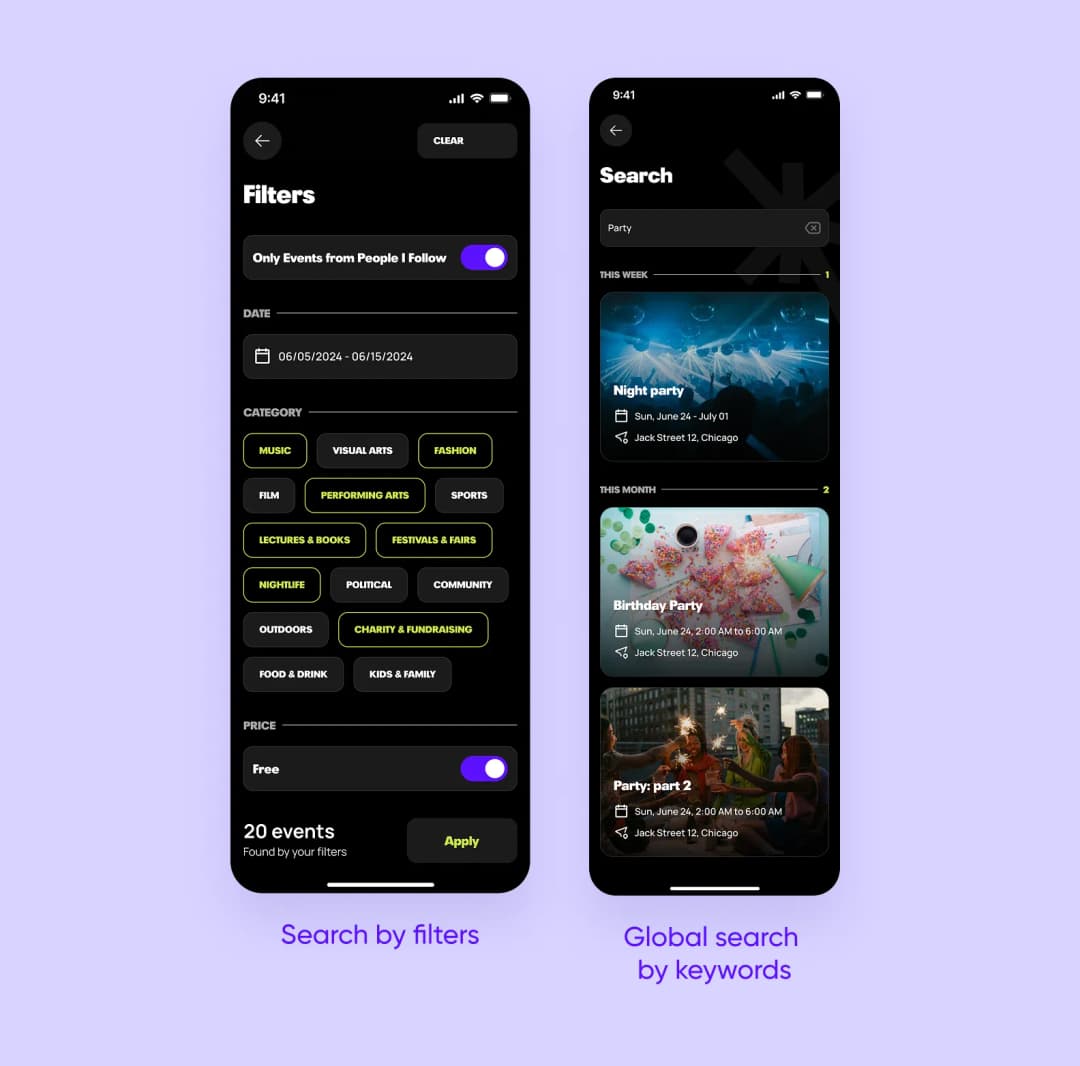
We also implemented filter-based search and global search across all public events or hosts.
When creating a new event, the user fills out information fields, selects categories, sets a date, and sets a ticket price if the event is paid.
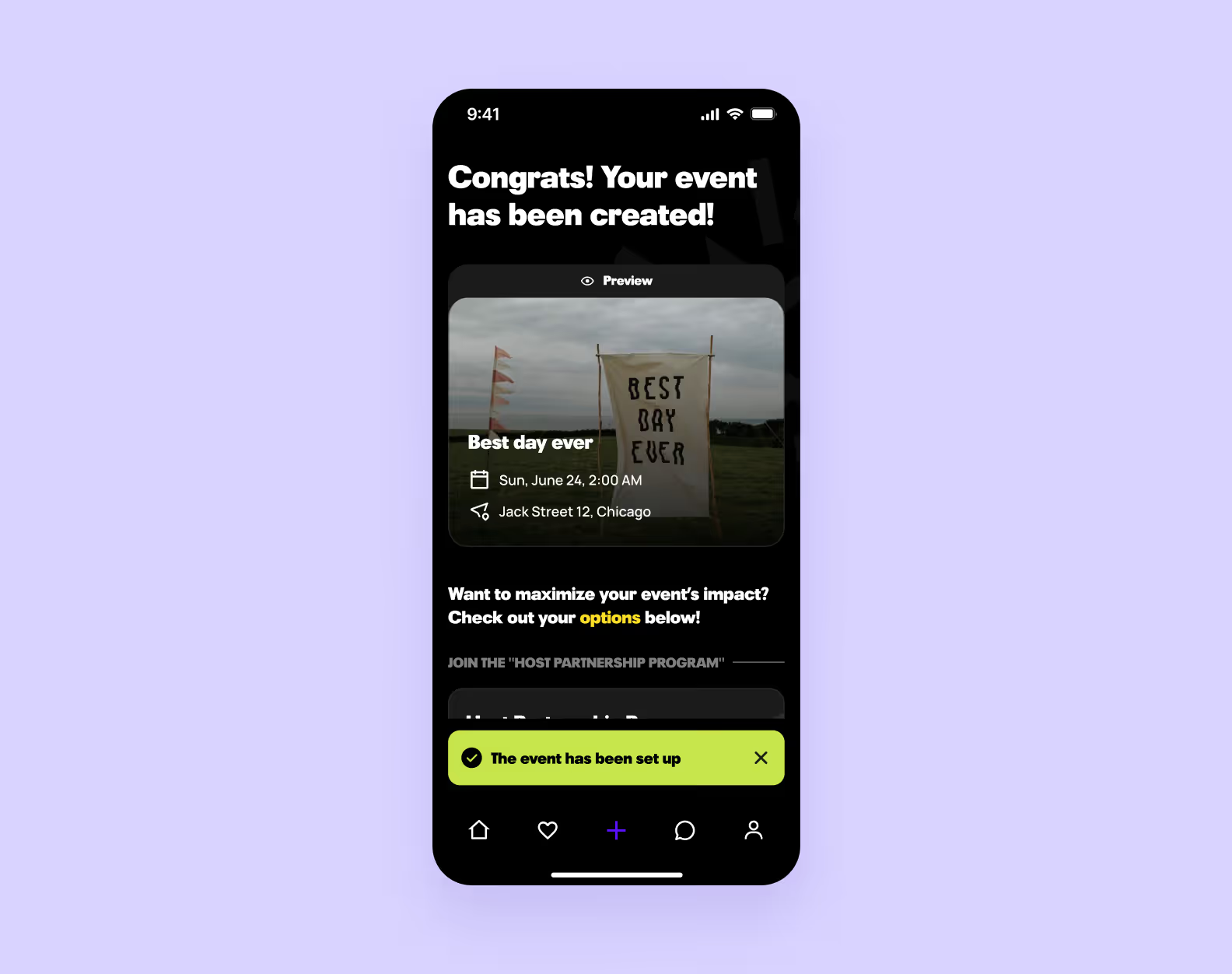
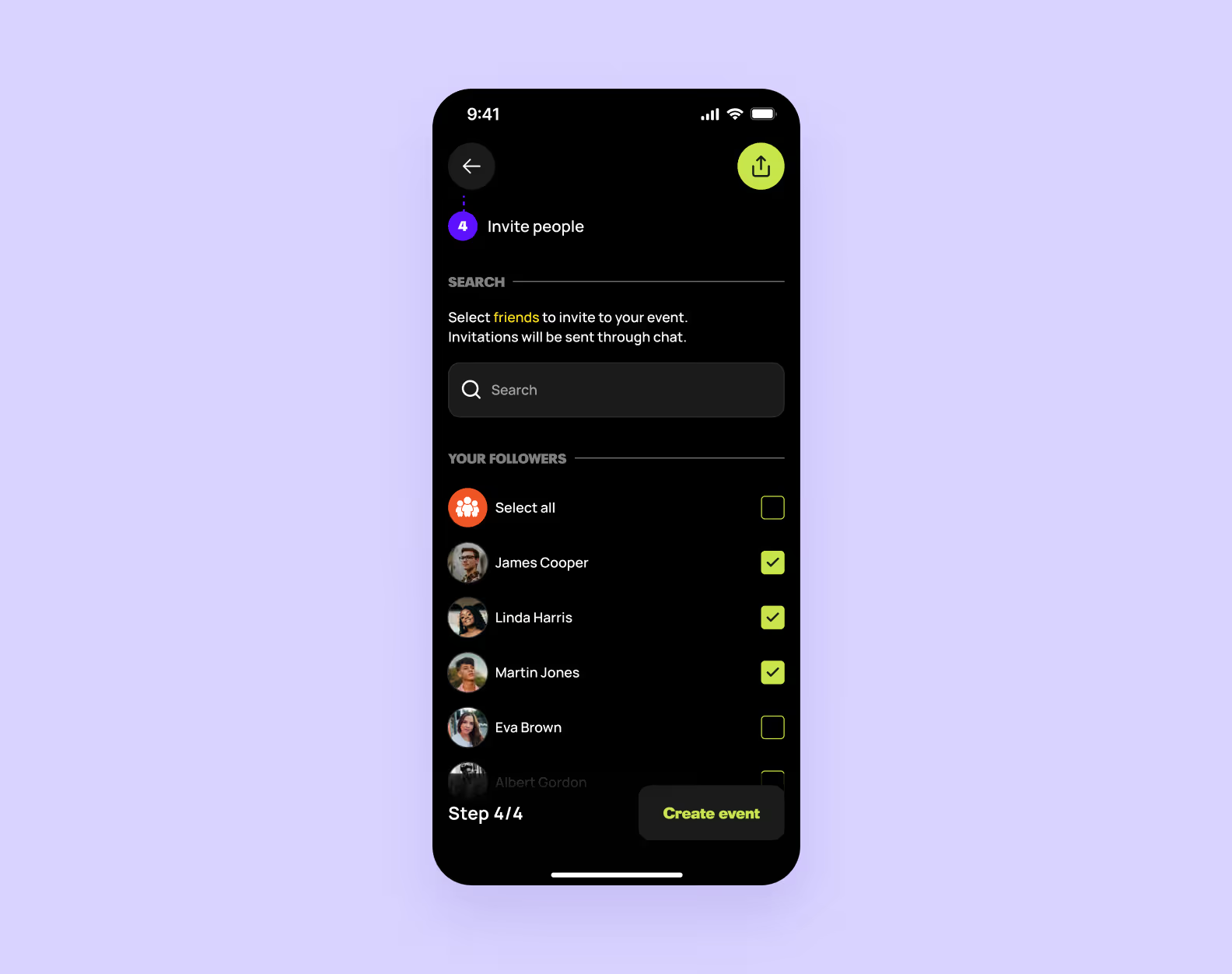
To create a private event, the user goes through the same steps, filling out a form. But in the final step, they need to "invite people" — this option is only available for private events.
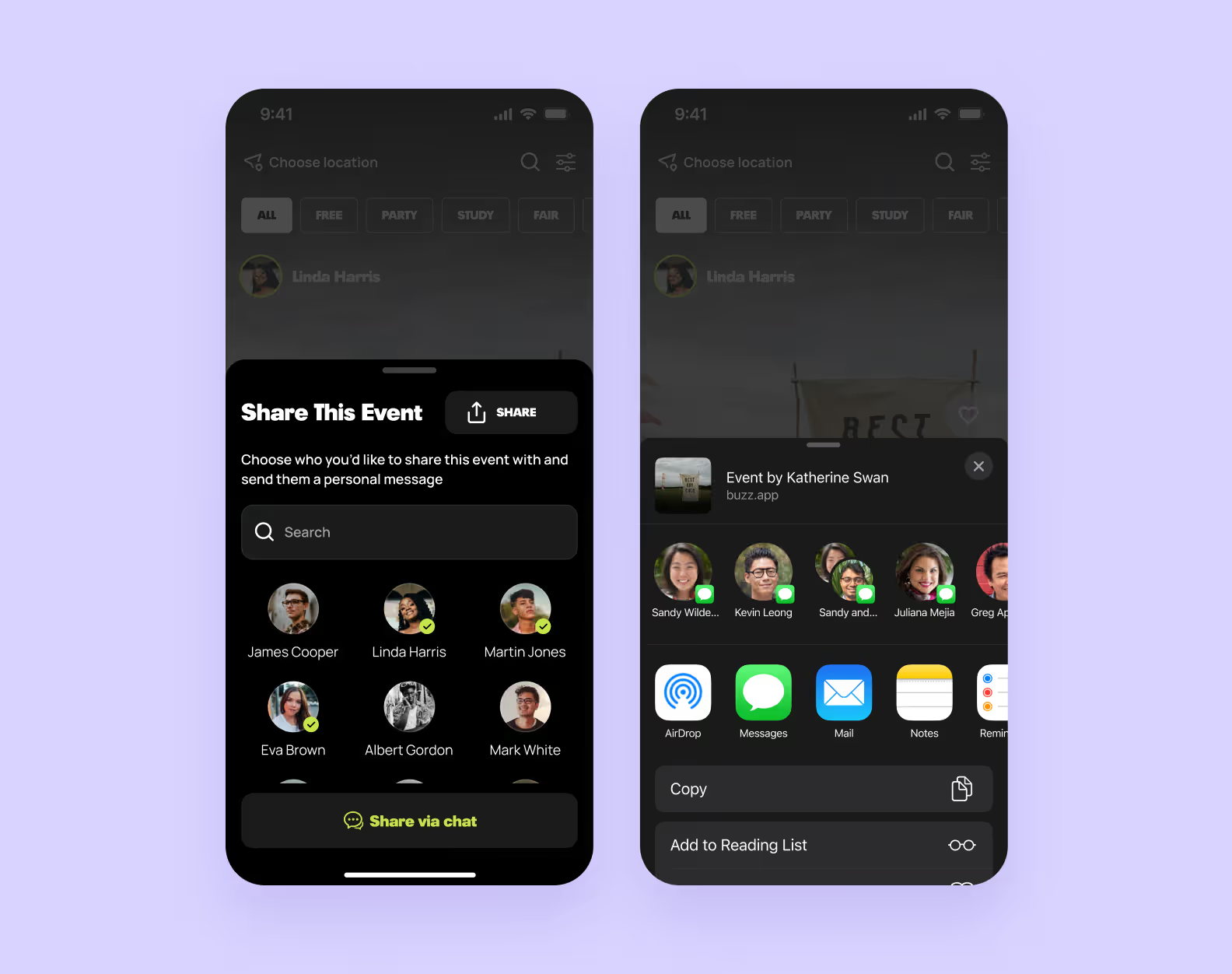
Users can share an interesting event with friends — in the app's chat or through external messengers.
The client wanted us to create a bold, recognizable style for Buzz and develop its brand identity. So, during the design concept phase, we focused not only on key flow screens and UX scenarios but also on colors, logo, and other brand elements.
The client wanted Buzz's design to resemble friendly social media interfaces and engage users. In the client's opinion, typical event announcement sites looked boring: they resembled news portals or aggregators. And they lacked the engaging mechanics we're used to seeing on social networks.
To present our design concept work to the client, we made a short video: showing interface dynamics, element interactions, and vibrant accents.
The final design is slightly different: for example, we made the interface more minimalist and removed some visual accents so as not to distract the user from key actions.
The app's metaphor is built on two ideas: party vibe and the visual style of the MTV era. This is best reflected in the mood boards — bright, filled with playful and joyful energy.
.png&w=1080&q=75)
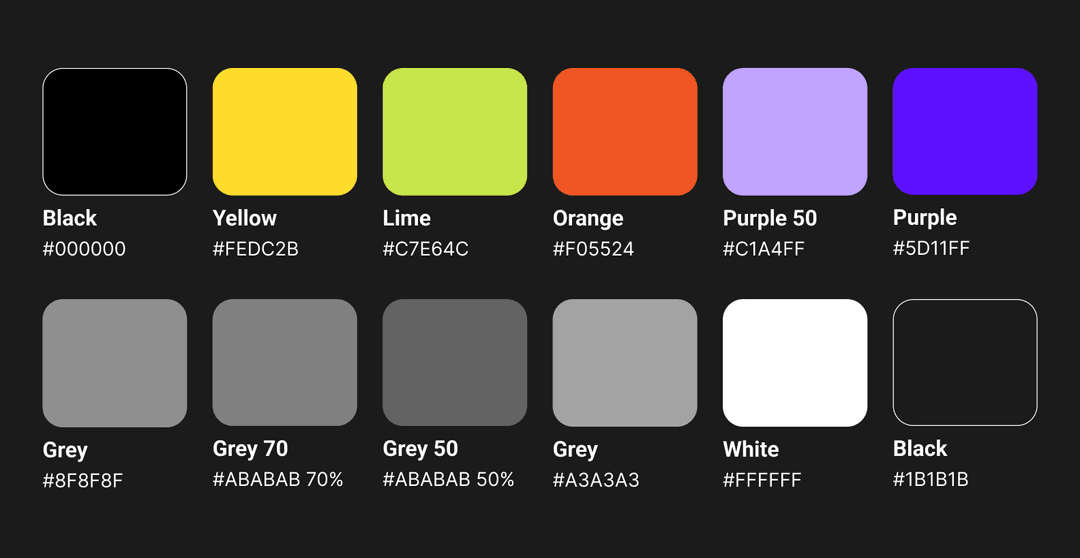
Buzz's palette uses bold colors. We chose lime, yellow, and red as primary colors, with shades of purple, white, and orange for accents.
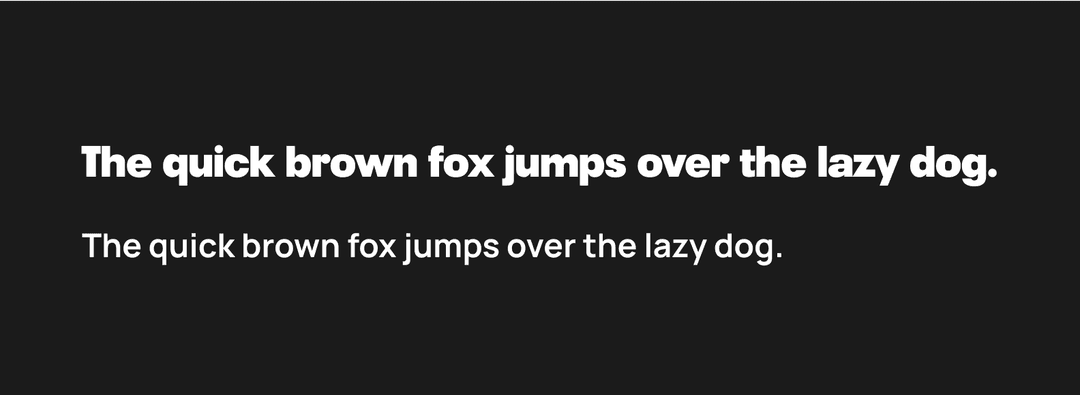
For typography, we chose the font pair Black LT and Monrope. The accent font Black LT emphasizes important interface elements, while Monrope enhances user experience by making the text easy to read.
We suggested using Crispy Doodles in the design. These are clean, detailed yet slightly casual sketches that add personality and liveliness to the interface.
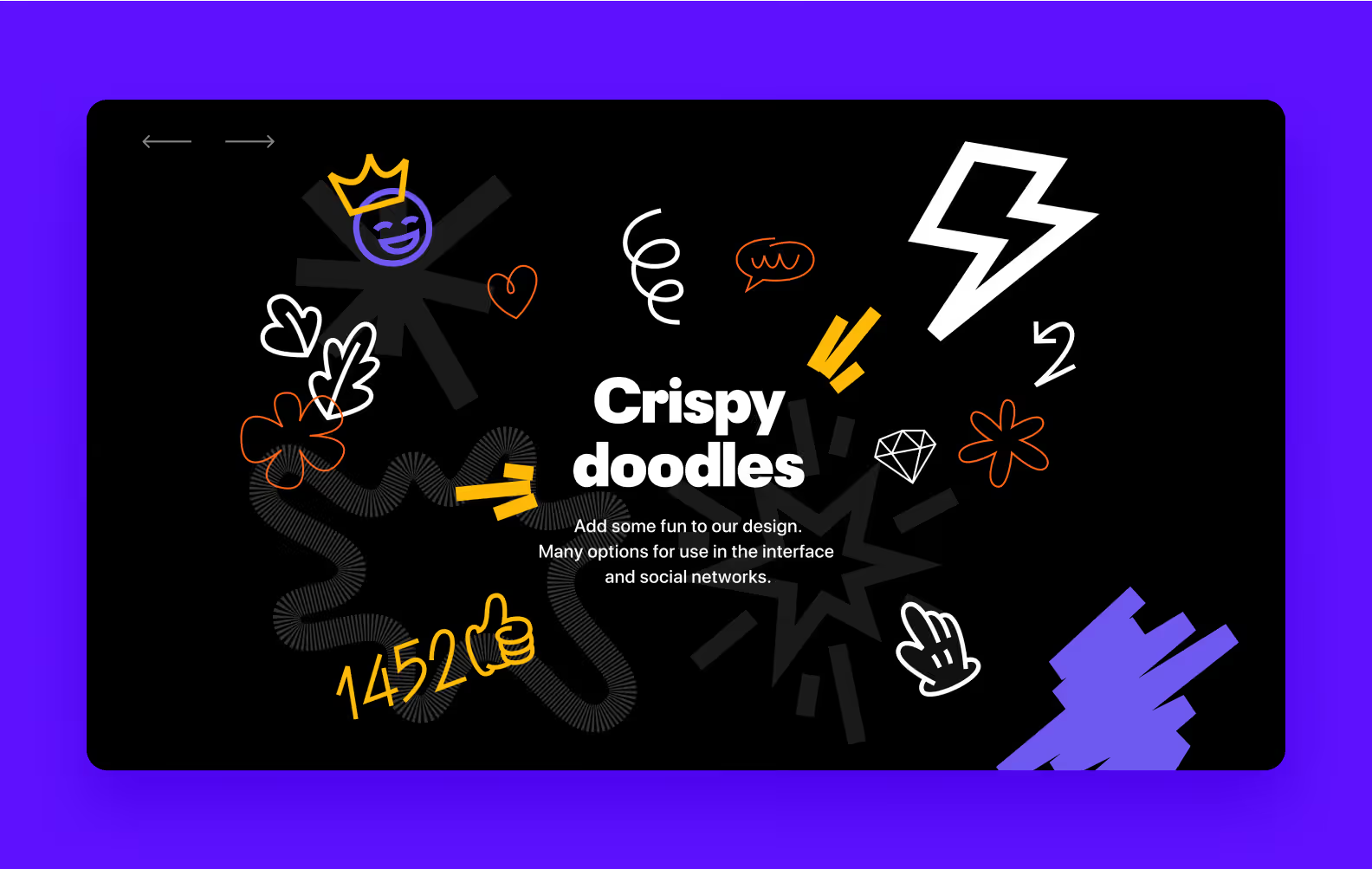
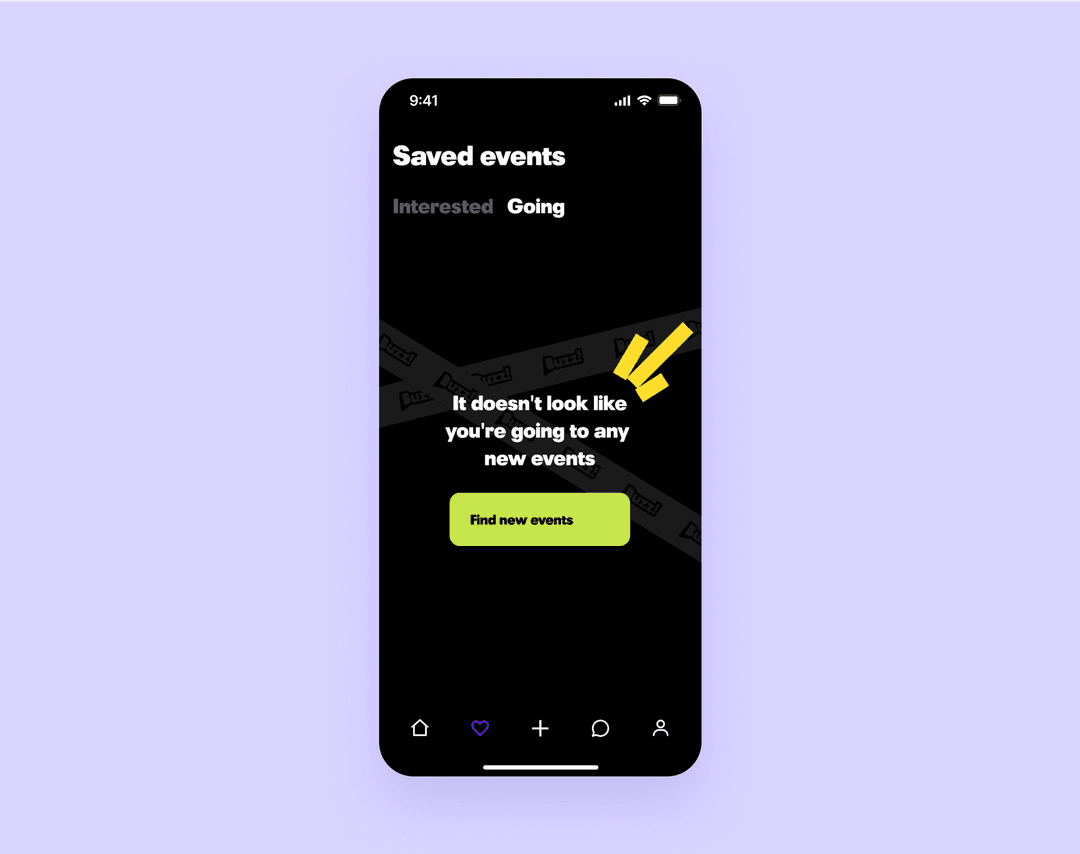
This style is often used in UX/UI design — for example, in onboarding or empty states — to make the interface more friendly. Here's how they look in the Buzz app.
We also developed a logo for the app. We wanted it to reflect one of Buzz's meanings: the app helps create communities and connect people. We kept it minimalist to maintain design purity and modernity.
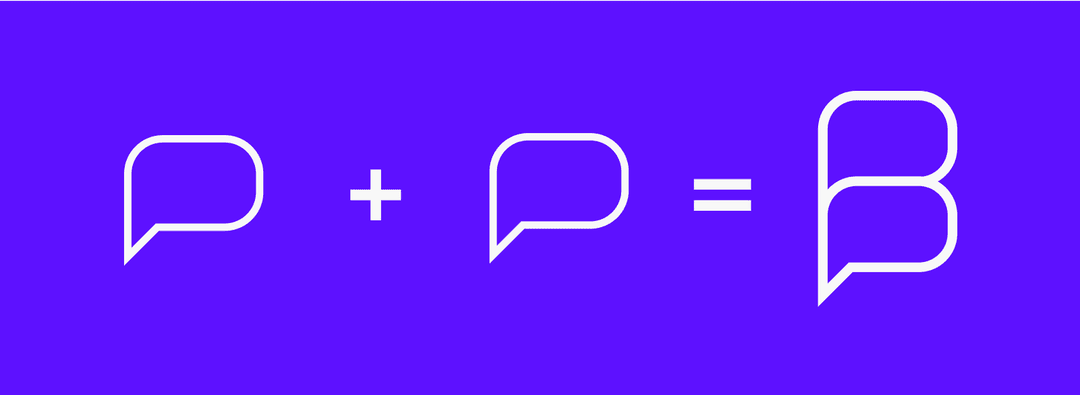
The logo can use the app's brand colors.
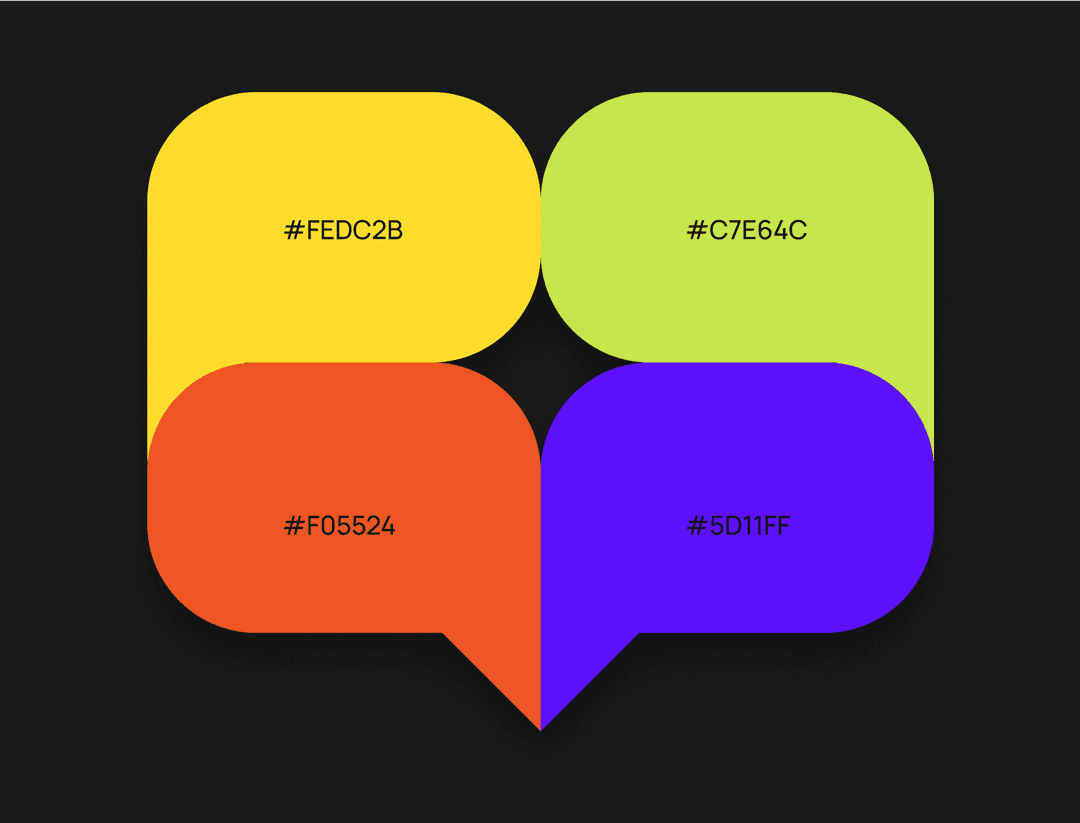
And to document all brand elements and usage guidelines for various promotional materials, we created a brand guidebook.

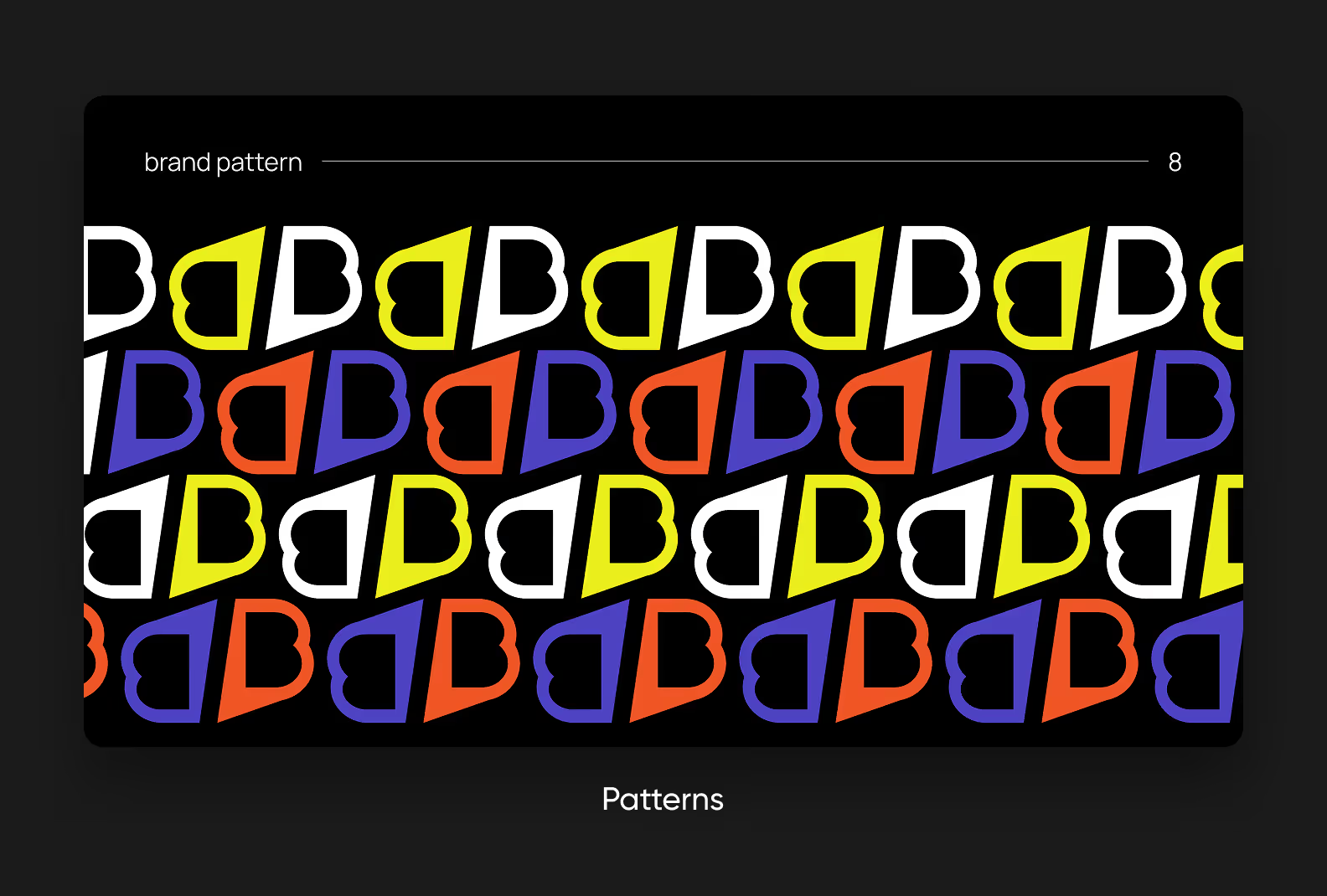
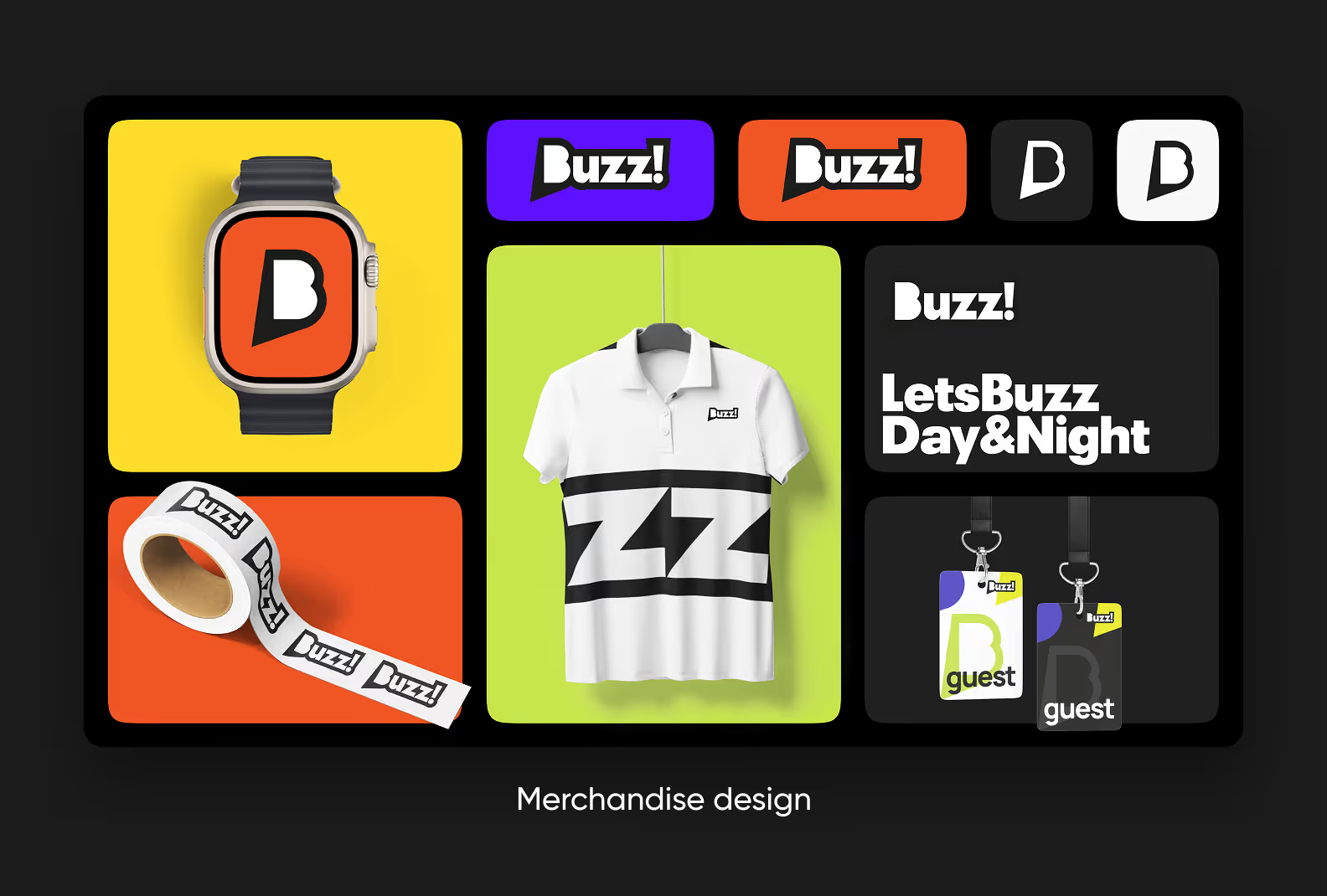
While developing Buzz, we faced several challenges and found optimal solutions for each task.
📍 Geolocation and event display. Locations needed to be displayed correctly both when creating an event and in users' event feeds. It was important to connect events to real locations so users would see relevant events in their or nearby towns. We revised our approach several times, adapting it to UX requirements and technical constraints to achieve accurate and stable display.
Sharing window: followers vs. chats. The client wanted both followers and chats to appear in the sharing window. However, this would have complicated the backend architecture by requiring an additional table for chats. We proposed several solutions, and ultimately chose the fastest and most budget-friendly — sharing only through chats.
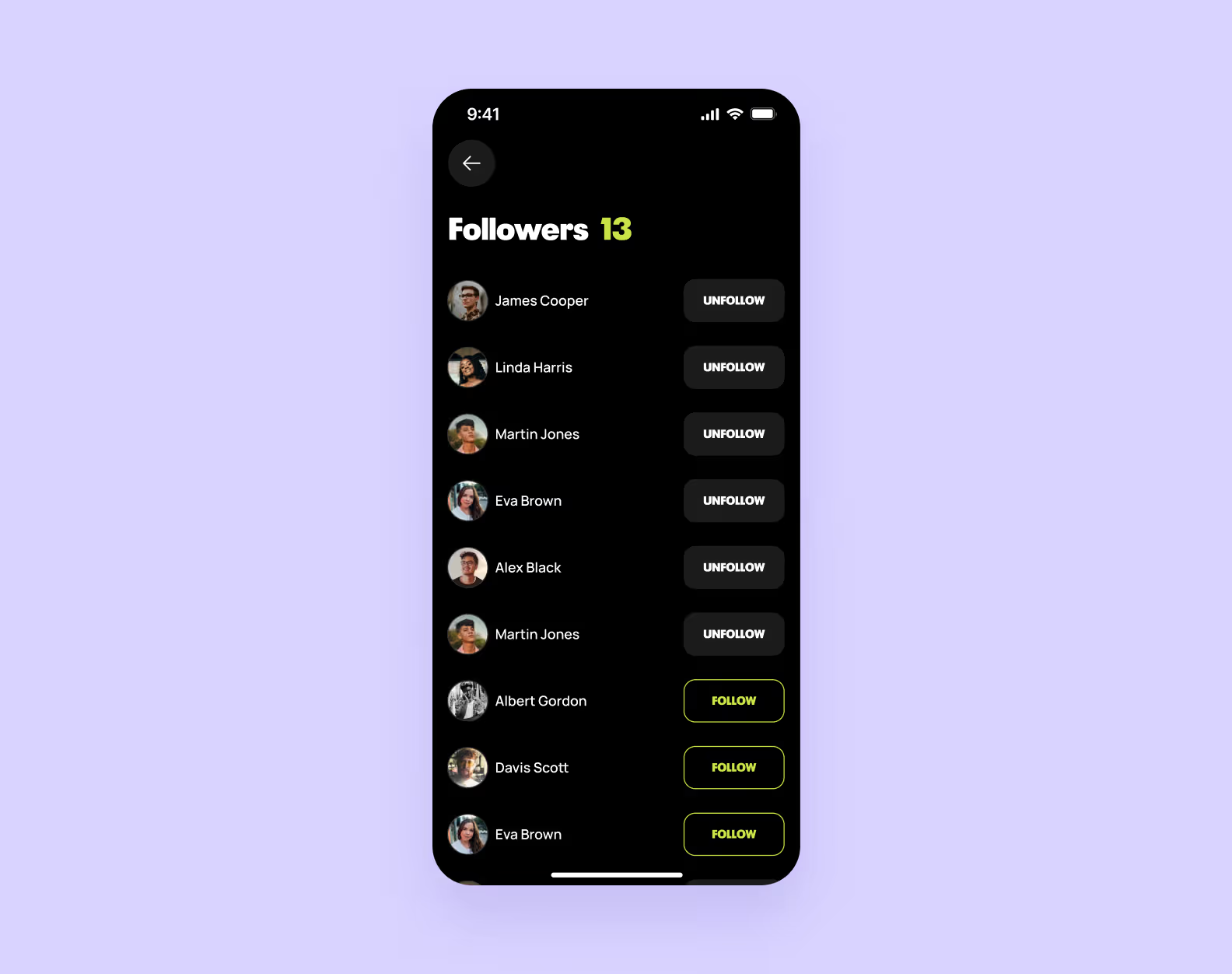
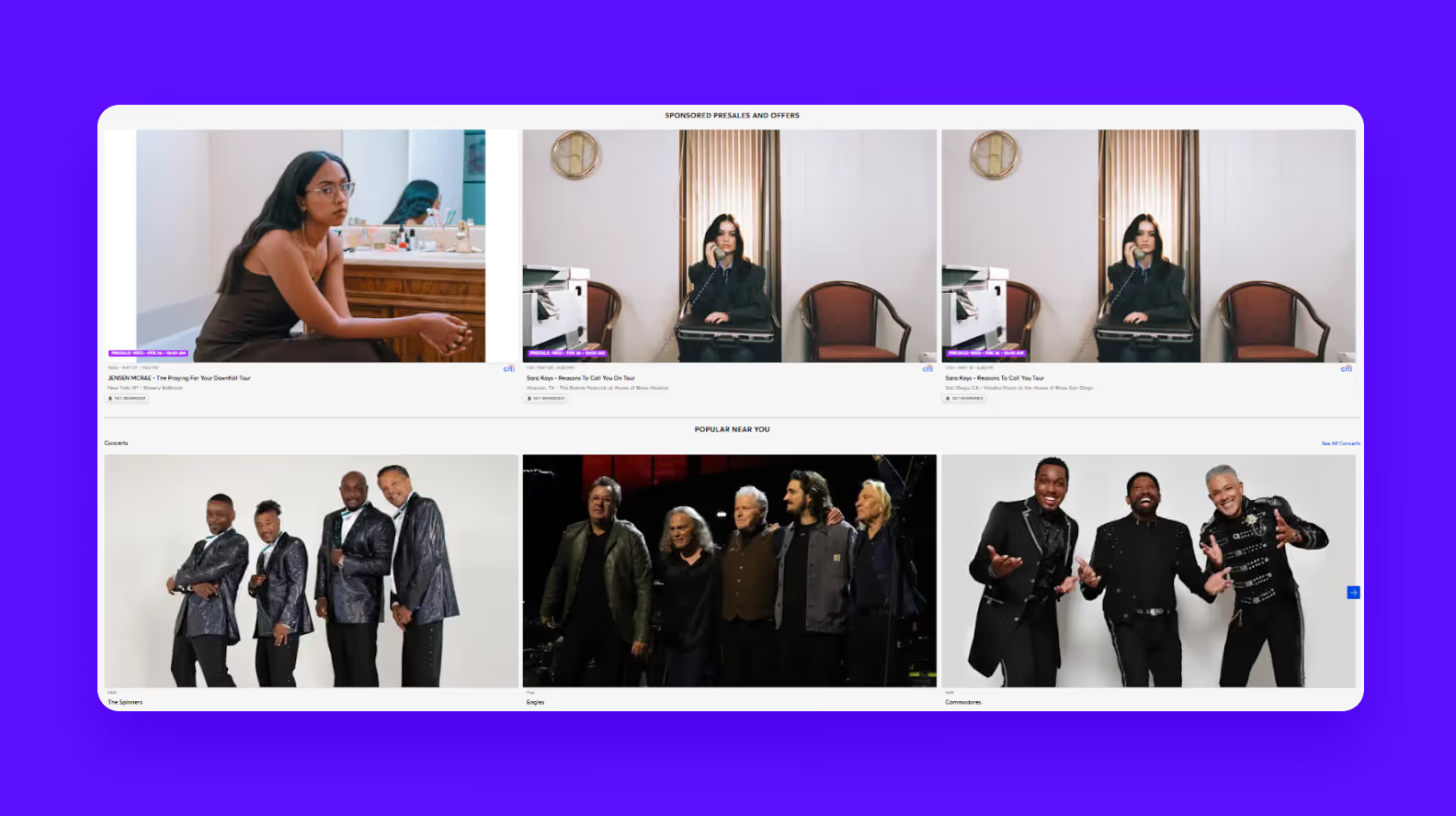
Ticketmaster integration. App monetization was planned through Ticketmaster, but we didn't learn about this until later 🤷 To implement the integration without delaying the timeline, we partially reworked the backend. We proposed an optimal solution, minimizing time costs, and the client allocated additional funding for implementation.
Admin panel for bulk events. Initially, the client planned to manage events directly through the database, but this proved to be too complex, especially for adding events in bulk. So we developed a user-friendly admin panel that simplified event uploading and sped up the moderation process.
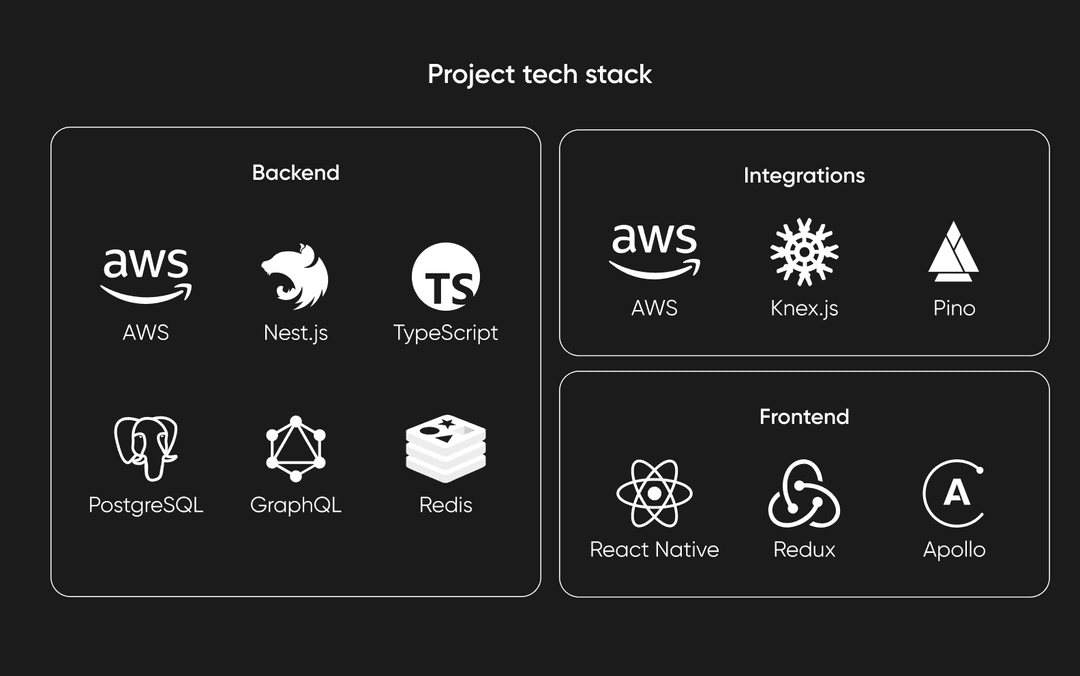
The Buzz app is already available in app stores. We also compiled a list of tasks for the post-MVP stage. We plan to add guest mode, a payment system, private accounts, and other features.
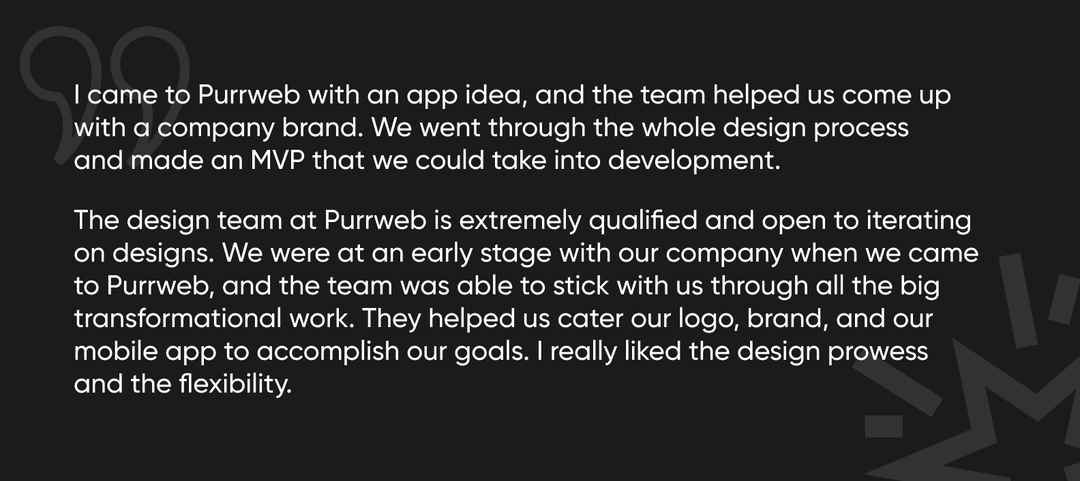
The client was completely satisfied with the result and collaboration with our team. Let's hear from him!
A brief text summary — in case you don't have time to watch the video:
➡️ We help startups quickly bring products to market. We build MVPs that focus on user needs, with user-friendly and aesthetic design, and scalable infrastructure. We'll dive into your project context, find the best technical solution, and help you decide on features. And if needed, before development starts, we'll conduct product discovery analysis to precisely determine how your product will address your target audience's pain points — increasing your chances of success.
Have a project? Contact us. We'll estimate timelines, budget, and outline a project roadmap.
Full-cycle mobile development. We handle the entire process: design, development, testing, and app store release support.
Over 12 years of experience. We've been creating IT products for businesses and startups for over a decade. We've delivered 550+ projects across diverse fields: IoT, EdTech, marketplaces, dating apps, and much more.
Turning ideas into real products. You don't need to come with a detailed technical specification. We'll take your ideas, flesh them out, suggest creative approaches, and turn your vision into a working product.


.svg)