Explore

Need help with your project?

Oops! Something went wrong while submitting the form.
Medical web development is the process of building websites and browser-based products for healthcare providers. A clinic website helps people understand its services and book an appointment. A web application gives patients or staff an interface for tasks such as viewing records or managing consultations. Because the product handles healthcare workflows and sensitive data, its architecture and security requirements change. That difference affects planning from the first discovery session.
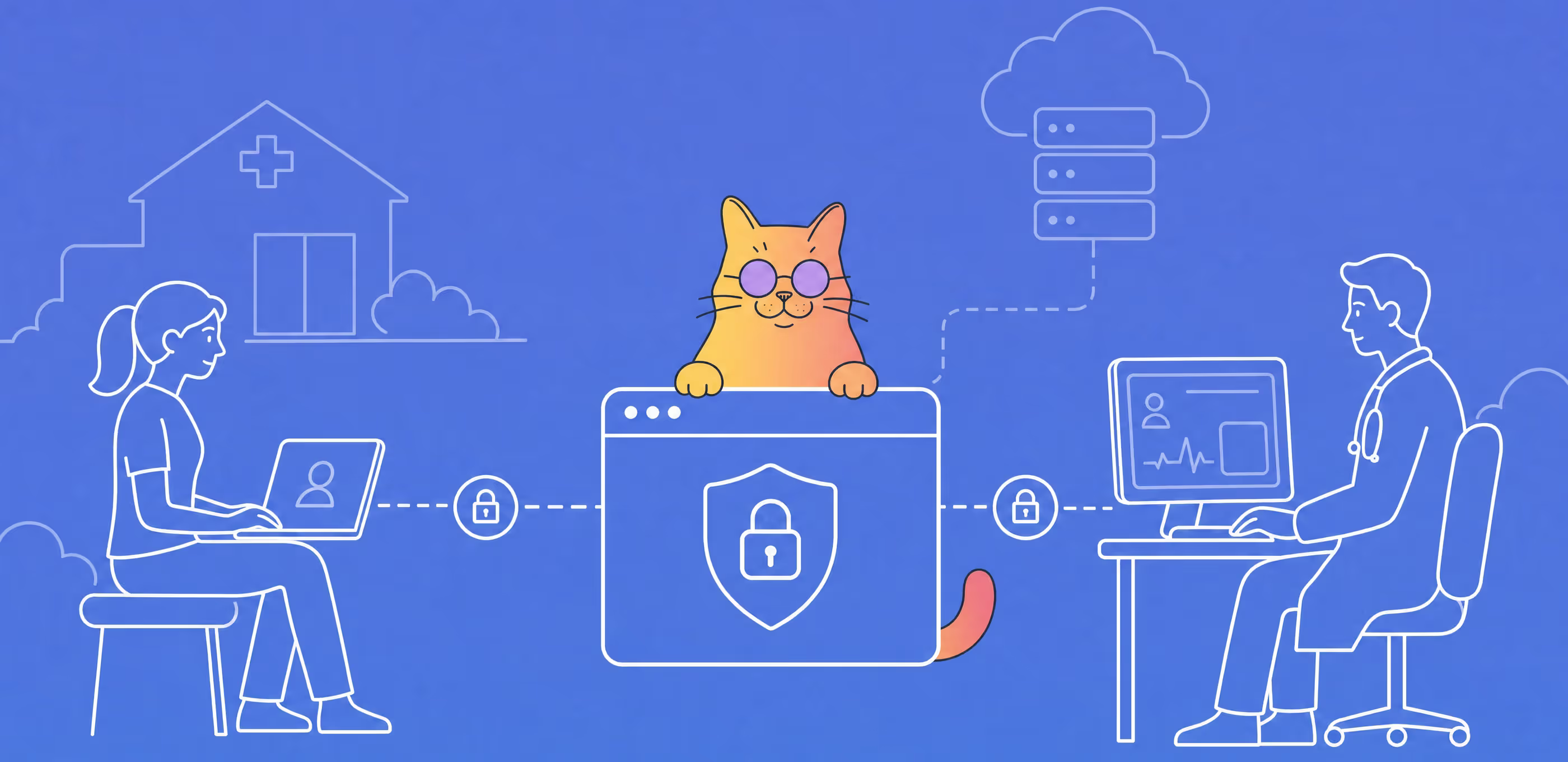
This guide helps healthcare decision-makers define the product before development starts. By the end, they can tell what belongs in the first release, where HIPAA changes the plan, and which questions a development team must answer before giving an estimate.
A healthcare web development project can be a public medical website, patient portal, or telehealth platform. The business task and product users determine the right choice. The buyer may be a medical practice or another healthcare organization, and the product may handle protected health information.
| Product type | What the business buys | Where the workflow ends | What changes the scope |
Medical website | A public channel for services and inquiries | Contact or appointment request | Content structure, accessibility, search, and form data |
Patient portal | A secure workspace for patients and staff | Records, messages, forms, or appointment management | User roles, protected data, and EHR or EMR integration |
Telehealth web product | A browser-based remote care service | Consultation and follow-up | Clinician workflows, video infrastructure, and health-data exchange |
The choice becomes clearer after mapping one complete user workflow. If it ends when a person contacts the provider, website scope may be enough. If the workflow continues into records, staff actions, or communication with a clinician, the project requires web-application architecture.
Mobile apps and full EHR systems are separate product categories. The rest of this guide focuses on medical website development, healthcare website development, and browser-based healthcare web applications.
Healthcare businesses use healthcare software development services when a website or web application has a defined business job. The product might help prospective patients understand a service, make routine tasks easier, or give staff better information before they respond.
The return changes with the product boundary. A public medical website makes a service understandable before a person contacts the organization. An authenticated healthcare web application carries work beyond that moment, connecting patient access with the operational information teams use to respond.
Healthcare web design shapes how a prospective patient, partner, or referring organization experiences a healthcare site. Good website design makes service information and the contact path easy to understand.
For a healthcare business, the investment is not just a polished public presence. It creates a reliable starting point for the conversations that later shape intake, referrals, or commercial relationships.
For Artromed and MedEquip, we created two medtech landing pages. Each page explained the company’s offer and gave prospective partners a clear contact path.
Our work covered design, copy, domain placement, and publication. We completed the two pages in 60 and 64 hours.
The case shows where a public landing page ends before a business builds patient access or internal workflows. Read the Artromed and MedEquip case
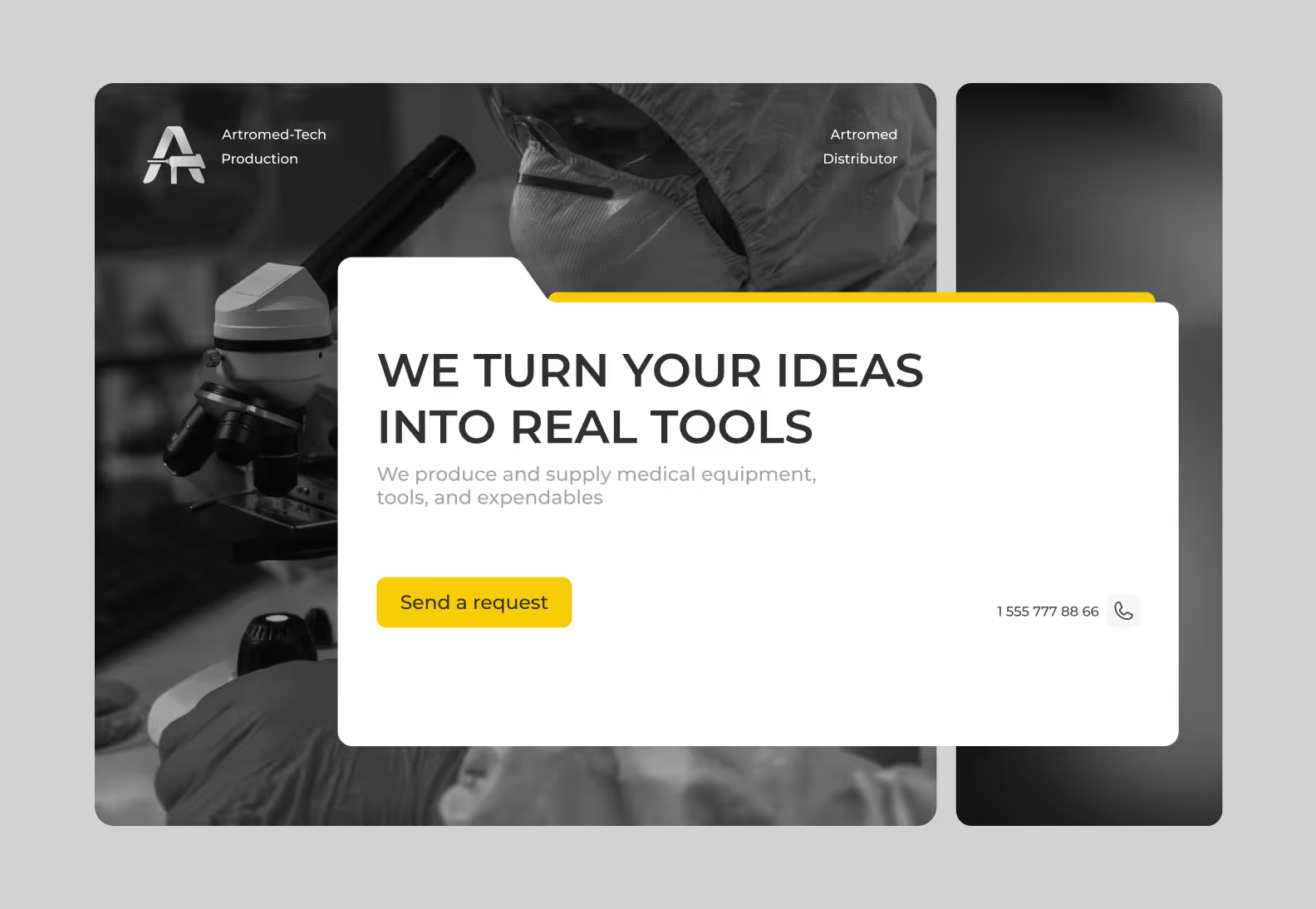
A dedicated landing page lets prospective partners see what a medtech product does before they contact the team
Website development becomes a patient-access decision when people need to use healthcare services online rather than simply learn about them. A portal has a concrete job when it supports appointments, records, or communication tied to a real care workflow.
Operational value appears when web interactions create dependable inputs for a team instead of isolated form submissions. A request that enters a defined workflow gives staff context for a response and makes responsibility visible.
The value comes from reducing handoffs between the public site, the people requesting help, and the team coordinating the service. That is where a healthcare web application earns its scope beyond an acquisition channel.
Medical web products need features that support a defined workflow. Each feature must connect a user action with the staff response and the system that owns the data. Without that connection, the feature adds interface complexity without solving an operational task.
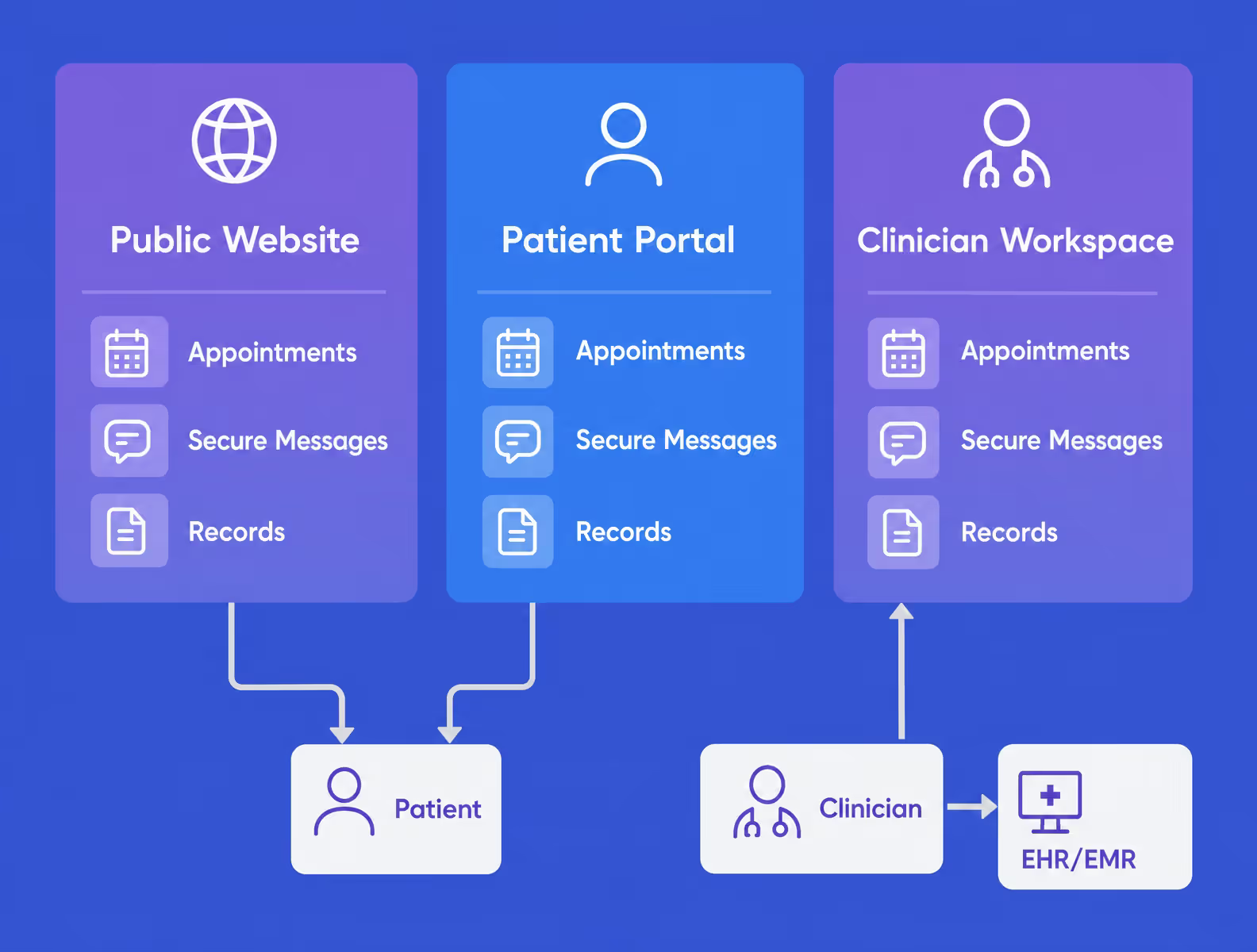
A feature map exposes which capabilities belong to the public site and which require authenticated workflows
| Feature | Product context | Business value | Scope implication |
Service pages and clinician profiles | Public medical website | Explains care options and who provides them | Content model and editorial ownership |
Appointment request | Public site or patient portal | Moves an inquiry into an intake process | Form logic, routing, and scheduling rules |
Secure messaging and records access | Authenticated patient portal | Supports ongoing patient tasks | Identity, permissions, and health-data handling |
Patient list and profiles | Clinician workspace | Gives staff context for the next action | Role-specific views and operational data |
EHR or EMR connection | Portal or clinician workspace | Keeps information aligned with the system of record | Interface ownership and data-exchange boundaries |
The same feature can create different development scopes. An appointment form on a public website may send a request to the reception team. Inside a medical web app or patient portal, appointment management also involves account access, scheduling rules, status changes, and staff actions. Website design is only one part of the web application development work.
Authenticated features make sense as a sequence rather than a collection of widgets. A patient submits information, a staff member receives it, and the product records what happens next. This sequence determines which roles need access and where the data should remain after the task is complete.
For Lytic Health, we built a doctor-facing web application around a dashboard and patient list.
Doctors can search and sort the list, open patient profiles, read messages, view patient statistics, and manage the appointment flow.
The patient-facing service and the doctor workspace support different parts of the same process. A single general dashboard would not give either role the context they need.
We separated the interfaces around each user’s next action. See the Lytic Health healthcare web application
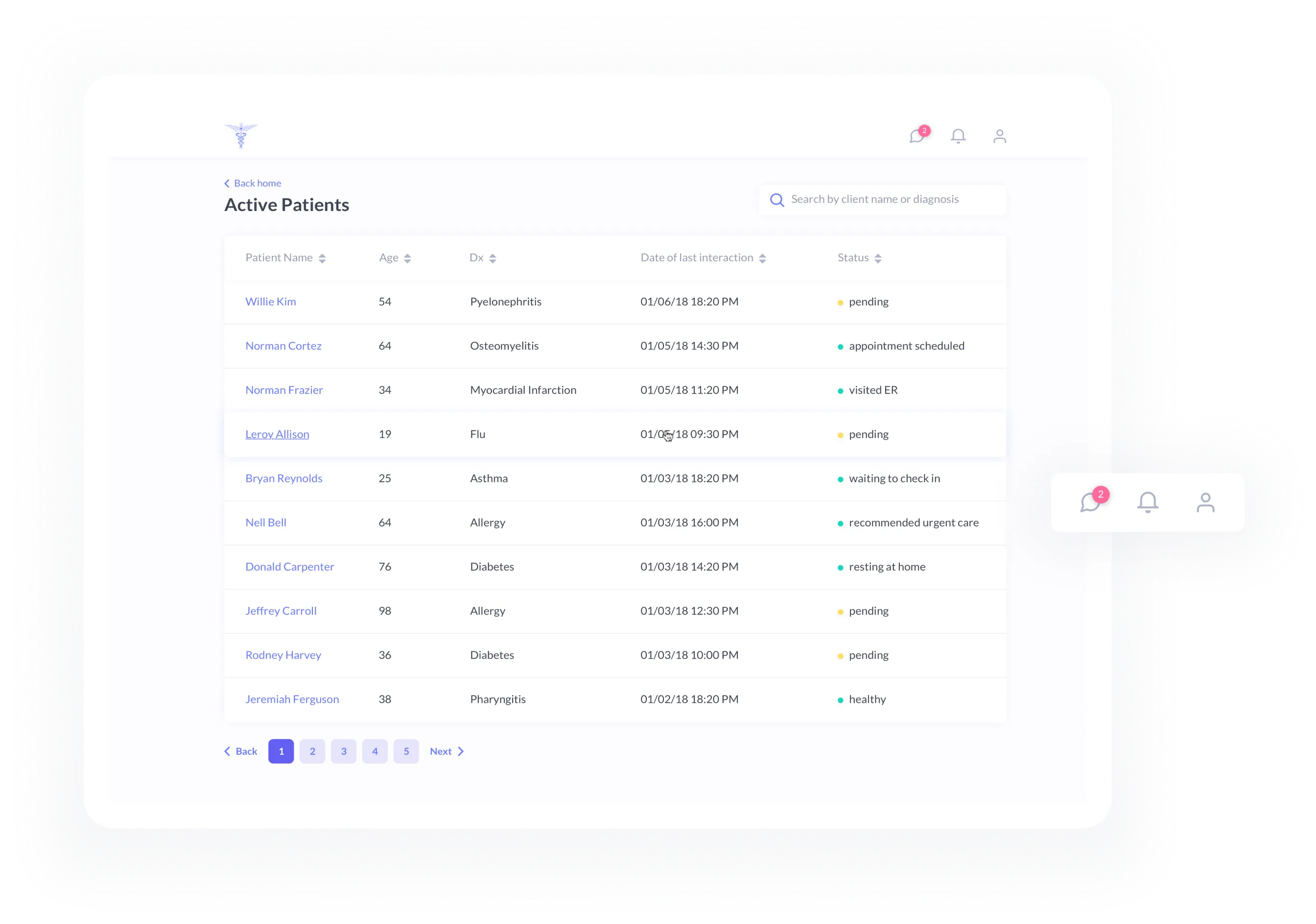
The clinician view keeps patient context and the next task in one browser workspace
An EHR (electronic health record) or EMR (electronic medical record) connection needs its own boundary. The estimate should identify which healthcare system owns the record, what medical information the web product reads or changes, and who controls access. Our guide to EHR/EMR interface design explains the interface decisions behind that integration.
The Health Insurance Portability and Accountability Act, or HIPAA, changes a medical web project when it handles ePHI for a covered entity or business associate. That work shapes the product scope, contracts, architecture, and ongoing operations from the outset.
The HHS Security Rule requires administrative, physical, and technical safeguards for electronic protected health information (ePHI). It connects the product’s workflow to the people and systems that handle health data.
| Decision point | Scope question | Accountable owner |
PHI entry points | Which forms, messages, uploads, or records create ePHI? | Product and clinical owners |
Transmission and storage | Where does ePHI move, and where is it stored? | Architecture owner |
User roles | Which patient, clinician, and staff roles access each data type? | Product and security owners |
EHR or EMR integrations | Which records move between systems, and who owns the interface? | Provider and integration owners |
Vendors and BAAs | Which vendors touch ePHI, and who reviews business-associate status? | Compliance and procurement |
Safeguards | Which administrative, physical, and technical controls apply to the workflow? | Security and operations |
Backups and recovery | Where do copies reside, and who owns restoration and testing? | Infrastructure owner |
Incident ownership | Who detects, escalates, investigates, and coordinates an incident response? | Security, legal, and operations |
For teams in the healthcare industry, the table turns HIPAA and healthcare data handling from a late-stage review into a product-scoping tool. Each row becomes a discovery decision with a named owner.
The provider defines its clinical policies and decides who may access each type of data. The development team implements those access rules and documents the boundaries between systems. Vendor agreements clarify which third parties handle ePHI. Making these decisions during discovery keeps compliance work visible in the estimate instead of hiding it under “hosting” or “integration.”
The responsibility map continues after launch. It identifies who approves access changes, tests data restoration, protects privacy, and coordinates the response to a data breach.
This section is product-scoping guidance, not legal advice. Legal and compliance teams determine the organization’s HIPAA obligations and the terms of its vendor relationships.
The right stack for a medical web product depends on its workflows, integrations, support model, and ePHI exposure. In healthcare web app development, technical choices need to match the responsibilities behind the healthcare software. A familiar cloud or framework is not enough.
| Layer | Practical role | Example technologies | Buyer decision |
Front end | The browser interface for patients, clinicians, and staff | React, Next.js, TypeScript | Match the interface to the users’ tasks and the team’s delivery skills |
Back end | Runs workflows, permissions, and business rules | Node.js, NestJS, Python, Django | Choose a platform the support team can maintain |
Database | Stores application records and health data | PostgreSQL, MongoDB | Define data ownership, retention, and access requirements |
APIs | Exchange data with EHR/EMR, video, insurance, or identity services | REST, GraphQL, FHIR APIs | Confirm integration ownership and the data that moves between systems |
Hosting and monitoring | Runs the service and makes problems visible | AWS, GCP, Azure, Datadog | Assign responsibility for uptime, alerts, and incident response |
Access control | Limits actions by role | OAuth 2.0, OpenID Connect, role-based access control | Map each role to the records and actions it is permitted to use |
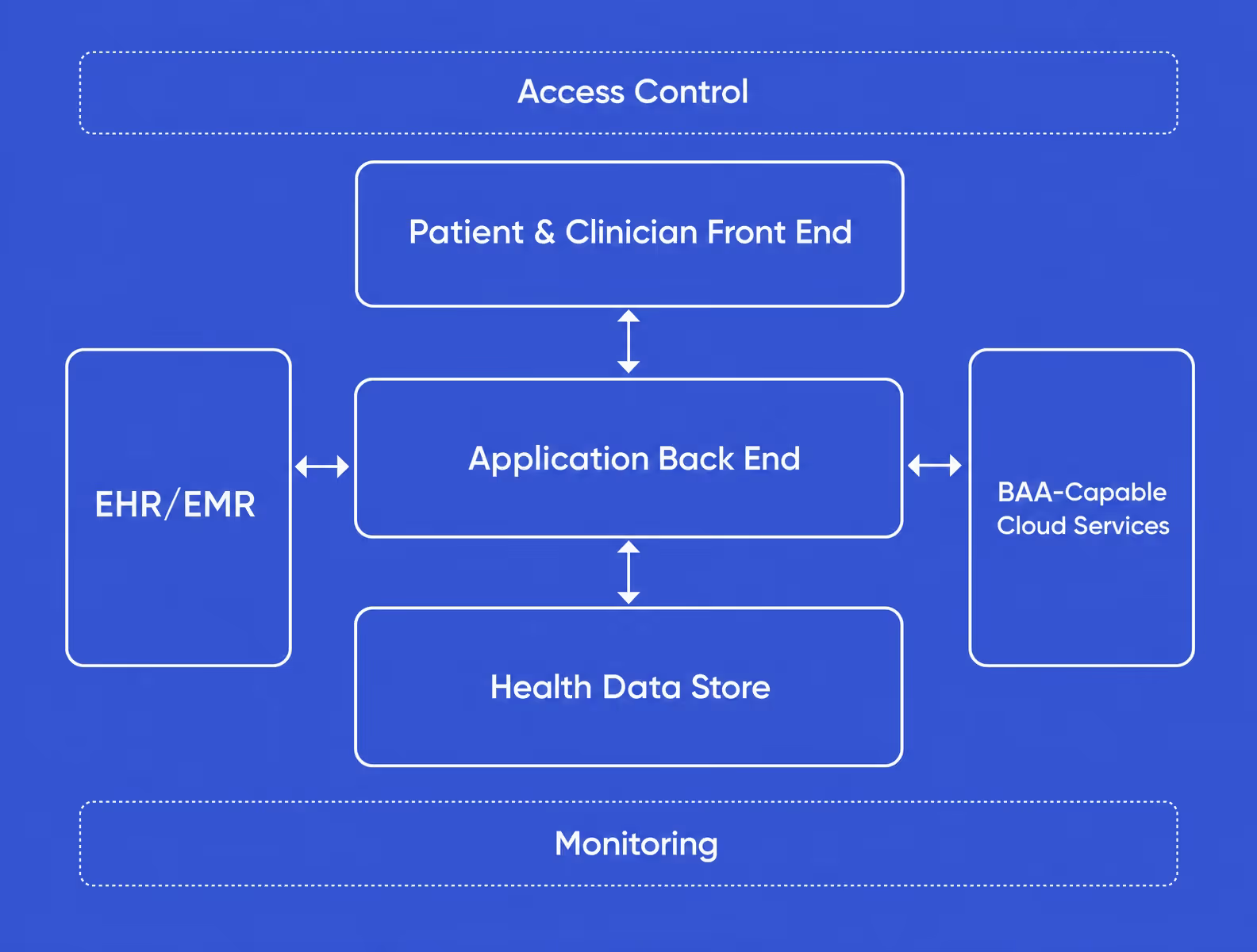
The architecture boundary clarifies ownership before an integration becomes a delivery commitment
The stack decision starts with the dependency that is hardest to change. If an EHR remains the system of record, integration with existing healthcare systems and their data rules shapes the API and back end. A public content site has fewer constraints because it does not support the same authenticated workflows. Framework and medical web design decisions come after this boundary is clear.
The second filter is ownership after release. The team maintaining the product needs a practical way to review alerts and analytics, change access, and investigate incidents. A cloud provider’s business associate agreement defines part of the vendor relationship, but it does not replace safeguards inside the application.
That is why custom web development starts with a workflow and responsibility map rather than a framework comparison. The map shows what the product does, where its data moves, and who supports each boundary.
We built My Therapy Assistant as an online mental health platform with separate web interfaces for clients and therapists.
The service supports therapist discovery, scheduling, video sessions, messages, notes, learning materials, and goal tracking across role-specific interfaces.
The product needed distinct workspaces for clients and therapists while connecting insurance payments through HealthCode.
We structured the workflows around each role and integrated HealthCode into the service. See the My Therapy Assistant web platform.
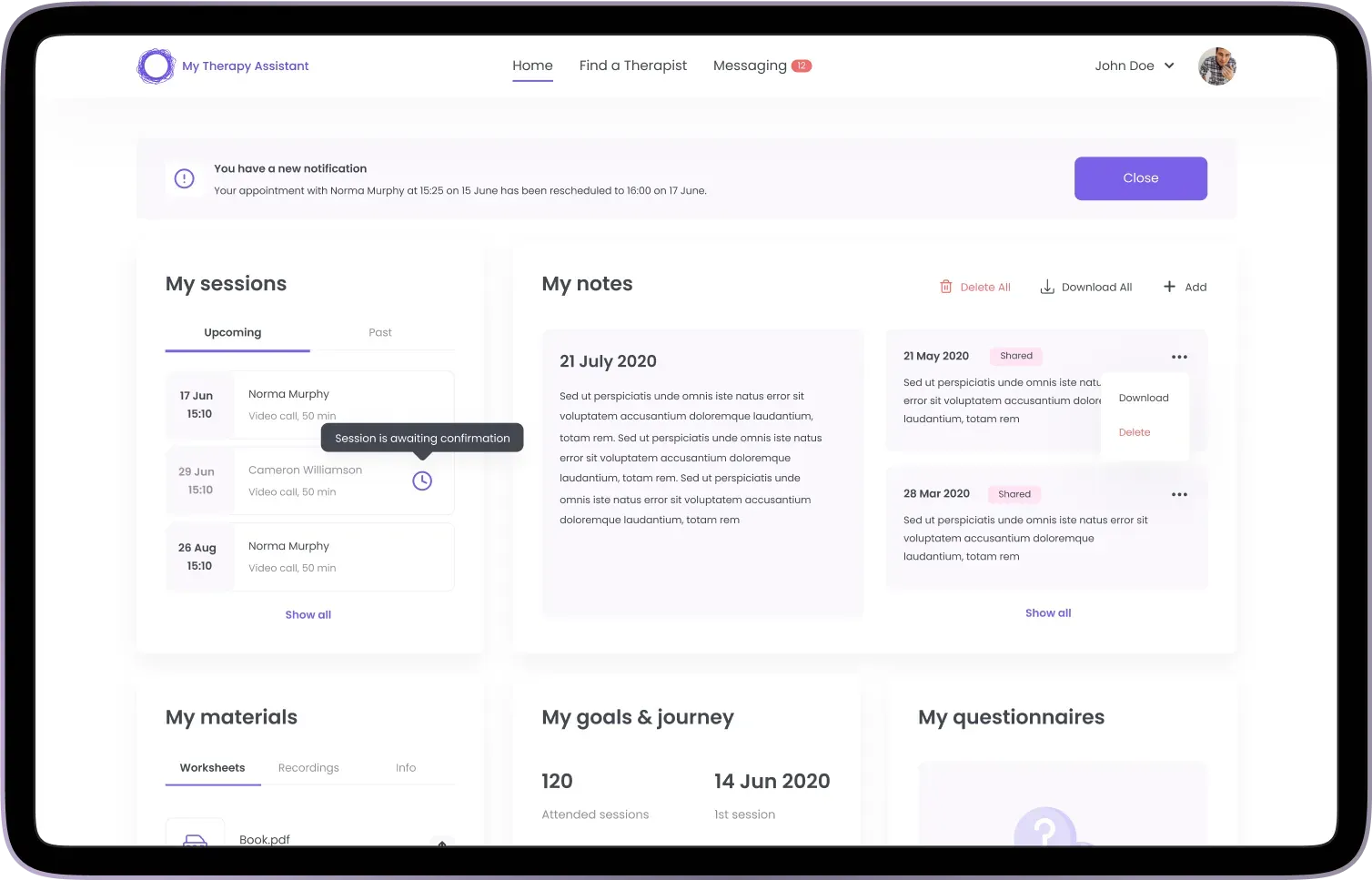
Separate workspaces keep therapy-session coordination visible to the person handling it
The medical web development process turns a healthcare business goal into a scoped browser product. Teams validate workflows, ownership, and release criteria before building. Each stage produces a decision record that keeps operations, technology, and risk aligned.
The order matters because a patient portal or telehealth web application has dependencies a public medical website does not. The team defines the operating problem, then exposes assumptions before they become code. The six steps of medical web development below name the business decision and the document that carries it forward.
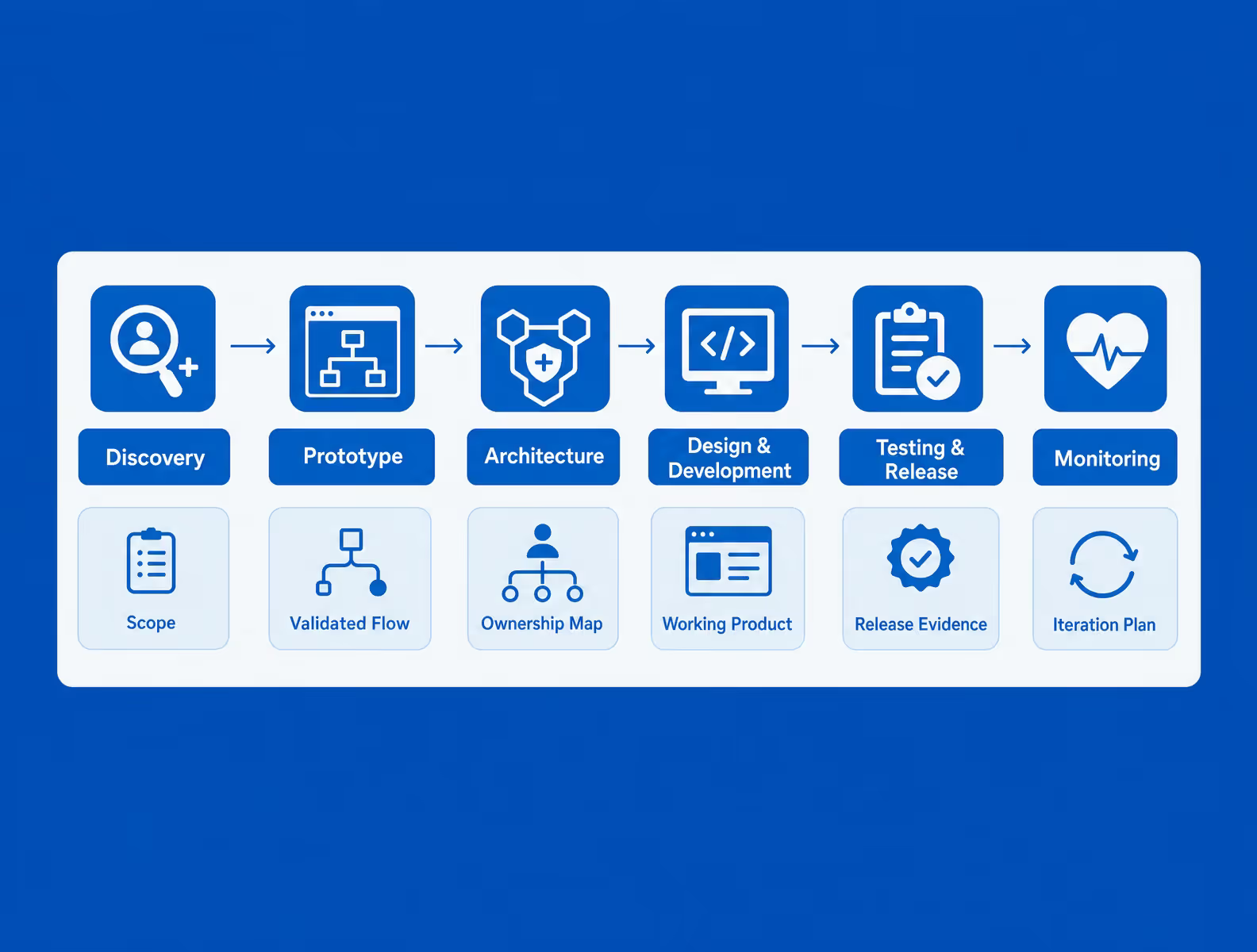
Each stage creates a decision record that narrows delivery uncertainty before release
The team defines the business outcome and the people involved in delivering it. The output records what the first release includes, how each user moves through it, where PHI appears, and who owns every external system. Security responsibilities begin here, before development.
The business decision is which patient, clinician, or staff workflow belongs in the first release. Software prototyping produces a clickable model showing each role's path, handoffs, and required information. Clinical and operational owners can then approve the flow or change it before it becomes a build commitment.
The business decision is where health data lives, which system owns it, and how responsibility divides among the provider, vendors, and delivery team. The output is an architecture record covering access roles, EHR or EMR boundaries, data flows, and security controls. PHI planning happens before development creates a hard-to-change dependency.
The business decision is which approved flows enter production scope and which remain outside the release. The output is a working front end and back end that implement the prototype, permissions, integrations, and content structure. Design resolves the agreed screens, while development connects them to supporting systems.
The business decision is whether the product is ready for real users and whether each owner can support it after launch. The output is release evidence, including workflow, access, and integration checks. A release checklist records publication approval, support ownership, and the response path for defects or security events.
The business decision is what the organization will measure, maintain, and improve after release. The output is an ownership plan for monitoring, access reviews, updates, incident handling, and a prioritized iteration list. Usage and operational feedback determine which workflow receives the next product investment.
The cost of medical web development depends on the product boundary, not a standard price list. Development costs follow the workflows and responsibilities inside that boundary. An informational website, patient portal MVP, and telehealth web product involve different workflows, data responsibilities, and delivery work. A reliable estimate follows that boundary.
| Product type | Complexity | Included scope | Principal cost drivers |
Informational medical website | Lower | Service pages, clinician profiles, content management, contact or appointment-request flow | Content migration, accessibility requirements, design depth, and publishing workflow |
Patient portal MVP | Moderate | Role-based accounts, appointment management, secure messaging or records access, and staff views | Role count, workflow depth, PHI exposure, EHR or EMR integration, and testing |
Telehealth web product | Higher | Patient and clinician workspaces, scheduling, communication, and video consultation flow | Video and messaging services, permissions, integrations, data handling, reliability testing, and support |
The table compares scope, not fixed price bands. A public site can stay contained when it ends with a request sent to staff. A patient portal expands the front end and back end around access, user actions, and medical data movement. Telehealth adds communication infrastructure and a live consultation workflow.
The estimate grows when one action triggers several role-specific steps. A simple appointment request may end in the reception team’s existing process. A portal might route the same request through patient confirmation, clinician availability, and staff approval inside the product.
Data boundaries create a different kind of work. The team has to define access rules and test how information moves between the web product and an EHR or EMR. A public website cost still depends on its own drivers, especially when content migration or accessibility affects many page templates. Backend infrastructure and design costs become more important when the product adds authenticated workflows.
Post-release ownership also belongs in the cost of healthcare web development. Monitoring a live integration and changing user access require ongoing technical work that a one-time website launch may not.
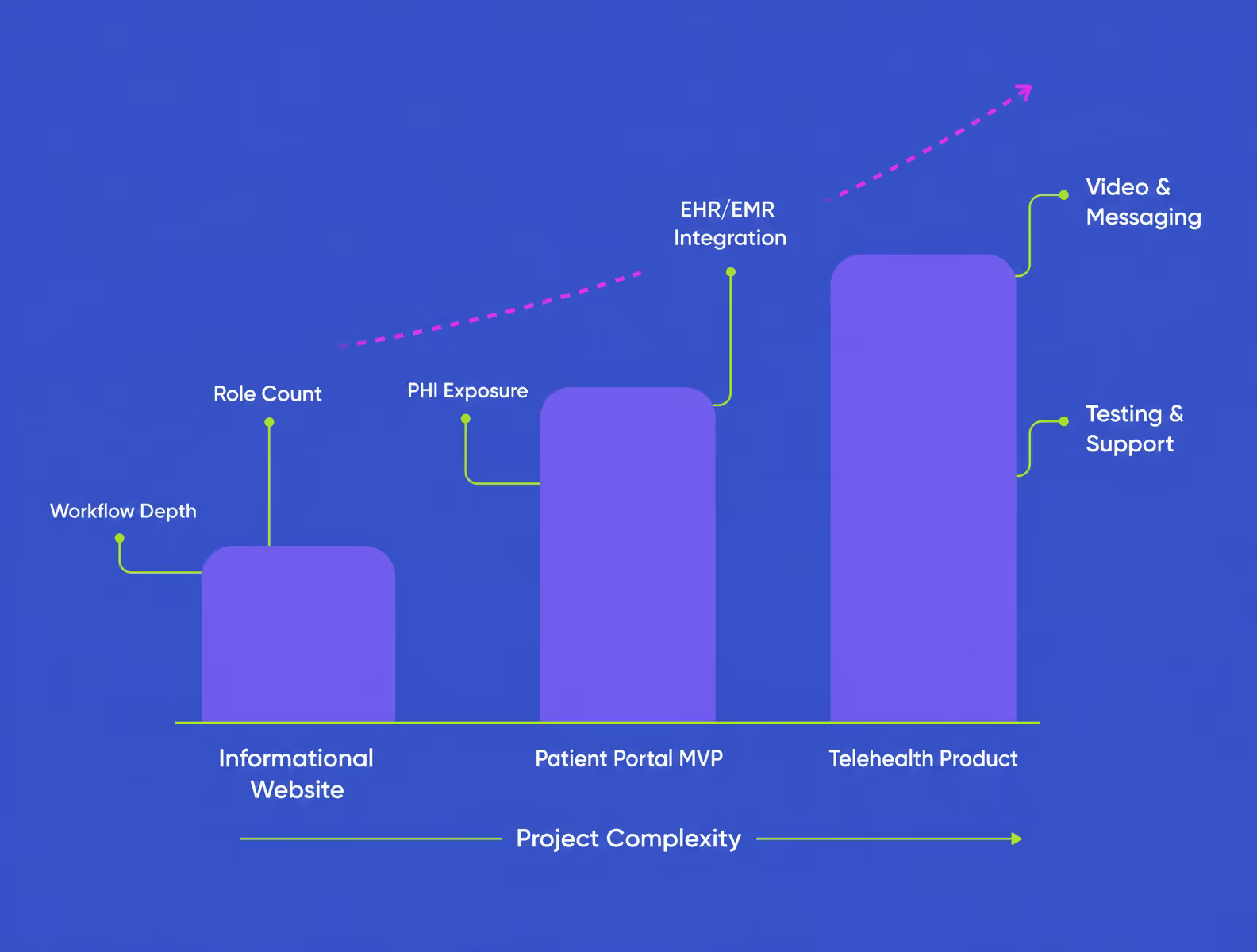
Complexity grows when a single request triggers role-specific actions and connected-system checks
A mobile app sits outside this web-only comparison. For that separate budget question, see our guide to healthcare app development cost.
A useful estimate names included scope, assumptions, exclusions, integrations, delivery stages, and post-release ownership. Protected health information boundaries, including an EHR or EMR integration, become work the team can assign and test.
A healthcare web development team is worth evaluating through evidence of a similar browser-based care workflow, not a general claim of experience in healthcare. The useful proof is not a healthcare logo wall. It is a clear account of what the team built, which responsibilities it carried, and how it prepared the product for release.
A relevant case should show who used the web application, what they did there, and which part of the product the team built. A healthcare logo or a polished interface does not answer those questions. The same example needs to show who managed each integration, especially when health data crossed an EHR, EMR, or third-party service.
Medico needed a clinician-facing web application for cancer patient monitoring, where doctors work with information submitted during treatment.
We built a doctor workspace that lets clinicians add patients, configure surveys around a treatment plan, review submitted test results, and receive alerts when indicators fall outside normal ranges.
The workflow had to connect survey setup with the results a clinician reviews, rather than treat those tasks as separate screens.
We brought patient creation, treatment-plan surveys, result review, and abnormal-indicator alerts into the same doctor web application. See the Medico cancer patient monitoring platform
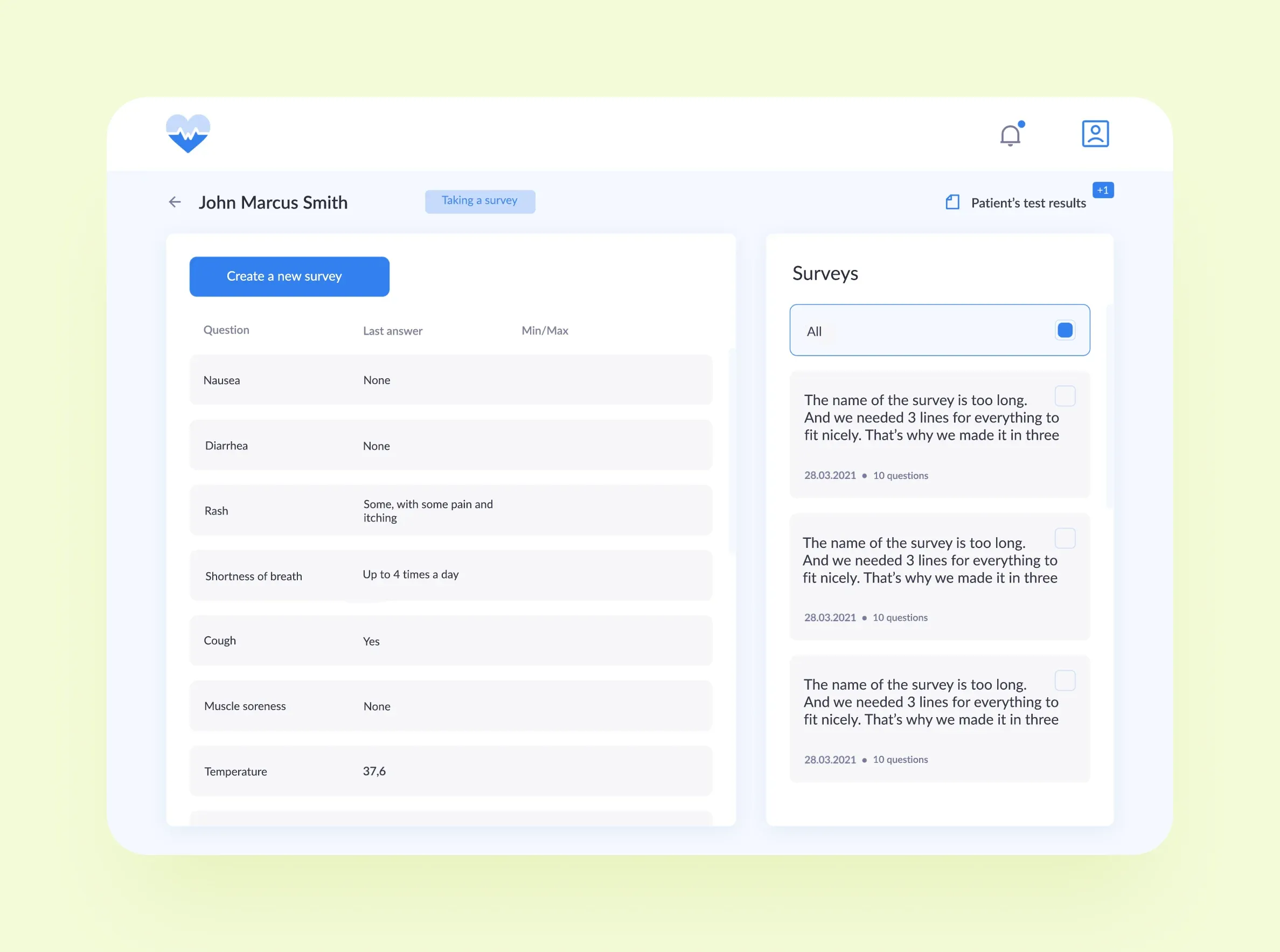
The clinician workspace connects treatment-plan surveys with the results that require attention
The strongest evidence is something the buyer can review directly. A workflow map or clickable prototype shows how the team turns tasks for patients and healthcare professionals into screens and roles.
Acceptance requirements and a release checklist show how it verifies those healthcare solutions before launch. A support plan shows who handles access changes, monitoring, and connected systems afterward.
| What to evaluate | What useful evidence looks like | Why it affects delivery |
Experience with a similar web product | A case walkthrough showing the users, browser workflow, and the part of the product the team built | Shows whether the team has handled a similar product, not just worked in healthcare |
Responsibility for integrations | A named owner and map of the systems, exchanged data, and vendor handoffs | Makes responsibility for EHR/EMR and other connections visible |
Handling of PHI and security | A data-flow discussion showing where PHI enters, moves, and is accessed | Separates concrete product responsibilities from broad claims of compliance |
Discovery or prototype work | A workflow map, prototype, or discovery document from a prior project | Shows how the team turns care operations into a scope it can estimate |
Testing and release records | Example acceptance requirements, test record, or release checklist | Connects the agreed workflow to a release decision the buyer can verify |
Support after launch | A support plan covering access changes, monitoring, and issue response | Clarifies who maintains the product after launch |
Medical web development starts with a product boundary. A public website, patient portal, and telehealth product create different workflows, data responsibilities, integrations, and support needs.
The next decisions are where health data enters and moves, which system owns the record, who accesses it, and what the first release must prove. Those choices shape the stack, estimate, testing, and post-release plan. A team is easier to evaluate when it shows similar browser workflows, names who handled each integration, and shares the documents used to plan and verify the release.
➡️ Share the workflow, data boundaries, and integrations to turn them into a development plan. Contact Purrweb to discuss the first release.
The cost depends on the product boundary and the work inside it. An informational medical website, patient portal, and telehealth web product have different requirements. Cost drivers include workflow depth, role count, health-data exposure, EHR or EMR integration, accessibility, testing, content migration, and post-release support. A useful estimate states scope, assumptions, exclusions, and ownership.
The duration depends on the first-release scope and the decisions resolved before development. A healthcare web application needs workflow validation, architecture planning, role and access definitions, and integrations. It also needs testing, release checks, and an ownership plan after launch. A public website has fewer dependencies when it ends with a request to staff rather than authenticated care delivery.
HIPAA planning starts by identifying whether the product creates, receives, maintains, or transmits ePHI for a covered entity or business associate. The scope then maps entry points, data movement, user access, vendors, safeguards, backups, and incident ownership. This is product-scoping guidance, not legal advice. Legal and compliance teams determine the organization’s obligations and vendor terms.
A medical website explains services and gives people a path to contact the provider or request an appointment. A medical web application supports work after that point, such as records access, appointment management, or clinician communication. It therefore adds authenticated accounts, role-specific actions, operational data, and boundaries for the systems that own and exchange information.
Web development still has a separate role when the organization needs a public website or browser-based workspace for patients, clinicians, or staff. Mobile products sit outside this web-only comparison. The product boundary depends on which workflow belongs in the browser and whether it ends at information, intake, or authenticated care delivery.
Choose a medical web development company based on evidence from a similar browser workflow. The case should show who used the product, what they did there, which integrations the team handled, and how access and release were checked. Workflow maps, prototypes, test records, and a support plan make the team’s responsibilities visible.


.svg)