Explore
Need help with your project?
This field is required
Incorrect phone number
Incorrect Email
This field is required
Please fill in all fields
Next
Next
Your role in the project
Services
Budget
Please select one option in each category
Submit
Submit
several colorful figures
Request sent
Our manager will contact you shortly.
Oops! Something went wrong while submitting the form.

Top Fintech Software Development Companies: 
What to Look for and Why Purrweb

Purrweb is a fintech software development company with 9+ years building compliant, scalable fintech software solutions across the global fintech industry — from payment apps and neobanks to trading systems and lending platforms. What separates the best fintech software development companies from the rest: compliance built into day one, not retrofitted before launch. Custom software, React Native + web, fixed timeline, post-launch support included.

Experience: 9+ yearsProjects delivered: 300+Clutch rating: 4.9 / 5.020+ countries

Trusted by Fintech Companies Worldwide

ELTECH
LXP IThub
LXP IThub
LXP IThub
LXP IThub
LXP IThub
ELTECH
LXP IThub
LXP IThub
LXP IThub
LXP IThub
LXP IThub
ELTECH
LXP IThub
Trassir
energo
Skuratov
SOAK
ELTECH
LXP IThub
Trassir
energo
Skuratov
SOAK
Clutch ratingGoodFirms VerifiedPCIGDPR

Custom Fintech Software 
Development Services We Deliver

Custom fintech software development is product development tailored to a specific financial product, regulatory environment, and user base — rather than adapting off-the-shelf software or generic application software. Building fintech products for the financial sector requires software ar‐ chitecture designed around compliance, scalability, and security from the start. We cover the full development process: discovery, architecture, design, engineering, QA, and post-launch support. Our clients are fintech companies, banks, insurance carriers, wealth management firms, and other financial institutions building consumer apps, B2B platforms, and back-office management software for the modern fintech landscape.

Our fintech software development services include:

Mobile Fintech Apps (iOS & Android)
We build native-quality mobile financial apps using React Native and TypeScript. Single codebase, both platforms, 30–40% faster time-to-market versus separate iOS and Android teams. PCI DSS-compliant payment flows and biometric authentication built in by default.
Explore our financial software development guide for a deep-dive on architecture decisions.
Green textured Apple logo and Android robot on a solid bright blue background.
Web-Based Financial Platforms
Dashboards, admin panels, trading interfaces, and back-office systems built on React or Next.js. User interface design and user experience work are part of our process — not an afterthought. We architect for high data throughput — fintech platforms we've shipped handle 10 000+ transactions per hour at launch.
Blue 3D atom model with textured orbits and nucleus on bright green background.
MVP for Fintech Startups
Need to validate before raising Series A? Our fintech MVP development process takes 3–4 months from signed brief to App Store/Play Store. Scope is fixed upfront; no scope creep, no billing surprises.
Person using laptop to start an online medical consultation with a questionnaire.
Compliance-First Architecture
Regulatory compliance isn't bolted on after the fact. KYC/AML flows, GDPR data handling, and PCI DSS Level 1 payment processing are built into the architecture from week one. Clients in the EU, UAE, and US markets rely on this approach to pass regulatory audits without rebuilding their stack.
Doctor wearing white coat with stethoscope texting on smartphone with a smiling chat bubble.
API Integration & Third-Party Connectivity
Open banking APIs (Plaid, TrueLayer), payment gateways (Stripe, Adyen, Braintree), core banking systems (Temenos, Mambu), and identity verification providers (Onfido, Jumio) — we've integrated all of them across live projects.
Man in plaid shirt sitting at table in video call on laptop for optional medical follow-up consultation.
Analytics & Reporting Modules
Real-time transaction dashboards, fraud detection feeds, and portfolio analytics — we connect data pipelines to your BI layer and build white-label reporting interfaces for end users. These modules are standard across our custom financial software projects, from neobank dashboards to investment platform reporting.
Hands holding a plain cardboard box on a table symbolizing discreet delivery service of medication.
Custom Financial Software Modernization
Fintech firms and established financial institutions also come to us to replace legacy systems. We assess existing fintech systems, design a migration path, and rebuild on a modern stack — without taking down production. Development time for a legacy modernization project typically runs 4–8 months depending on integration complexity.
Smiling man in white coat with text about continuous support and 24/7 help for treatment options.

Fintech Industries We Serve

Purrweb's fintech app development work spans nine product verticals across the financial services industry. The global fintech market reached $340 billion in revenue in 2024 (Statista), and fintech businesses are active across every one of these segments. Hub pages for each vertical carry full technical specs, cost breakdowns, and case references — links below.
Blue textured bank building with dollar sign symbol on bright green background.
Banking & Neobanking
Banking software for retail and corporate financial institutions: digital account opening, card issuance, and core banking API wrappers. We've built neobank app development products that launched with 5 000+ users in the first 30 days.
Bright green Apple logo and Android robot icon on a blue background.
Payments & Money Transfer
Peer-to-peer transfers, merchant payment terminals, and international remittance apps. See payment app development and money transfer app development.
Blue piggy bank with textured diamond pattern on a bright green background.
Investment & Trading
Brokerage interfaces, robo-advisory platforms, and wealth management dashboards. Investment app development— typical timeline 6–9 months for a production-grade trading platform that meets regulatory audit requirements.
Two green credit cards and three green coins on a blue background.
Lending & BNPL
Loan origination, credit scoring API integrations, and buy-now-pay-later checkout flows. Lending platform development with underwriting logic built to your risk model.
Close-up of a blue Bitcoin coin symbol on a bright green background.
Blockchain & DeFi
Smart contract development, token issuance, and decentralized exchange interfaces. Cryptocurrency wallet products — both custodial and non-custodial wallet development — are a significant share of our Web3 work. DeFi app development and NFT marketplace development for Web3-native products.
Bright green leather wallet with textured pattern on a solid blue background.
Digital Wallets
Multi-currency wallets, QR-code payments, and loyalty point systems. Full stack: digital wallet development from architecture to App Store submission.
Blue shield with a checkmark pattern on a solid bright green background.
Insurance & Insurtech
Our insurance software development covers policy management dashboards, claims intake apps, and underwriting workflow software for carriers and brokers. We approach insurtech as a regulated financial product — same compliance discipline as banking and lending, plus actuarial-data integration where it's needed.
Green sculpture resembling a vintage mobile phone shaped like a silver bar against a blue background.
Banking App Development
Banking app development covers enterprise banking portals and white-label mobile banking suites for established financial institutions and credit unions.

Fintech Industries We Serve

Purrweb's fintech app development work spans nine product verticals across the financial services industry. The global fintech market reached $340 billion in revenue in 2024 (Statista), and fintech businesses are active across every one of these segments. Hub pages for each vertical carry full technical specs, cost breakdowns, and case references — links below.

Frontend & Mobile

  • React Native + TypeScript — single codebase for iOS and Android; 90%+ code reuse on all our fintech mobile apps; Expo for faster iteration in early sprints
  • React / Next.js — web dashboards, admin panels, trading UIs; server-side rendering for data-heavy screens
Blue textured 3D atom model and smartphone back with triple camera on a green background.

Backend & APIs

  • Node.js / NestJS — event-driven microservices; handles async transaction flows without blocking I/O
  • Python (FastAPI) — machine learning scoring models, fraud detection, risk analytics
  • PostgreSQL + Redis — transactional data with ACID guarantees + high-speed caching for real-time feeds
Green snake-shaped object with a textured pattern on a solid bright blue background.

Cloud & Infrastructure

  • AWS / GCP — multi-region deployments; VPC isolation for PCI DSS scoped environments; horizontal scalability for high-throughput payment processing
  • Docker + Kubernetes — container orchestration; zero-downtime deploys critical for 24/7 financial platforms
Bright green letters and shapes on a bold blue background forming part of a stylized word and cloud.

Blockchain (for DeFi/Web3 projects)

  • Solidity + Hardhat — EVM-compatible smart contracts
  • Ethers.js / wagmi — frontend Web3 integration
  • IPFS — decentralized storage for NFT metadata
We also support DeFi app development projects that require custom L2 integrations.
Close-up of a blue textured chain link on a bright green background.

Security & Compliance

  • TLS 1.3, AES-256 encryption — data in transit and at rest
  • Vault (HashiCorp) — secrets management; API keys and credentials never in codebase
  • KYC/AML providers: Onfido, Jumio, Sumsub — integrated via SDK and REST
  • PCI DSS scope reduction via tokenization (Stripe Elements, Adyen Drop-in) — we design the integration to minimize your compliance surface area
Bright green textured judge's gavel and block on a solid blue background.

Why Choose Purrweb Among Fintech Software Development Companies

Most fintech software development companies hand you a generic pitch deck and standard NDA. Here's what actually differentiates Purrweb as a software development partner on fintech projects — and why early-stage fintech companies pick us over agencies twice our size.

React Native as a Strategic Advantage

React Native is not a compromise. It's the reason fintech startups we work with get to market 4–6 weeks faster than teams running separate iOS and Android codebases. When a regulatory change requires a KYC flow update — one codebase means one fix, not two parallel sprints.

Post-Launch Support Included

Every fintech project includes a 3-month post-launch support period: bug fixes, performance monitoring, and payment gateway incident response. After that, we offer a retained support model starting at $2 500/month. Most of our fintech clients stay on for 12+ months after launch.

Fixed-Scope Engagements for Predictable Budgets

We run projects on fixed-scope contracts with milestone-based payments. No hourly billing that balloons during integrations. A fintech startup we worked with (NDA) went from signed contract to App Store live in 14 weeks on a fixed $85K budget — on time, no change orders.

Compliance Built Into the Process, Not Added Later

We've seen what happens when compliance is an afterthought: 3-month rewrites before launch, rejected App Store submissions, failed payment processor audits. Our discovery phase includes a compliance mapping session — we document PCI DSS scope, GDPR data flows, and KYC requirements before a single line of code is written.

US-Accessible, Global Team

Our clients in the US, UK, UAE, and EU work with US-timezone-overlapping team leads. Your development team includes a PM, tech lead, 2–3 engineers, a QA specialist, and a designer — assembled for each project, not borrowed from an overflow pool. No "batch communication" — your PM is on Slack and responds within 4 business hours during your working day.

Want to vet Purrweb against your criteria? 
Book a 30-minute technical call.

Estimate your FinTech app

A ballpark range in seconds — refine it below, then talk to an expert.

What are you building?
Platforms
Stage
Features — the cost of each
Design maturity

FinTech / crypto / banking

$40,000 $70,000

Timeline: 36 months · team of ~5

Plus UI/UX design $5k$10k · QA & project management included

This is already a lean MVP scope — the fastest, cheapest way to launch.

Discuss your estimate with an expert

Preliminary estimate, refined on a call. USD.

Advanced Fintech Solution Capabilities We Build Into Every Product

Advanced fintech software solutions go beyond basic transaction flows. The fintech companies achieving product-market fit in 2026 are those that treat machine learning, user experience design, and regulatory technology as core engineering disciplines — not optional layers added at the end.

Machine Learning for Risk and Fraud

Machine learning is now a standard component in production fintech products, not a research project. We integrate ML-powered fraud detection (real-time transaction scoring via Python microservices), credit risk assessment models, and anomaly detection for AML compliance. These systems connect to the main application via REST APIs and can be updated without redeploying the core product.
Blue human brain model with textured surface on a bright green background.
Green painter's palette and paintbrush on a solid blue background.

User Interface and User Experience Design

Fintech products fail at user onboarding more than anywhere else. Our UX process for financial applications is built around reducing drop-off in KYC flows, simplifying authentication, and making complex wealth management and trading data readable on a 375px screen. User interface decisions in fintech are compliance decisions too — a confusing consent screen is a GDPR risk.

Wealth Management and Investment Tooling

Wealth management dashboards require a different architecture than payment apps: real-time portfolio valuation, multi-asset allocation views, tax-lot tracking, and regulatory reporting (MiFID II transaction reporting, for example). We've built these components for investment platforms where sub-second data refresh and audit trails are non-negotiable.
Blue 3D castle constructed from silver bars marked 999.9 on a bright green background.
Green shield with a check mark symbol on a blue background representing security or approval.

Computer Security and Data Privacy

Computer security in fintech is not just about HTTPS and password hashing. We implement: end-to-end encryption for sensitive data at rest (AES-256), secrets management via HashiCorp Vault, penetration-test-ready infrastructure, and SIEM integration for production monitoring. Scalability and security are engineered together — a system that can't scale securely under load is a liability in financial services.

How to Choose Among Fintech Software Development 
Companies

Choosing the right fintech software development company is a decision that affects 12–18 months of your roadmap. Most fintech businesses shortlist 3–5 vendors based on portfolio & pricing — but the criteria that matter most are rarely on the first page of a proposal.

Compliance track record, not just compliance language

Every fintech software development company claims compliance expertise. Ask for specifics: which KYC provider SDKs have they integrated, what PCI DSS scope reduction approach do they use, and have they been through a payment processor audit with a client? Fintech firms that skip this due diligence often discover the gap 4 weeks before launch.

Fixed-scope vs. time-and-materials contracts

Software development partner relationships in fintech should be fixed-scope by default. Time-and-materials billing creates the wrong incentives on compliance-heavy integrations: the harder the problem, the more billable hours. Fixed-scope contracts force the agency to scope accurately upfront — which is exactly the discipline you want in a financial software development project.

Domain depth in your specific vertical

A fintech software solutions provider with 20 banking projects is a different conversation than a generalist agency that has done one payment app. Check whether their portfolio includes your vertical: lending, neobanking, trading, insurance, or DeFi. Fintech services vary significantly by regulatory environment — lending compliance in the US (FinCEN, CFPB) is different from EU open banking (PSD2, MiFID II).

AI-powered fintech capabilities

Evaluate whether the agency can integrate AI-powered fintech features: fraud detection scoring, credit risk models, and AI-assisted customer support. These are now expected in production fintech products, not premium add-ons. A vendor without Python/ML experience on the team will outsource this piece — adding risk and development time.

Want to vet Purrweb against your criteria? 
Book a 30-minute technical call.

Fintech Case Studies: Real Projects from Our Portfolio

Real projects from the Purrweb portfolio. Where metrics aren't published, we describe scope and outcome without invented numbers.
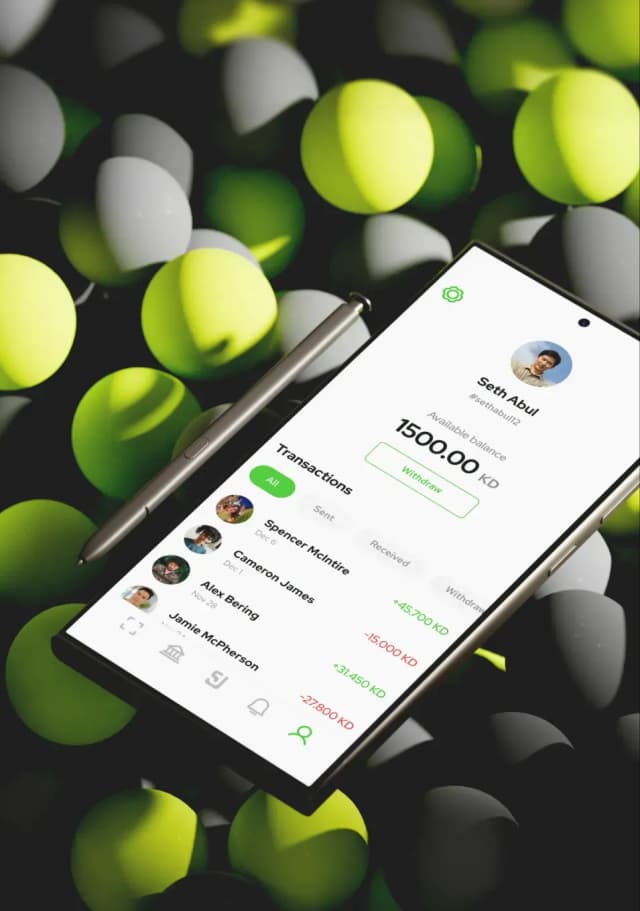
KEM — P2P Payment App, Kuwait
Situation: Online banking access in Kuwait isn't universal. KEM founders needed an MVP they could show to local banks to negotiate access to real banking APIs.
Action: We built a mobile P2P payment MVP with mocked transaction data — enough fidelity to demo the product, the user flows, and the integration shape that banks would need to support.
Result: KEM raised$1M seed roundfrom the Kuwait Investment Fund and international investors. The team then expanded with local Kuwait-based developers (a banking-licensing requirement) and is preparing a Saudi Arabia launch and a neobank built on the same product.
"The team delivered a polished MVP that helped us close our seed round and open conversations with Kuwaiti banks." —Seth Abel-Sadeq, CEO, KEM

KEM — P2P Payment App, Kuwait

Mobile banking app screen showing a primary Visa card and a list of bank cards from Kuwait.
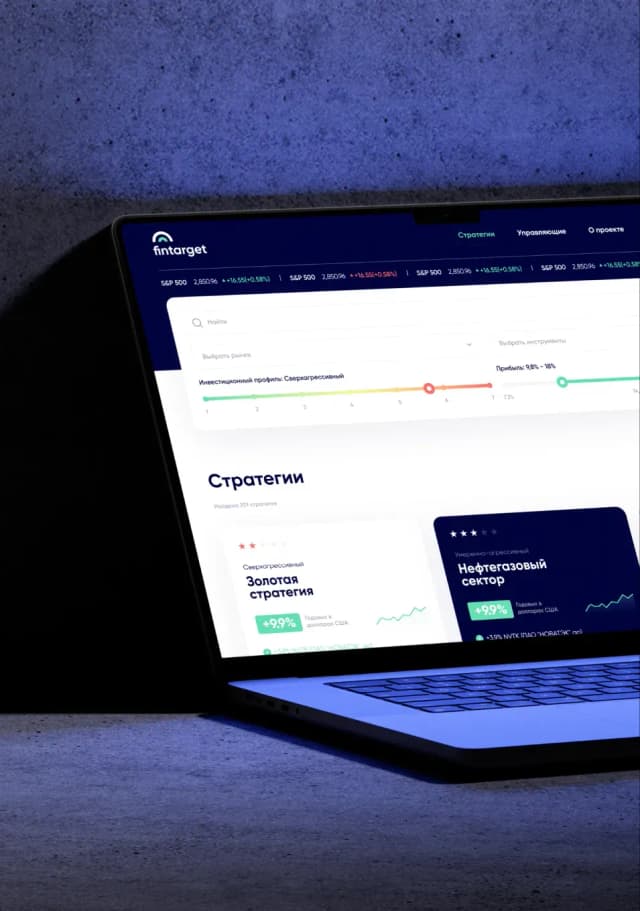
Fintarget — Investment Strategies Platform for BCS Broker
Situation: BCS Broker, one of the largest brokers in its market, was launching a new product line: a marketplace where investors could browse, select, and invest in strategies authored by BCS analysts and independent finance professionals.
Action: We designed and built the web platform — strategy catalog, search and filtering, investor cabinet with portfolio statistics, in-product knowledge base and FAQ.
Result: Platform launched (2019) as the new investment product channel for BCS Broker clients. The Fintarget case later attracted other fintech clients to Purrweb directly through Behance — including Pay-Pay (crypto e-wallet redesign).

Fintarget — Investment Strategies Platform for BCS Broker

Laptop screen showing Fintarget platform with investment strategies and risk slider set to 8 out of 10.
Kaiju — Crypto Wallet + Web3 Gaming App
Situation: Kaiju Labs (Singapore) faced the standard Web3 gaming problem: customer acquisition cost of $4–5 per user, far above traditional mobile games. They needed a UX that fused gameplay and a built-in crypto wallet so onboarding wouldn't drop users to external wallets.
Action: We delivered the UX design — send/receive crypto, QR transfers, bank-card top-up, WalletConnect, NFT gallery, daily reward wheel, and a leaderboard — all within a single in-game flow.
Result: Product launched, secured investment, and onboarded its first user cohort. Specific user metrics aren't public.
"We approached Purrweb for UX design for our app and were very pleased with the results." —Samira Nilupul, CEO, Kaiju Labs

Kaiju — Crypto Wallet + Web3 Gaming App

Smartphone displaying a colorful spin wheel game to win Kaiju Tokens and mystery boxes.
Other fintech projects in the portfolio: Broex (multi-currency crypto wallet, React Native + GraphQL) · Pay-Pay (crypto e-wallet redesign) · Budss (cashback app, Israel) · Dosis (streaming app with internal crypto wallet, Spain).

Engagement Models and Fintech Development Cost

Fintech software development cost depends on product type, compliance scope, third-party integrations, and platform targets (mobile only, web only, or both). Our development process is fixed-scope by default — we agree on milestones and budget before kicking off. Here are the ranges from our actual projects, not industry estimates.
Product Type
Typical Budget
Timeline
Notes
Fintech MVP (1 platform)
$30 000 - $70 000
3–4 months
Core flows only; 1 payment
gateway; basic KYC
Full mobile fintech app (iOS + Android)
$80 000 - $150 000
4–6 months
React Native; 2–3 integrations; compliance layer
Neobank / digital banking
platform
$150 000 - $300 000
6–9 months
Core banking API; multi-currency; KYC/AML; web + mobile
Trading platform / investment 
app
$200 000 - $500 000
9–12 months
Real-time feeds; brokerage API; regulatory reporting
Post-launch support (retainer)
from $2 500 / month
Ongoing
Bug fixes, monitoring, incident 
response

FAQ: Fintech Software Development

What types of fintech software solutions can you develop?

We build payment apps, neobank platforms, investment and trading dashboards, lending origination systems, digital wallets, DeFi interfaces, and KYC/AML compliance tools. All products are available as mobile (React Native), web (React/Next.js), or combined — depending on your user base and go-to-market timeline.

How do I choose between fintech software development companies?

Strong fintech software development companies share three traits: a documented compliance approach (not "we'll figure it out later"), real production fintech case studies on their site, and a fixed-scope engagement model. Avoid agencies that quote on an hourly basis without a discovery sprint — fintech projects with open-ended billing routinely overrun by 2–3×.

How much does it cost to develop a fintech app or platform?

Fintech software development cost ranges from $30 000–$70 000 for an MVP (one platform, basic integrations) to $200 000–$500 000 for a full trading or banking platform with multi-jurisdiction compliance. The largest cost drivers are number of third-party integrations, regulatory scope, and whether you need mobile + web or just one platform. We provide fixed-price estimates after a paid discovery sprint (1–2 weeks).

What security and compliance standards do you follow?

We design for PCI DSS Level 1 scope reduction, GDPR-compliant data architecture, and KYC/AML flow implementation using certified service providers (Onfido, Sumsub, Jumio). Every fintech project starts with a compliance mapping session that documents data flows, encryption requirements, and audit logging obligations before development begins.

What is the typical timeline for a custom fintech application?

A fintech MVP takes 3–4 months. A full mobile + web financial platform takes 5–8 months. A neobank or trading platform with regulatory compliance across multiple jurisdictions takes 9–12 months. Timelines are fixed at the discovery stage — we don't run open-ended sprints on fintech projects.

Do you work with early-stage fintech startups?

Yes. Roughly 70% of our fintech clients come to us pre-Series A. We have a fintech MVP development track specifically for early-stage teams: fixed scope, fixed price, 3–4 month delivery. For example, our MVP for KEM (a P2P payment app in Kuwait) helped the founders close a $1M seed round.

Can you integrate with banks, payment gateways, and third-party APIs?

We've integrated Stripe, Adyen, Braintree, Plaid, TrueLayer, Onfido, Jumio, Sumsub, Temenos, Mambu, and Stripe Treasury across live fintech projects. If your target API has public documentation, we can integrate it. Proprietary core banking APIs require a discovery sprint to assess scope.

Can you apply AI or machine learning to fintech applications?

We integrate pre-trained machine learning APIs for fraud detection (transaction risk scoring), credit scoring connectors, and AI-powered chatbots for customer support. For projects requiring custom model training, we bring in machine learning specialists as part of the extended team. Most fintech AI features we ship use Python (FastAPI) microservices connected to the main Node.js backend.

How does fintech software outsourcing work with Purrweb?

We run a 4-step process: (1) paid discovery sprint — requirements, compliance mapping, architecture design, $5 000–$10 000 fixed cost; (2) fixed-scope proposal with milestone payments; (3) development with weekly demos and Slack access to the full team; (4) launch + 3-month support period. You own all code and IP from day one.

Which fintech software development company is best for a startup in the USA?

When comparing fintech software development companies, US startups should weigh: US-timezone communication, experience with US payment processors (Stripe, Dwolla, Brex), familiarity with FinCEN AML requirements, and a track record of shipping compliant fintech products. Purrweb has delivered projects for US-based clients across payments, lending, and investment verticals — with PM availability during EST/PST business hours.

What is the difference between fintech app development and fintech software development?

Fintech app development typically refers to consumer-facing mobile applications (iOS/Android) — wallets, banking apps, investment dashboards. Fintech software development is a broader term covering web platforms, backend systems, API layers, compliance tooling, and back-office infrastructure — in addition to mobile apps. Purrweb covers both: /services/finance/ handles mobile-first projects; this page covers the full software stack.

What is the current state of the fintech industry in 2026?

The global fintech industry processed over $9 trillion in digital payments in 2025 (McKinsey Global Payments Report, 2025). Digital transformation is accelerating across the financial sector — traditional banks are rebuilding consumer-facing products on open banking APIs, while fintech startups are targeting underserved segments in lending, insurance, and cross-border payments. The key shift in 2026 is regulatory: the EU's MiCA framework for crypto assets is fully in effect, and US federal fintech licensing discussions are ongoing, making compliance a first-class engineering concern rather than a legal afterthought.

How do you handle legacy fintech systems modernization?

Legacy fintech systems modernization is a 4–8 month process depending on the complexity of existing integrations. We start with a technical audit of the current system — data models, API contracts, and third-party dependencies. Then we design a strangler-fig migration: new fintech services run in parallel with the legacy system, with traffic gradually shifted until the old infrastructure can be retired safely. No big-bang rewrites on production financial systems.

Ready to Build Your Fintech Platform?

Tell us your product type, target market, and compliance requirements.
We'll scope the project, map the architecture, and give you a fixed-price estimate within 5 business days.
No generic proposals. No offshore handoffs. A direct conversation with the team that will build your product.
4.9 on Clutch · 300+ projects shipped · 9+ years in mobile and fintech development