Explore

Need help with your project?

Oops! Something went wrong while submitting the form.
Healthcare products reach a point where the roadmap grows faster than the internal development team. An integration, a fixed launch date, or a regulated feature calls for expertise that is expensive to keep full-time. The harder question is how to keep control once an external team joins. Patient data, compliance decisions, product priorities, and the codebase all need clear owners.
In this guide, we'll talk about when healthcare software development outsourcing makes sense and which work can be handed over. We'll compare engagement models, partner assessment, contract terms, cost drivers, shared security responsibilities, and vendor governance after launch.
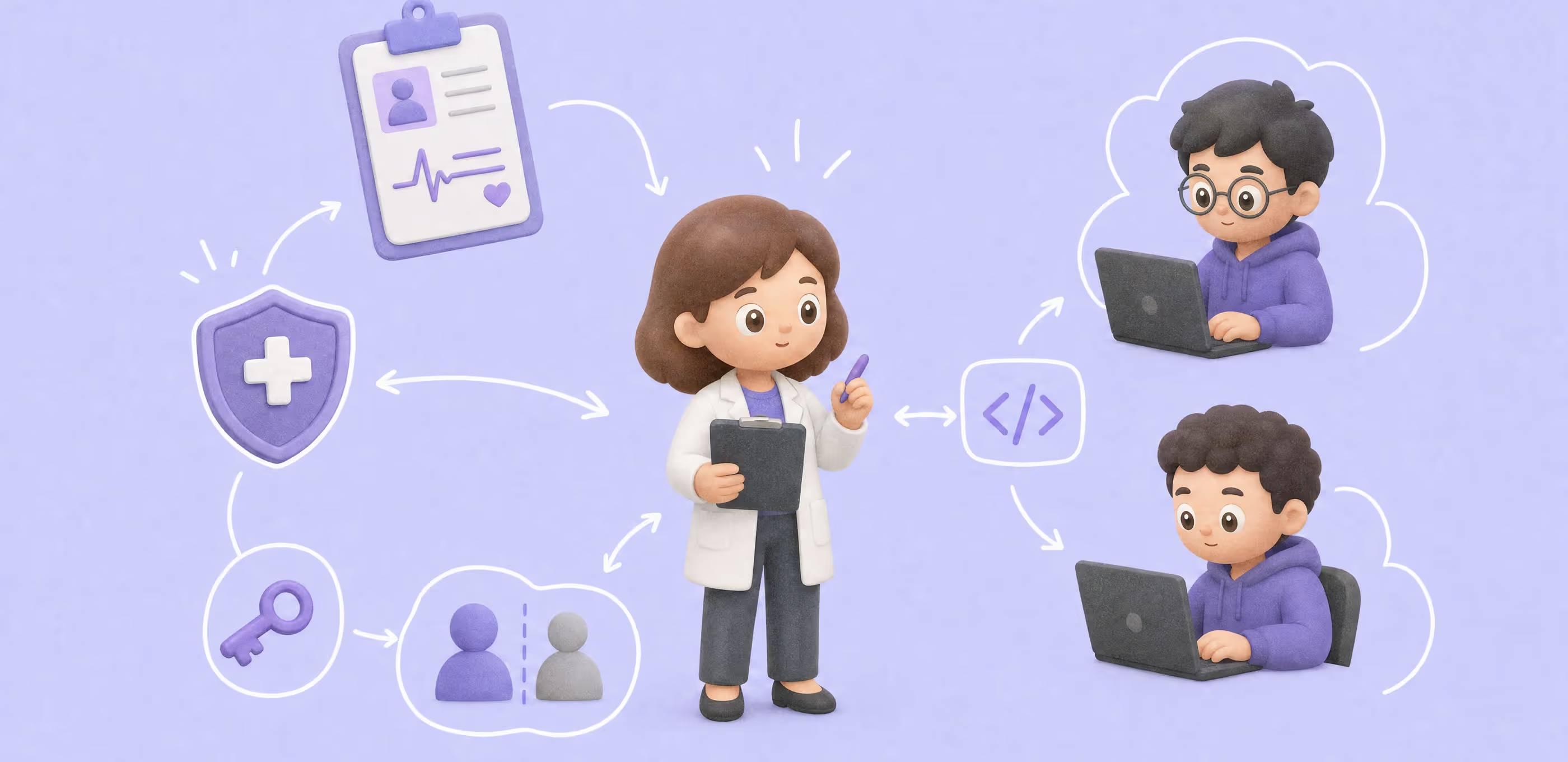
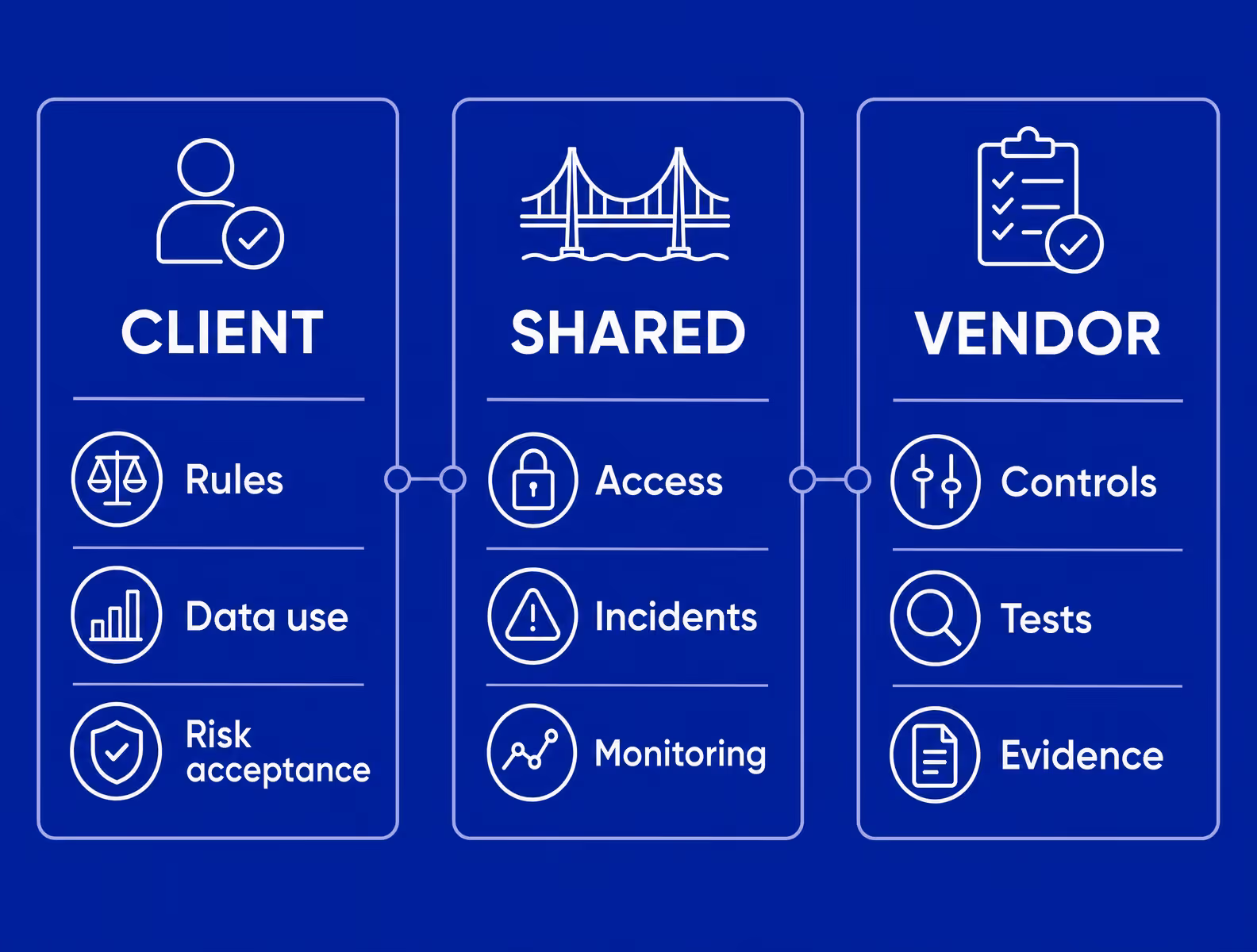
Healthcare software development outsourcing means assigning product delivery to an external team. The client retains authority over product goals, regulatory applicability, data governance, vendor oversight, and acceptance.
Outsourcing changes who performs work, not who owns decisions.
A provider of healthcare software development services may deliver a product or bounded workstream. The client still sets the intended outcome, applicable rules, data boundaries, and acceptance criteria.
| Model | Who directs delivery | What remains with the client |
| Outsourcing | The vendor manages an agreed scope and reports against milestones or service levels. | Product goals, applicable rules, data boundaries, acceptance, and contractual rights to code and handover materials. |
| Staff augmentation | Internal leaders assign and supervise the added specialists. | Day-to-day delivery management, architecture decisions, priorities, and acceptance. |
| Software as a service (SaaS) | The supplier owns the existing product and its roadmap. | Configuration, access policies, vendor assessment, and decisions about how the product is used. |
Software developers can handle engineering while the client retains product decisions, evidence review, and acceptance.
Contracts need to reflect that boundary. The next question is whether outsourcing fits the current project.
Outsourcing fits when the client has a clear outcome, an internal owner, and a temporary skills or capacity gap. It is a poor shortcut for unclear priorities, uncontrolled data access, or decisions nobody inside can make.
The question is whether the constraint sits in delivery or ownership. A fixed deadline, integration backlog, or temporary need for senior specialists points to delivery. An absent product owner, unstable priorities, or no acceptance process points to an internal gap a vendor cannot resolve.
| Signal | Outsource now | Prepare first | Keep in-house |
| Skills or capacity gap | Outcome, owner, access rules, and acceptance are clear. | Assign decision-makers and define the vendor’s role. | The capability is a permanent product differentiator. |
| Fixed launch window | A bounded release can move outside without transferring clinical or product decisions. | Stabilize priorities, dependencies, and acceptance criteria. | Safety or regulatory decisions would be rushed to meet the date. |
| Modernization or integration backlog | System owners, interfaces, and target data flows are known. | Inventory legacy dependencies and missing documentation. | Critical system knowledge exists only internally. |
| Governance readiness | Product and security owners can review evidence promptly. | Define safe access, review cadence, and escalation routes. | The organization cannot supervise access or assess delivered work. |
Someone inside still needs to answer product and risk questions, choose tradeoffs, and accept the outcome. Without those roles, paid discovery may fit better than full delivery.
An external team can deliver a healthcare solution or a bounded workstream. Product direction, clinical decisions, data governance, priorities, and acceptance stay with the client.
⭐Our experience.
Clearstep's founders came to us with a $1,500 budget and a concept for a healthcare app that would collect symptoms, ask follow-up questions through a chatbot, and guide users toward care.
Their immediate constraint was investor validation, not production engineering. We recommended outsourcing a focused design and prototype scope instead of spreading the budget across an incomplete build.
The design concept was accepted on the first try after two days, and the clickable prototype took about 1.5 weeks. The founders later raised $400,000.
The project shows that the right outsourced scope can be much smaller than the eventual product.
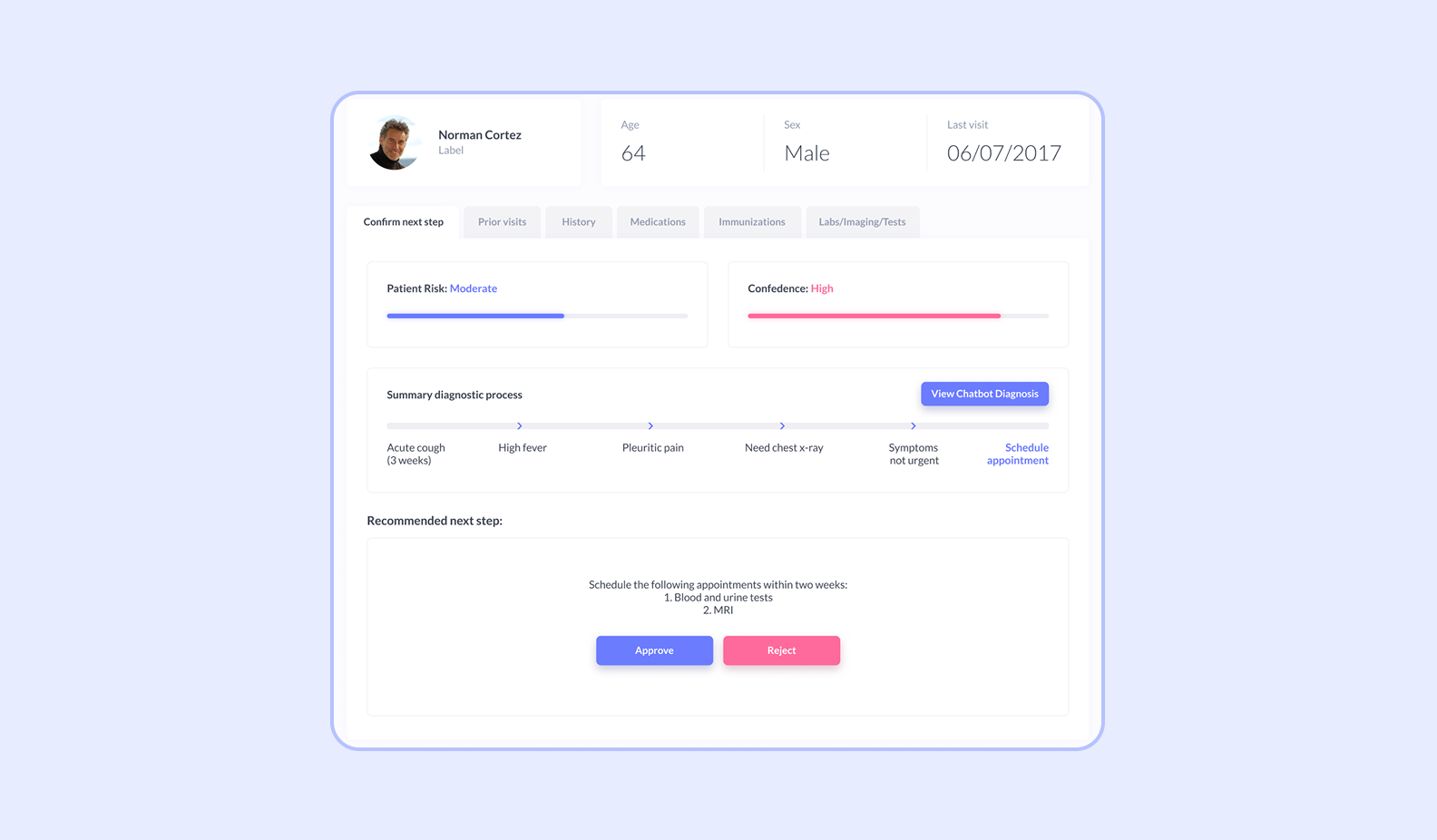
Healthcare projects usually divide into five practical scopes:
Our guide to medical software development covers product types in more detail. A bounded scope is easier to govern, price, and accept than an undefined request to “build the platform.”
The right engagement model depends on scope certainty and the amount of delivery control available inside the client team. Each model distributes planning, management, budget risk, and healthcare-specific oversight differently.
Most healthcare IT outsourcing decisions sit between two questions: how clearly can the work be defined, and who will direct the product development process each week? A stable scope favors a delivery commitment. An evolving roadmap needs a team that can adjust without renegotiating every task.
| Model | Best for | Client control required | Budget predictability | Main healthcare risk |
| Project-based | Stable scope and explicit acceptance criteria. | Low to medium. The client resolves product and regulatory questions. | High if assumptions and change rules are clear. | Evidence gets pushed into change requests. |
| Dedicated team | An evolving product roadmap. | Medium. The client owns priorities. | Medium. Capacity is stable while the backlog changes. | Weak product ownership turns flexibility into drift. |
| Staff augmentation | An internal team needing specialist skills. | High. Internal leaders direct daily work and architecture. | Medium to low as effort follows the backlog. | Responsibility fragments across teams. |
| Hybrid | High-risk work alongside a scalable delivery stream. | Medium to high, with ownership defined at each handoff. | Medium if the workstream boundary stays stable. | Evidence or ownership gets lost between teams. |
Onshore, nearshore, and offshore describe location, not engagement. More distance can expand the talent pool, but it requires stronger handoffs, documentation, access controls, and escalation. Any model can use any location.
Whichever model fits, the next step is the same. The client and vendor need to assign compliance, security, and interoperability responsibilities before delivery begins.
The client owns regulatory compliance decisions, applicable healthcare regulations, and data rules. The vendor implements controls and supplies evidence. Define ownership, proof, and monitoring before anyone receives production access or handles protected health information.
| Control or decision | Client owns | Vendor owns | Evidence required before signing |
| Legal scope and data flows | Rules, data classes, permitted uses, and risk acceptance. | Document processing, requested access, and control implementation. | Data-flow map, responsibility matrix, and draft BAA or DPA. |
| Security operations | Control requirements and escalation authority. | Access, encryption, logs, backups, and incident response. | Architecture, restore evidence, and incident test results. |
| Interoperability | Source-system owners and acceptance rules. | Data mappings, error handling, and integration tests. | Interface inventory, sample messages, and test plan. |
| Hosting and subcontractors | Approved regions, providers, and change rights. | Provider disclosure and equivalent downstream duties. | Hosting diagram, subprocessor list, and change-notice process. |
For US projects, the client identifies whether a vendor handles protected health information (PHI) as a business associate.
A business associate agreement (BAA) defines permitted use, safeguards, incident reporting, subcontractor duties, and data return or destruction. Our HIPAA compliant app development guide covers implementation in detail.
For European data, the client acts as controller and the vendor as processor. The data processing agreement (DPA) records instructions, security duties, assistance, subprocessor approval, and end-of-contract handling. It does not remove the controller's responsibility to select and oversee the processor.
Food and Drug Administration (FDA) applicability depends on what a software function does, not the product label. The client owns the intended use and regulatory strategy. The vendor preserves requirements, traceability, test evidence, and change records for that strategy.
Health Level Seven (HL7), FHIR, and Digital Imaging and Communications in Medicine (DICOM) are healthcare standards for data exchange. The client identifies source systems and data owners. The vendor documents mappings, failure handling, test environments, and acceptance evidence.
Security responsibilities extend through hosting and subcontractors.
Partners represented 4% of threat actors in the healthcare snapshot, making vendor access and subprocessor disclosure contract issues rather than procurement details.
The health-sector cybersecurity recommendations treat third-party technology as a systemic risk.
A healthcare software development company is credible when claims are supported by artifacts, named specialists, delivery data, and contract-ready controls. Screenshots and ratings do not prove that the proposed team can operate the agreed responsibility model.
Compare development companies through evidence, weighting healthcare delivery and security most heavily. Weaknesses there are difficult to repair after production access or architecture decisions.
| Criteria | Evidence to request | Red flag | Weight |
| Relevant healthcare delivery | A case with similar data, integration, or workflow constraints, including what changed when the plan failed. | No named challenge, decision, or outcome. | 20% |
| Security and compliance operations | Access model, incident process, control ownership, and test evidence. | Compliance claims without artifacts. | 20% |
| Architecture and interoperability | System diagram, integration example, failure handling, and test strategy. | Senior engineers appear only after signing. | 15% |
| Senior team and domain interview | A session with the proposed technical lead, analyst, and delivery owner. | Sales staff answer delivery questions. | 15% |
| Delivery metrics and governance | Release history, defects, estimate accuracy, escalation, and review cadence. | Activity replaces accepted outcomes. | 10% |
| References and outcome verification | A reference covering communication, changes, and handover. | Testimonials do not match the team or scope. | 10% |
| Subcontractors, IP, and exit | Subcontractors, repository access, ownership, documentation, and transition support. | Code access or handover is discretionary. | 10% |
The weights total 100%, but a critical failure overrides the score. Missing safe access or repository handover is disqualifying.
Relevant experience means similar constraints, not an identical app. Sensitive data, unreliable third parties, and multi-role workflows matter more than a copied interface. Our guide on how to find a software development partner covers the wider selection process.
A paid discovery or pilot tests assumptions through an artifact, working cadence, and response to disagreement before a larger commitment.
There is no reliable single cost to outsource healthcare software. Two vendors can quote the same project and arrive at very different numbers because they have priced different versions of the work.
A useful comparison starts by checking the assumptions behind each estimate. Six areas usually account for most of the difference:
Fixed price fits stable scope and explicit acceptance criteria. Time and materials fits an evolving backlog. A dedicated team buys predictable capacity, not a fixed result.
Discovery, audits, cloud services, licenses, changes, maintenance, and knowledge transfer may sit outside the headline estimate. Our healthcare app development cost guide breaks down product budgets. Compare proposals by inclusions and exclusions.
⭐Our experience.
For Medico, we designed a patient mobile app and a doctor web app around recurring health surveys. Lab results mattered, but surveys were the core workflow and a separate lab interface would have consumed budget without improving the first release.
We kept the handoff simple. Patients uploaded a PDF or photo, and doctors received a notification with direct access to the file. This preserved the clinical workflow without building a full laboratory module.
The case shows why cost follows scope decisions. A lower estimate does not always come from a lower rate. Sometimes the team removes work that does not serve the release.
A controlled outsourcing process does not move from a request for proposal (RFP) straight to a large contract. Each stage answers a risk question and produces an artifact that shows whether the project is ready to continue.
Document the outcome, users, data classes, intended use, integrations, and compliance assumptions. Product and security owners approve a one-page boundary. Do not issue the RFP while ownership or access remains undefined.
Turn the boundary into scope, deliverables, evidence, dependencies, and acceptance criteria. Product and technical owners approve one assumption set for every candidate.
Use the scorecard to retain candidates that pass access, ownership, and handover requirements. A presentation cannot replace a control model.
Meet the proposed technical lead and review architecture, integration, access, incident, and testing approaches. Require a written risk log with owners and open questions.
Test the riskiest assumption through a prototype, integration spike, or technical plan. Use the reviewed artifact to revise the delivery estimate.
Put scope, ownership, service levels, change rules, evidence, repository access, and exit terms into the contract. The legal and operating models must match.
Review increments against acceptance criteria. Before launch, transfer code access, documentation, credentials, support procedures, and the risk register. Product, technical, and operational owners accept the release.
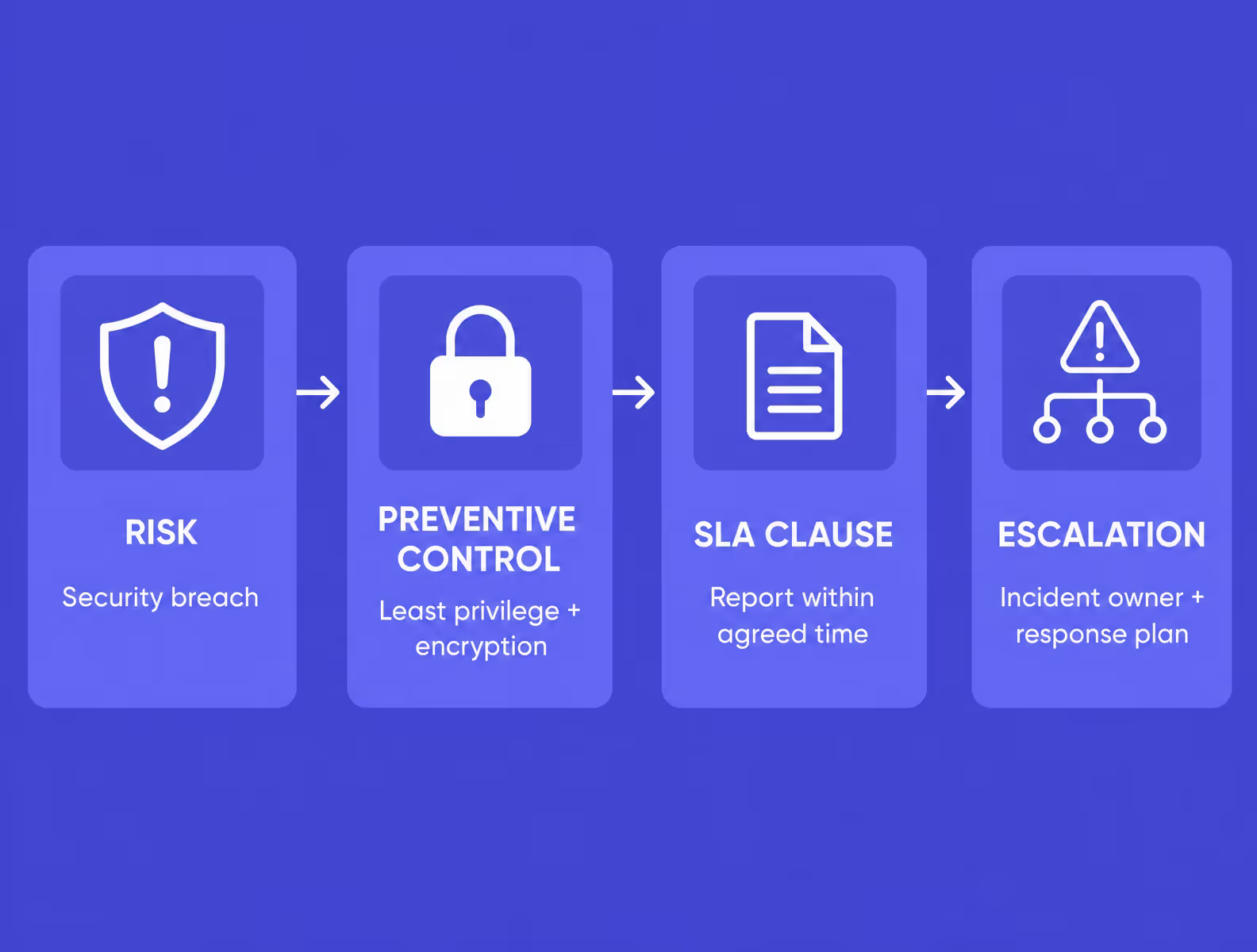
A useful contract connects each material risk to a preventive control, measurable service-level agreement (SLA) obligation, evidence, and escalation. Legal language cannot replace the operating process.
| Risk | Preventive control | Contract or SLA clause | Escalation trigger |
| Security breach | Least privilege, monitoring, backups, and incident response. | Notification, cooperation, evidence preservation, and recovery targets. | Confirmed exposure, missed notification, or failed restore. |
| Missed quality | Acceptance criteria, tests, review, and defect tracking. | Severity, correction windows, and release thresholds. | Repeated critical defects or failed acceptance. |
| Schedule drift | Dependency log, milestone reviews, and forecast updates. | Baseline dates, change rules, recovery plan, and reporting cadence. | Forecast exceeds the agreed tolerance. |
| Communication gaps | Named owners, decision log, overlap hours, and escalation. | Response windows and required decision-maker attendance. | An unresolved blocker exceeds the response window. |
| Vendor lock-in | Client repository, documentation, credentials, and knowledge transfer. | Ongoing access plus transition assistance at termination. | Access is restricted or documentation falls behind the release. |
| Key-person or subcontractor change | Role backups, onboarding records, and advance disclosure. | Approval rights and equivalent obligations for replacements. | An unapproved change affects a critical role or data access. |
Exit terms cover repository access, documentation, credentials, data return or deletion, transition support, and knowledge transfer. Defining them before launch avoids a new negotiation during termination.
⭐Our experience.
My Therapy Assistant needed an insurance integration with HealthCode. The available API documentation was outdated, and the service had no sandbox for testing payments.
Our team lead worked with HealthCode support to clarify the integration. Real payment paths still produced failures across insurers, so the team investigated them with the third-party provider and continued supporting the product after launch.
This is the kind of dependency a contract needs to anticipate. The vendor controls its own code, but not the third-party service. Ownership, test limitations, escalation routes, and post-launch support need to be explicit before the integration becomes critical.
The contract creates a baseline, not self-running governance. After launch, the client still reviews performance, evidence, dependencies, and exit readiness on a recurring schedule.
Post-launch governance keeps the responsibility model current after the project moves into support. A signed contract provides the baseline, but service performance, access, evidence, dependencies, and product priorities continue to change.
A review calendar keeps those changes visible without turning every meeting into an audit.
Review uptime, incidents, defect trends, support response, unresolved risks, and changes to privileged access. Product and service owners decide whether any issue needs a recovery plan or escalation. The output is an action log with owners and dates.
Check vulnerability and dependency updates, backup or restore evidence, audit logs, subcontractor changes, team capacity, and the next roadmap period. This reconnects operational health with product decisions, so security work does not sit outside delivery planning.
Confirm repository access, documentation, credentials, data-return or deletion procedures, and knowledge coverage for critical roles. Test whether another team could operate the system from the available materials. The exercise reveals hidden dependencies before renewal, even when the relationship is healthy.
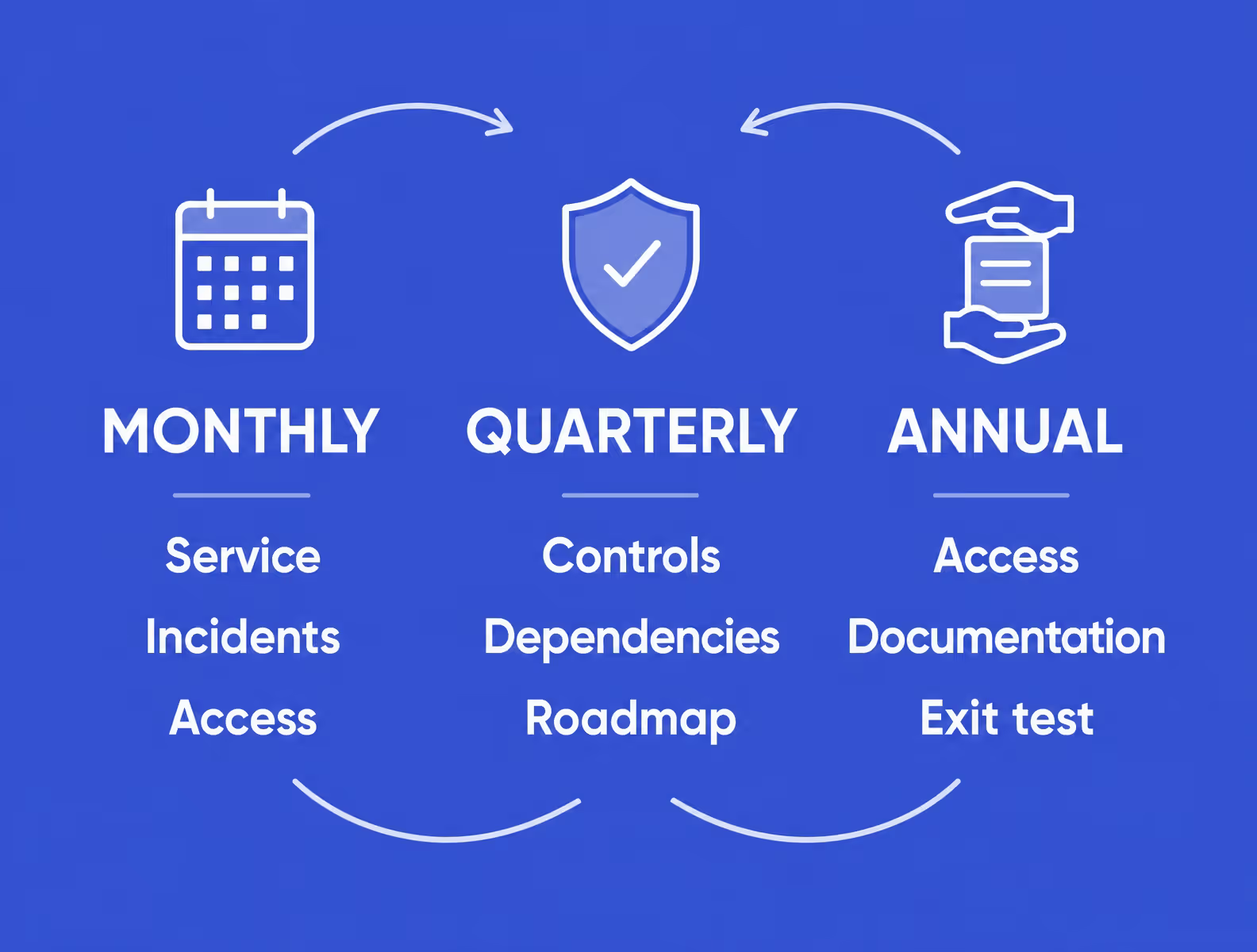
The vendor maintains agreed controls, reports evidence, and supports releases. The client reviews evidence, approves roadmap tradeoffs, controls data use, and decides whether service levels remain acceptable.
Support terms and source-code access need to be ready before launch, not negotiated after the first incident. Regular governance keeps those arrangements usable as the product, team, and risk profile change.
Outsourcing works when the delivery boundary is clear. The vendor can add capacity, specialist skills, and a managed development process. The client still owns product direction, regulatory applicability, data use, risk acceptance, and final approval.
That boundary should remain visible from the first RFP through post-launch support. Choose the model by the control available inside the client team. Compare vendors through evidence instead of claims. Put responsibilities, controls, service levels, repository access, and exit duties into the contract and operating process. Then review them on a recurring schedule as the product and risks change.
➡️ If you are defining an outsourced healthcare project, tell us what you are building. Purrweb can help shape the scope and delivery model before development starts.
Healthcare software development outsourcing is a delivery model in which an external company designs, builds, tests, integrates, or supports medical software for a healthcare organization. The client still owns product decisions, regulatory applicability, vendor oversight, and acceptance criteria, while the vendor is responsible for the contracted engineering work and documented controls.
Outsourcing is a practical option when the organization lacks specialized engineers, needs temporary capacity, faces a fixed launch window, or must modernize and integrate systems without building a permanent team. It is a poor shortcut when no internal product owner can make decisions, define priorities, review risks, and accept the delivered software.
It can be safe if the client verifies the vendor’s security program and assigns responsibilities before access is granted. Due diligence should cover data flows, least-privilege access, encryption, audit logs, incident response, backups, subcontractors, hosting, and evidence of applicable HIPAA or GDPR processes. A contract alone does not prove that controls operate effectively.
There is no reliable single price because cost depends on scope maturity, integrations, platforms, data migration, compliance obligations, security testing, team seniority, location, and support terms. Compare proposals by assumptions and deliverables, not only hourly rates. Budget separately for discovery, audits, cloud services, third-party licenses, change requests, maintenance, and knowledge transfer.
Choose a partner by reviewing evidence: relevant healthcare cases, references, architecture and security artifacts, interoperability experience, delivery metrics, senior specialists, subcontractor disclosure, and a realistic estimate. Run technical and security interviews, then use a paid discovery or pilot before a large commitment. The contract should secure code ownership, repository access, service levels, handover, and exit assistance.


.svg)