Explore

Need help with your project?

Oops! Something went wrong while submitting the form.
In 2026, digital banking is being reshaped by autonomous AI, embedded finance, and the move from legacy cores to cloud-native infrastructure. The banking industry no longer competes on who has an app, but on what that app can do without a human in the loop.

In 2026, digital banking is being reshaped by autonomous AI, embedded finance, and the move from legacy cores to cloud-native infrastructure. The banking industry no longer competes on who has an app, but on what that app can do without a human in the loop.
This article breaks down the ten digital banking trends that matter most in 2026. For each one, it covers what the trend means for the teams building these products, and what it realistically costs to act on.
Digital transformation in banking has stopped being a roadmap item and become a structural shift. If you’re building a banking product, that shift hits at the architecture level, not the interface. That is exactly where our mobile banking app development team works. Three forces drive it.
The ten trends below reflect where that pressure lands.
Each trend below changes the architecture of a banking product rather than its screens. The list runs from intelligence and distribution toward infrastructure, and closes on who the product actually serves. Every entry carries a short note on the stack and cost involved, which is where most trend roundups stop short.
Agentic AI is software that doesn’t just answer questions but carries out multi-step financial tasks on its own, from moving idle funds into a higher-yield account to disputing a fraudulent charge, all under preset guardrails rather than step-by-step human approval.
In 2024, the bar was a generative AI chatbot that could summarize last month’s spending. By 2026 that’s baseline. The shift is from AI that advises to AI that acts. A banking agent now monitors cash flow, predicts a shortfall weeks ahead, and proposes or executes a fix before the account holder opens the app. That moves the product surface itself, because the primary user is increasingly the agent rather than the screen.
What it means for your project: the stack centers on an LLM orchestration layer, a policy engine that bounds what the agent may do, and full audit logging for every autonomous action. Most teams build this as a hybrid and reach a controlled MVP in three to six months.
Embedded finance is the delivery of banking services, such as payments, accounts, and lending, directly inside non-financial products. A retailer or a SaaS tool can offer a branded bank account without ever holding a banking license. Banking-as-a-service, or BaaS, is the licensed infrastructure underneath, exposed through APIs, that makes embedded banking work.
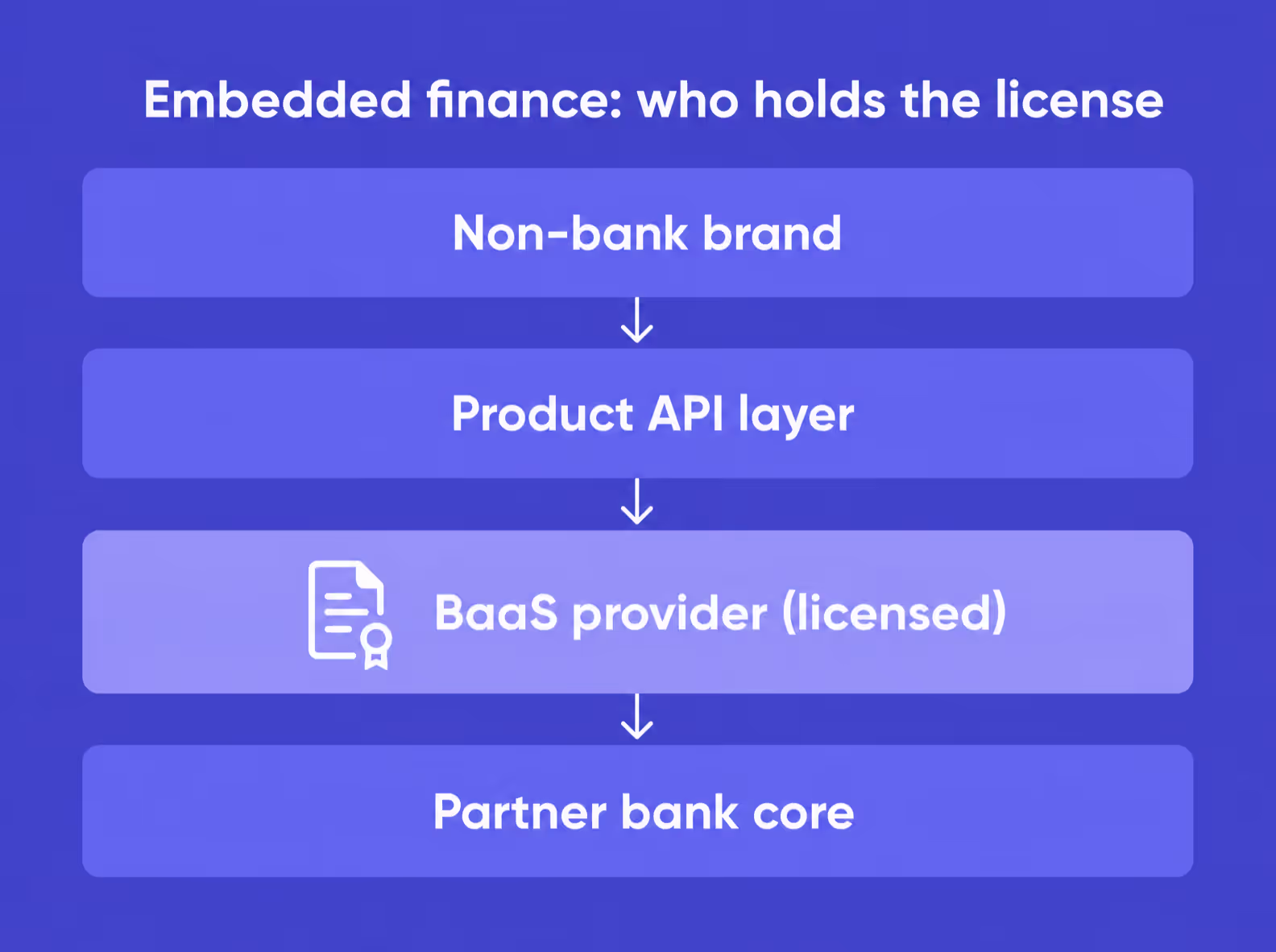
Embedded finance hides four layers behind one branded screen, and only the BaaS provider holds the license
The capital following this is hard to ignore. The fintech-as-a-service market is projected to grow from roughly $485 billion in 2026 to around $1.82 trillion by 2035. For incumbents, the real question is whether to stay the customer-facing brand or become the back-end utility behind someone else’s interface.
What it means for your project: this is mostly a buy decision. The common pattern pairs a BaaS provider for licensing and ledgers with a thin API layer your team owns for product logic. A focused MVP ships in 2 to 4 months.
Open banking is a framework in which account holders grant third parties access to their financial data, and sometimes the ability to initiate payments, through secure APIs and explicit consent. What began as a regulatory mandate in the EU and UK has become a default architecture pattern well beyond those regions.
The practical effect is that an open banking API now sits at the center of most new financial products. Account aggregation, income verification, and payment initiation stop being things a team builds from scratch and become services it connects to. API-first design has moved from a backend preference to a market position, because partners and embedded distribution both depend on clean, documented interfaces.
What it means for your project: in practice this is a buy-API decision. An open-banking aggregator absorbs the bank connections and compliance overhead, and a typical integration lands in one to three months rather than a multi-quarter build.
Hyper-personalization is the use of real-time behavioral and transactional data to tailor a banking product to each individual, rather than to a broad segment. The unit of personalization shrinks from a demographic group to a single account holder acting right now.
The shift in 2026 is from rules to signals. Static segments give way to models that read spending patterns as they happen and adjust offers, limits, and prompts in the moment. Retention mechanics ride on the same data. Gamification in banking, for instance, turns transaction history into challenges and rewards that keep a customer-centric product sticky without adding headcount.
What it means for your project: this leans on a real-time data pipeline, an event stream feeding a personalization service, and a feature store the rest of the product can query. Teams that already capture clean transaction events reach a working layer faster than those retrofitting analytics onto a legacy schema.
Cloud-native core banking is a core system built as independent, event-driven services running on cloud infrastructure, rather than a single monolith on fixed hardware. It replaces the decades-old ledger that still sits under most traditional banking.
The pressure in 2026 is competitive, not cosmetic. A polished app on top of a legacy core hits a ceiling the moment it needs real-time balances, instant payments, or per-second scaling. Cloud computing in banking is what lets a product team ship a feature in days instead of quarters. The trade is depth of change against time, since this is the slowest trend on the list to act on.
What it means for your project: this is a build-or-migrate decision, not a buy. The pattern is microservices, an event-driven backbone, and incremental migration off the old core rather than a single cutover. Realistic timelines run twelve to twenty-four months.
Biometric security is authentication based on a person’s physical traits, such as a fingerprint or face, instead of a password the account holder has to remember and an attacker can steal. Invisible fraud prevention is the layer behind it that scores risk on every action without interrupting the user.
In 2026 the two work together. The login becomes a glance, while a risk engine watches device, location, and behavior in the background and steps in only when a signal looks wrong. Privacy sits at the center of the design, because biometric data carries more weight than a credential anyone can reset.
What it means for your project: the stack pairs on-device biometric APIs (Face ID, Touch ID, Android equivalents) with a server-side risk and KYC layer. Identity vendors carry the heavy compliance, so the work is integration rather than invention. Most teams add this in weeks, not months.
We built Broex, a multi-currency crypto wallet aimed at first-time users, on React Native. The product needed bank-grade trust without a clumsy sign-in, so security had to stay out of the user’s way.
In the project, we developed biometric login with Face ID and Touch ID on iOS, and handled identity checks through a SumSub KYC integration instead of building verification from scratch. The wallet launched in stages, with core flows first and biometrics in a later release once the foundation was stable.
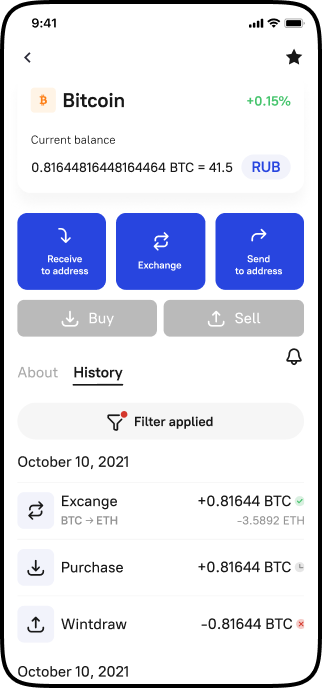
Biometric login went live in a later release, once the core wallet flows were stable
Real-time payments move money between accounts in seconds, around the clock, with no batch delay. Next-gen digital wallets are mobile wallets that go past storing a card to become the main place a person holds, spends, and moves money.
The shift in 2026 is toward account-to-account rails and instant settlement as a default expectation rather than a premium feature. Mobile wallets absorb functions that used to live in separate apps, from peer transfers to bill splitting, and the card slowly recedes behind the wallet interface. For many users, the wallet is now the bank, and the underlying financial transactions never surface as a separate step.
What it means for your project: the pattern is buy the rails, build the experience. Payment infrastructure and tokenization come from a provider, while your team owns the wallet flows, the transaction feed, and the security layer on top. Most teams reach a working mobile payment wallet in two to four months.
A neobank is a digital-only bank that runs entirely through an app, with no branch network behind it. A super app bundles many services, financial and otherwise, into a single interface, so one login covers payments, savings, credit, and more.
The 2026 story is convergence. Neobanks chase full banking charters, established wallets add lending and savings, and the line between a digital-only bank and a financial super app keeps thinning. The teams that win treat the app as a hub other services plug into rather than a fixed menu, which is mostly a foundation problem. Our guide on how to build a neobank walks through what that base needs.
What it means for your project: lean on a BaaS layer for the banking core, and design the product as modular services around it. That keeps each new offering an addition rather than a rebuild.
We built CryptoWallet, a cross-platform wallet for people new to crypto, as the first piece of a larger product the founders planned around crypto education.
When the team asked for manual NFT import and token deletion up front, we suggested shipping the core wallet first and adding those during testing. That kept the scope tight and hit the deadline, with the extra features layered in once the foundation held. A team of five, one PM, one designer, two developers, and a tester, ran the build.

The wallet shipped as an MVP first, with NFT features added during the testing phase
RegTech is technology that automates regulatory work, from identity checks (know your customer, or KYC) and anti-money-laundering (AML) screening to the reports a regulator expects. Automated compliance means those checks run continuously in the background instead of as periodic manual reviews.
In 2026 this stops being optional. As embedded finance and open banking spread financial services across more products, the compliance surface grows with them, and manual review cannot keep pace. Regulatory compliance becomes something a product handles per transaction, in real time, rather than per audit. Done right, it also speeds onboarding instead of slowing it.
What it means for your project: the work is integration, not invention. Identity and screening vendors carry the certified compliance, and your team wires KYC and AML flows into onboarding and monitoring. Built in from week one, this adds weeks rather than the months a late retrofit costs.
Sustainable banking ties financial products to environmental and social goals, often grouped under ESG (environmental, social, and governance) criteria. Inclusive banking aims to reach people that the traditional system leaves out, the unbanked and underbanked who have no account or only partial access to financial services.
In 2026 these stop being side projects. Mobile-first products reach segments a branch network never could, and financial literacy tools built into the app turn first-time users into active ones. On the sustainability side, carbon-footprint tracking on spending and transparent ESG reporting move from marketing add-ons toward features customers actually check. The two threads meet in the same place: a product that widens who banking serves and shows its impact honestly tends to earn trust faster than one that competes on rates alone.
What it means for your project: most of this is a data and design problem, not a licensing one. Spending categorization, an emissions data source, and clear in-app education cover the core, and a working layer ships in weeks.
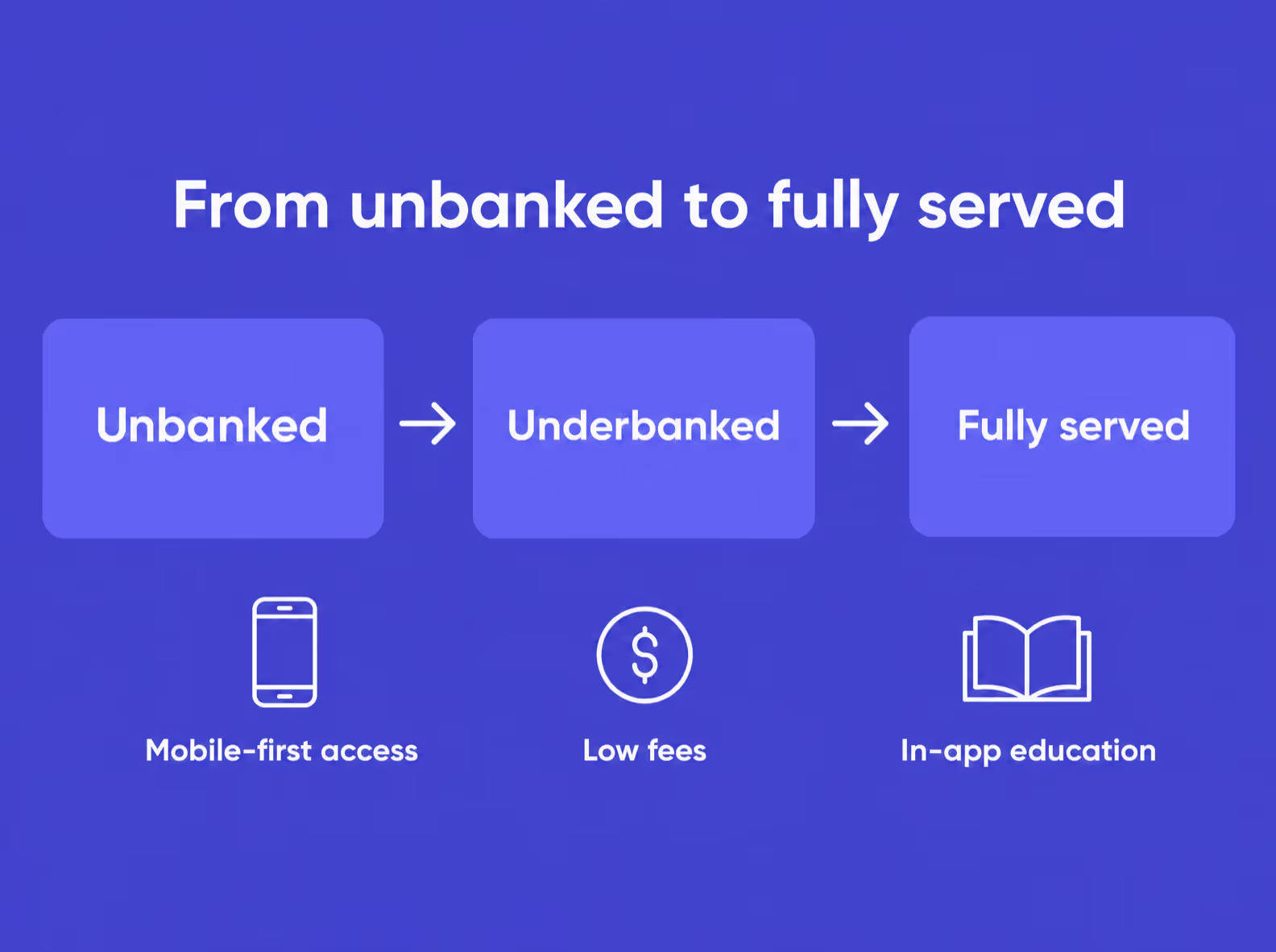
Mobile-first products move people from no account to fully served, a market traditional branches never reached
Most roundups stop at naming a trend. The harder question is what each one costs in money, stack, and time. The honest answer depends on a single upstream decision: build or buy. Buying infrastructure trades control for speed. Building it trades months for a tailored product.
The table below maps that decision across all ten trends, with how much it would take to implement into an MVP.
| Trend | Build vs buy | Typical stack | MVP timeline |
| Agentic AI | Hybrid | LLM orchestration + guardrails + audit log | 3–6 months |
| Embedded finance / BaaS | Mostly buy | BaaS provider + API layer | 2–4 months |
| Open banking | Buy (API) | Open-banking aggregator | 1–3 months |
| Hyper-personalization | Build | Real-time data pipeline + feature store | 2–4 months |
| Cloud-native core | Build / migrate | Microservices, event-driven | 12–24 months |
| Biometric security | Buy + integrate | On-device biometrics + risk/KYC layer | Weeks |
| Real-time payments / wallets | Buy rails, build UX | Payment provider + tokenization, custom flows | 2–4 months |
| Neobanks / super apps | Buy core, build modular | BaaS core + modular services | 4–6 months |
| RegTech | Buy + integrate | KYC/AML vendor integration | Weeks |
| Sustainable / inclusive | Build | Spending categorization + emissions data + education | Weeks |
Two patterns hold here. The buy-heavy trends reach a working MVP in a quarter or less, because a provider carries the license while your development team owns only the product layer, which matters when early market share is the prize. The build-heavy ones can take years rather than months and reshape the business model completely.
As a rough frame, a custom fintech MVP on one platform runs $30,000 to $70,000, while a full banking platform with multi-jurisdiction compliance lands closer to $200,000 to $500,000. For a closer breakdown, see our guide on fintech app development cost.
We redesigned Pay-Pay, a crypto e-wallet whose owner came to us with a working app built on an off-the-shelf template that gave it no identity of its own.
Rather than rebuild everything at once, we started from a lean scope to test demand, then expanded into a full custom interface once the product proved out. We delivered three UI concepts, built a detailed mind map from calls with the owner, and handed a finished UI kit to their in-house development team to implement.
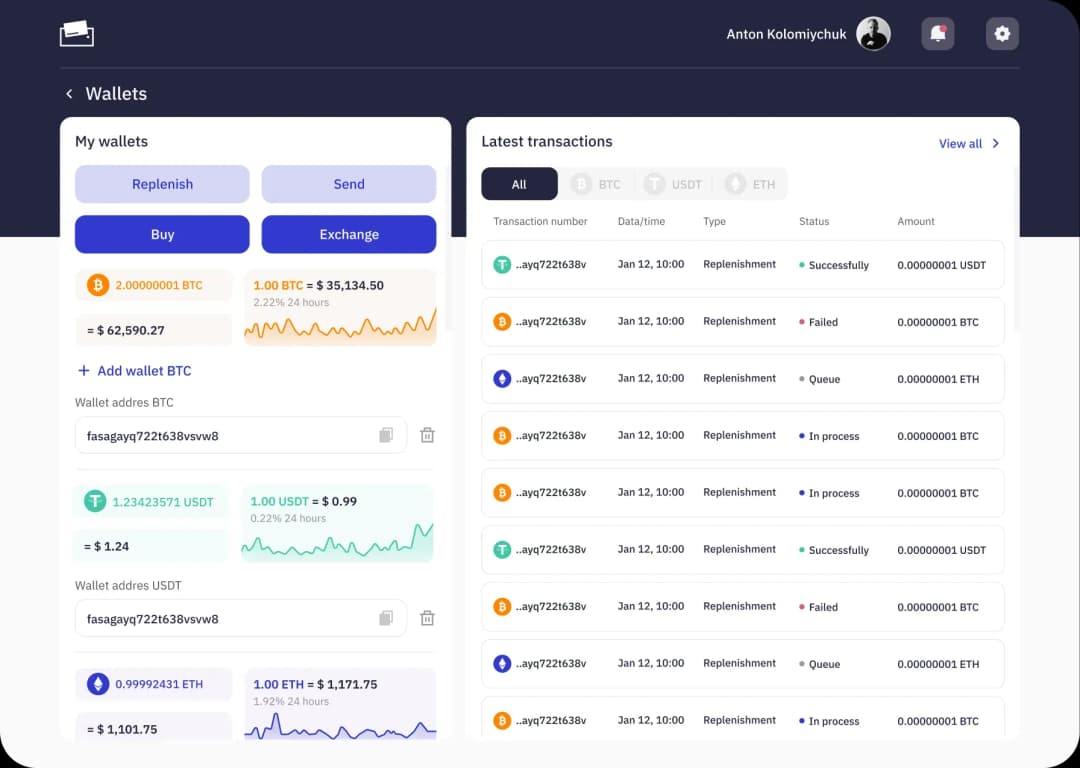
Starting from a lean scope kept early costs down before the full redesign
The same trend list reads differently depending on where you start. A startup building from scratch has one real advantage: no legacy core to unwind. That argues for going cloud-native and leaning on BaaS from day one, buying infrastructure rather than building it, and treating these trends as the default architecture instead of a migration. The trap is chasing all ten. The teams that move fastest pick the two or three that fit their core idea and ship those.
For an established bank, the constraint flips. The systems already in place, plus a base of existing customers, rule out a clean rebuild. Here digitalization runs in stages: embedded finance opens new distribution, open banking keeps the product relevant, and the old core migrates piece by piece. The hard part is sequencing, not technology.
The trend list for 2026 is long, but acting on it comes down to a few decisions: where you start, what you buy, and how many trends you actually chase. Most are a buy decision you can ship in a quarter, so do the research and keep a couple that your audience will truly need. The teams that move fastest aren’t chasing every trend. They picked the right few and shipped.
➡️ If you’re weighing which of these trends to act on first, we can map them to your product and budget. Fill in the form and get a free project estimate within 48 hours.
The defining shifts are agentic AI that acts on a user's behalf, embedded finance delivered through banking-as-a-service, open banking through APIs, cloud-native core modernization, and real-time payments with next-generation digital wallets. Together they move banking from screens toward infrastructure.
Embedded finance puts banking, such as payments, accounts, or lending, inside non-financial products. A bank implements it by exposing licensed infrastructure through APIs, or a non-bank adds it by integrating a banking-as-a-service provider that carries the license and ledger underneath.
AI started with chatbots and spending summaries. Agentic AI goes further, carrying out multi-step tasks on its own under set guardrails, from responding to fraud to moving idle funds. It also drives real-time personalization and risk scoring across the product.
Open banking lets account holders grant third parties access to their financial data, and sometimes payment initiation, through secure APIs and explicit consent. For developers, account aggregation, income verification, and payments become services to connect to through an aggregator rather than build from scratch.
Digital banking is the umbrella for any banking delivered through digital channels. Online banking is the subset accessed through a web browser. Mobile banking is the subset delivered through a smartphone app. For most users, mobile is now the primary channel.
A custom fintech MVP on one platform typically runs $30,000 to $70,000, while a full banking platform with multi-jurisdiction compliance lands closer to $200,000 to $500,000. The biggest cost driver is the build-versus-buy decision, followed by compliance scope.
BaaS is licensed banking infrastructure, accounts, payments, and cards, exposed through APIs so a product can offer banking without its own charter. Startups usually should: it trades some control for speed and removes the licensing burden. A custom core fits only at scale.
A typical stack layers a cloud-native, microservices core, often a BaaS provider, under an API layer, with open-banking aggregators for data, identity and KYC vendors for compliance, and an AI layer for personalization and fraud. The product team owns the experience on top.


.svg)