Explore

Need help with your project?

Oops! Something went wrong while submitting the form.
Customers expect their banking app to improve every week, the way a neobank's does. But releases at most banks still move in quarters, and every deploy risks breaking an audit trail or a compliance control. DevOps in banking is the way out of that bind. It merges development and operations into one continuous flow, so a bank ships software faster while keeping every change secure and auditable.

This guide covers how banks make that shift and what it takes to defend the decision. You'll see the CI/CD practices behind faster delivery, the DevSecOps controls regulators expect, and the costs, tools, and metrics that show whether it's working.
DevOps is the practice of merging software development and IT operations into one workflow, run by joined-up development and operations teams. It automates the path from a developer's machine to production, running build, test, and release steps instead of manual handoffs. That transforms how often a bank can safely ship.
Continuous integration merges and tests every code change as it lands. Continuous delivery keeps that tested change ready to ship on demand.
In a bank, the same loop carries extra weight. A generic tech company optimizes for speed. A bank optimizes for speed a regulator can still trace. So every automated step records who changed what, when, and who signed off. Every release also runs through compliance and security checks before it reaches a customer.
For a product owner, the takeaway is simple. DevOps in banking is not a tooling project for the engineering team, and it applies to any financial institution, not just a retail bank. It is what lets the business ship a new feature in days, survive an audit without a fire drill, and treat a production release as routine instead of a risk event.
The pressure to adopt DevOps in the banking sector comes from the business side, not the engineering side. Four forces push in the same direction across banking and financial services.
The first is faster time-to-market. Financial technology (fintech) challengers and neobanks release features continuously, and customer expectations now form around that pace. A bank that ships a redesigned onboarding flow two quarters after a competitor has already lost the customers who compared them.
The second is the cost of downtime. In a manual release process, a bad deploy can take a core banking service offline for hours. Every hour carries real revenue loss, support cost, and reputational damage. Automated rollbacks turn a multi-hour incident into a few minutes.
The third is customer experience. People judge a bank by its digital banking app now, not its branch. Frequent, low-risk updates let a bank fix friction in its banking services and add features while the memory of the complaint is still fresh.
The fourth is regulatory and competitive pressure combined. Digital transformation programs across the banking industry have made "we move slowly because we're a bank" an unconvincing excuse. That is especially true when a legacy system is the real bottleneck. DevOps turns that transformation from a slide deck into shipped software.
The gains from DevOps in banking are measurable, which matters when you have to defend the budget. Automation removes the manual steps between a finished code change and a live release, so deployment happens more often and with less risk.
Teams ship new features in smaller batches, roll back fast when something breaks, and streamline repetitive release work. Automation like this accelerates delivery without adding risk.
The payoff is better operational efficiency and a process that scales as the product grows, so scalability stops being a launch-day surprise.
The industry has a standard scorecard for this, the four DORA metrics. They are deployment frequency, lead time for changes, change failure rate, and time to restore service after an incident (MTTR, or mean time to recovery). Tracking them is part of what site reliability engineering (SRE) brings to a bank.
Together they answer the real question, whether faster releases are also safer ones. Google's 2025 DORA report found that more than 80% of teams say AI has raised their productivity. But it also warned that pushing delivery speed up can drag stability down unless automated testing and rollback keep pace. That balance is the whole game for a bank.
Speed like that is not reserved for greenfield fintech startups.
We built Kem, a peer-to-peer payment app for the Kuwaiti market, where many people had little access to easy online transfers. The product had to move money fast and stay secure on every transaction.
The constraint was timing. The founders needed to show banks a working product before they could get real API access. So we shipped a functional MVP in about two months by building against a mock-up API. That let them demo live money movement and win the bank partnerships a full launch depended on.
A bank's CI/CD pipeline is the assembly line that turns a code change into a released feature without a person carrying it by hand between steps. Its shape matters for one reason. It shows you where speed comes from and where control lives.
The flow is consistent across most DevOps practices. It starts in version control, where a developer commits a change. Continuous integration builds it and runs automated tests. Security and compliance checks run next, on the same pipeline.
If everything passes, continuous delivery stages the change, and a deployment goes out through controlled, repeatable steps instead of a late-night manual push. Monitoring then watches the live service, which is what site reliability engineering formalizes, and can trigger an automatic rollback.
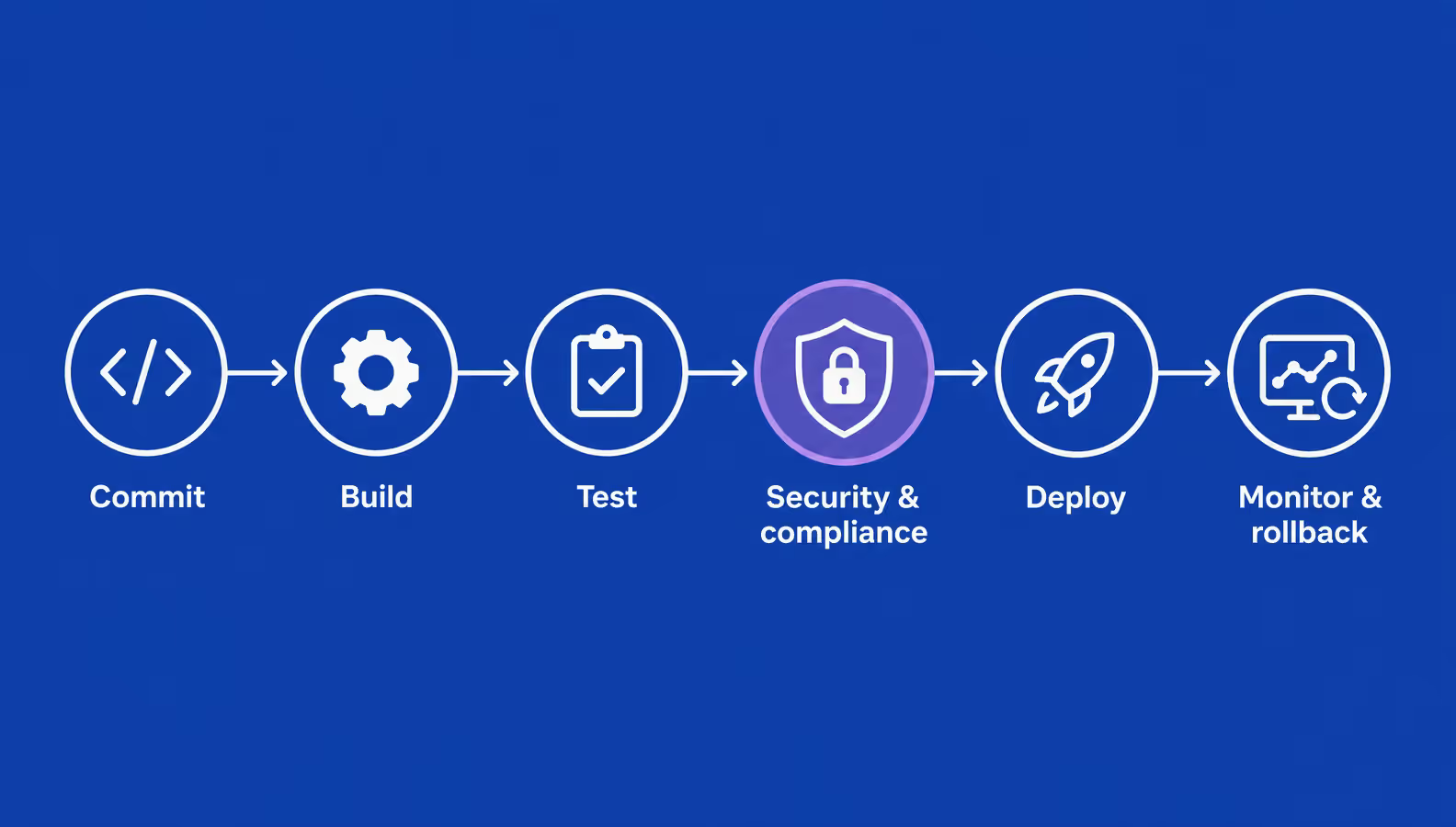
In a bank, the security and compliance gate sits inside the pipeline, not after it
What makes this a banking pipeline, rather than a generic one, is where the security and approval gates sit. They live between development and deployment, inside the flow, not bolted on afterward. That integration is also the hard part. Building deployment pipelines that satisfy an auditor while still moving fast takes experience most in-house teams are still acquiring.
That is where a specialized fintech software development company earns its place. The wider development process around the pipeline, from architecture to release, is covered in our guide to banking software development.
For a bank, the strongest case for DevOps is not speed. It is control of regulatory risk. A failed audit, a data breach, or an outage can bring fines, revoked licenses, and lost enterprise deals. Regulatory compliance is a board-level concern, not an IT footnote.
The bar rose again in 2025. The EU's Digital Operational Resilience Act is a regulation on ICT risk management for financial services firms across the financial sector. It has applied to banks since January 2025, and it adds formal requirements for how they manage and recover their systems.
DevSecOps closes that risk. It integrates security into the pipeline instead of leaving it as a final gate before launch. The industry term is "shift-left", meaning security checks run early and on every change.
In practice a bank's pipeline runs several checks, increasingly with AI helping the review. Static and dynamic application security testing (SAST and DAST) scan the code and the running app for flaws. Software composition analysis (SCA) checks open-source dependencies. Secrets-scanning stops passwords or keys from ever reaching a repository.
Policy-as-code turns compliance requirements into automated checks the pipeline enforces against your security standards. It maps those controls to the compliance standards a bank reports on, and keeps data security consistent on every release. Every build leaves an automated audit trail showing what changed and who approved it. Sensitive financial data and customer information privacy stay protected because security teams define the controls once.
| Compliance framework | Business risk if it's missed | DevSecOps control that removes it |
| PCI DSS | Fines, revoked card-processing rights | Secrets-scanning, encryption defined in infrastructure as code, segregation of duties in CI |
| SOC 2 | Lost client trust, stalled deals | Automated audit trails, policy-as-code, approval gates |
| Digital Operational Resilience Act (EU) | Regulator sanctions, mandatory downtime reporting | Automated rollback, monitoring and observability, change management |
| GDPR / FFIEC | Fines for an information privacy breach | Data-masking in test environments, access control in the pipeline |
GitLab's 2025 Global DevSecOps report found that 76% of teams discover more compliance issues after deployment than during development. That is the slow and expensive way to find them.
Wiring security and compliance checks into the pipeline reverses that order and meets regulatory requirements before code ships, not after. For the controls specific to financial products, our guide to fintech cybersecurity best practices goes beyond pipeline security alone.
Broex is a multi-currency crypto wallet we built on React Native, wired to the client's backend over GraphQL and shipped under a European license. Because the license set a high bar from day one, security was designed in, not retrofitted.
Identity checks run through the SumSub KYC SDK, and login uses Face ID and Touch ID. The app validates data on the client side because we worked against a backend we did not write. It handles up to 10,000 transactions a day and went live on both app stores without a post-launch security rewrite.
Adoption is where most banks stall, and the barriers are rarely about tools. Four of them come up on almost every project, and each has a known way around it.
None of these is solved by buying a tool. Implementing DevOps in banking is an organizational change first. Integrating DevOps into a regulated shop means shortening development cycles deliberately, with the business sponsoring the change, not engineering alone.
The honest answer to "what does this cost" is that it's an investment with a lag, not a line item. The cost of a DevOps implementation falls into three buckets:
The benefits of DevOps land on the other side of that spend:
Return on investment (ROI) is not a single payback date here. It's the point where operational efficiency gains and avoided incidents together outweigh the run cost of the pipeline. For banks that adopt DevOps seriously, that crossover tends to arrive in quarters rather than years, though the exact curve depends on how much legacy you carry in.
Once a bank commits to DevOps, the next decision is who runs it. There's no universal answer, only a fit to your situation. A few criteria settle it:
Kaiju is a crypto wallet we built for a Singapore Web3 team in two months, start to finish. Several integrations (send and receive, QR transfers, card top-up, WalletConnect, and an NFT gallery) all had to live inside one secure in-app flow instead of bouncing users out to outside services.
A partner absorbed that complexity on a tight timeline, and the wallet launched, secured investment, and onboarded its first users on that build, without trading away security for speed.
Most banks land on a mix. They keep governance and core operations in-house. A partner stands up the pipeline, brings agile and DevOps practices, trains the DevOps team, and proves the model on a single product before scaling it wider. That hybrid is what enables financial institutions to adopt DevOps for banking, and DevOps in financial services more broadly. It avoids pausing the roadmap for a full year of hiring, and it keeps ownership of the outcome where it belongs, with the bank.
The question a bank should ask is not "which tool is best" but "which tool fits our constraints". For a regulated institution, three criteria outrank features.
Hosting model comes first. Can the tool run self-hosted, so sensitive data and build logs stay inside your own environment instead of a vendor's cloud?
Auditability and access control come next. The tool should record who ran what, enforce approvals, and support least-privilege access, because that's exactly what an auditor asks to see.
Integration decides the rest. A tool that fits the source control and cloud you already run lets automation span the whole flow instead of stopping at a tool boundary.
Against those criteria, the common choices line up like this:
| Tool | CI/CD role | Self-hosted / compliance fit | When it fits a bank |
| Jenkins | Open-source automation server for build and deploy pipelines | Fully self-hosted, maximum control | You want full control of the environment and have the team to maintain it |
| GitLab CI | CI/CD built into the GitLab platform | Self-managed or SaaS, self-managed suits regulated data | You want source control, CI/CD, and security scanning in one auditable place |
| GitHub Actions | CI/CD wired into GitHub repositories | Mainly SaaS, self-hosted runners available | Your code already lives in GitHub and you want fast setup |
| Azure DevOps | End-to-end pipelines plus boards and artifacts | SaaS with enterprise controls, or on-prem server | You run on Microsoft Azure and need enterprise governance |
None of these is the winner. The right pick depends on your hosting rules, your existing platform, and how much of the pipeline you want in one place. What matters more than the brand is fit. Your choice should support the deployment strategies and modern DevOps practices your banking applications actually need, and integrate cleanly from commit to production.
The hardest part of DevOps in a bank is rarely the new code. It's the old code. A core banking system running on a mainframe or a monolith is legacy infrastructure. It was never designed for frequent, automated deployment, and a big-bang rewrite of that legacy system is how banks end up with outages and blown budgets. The safer path is phased, and the sequence matters more than the speed.
The infrastructure choices underneath this, especially the move to cloud-native, are their own decision. Our guide to cloud computing in banking covers that side. The DevOps point here is narrower. Migrate in slices, keep each slice releasable, and never bet the bank on one cutover.
Look toward 2026 and the change in DevOps for banking is mostly about AI moving deeper into the pipeline. AI already writes and reviews code. It's spreading into testing, anomaly detection, and AIOps, where models watch production systems and flag incidents before a human would. Compliance automation comes next, with AI tools that check policy and assemble audit evidence on their own.
For a bank planning an investment, the useful signal is the caution inside the hype. The same 2025 DevSecOps research that shows near-universal AI adoption also found that only 37% of teams would trust AI to run day-to-day work without human review. In a regulated environment, that number is the whole point.
AI will play a larger role in modern DevOps practices and speed up digital transformation across the future of banking. But DevOps will play the balancing part, keeping a governed pipeline and the humans accountable for a release, rather than letting AI replace them.
Routine operations are automating the same way across the sector, which we cover in our guide to RPA in banking. The future of DevOps here is human-supervised automation, not autopilot.
DevOps in banking succeeds when it's treated as a business decision, not an engineering upgrade. The banks that get value from it start with one thing, the outcome they want, faster releases that stay auditable. Then they work backward to the pipeline, the controls, and the team model that deliver it.
From there the pattern is consistent. They wire compliance into the flow instead of bolting it on, migrate legacy systems in slices, and keep humans accountable even as AI takes on more of the routine work. The tooling matters less than the discipline around it.
➡️ The move is significant but well-mapped, and you don't have to make it alone. If you're weighing DevOps for a banking or fintech product, contact us for a free, no-strings project estimate within 48 hours.
DevOps in banking merges software development and operations so a bank can build, test, secure, and release software in one continuous flow. It brings faster releases while keeping the audit trails, compliance checks, and controls a regulator expects.
The main ones are cultural silos between dev and ops, and legacy core systems not built for automated deployment. Add regulatory limits on release speed and a shortage of DevOps talent. Each is solved organizationally and gradually, not by buying a tool.
DevSecOps shifts security left, running checks on every change instead of once before launch. In the pipeline that means SAST, DAST, secrets-scanning, and policy-as-code, plus automated audit trails that map directly to frameworks like PCI DSS and SOC 2.
The four DORA metrics: deployment frequency, lead time for changes, change failure rate, and time to restore service. For a bank, add audit-prep time, since less manual evidence-gathering is a real, recurring gain.
By automating the build, test, and release steps that used to be manual handoffs. Smaller, more frequent deployments and automated rollbacks let a bank ship new features in days and fix issues quickly, without a risky quarterly release.
Common choices are Jenkins, GitLab CI, GitHub Actions, and Azure DevOps, along with infrastructure-as-code and monitoring tools. The right pick depends on hosting rules and auditability rather than popularity, since regulated data often needs self-hosting.
Depending on region and product, a pipeline usually has to satisfy PCI DSS, SOC 2, and the EU's Digital Operational Resilience Act. In the US the Sarbanes-Oxley Act (SOX) adds financial-reporting controls, and data rules like GDPR or FFIEC guidance apply too.
Yes, more than ever. AI speeds up coding, testing, and monitoring, but only a minority of teams trust it unsupervised. In a regulated bank, DevOps provides the governance and human accountability that keep AI-assisted delivery safe.


.svg)