Explore

Need help with your project?

Oops! Something went wrong while submitting the form.
Picking a fintech app development company comes with a catch most listicles ignore: the hard part isn't finding vendors, it's telling them apart. Directory rankings blur into the same claims, and a slick portfolio says little about whether a team can handle payment integrations, KYC/AML, or a PCI DSS audit.

This list is built around the decisions that actually matter. For each of the ten companies you get who they fit, their stack and delivery model, and the financial products they've shipped. A comparison table and a short set of criteria round it out, ready to weigh against your own timeline and budget.
A fintech app development company takes a financial product from idea to a live, compliant app — and the "compliant" part is what separates it from a general app shop. The work runs through a familiar sequence, but every stage carries constraints a consumer app never faces.
Their development process starts with discovery: mapping the product, the regulations that apply, and the integrations you'll depend on. Then come design and UX, where a payments or banking flow has to feel simple while still handling limits, errors, and verification steps.
Development follows across iOS, Android, and web apps, often on a cross-platform stack like React Native so a single codebase ships to both mobile platforms. Alongside that sit the integrations that make a fintech product work — payment gateways, banking APIs, card issuing, and identity checks like KYC/AML.
Security and regulatory compliance run through every step, not bolted on at the end. A capable team designs for data protection, encryption, audit logging, and standards like PCI DSS from the first sprint. After launch, they handle monitoring, updates, and support, since fraud patterns and regulations across the fintech industry keep shifting.
Two things separate financial technology work from ordinary mobile app development. The first is testing: a fintech app needs heavier QA around edge cases like failed transactions, currency rounding, and session timeouts.
The second is data, since personal finance records are sensitive and demand encryption, tokenization, and strict access controls as table stakes. Choosing cross-platform software such as React Native can speed delivery, but it never removes those fintech-specific obligations.
That last layer is what makes fintech app development services different from ordinary custom software development. Building a mobile banking app development project or a lending platform means real money, real regulators, and real fraud risk. Domain experience counts for more than raw output.
That split also explains why some firms build while others advise. If you need strategy before code, fintech consulting companies are a different category from the development teams below.
The right fintech app development company for a bank or a financial services firm isn't the right one for a two-founder startup. Before you compare names, get clear on six things. They separate a partner who ships from one who stalls at the first compliance review.
Start with fintech domain experience. General app teams can build a clean interface, but a fintech solution lives or dies on payment integrations, KYC/AML flows, and fraud handling. Ask for case studies in your exact niche, not just generic finance work.
We built Abel, a mobile crypto wallet MVP where users store crypto and NFTs, send and receive transactions, and track balances. To keep users anonymous, it runs without a central backend, so data lives on the device rather than our servers.
That decentralized setup created a problem: a single blockchain API kept hitting free-tier rate limits, and a paid backend would have raised the client's costs.
We spread the load across specialized APIs: Etherscan and Infura for balances, CryptoCompare for prices, OpenSea for NFTs, Moralis for history. That kept the wallet free to run, with no rate-limit errors.
Read the full crypto wallet case
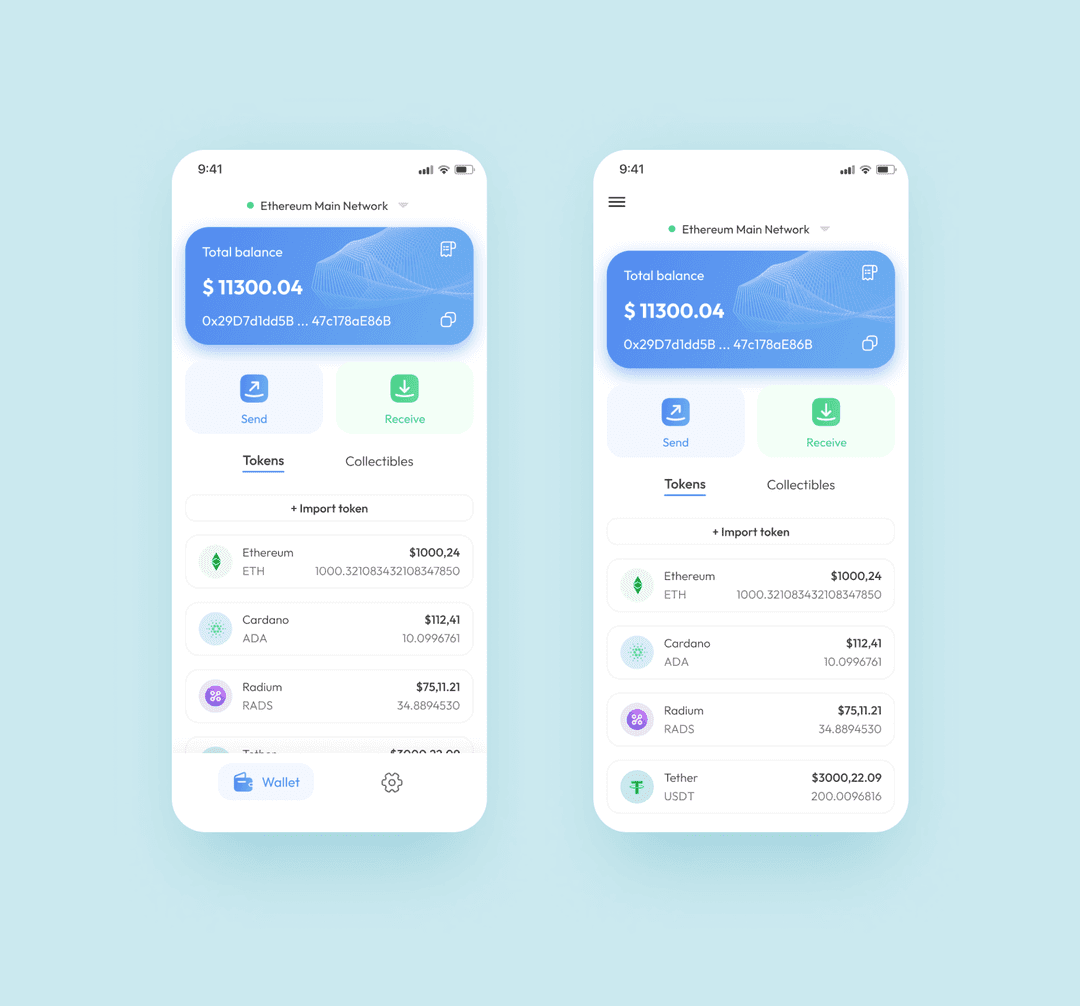
Abel crypto wallet — balances, transactions, and NFT tokens in one app
Then pin down their development approach to security and compliance. A serious development partner designs for PCI DSS, GDPR (General Data Protection Regulation), and data protection from day one, not as a pre-launch patch.
Next, weigh the practical fit. Check the tech stack — a modern, cross-platform setup like React Native keeps one codebase across iOS and Android and trims cost. Clarify the delivery model, since a fixed-scope MVP and open-ended time-and-materials suit different budgets. Look at team and communication — who you'll talk to, and in which timezone. Finally, verify the portfolio against independent reviews on Clutch.
A few answers should give you pause. A partner who can't name fintech projects, treats compliance as your problem, or quotes a firm price before any discovery is a risk. So is a team that pushes a full build when a smaller MVP would test the idea faster.
The strongest signal is specificity. Look for real integrations they have wired, regulators they have worked under, and problems they have solved, not a generic promise to deliver quality software.
This is the lens we apply at Purrweb: mobile-first React Native, a fixed-term MVP so founders know the cost up front, and a fintech focus over generic app work. For the full picture of scope and pricing, our fintech software development page breaks it down.
| What to check | Question to ask | What good looks like |
| Fintech domain experience | Case studies in my niche (payments, lending, banking)? | Named fintech projects, not generic "finance" |
| Security and compliance | How do you handle PCI DSS, GDPR, KYC/AML? | Compliance designed in from discovery |
| Tech stack | What stack, and is it cross-platform? | Modern and maintainable, e.g. React Native |
| Delivery model | Fixed-scope or time-and-materials? | Model matched to your budget and stage |
| Team and communication | Who is on my team and how do we sync? | Direct access, overlapping hours |
| Reviews and portfolio | Where can I see verified reviews? | Clutch profile plus reference calls |
Now the ranking. Below is the whole list at a glance, then a full profile for each company — what they do, who they fit, and the stack and delivery model they work in.
Purrweb leads as a mobile-first product studio, but read the rows to compare fintech app developers on the fit that matches your stage and budget. An enterprise vendor and a fixed-scope MVP studio solve very different problems. For a neighboring ranking focused on core banking platforms, see our banking software companies guide.
| Company | Best for | Delivery model | Key specialization |
| Purrweb | Fintech startups, fixed-term MVP | Fixed-scope MVP | Mobile-first, React Native |
| DashDevs | Digital banking and neobanks | Dedicated teams, staff aug | Core banking, BaaS, payments |
| Itexus | Fintech with AI features | End-to-end, dedicated teams | BaaS, trading, lending apps |
| ScienceSoft | Enterprise financial software | Fixed-price, T&M, dedicated | Banking, insurance, fraud systems |
| EffectiveSoft | Trading and crypto builds | Full-cycle, dedicated team | Trading platforms, wallets, crypto |
| Cleveroad | Fintech with blockchain/DeFi | Dedicated teams, fixed project | Mobile and web fintech, DeFi |
| Intellectsoft | Enterprise, multi-vertical | Long-term dedicated team | Digital banking, enterprise software |
| Artkai | Design-led fintech products | Embedded product teams | UX-first fintech, banking UX |
| Interexy | Web3 and blockchain fintech | Dedicated project teams | Blockchain, crypto/DeFi, AI apps |
| Appinventiv | Full-service, compliance-heavy | Agile dedicated teams | Large fintech apps, RegTech |

Purrweb is a mobile-first product studio that takes fintech startups from idea to a released app, usually on a fixed-scope MVP. The team works on a single React Native codebase, so one build ships to both iOS and Android and keeps budgets predictable. A discovery-to-store cycle runs about three to four months.
Its fintech portfolio leans toward crypto and payments. Recent builds include Abel, a backend-free cryptocurrency wallet with NFT support, Broex, a multicurrency wallet with trading, and KEM, a mobile payment platform.
Product and app design sit in-house alongside development, so UX, build, and release come from one team instead of handoffs. It fits founders who want a working financial app on a set timeline and budget, not an open-ended engagement.
DashDevs is a fintech-focused development firm built around banking and payments rather than general app work. It covers digital and neobanking platforms, core banking, lending and loan origination, payment gateways, e-wallets, open banking, and card issuing. Banking-as-a-Service building blocks help speed up launches.
Engagements range from full custom development to dedicated teams, staff augmentation, and a CTO-as-a-service option for founders without an in-house tech lead. With more than a decade focused on fintech, the team knows banking regulation and payment rails well enough to skip the usual ramp-up. It fits fintech-native startups and scaleups that want domain depth from day one.
Itexus builds full-cycle fintech products with a clear data and AI bent. Its work spans Banking-as-a-Service, trading platforms, lending systems, mobile banking apps, and e-wallets. It also covers AI-driven financial analysis and digital onboarding with KYC/KYB flows.
The company handles end-to-end delivery but also offers engineers for hire, so you can hand over a whole product or extend an existing team. A broad stack — .NET, Node.js, Python, plus native and cross-platform mobile — lets it manage both greenfield builds and integrations into legacy systems.
It fits SMBs and startups that want a full-cycle fintech partner with extra depth in AI and data science.

ScienceSoft is an enterprise vendor with a long track record in financial software. It builds digital banking platforms, payment and transaction systems, and fraud detection. The work also covers trading and investment automation and regulatory reporting for banks, insurers, and lenders.
The engagement options are flexible, from end-to-end delivery to dedicated teams and staff augmentation. Pricing can be fixed, time-and-materials, or consumption-based, which helps larger organizations plan budgets around scope.
With a large engineering bench and decades in the field, it leans toward complex, compliance-heavy systems rather than quick MVPs. It fits enterprises and regulated financial institutions that want an established partner with broad security expertise.
EffectiveSoft handles deep-tech fintech development where security and complexity matter most. Its portfolio covers trading platforms, payment gateways, mobile banking, digital wallets, peer-to-peer (P2P) lending, crypto exchanges, and wealth management tools.
The team runs full-cycle development with dedicated teams, taking a product from discovery through release and maintenance. Security credentials back the work, including ISO/IEC 27001 certification, which matters when you handle regulated financial data.
It fits companies that need complex trading or crypto systems and want strong security practices baked into delivery.

Cleveroad is a mid-size outsourcing partner that spans fintech, banking, and blockchain. It builds investment and trading platforms, e-wallets, P2P and lending systems, mobile banking, and insurance tools, along with blockchain and DeFi products.
Engagements come as dedicated teams, staff augmentation, or fixed-scope projects, so you can match the model to your budget and stage. The mix of mobile, web, and blockchain work makes it a flexible option when a product crosses several categories.
It fits SMBs and mid-market companies that want one partner across fintech, banking, and blockchain rather than several specialists.

Intellectsoft delivers custom software solutions across several industries, with fintech and digital banking among them. Its financial work includes mobile and digital banking, along with enterprise systems that connect to existing back-office software.
The model centers on long-term dedicated teams rather than one-off projects, which suits organizations that plan multi-year roadmaps. Because it also serves construction, healthcare, and insurance, it brings cross-industry patterns to financial builds.
It fits enterprises that want a long-term software partner and treat fintech as one part of a broader technology program.

Artkai leads with product design, shaping the experience before and during engineering. In finance, it has designed and built banking interfaces and crypto-exchange products, plus back-office automation that streamlines internal workflows.
Teams embed with the client across the full product cycle, and since 2023 the company has been part of the Euvic group, which extends its delivery capacity. The focus stays on usability, which matters for financial products where a confusing flow costs conversions.
It fits founders and enterprises that want design-led engineering and treat user experience as a core part of a financial product.
Interexy specializes in fintech built on emerging tech, with a strong lean toward blockchain development and Web3. It develops mobile fintech apps, crypto and DeFi products, and AI and machine-learning features layered on top.
Work runs through dedicated project teams on a custom development model, which suits startups moving fast on a new idea. The emphasis on blockchain and AI makes it a fit when a product depends on those capabilities rather than standard payments.
It fits startups that need blockchain, Web3, or crypto at the center of their fintech app.
Appinventiv is a full-service app developer with a large fintech practice. It builds mobile banking, digital wallets, trading and investment platforms, P2P lending, and payments or mPOS tools. RegTech and insurtech round out the mix, with GDPR and PCI DSS handled as standard.
The firm runs agile development teams and reports a high-volume delivery track record across industries. Its breadth of tech, from mobile to AI and blockchain, supports large, compliance-heavy builds that smaller shops may struggle to staff.
It fits enterprises and funded startups that need a large-scale partner for a complex, regulated fintech product.
The teams above are already building toward where the market is heading, and it's heading up. The global fintech market is on track for $652.8 billion by 2030, a 15.27% CAGR (Mordor Intelligence). Four shifts are shaping fintech apps in 2026, and each changes what to expect from a development partner.
Artificial intelligence and machine learning have moved from pitch decks into the backend. They now power credit score checks, transaction monitoring, and fraud detection, flagging risky activity in real time instead of after the fact. If your product touches lending or payments, ask how a partner approaches AI in fintech before you scope the build.
Embedded finance and open banking keep spreading, letting non-financial apps offer payments, accounts, and lending through banking APIs. That raises the integration bar, since a modern fintech app often plugs into several providers at once.
Wallets and super-apps keep absorbing more services, from payments to investing to loyalty. Demand tracks the money. Global digital payments are projected to reach $20.09 trillion in transaction value in 2025 (Statista). That volume pulls product roadmaps toward one-stop financial experiences.
Compliance-by-design is moving earlier in the build. Regulators expect data protection, KYC/AML, and audit trails designed in from the start, so it is becoming the default rather than a final review. It is one more reason domain experience matters more than raw development speed.
Choosing a fintech app development company comes down to fit, not fame. Match the team to your stage and product. A fixed-scope MVP studio works when the goal is shipping fast on a set budget. A larger enterprise vendor fits a regulated, high-volume platform.
Whichever way you lean, weigh the same things: real fintech case studies, a compliance-first approach, a modern stack, and a delivery model you can plan around. Get a rough number early too, since budget shapes the choice as much as skill does. For a detailed breakdown of how much a fintech app costs, start there before you commit.
A basic fintech app usually starts around $25,000–$50,000, a mid-level product with more features runs roughly $50,000–$120,000, and advanced platforms like digital banking or trading systems can exceed $300,000. The final figure depends on features, integrations, compliance scope, and platforms. See our detailed fintech app development cost guide for a breakdown.
Look for proven fintech domain experience and case studies, a clear approach to security and compliance (PCI DSS, GDPR, KYC/AML), a modern tech stack, a transparent delivery model, and strong communication. Ask for references and verified reviews (for example on Clutch), and start with a small discovery phase before committing to full development.
An MVP typically takes about 3–5 months, while a full-featured product with multiple integrations and compliance requirements can take 8–12 months or more. Timelines depend on scope, the number of integrations, regulatory work, and team size. A phased approach — MVP first, then iterate — usually gets you to market faster with lower risk.
A capable partner should design for compliance from the start: data protection (GDPR and local equivalents), payment security (PCI DSS), and identity checks (KYC/AML) where relevant. They should also help with secure data storage, encryption, audit logging, and, depending on your market, requirements from financial regulators. Compliance-by-design avoids costly rework later.
For most financial products a fintech-focused team is safer: they understand payment integrations, regulatory constraints, and fraud prevention, and they have relevant case studies. A general app developer can work for very simple products, but the domain complexity of fintech — security, compliance, and financial integrations — usually makes specialized experience worth it.


.svg)