Explore

Need help with your project?

Oops! Something went wrong while submitting the form.
A search for software development companies in California quickly turns into a stack of similar service lists. Some firms have local offices, while others work with California clients through remote or nearshore teams. The harder question is which delivery setup and experience match the product being built.
In this guide, we'll look at 10 custom software development companies through the decisions that matter during vendor selection. The comparison focuses on project fit, verified specializations, delivery models, and the types of clients each company is set up to serve.
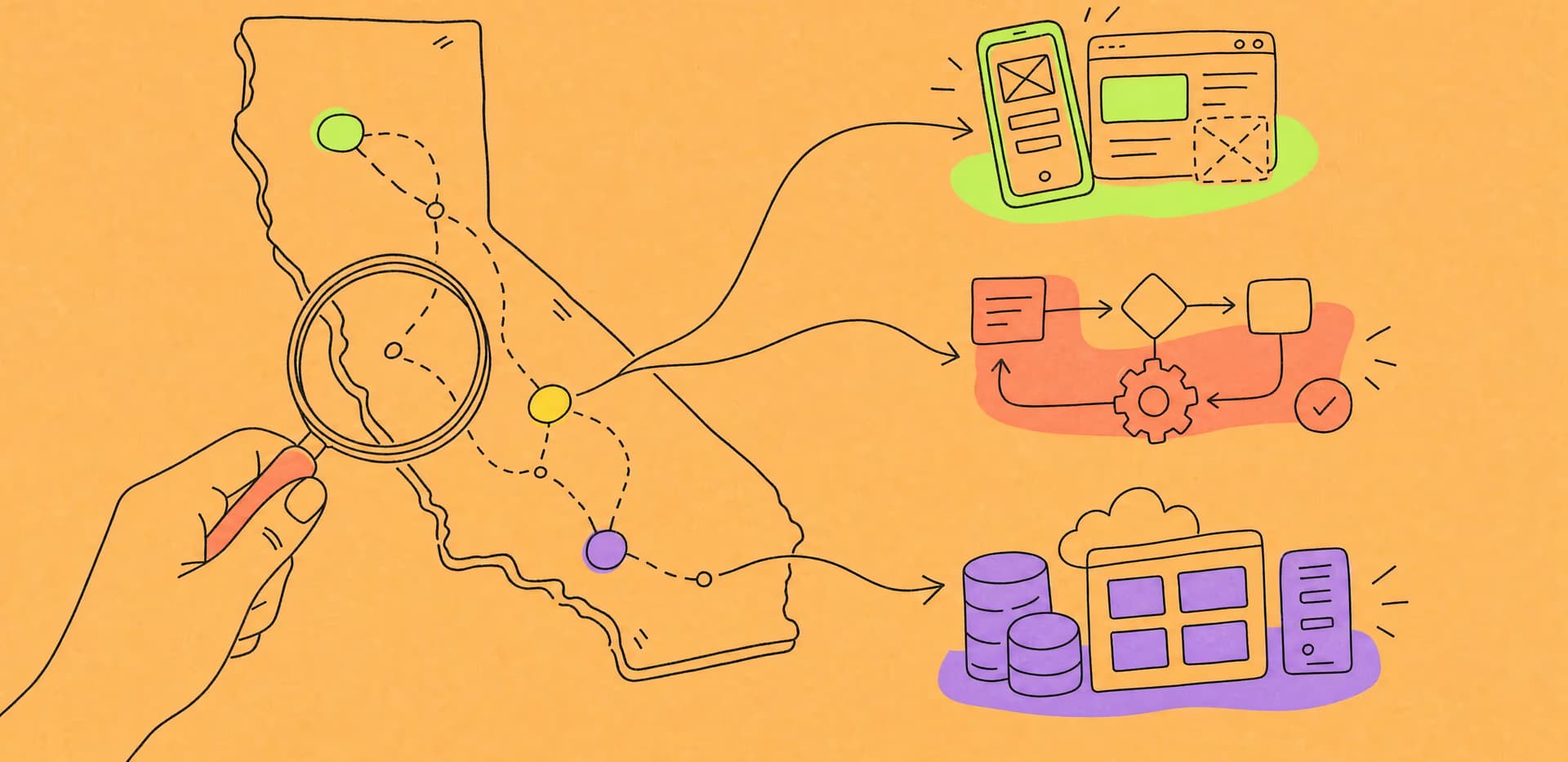
We included software companies that build software for specific business requirements and support their claims with an active official site and project evidence. Each company also has either a verified California presence or a clearly stated delivery model for clients in the state. The comparison considers specialization, post-launch support, and how each development team is structured around a buyer's project type.
This distinction matters in a market with a large concentration of technical work. California's high-tech sector, which includes software and services, contributed about $580 billion to the US economy in 2025. That scale supports software innovation and a dense market of tech companies. It does not make every local or California-facing software development firm suitable for the same product.
We reviewed official service pages and case studies to evaluate each company's expertise in software development. Directory position was not treated as proof of delivery quality. Experience with relevant constraints carries more weight than company size or review count. This list of the top software companies in California is not pay-to-rank, and the order does not claim that one provider fits every buyer.
Purrweb appears first because this is our publication, so its placement is transparent rather than presented as an independent award. Its profile follows the same evidence standard as the other entries. Buyers comparing custom software development services can use the profiles to check project fit before moving to discovery calls and estimates.
The companies in this section support different product stages and operating models. The table helps narrow the field by buyer fit before the individual profiles add project evidence, delivery context, and the practical limitation of each option.
| Company | California presence / delivery | Best for | Core specialization | Typical client type |
| Purrweb | International remote delivery | MVPs and new digital products | Product discovery, UI/UX, web, and mobile development | Startups and product teams |
| Idea Maker | California presence with local and remote delivery | Defined custom product ideas | Custom software, SaaS, AI, web, and mobile apps | Startups and SMBs |
| Azumo | California presence with nearshore delivery | AI and data-intensive products | AI development, data engineering, and custom software | Product and engineering teams |
| Closeloop Technologies | California account management with distributed delivery | Business automation and connected systems | Custom software, SaaS, mobile, and AI integrations | SMBs and enterprises |
| Naked Development | California-based product delivery | Early-stage app businesses | Product strategy, design, development, and launch support | Founders and startup teams |
| Goji Labs | California presence with distributed delivery | Products that need strategy and UX direction | Product strategy, UX/UI, custom software, and AI products | Startups, nonprofits, and product teams |
| Baytech Consulting | California presence with US onshore delivery | Enterprise systems and modernization | Enterprise software, AI solutions, and modernization | Midsize and enterprise organizations |
| Saritasa | California presence with multidisciplinary delivery | Complex multi-platform products | Custom software, mobile, IoT, AR/VR, and integration | Established businesses and enterprises |
| Art+Logic | California presence with collaborative remote delivery | Specialized and long-lived systems | Custom software, legacy modernization, and hardware integration | Organizations with complex technical requirements |
| ISBX | California-based product delivery | Venture-backed and enterprise products | Web app development, mobile development, enterprise software, AI, and data products | Startups, research teams, and enterprises |
A local presence can simplify workshops and procurement, but it does not establish technical fit on its own. The stronger comparison points are relevant delivery evidence, the actual team assigned to the work, and a commercial model that matches how stable the product scope is.
Best for: startup founders and product teams that want to move from product discovery through UI/UX design to a working MVP with one design and development partner.
Purrweb is a company specializing in custom software development for startups, including web development and mobile app development. Its team can shape early requirements, design the interface, build the product, and prepare it for market testing. The delivery model is international and remote rather than based in California, which suits teams comfortable with overlapping work hours and documented collaboration.
This global software development model works well when design and engineering decisions need to move together. A company that requires frequent in-person workshops in California may prefer a local provider. The same applies to buyers who want only individual developers added to an existing team.
We built Settler for a Dubai startup that helps apartment owners oversee renovations remotely. The MVP connected the customer-facing mobile app with an administrative panel used to manage renovation projects.
The main constraint was the budget. Live project updates, payments, and scheduling could each have grown into an expensive custom subsystem. We found simpler implementation routes that preserved the core user experience without building unnecessary infrastructure.
These decisions reduced the projected development cost by more than $12,000. We completed the MVP in four months and prepared the product for handoff to the client's internal development team.
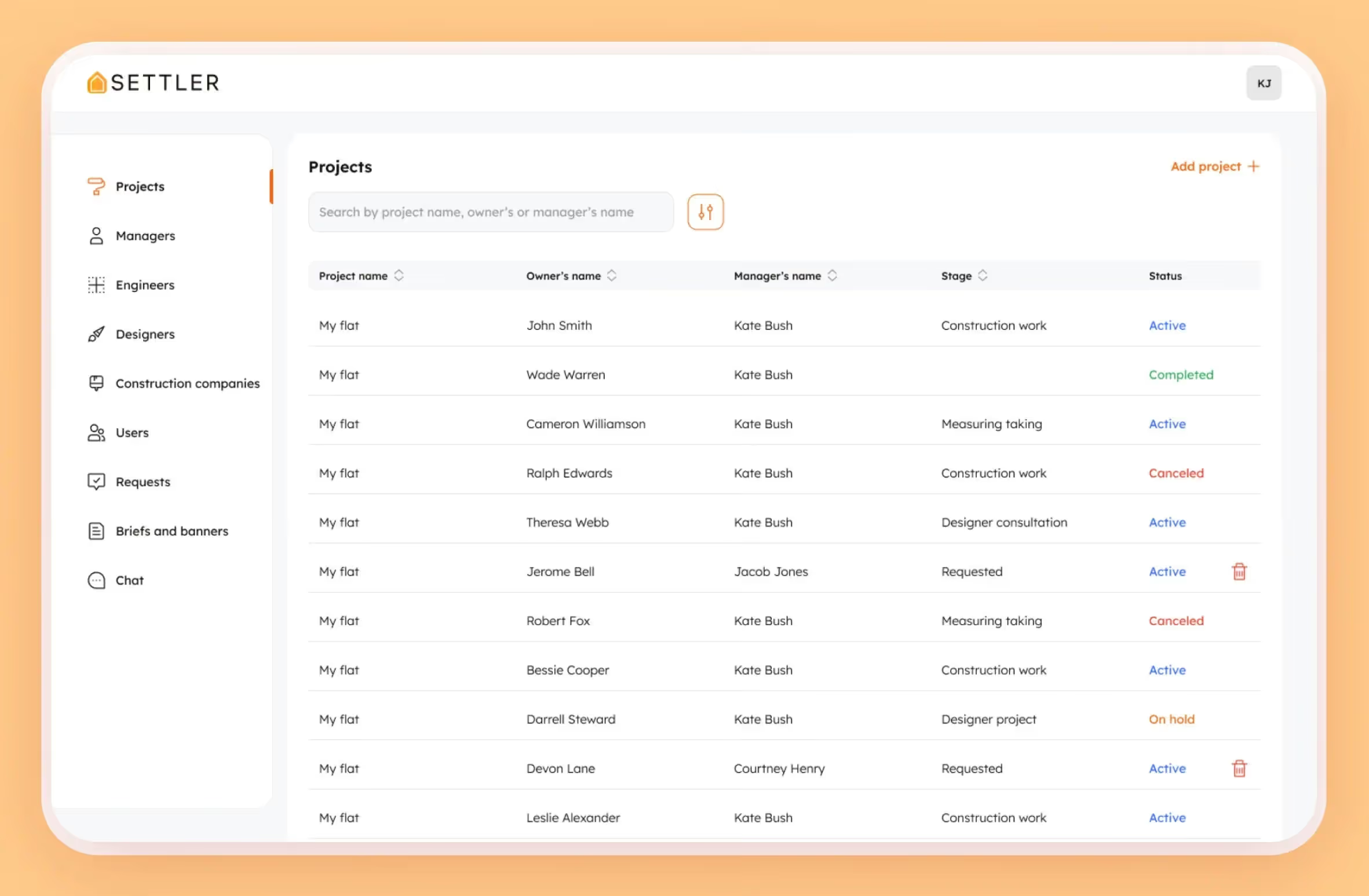
The first release connected the customer app with the operational tools needed to manage renovation work remotely
Best for: startups and SMBs that have a defined product idea and want a California-facing custom software development agency to design and build it.
Idea Maker develops custom software solutions, software as a service (SaaS) platforms, AI-enabled products, and mobile and web applications. Its official service pages support both local and remote delivery. One portfolio example is a spreadsheet-processing SaaS application with bulk imports, automated sorting, reporting, data visualization, and email automation.
That case reflects a practical fit for products where custom software solutions are built to replace repeated office work with a structured workflow. The combination of imports, processing rules, and reporting also shows experience beyond a simple customer-facing interface.
A buyer looking for a web development partner can use discovery to test whether the team understands the underlying operation before discussing screens or technology. The contract should also define ownership of imported data and configuration rules.
The company fits products where creating custom software for a business workflow is more suitable than using a generic off-the-shelf tool. Buyers with specialized infrastructure or regulated enterprise requirements still need to confirm that the proposed team has direct experience with those constraints.
Best for: product and engineering teams that need an AI development company with data specialists and are comfortable working through a nearshore delivery model.
Azumo focuses on artificial intelligence (AI) development, data engineering, custom applications, and software engineering team extension. Its California presence is paired with distributed nearshore engineering. For Big Run Studios, the company built a data pipeline, a Snowflake warehouse, and near-real-time player analytics for a gaming product.
The project demonstrates work across ingestion, storage, and product-facing analysis rather than a standalone dashboard. That depth is useful when AI features depend on reliable operational data or when the existing data layer cannot support new product decisions.
It also gives buyers a concrete topic for the technical discovery call: who owns data architecture after launch. A support plan matters once the pipeline becomes production infrastructure.
That combination is relevant when cloud computing and data infrastructure are part of the product rather than a reporting task added near launch. Buyers expecting a fully local team need to verify working-hour overlap, technical ownership, and the seniority of the people assigned to delivery.
Best for: businesses replacing manual workflows or connecting several operational systems in one software solution.
Closeloop works on custom software, SaaS products, mobile and web applications, and AI integrations. It combines California account management with distributed delivery. The Home Run Financing case involved a compliance-focused customer relationship management (CRM) platform for loan-lifecycle automation in California and Florida.
In financial technology, a system like this has to keep customer records, process states, and compliance steps consistent as work moves between teams. That makes the example more relevant to CRM development and operational software than a generic CRM label would suggest.
Buyers planning similar automation can ask how Closeloop maps existing rules and exceptions before replacing the current tools. The estimate should separate migration, integration, and user-facing workflow work so dependencies remain visible before development begins.
The portfolio makes Closeloop a relevant option for software that coordinates data and tasks across departments. The buyer still needs to verify the proposed team's direct experience. The workflow, integrations, and compliance rules involved in the project determine whether that experience is relevant.
Best for: early-stage app businesses that want product strategy, design, development, and launch support from the same company.
Naked Development offers a California-based product model built around turning an app concept into a market-ready release. Its work covers new products and code takeovers. The SnapMD health care project included web and mobile app development for telemedicine, UI/UX work, fundraising support, and launch execution.
The case shows a delivery model that extends beyond writing the application code. It connects development and design with launch preparation. That can reduce handoffs for a founder who has not assembled an internal product organization. It also makes the boundaries of each service important during estimation.
This broad founder-focused model helps when the product still needs commercial and design decisions alongside engineering. A team with a mature specification and internal product leadership may not need the full program. The discovery scope and staffing model are important points to settle before engagement.
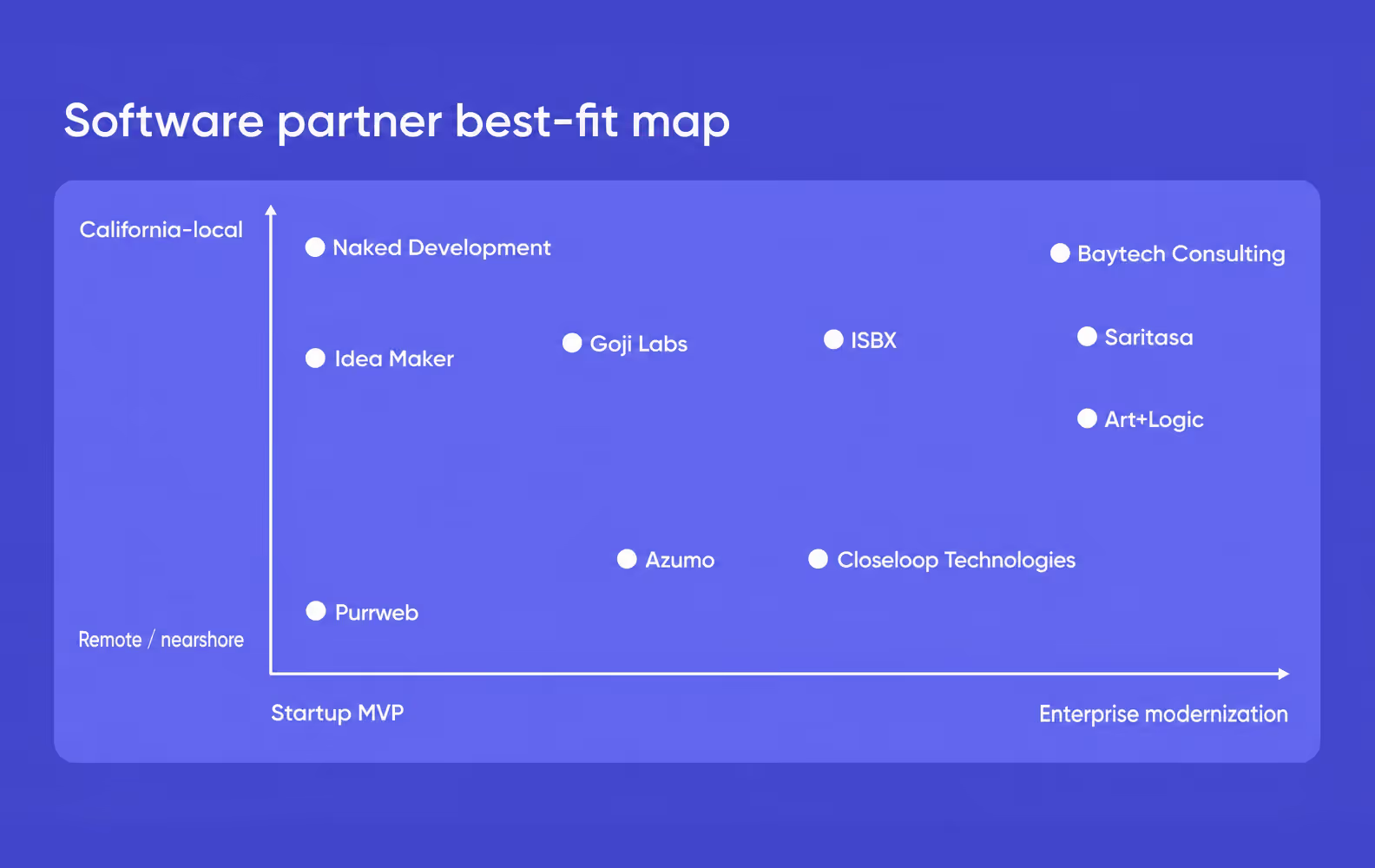
The useful dividing line is not local versus remote alone, but the combination of project type and delivery model
Best for: startups, nonprofits, and product teams that want strategy and UX research to shape the software before and during development.
Goji Labs combines product development strategy, UX/UI design, and custom web and mobile engineering. It has a California presence and works through a distributed delivery model. For KCRW, the company handled a mobile redesign and broader modernization of the member experience platform.
The example is useful for organizations whose digital product already has an audience but no longer supports the experience they want to provide. Digital transformation in that situation involves product decisions as well as technical changes.
Buyers can ask how user feedback and research findings become prioritized engineering work. They can also ask how the team measures whether the redesigned flow solves the original problem. The plan should also show when research ends and build commitments begin.
The strategy-led approach fits teams that are still resolving user flows or product priorities. Buyers arriving with fixed requirements may want to confirm how much discovery is required and how design decisions affect the engineering estimate and schedule.
Best for: midsize and enterprise organizations that prioritize US onshore delivery for custom systems or modernization work.
Baytech Consulting handles enterprise software development, AI solutions, and web application delivery through a California-based onshore model. Its New American project was a custom CRM for a Southern California mortgage lender, developed with .NET, ASP.NET, C#, and SQL Server.
The project points to experience with business-critical data and workflows that employees use throughout the day. In this type of system, reliability and maintainability carry more weight than a rapid visual prototype.
Procurement teams can use the architecture, release controls, and support responsibilities to judge whether the onshore model creates practical ownership. A modernization estimate should separate continuity work from optional feature changes before the contract is signed and approved.
The company is a closer match for operational systems with established business rules than for a small experiment built around the lowest starting budget. Buyers also need to examine how the proposed architecture, support arrangement, and release process fit the lifespan of the internal system.
Best for: established companies and enterprises whose project crosses software, mobile, connected devices, or immersive technology.
Saritasa develops custom software and web and mobile products. Its wider experience covers Internet of Things systems, augmented and virtual reality, and integration. Its California presence supports multidisciplinary delivery.
For Toro Enterprises, the company modernized a workforce-management application with mobile access and operational workflows. The work also covered role permissions, notifications, and continued support.
The example shows how several interfaces can serve one operational process without becoming disconnected products. Field access, administrative permissions, and notifications all depend on the same underlying rules.
A buyer with a comparable project can ask how Saritasa separates shared platform logic from the requirements of each device or user group. The support proposal should identify who clearly owns each technical surface after release.
That breadth suits complex software development programs with several technical surfaces. A conventional web or mobile MVP may not require the same range. The engagement needs to be sized around the actual product rather than the vendor's full capability.
Best for: organizations with specialized systems, legacy applications, or software that connects to physical equipment.
Art+Logic is a custom software development company specializing in applications, modernization, web and desktop software, and hardware-integrated systems. It has a California presence and supports collaborative remote delivery. One case involved a tablet and cloud platform for ultrasonic corrosion monitoring. The system combined field data capture, hardware integration, and projections of possible equipment failure dates.
That project required software to reflect a specialized physical process rather than only manage ordinary business records. It also had to connect work performed in the field with cloud reporting.
Buyers with domain-heavy systems can use technical discovery to see how Art+Logic learns the operating context and validates assumptions with subject-matter experts. Acceptance criteria also need to cover real operating conditions, not only interface behavior.
This engineering profile fits technically unusual or long-lived systems where domain logic matters more than a standard app template. Consumer startups focused on a short design-led market test may find a product studio better aligned with that pace and scope.
Best for: venture-backed startups and enterprises building web, mobile, data, or AI-enabled products.
ISBX combines product strategy, UX design, web and mobile application development, quality assurance, and launch support through a California-based delivery model. For File Keepers, the company designed and developed an on-demand web and mobile application for a Southern California file-storage business.
The case connects a customer-facing ordering experience with the operational side of a physical service. Web and mobile access need to share account and request data while remaining usable in different contexts.
Buyers planning a similar product can ask how ISBX divides responsibilities between product strategy, interface design, backend engineering, and quality assurance. They also need a clear owner for cross-discipline decisions. The release plan has to cover both customer and operational users before product development begins in earnest.
The service range supports products that need both planning and execution across several disciplines. A buyer seeking only a web development company or short-term staff augmentation needs to confirm that ISBX's model fits that smaller responsibility. The same check applies to an isolated feature team.
Choosing the right software development company means finding a software engineering partner whose evidence and operating model match the project's biggest risks. When several proposals promise senior engineers and transparent delivery, the useful differences appear in named staffing, decision ownership, and change handling. A client list or nearby office provides context, but it cannot answer those questions.
California's talent market makes those details especially relevant. The state's software-developer talent data projects 222,110 job openings from 2023 through 2033. The same report lists a 2025 median annual wage of $175,555. It also recorded 9,838 online job advertisements during the measured period in 2025.
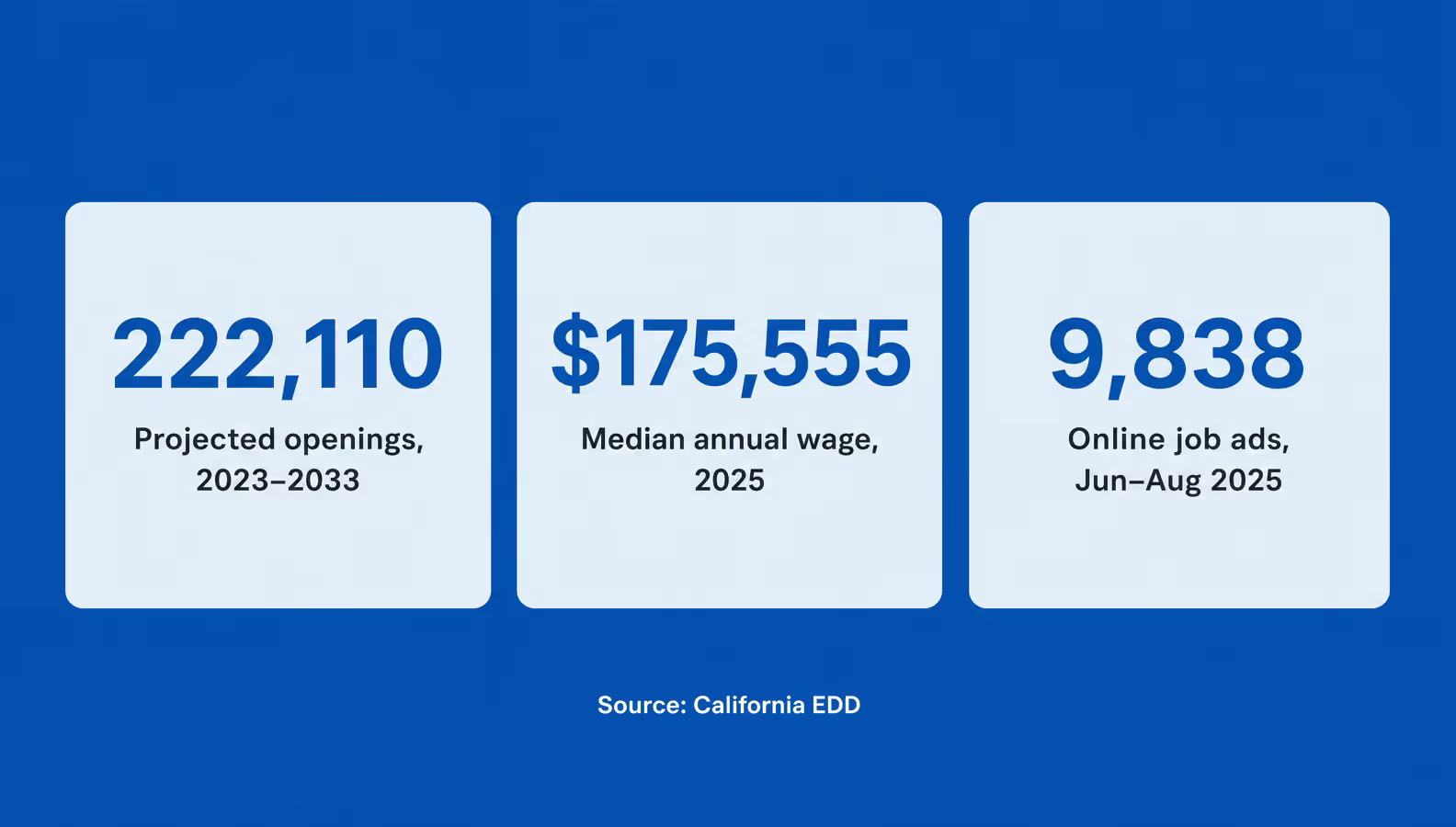
A competitive talent market makes the proposed team and retention model part of vendor due diligence
The figures describe the labor market, not the quality of any company here. They show why a California address alone says little about team stability. The following checks reveal more about the delivery relationship:
Our guide on how to find a software development partner covers proposal review in more detail. Projects limited to iOS or Android can use the narrower list of California mobile app developers.
The final choice usually depends on which risk matters most. A software development company based in California can support workshops and procurement requirements. A development company headquartered elsewhere can widen access to specialized engineers through remote or nearshore delivery. In both models, a reliable development partner is defined by named accountability and relevant delivery evidence, not location alone.
The engagement model determines how a software development project absorbs uncertainty. Fixed price protects an agreed scope, time and materials supports changing priorities, and a dedicated team provides stable capacity. None of the three models guarantees a lower final cost without clear ownership and delivery controls.
| Model | Works best for | Budget predictability | Main risk |
| Fixed price | A bounded release with stable requirements and acceptance criteria | High while the agreed scope remains stable | New information turns into change requests or forces scope trade-offs |
| Time and materials | Products whose priorities will evolve during discovery and development | Medium, controlled through milestones and burn reporting | Weak prioritization allows the backlog and budget to drift |
| Dedicated team | Long-running product development, modernization, or a sustained engineering roadmap | Medium to high at the team-capacity level | The buyer needs enough product leadership to use the capacity well |
The vendor's address, or a label such as comprehensive software development services, rarely determines the budget by itself. Integrations, data migration, compliance, team seniority, development and testing depth, and post-launch support have a stronger effect. Our guide to software development costs breaks down those drivers beyond the California market.
Fixed price fits software tailored to specific requirements and acceptance criteria before development starts. It becomes restrictive when discovery is expected to change the product. Time and materials works better in that situation because scope can move between iterations, though the buyer still needs transparent burn and priority decisions.
A dedicated team is closer to a capacity commitment than a project quote. It suits organizations with long-running development projects and internal product ownership. Companies choosing a partner for custom software and comparing local delivery with software outsourcing companies can apply the same model logic to either option.
The useful result of a company ranking is not a universal winner. It is a smaller group of providers whose experience, delivery model, and team structure match the project being planned. California presence can matter for workshops or procurement, while remote and nearshore models can provide access to specialists. In either case, the proposal needs to make ownership and budget control visible.
Start with the profiles that match the product type, then use discovery to test the assigned team and assumptions behind the estimate. The engagement model can be chosen once the stability of the first release is clear.
➡️ Have a custom software project to scope? Tell us what you are building, and we'll prepare a free project estimate within 48 hours.
The strongest list of candidates depends on the project rather than a universal ranking. Compare companies by relevant case studies, team seniority, delivery model, California presence or client experience, security practices, and post-launch support. The table in this guide groups 10 providers by best-fit project type so buyers can narrow the list before requesting discovery calls and estimates.
Start with firms that have shipped products similar to yours in scope, industry, and technical complexity. Verify who will work on the project, how estimates and change requests are handled, who owns the intellectual property, and what happens after launch. A California office can simplify meetings, but transparent delivery and relevant expertise matter more than location alone.
Cost varies with scope, integrations, platform count, compliance needs, team seniority, and engagement model. A focused MVP may require a smaller fixed scope, while enterprise modernization usually needs a longer time-and-materials or dedicated-team engagement. Ask each vendor for assumptions, milestones, exclusions, QA coverage, and support costs rather than comparing a single hourly rate.
Choose a California-based team when in-person workshops, local market knowledge, or procurement requirements are essential. A remote team can be equally effective when it provides overlapping work hours, senior specialists, documented communication, and clear accountability. Evaluate delivery evidence and collaboration practices first, then treat physical location as one selection factor rather than the deciding factor.
Common services include product discovery, UX and UI design, custom web and mobile development, SaaS engineering, AI and data solutions, API integration, cloud migration, QA, and post-launch maintenance. Capabilities differ significantly between firms, so buyers should confirm whether the vendor can cover the full lifecycle or only a specific phase of the product.
A tightly scoped prototype or MVP can take several months, while a complex platform with integrations, compliance requirements, and data migration can take much longer. The reliable way to estimate timing is a discovery phase that defines user flows, architecture, dependencies, milestones, and acceptance criteria. Treat estimates without documented assumptions as preliminary rather than contractual.


.svg)