Explore

Need help with your project?

Oops! Something went wrong while submitting the form.
Hiring a software development company in Canada looks simple until you open a directory and find hundreds of them. The hard part isn’t finding a vendor. It’s working out which one actually fits the product you’re building and the way your team likes to work.

This guide narrows the field to 10 companies that serve the Canadian market, each with a note on who it suits best. You can look at the companies on the list by specialization or by how each team prefers to work, then decide which two or three are worth a real call.
Every company here earned its place against the same set of checks, not a pay-to-play ranking. We looked at real delivery instead of marketing copy, and weighed each of these software companies in Canada on what a founder or CTO actually cares about once the contract is signed.
If you want a framework before you commit, our guide on how to choose a software development partner walks through the trade-offs.
Here are the 10 software development companies, starting with Purrweb and running through teams that handle everything from mobile application development to enterprise software solutions. The table gives you a fast read on who each one suits and how clients rate them, and the profiles below go deeper on the ones that match your project.
| Company | Best for | Team size | Clutch rating |
Purrweb | Startups and MVPs | 200+ | 4.9 (44 reviews) |
MindSea | Healthcare and HealthTech apps | 10–49 | 5.0 (41 reviews) |
Spiria | Enterprise custom software | 50–249 | 4.9 (26 reviews) |
Osedea | AI, robotics, and custom builds | 50–249 | 4.9 (42 reviews) |
Architech | Enterprise AI and workflow systems | — | 4.8 (4 reviews) |
Iversoft | Product builds and modernization | 10–49 | 4.9 (12 reviews) |
Whitecap Canada | Microsoft and .NET enterprise | — | 4.9 (8 reviews) |
Konrad | Digital products at scale | 500+ | — |
Sidekick Interactive | Connected and IoT apps | — | 4.9 (30 reviews) |
Datarockets | Web and SaaS startups | — | 5.0 (22 reviews) |
Purrweb is a product design and development studio that takes startups from a rough idea to a launched app, usually on a tight timeline. The team works mobile-first with React Native, so one codebase ships to both iOS and Android and early-stage budgets stay lean. Software design and engineering sit under one roof, so the people drawing the screens are the ones shipping them.
Their sweet spot is the first version of a product, the MVP (minimum viable product) that proves an idea with real users before a full build. Founders who need a working app in months rather than a year tend to fit here.
Purrweb runs MVP development as a fixed-scope engagement, which is how most first-time founders start.
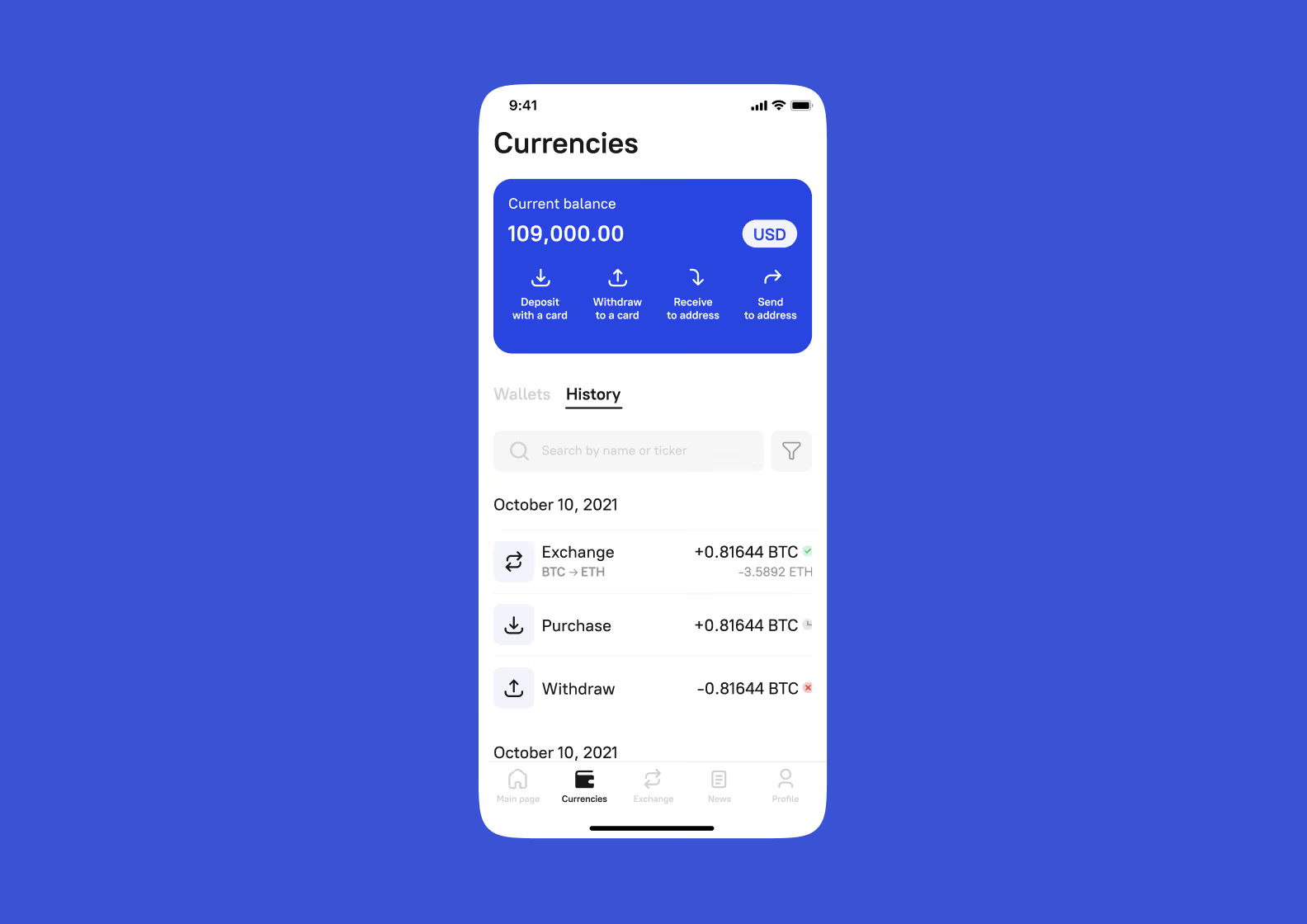
We built Broex, a cross-platform crypto wallet, for a client who wanted first-time users to buy and hold multiple currencies without the usual intimidation. We shipped it in React Native and connected the app to their backend over GraphQL, so a single codebase covered both platforms.
The hard part was trust. New crypto users drop wallets that feel unsafe. So we layered iOS biometric login on top of email and password, plus clean balance monitoring and a favorites list for quick exchanges. We released it in phases, starting with core wallet functions and adding transactions and biometrics on later builds.

.svg)

MindSea builds one thing well: healthcare apps. The team focuses on digital health and health care, so its work runs from patient-facing apps to the harder problems around clinical data and regulated workflows. That focus shows in the details, like how the apps handle privacy and connect to medical records.
Health and HealthTech companies are the natural fit here. It suits teams that need people who already know the rules of the space instead of learning them on your budget. The stack covers iOS, Android, and React Native, with product strategy on top.
Spiria has been building custom software for over two decades, and it shows in how the team handles messy, established systems. It takes on full custom software solutions and the less glamorous work of modernizing software that’s aged past its prime. If you have a legacy platform that still runs the business but slows it down, this is the kind of partner that untangles it.
Beyond full builds, Spiria offers team extension, so you can add its engineers to your own instead of standing up a whole vendor relationship. That flexibility suits mid-to-large organizations that need capacity or expertise for a defined stretch.
Osedea leans into the harder end of software: AI, robotics, and custom builds for industries that don’t tolerate hand-wavy prototypes. Think manufacturing lines, mining operations, and health systems, where a model has to hold up against real-world mess. The team pairs product design with engineering, so the artificial intelligence actually ships inside something people use.
That makes Osedea a fit for industrial and enterprise clients with a concrete operational problem, not just a research experiment. Companies come here when they want automation or a custom platform built around a specific process.
Architech spent two decades building critical business systems, and it now points that experience at AI. The pitch is practical: redesign the workflows a company actually runs on, then build the AI systems that run them. It’s less about flashy demos and more about the plumbing behind big operations.
That focus makes Architech a fit for large enterprises modernizing core systems rather than launching a first app. Teams that already have complex operations, and want AI woven into them without breaking what works, are the right match.
Iversoft is a product engineering partner that builds new software and rescues the software that’s gone sideways. That second part matters. Plenty of projects stall halfway, run over budget, or end up held together with duct tape, and Iversoft is set up to step in and stabilize them. The team frames its work around outcomes, not just shipped code.
You can bring Iversoft in for a full build, an embedded product team, or extra hands on your own roster. That range fits organizations that want a steady partner across a product’s life rather than a one-off vendor.

Whitecap Canada is a custom software development firm and Microsoft shop through and through, with close to three decades spent building on the .NET and Power Platform stack. If your enterprise runs on Microsoft tooling, this is a team that speaks the language natively, from Power BI dashboards to Dynamics 365 and SharePoint. This Canadian software development team keeps its work in-house rather than offshoring, which appeals to companies that want tight control and accountability.
The sweet spot is established organizations modernizing internal systems or building custom business apps on Microsoft rails. Regulated and process-heavy sectors tend to feel at home here.
Konrad operates at the big-brand end of the market, a digital consultancy that blends strategy, design, and technology for large companies. Its client roster leans enterprise, the kind of organizations that need a partner able to staff a major initiative and see it through. With 500-plus people, Konrad has the scale to match.
Lately the firm has pushed hard on AI, positioning itself to build the customer-facing products and internal tools that large brands now expect. If you’re a smaller startup company, this is likely more firepower than you need. For enterprises launching digital products at scale, it fits.
Sidekick Interactive specializes in the tricky space where apps meet hardware. Connected devices, IoT products, and anything that has to talk to a physical machine are its home turf, backed by more than fifteen years of mobile work. That’s a niche most generalist shops avoid, because the edge cases multiply once real hardware is involved.
If your product involves sensors, a connected device, or a companion app for physical equipment, Sidekick has done the reps. The team also handles standard mobile and web builds, but the connected-device focus is what sets it apart.
Datarockets closes out the list as an AI-native software development agency with a startup streak. Its roots are in Ruby and React web builds, and it’s leaned into AI agents across design, architecture, coding, and testing. The angle is speed: use AI to compress the path from idea to working software products without dropping quality.
That makes it a natural fit for startups and SaaS companies that want an AI-forward MVP or a lean product team. Founders who value fast iteration over heavyweight process tend to click with how Datarockets works.
A logo on a comparison table only tells you so much. Before you sign, a few checks separate a custom software development company that fits from one that just looks the part. Here’s what actually moves the needle.
Start with domain expertise. A team whose software development services already cover your industry knows its regulations, its users, and its failure modes, so you aren’t paying them to learn on the job. Ask for case studies close to your problem, not just an impressive client list.
Then pin down the engagement model. Some firms work fixed-scope, others embed a dedicated development team or add engineers to yours. Each suits a different stage of the software development process, and the wrong fit shows up as friction later. Our breakdown of in-house vs outsourcing covers the trade-offs in depth.
Communication matters more than most founders expect. You want working hours that overlap yours and agile project management that keeps you informed without daily chasing.
For anything touching personal data, ask about security and compliance. Canadian projects fall under PIPEDA (the Personal Information Protection and Electronic Documents Act, the country’s privacy law), and regulated sectors pile on more.
One budget lever is worth naming. A cross-platform, mobile-first build ships to iOS and Android from a single codebase, which often costs less than two native apps. Cloud computing then adds scalability as you grow. If that suits your product, custom software development partners who work this way stretch the budget further. For a narrower mobile-only comparison, review our guide to mobile app development companies in Canada.
The right partner depends on your project, not a ranking. A pre-seed founder chasing an MVP wants a different team than an enterprise modernizing a core system, and this list covers both ends. Match the specialization and engagement model to your stage, check the case studies and reviews, and the choice narrows fast.
The timing is on your side. Canada’s software market is projected to reach roughly $140 billion by 2030, and demand for skilled software developers in Canada keeps climbing. Budget usually decides the final call, and our guide on how much software development costs helps you plan with real numbers.
➡️ Ready to scope your project? Contact Purrweb for a free estimate within 48 hours.
Canadian agencies typically charge more than offshore teams, and rates depend on seniority, city, and engagement model (fixed-price vs dedicated team). A small MVP usually starts in the tens of thousands of dollars, while enterprise projects cost significantly more. A cross-platform approach can meaningfully reduce the total budget.
Check the portfolio and relevant case studies, domain expertise, verified reviews on Clutch, the engagement model, communication and time-zone fit, and the company's approach to security and compliance such as PIPEDA.
Usually yes, but they offer closer time-zone, cultural, and legal alignment. Many teams also provide a hybrid model — Canadian management with nearshore engineers — that balances cost and quality.
Toronto, Montréal, Vancouver, Ottawa, and Halifax are the largest tech hubs, each with a strong concentration of product and enterprise software studios.
It depends on budget, time zone, and compliance needs. A local team is simpler for regulated industries, while outsourcing or outstaffing helps when speed and cost matter most. Many projects combine both approaches.