Explore

Need help with your project?

Oops! Something went wrong while submitting the form.
Businesses comparing software development companies in Melbourne are usually deciding whether a bespoke software development project or off-the-shelf software fits the work, not choosing from a generic vendor category. A legacy rescue, a new mobile MVP, and a Microsoft integration each need different evidence. The useful first question is which published capabilities match the system, constraints, and handover required.
This guide compares each software development company in Melbourne through published capabilities, project evidence, and the questions worth taking into a first conversation. Purrweb appears first by editorial order, not as a measured winner. The ABS reports that 12% of Australian businesses used AI in 2024–25, so confirm a provider’s custom software development capabilities and development process rather than assuming AI is necessary.

A city-specific search is only the start of a software partner comparison. Project scope, technical constraints, and evidence from similar work are more useful. The table covers all ten providers. The profiles show their published capabilities and what to confirm in an initial conversation.
| Company | Consider for | Verify before contacting |
| Purrweb | Web and mobile product MVPs | Scope, IP, and handover |
| Mintec Systems | Legacy systems and rescue | Legacy support ownership |
| DiUS | Cloud-connected product engineering | Comparable engineering scope |
| Alliance Software | Custom CRM and ERP workflows | Discovery deliverables |
| Dcode Group | Operational integrations | Existing-system integration |
| Envision IT | Microsoft business systems | Engineering versus licensing |
| TatvaSoft | Applications and quality assurance | Testing and handover scope |
| F1 Solutions | Cloud and SaaS modernization | Completed work and support |
| Microknot | .NET and Azure applications | Infrastructure experience |
| Intesols | Administrative business workflows | Current specialist availability |
⚙️ Services: custom web development, mobile app development, MVP development, UI/UX design, product development, testing, and maintenance.
🔎 Website: Purrweb custom software development services
For teams turning an early product idea into a web product or mobile app, Purrweb brings design and engineering into the same published service scope. That includes product development, testing, and maintenance around an initial release, not only the interface.
The service range spans UI/UX, testing, and maintenance alongside MVP development. It fits a buyer who wants to separate launch scope from the product work, handover, and maintenance expected after the first release. An initial brief can identify the user flow to validate and the work that remains after that release.
KEM needed a P2P payment MVP for conversations with banks and investors. We designed and built the demonstration product with payment-flow logic. Real banking API access was unavailable, so the MVP used simulated banking data rather than a live integration.
After handover, KEM’s in-house team built the back end that connected to real APIs. The project does not support claims that Purrweb completed compliance work, launched KEM, or operated live bank transfers.
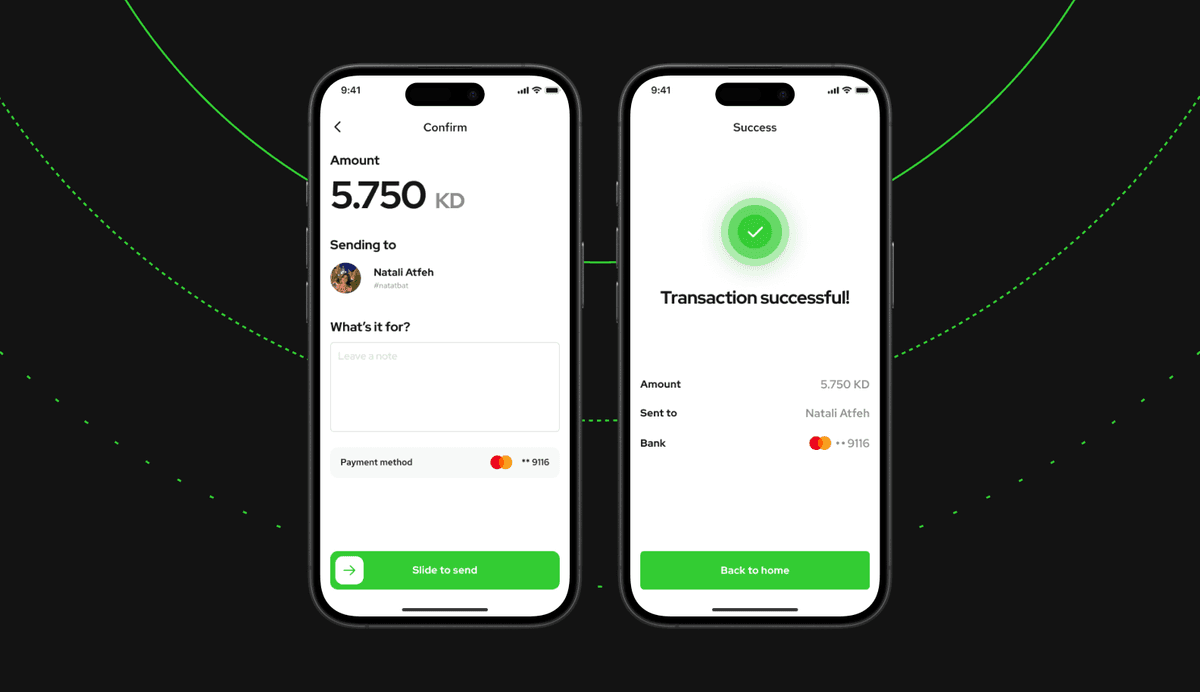
KEM MVP payment-flow screens; the demonstration used simulated banking data.
⚙️ Services: custom business software, systems integration, project rescue, legacy-system support, maintenance.
🔎 Website: Mintec Systems
Mintec Systems publishes bespoke software development and custom software solutions for business software that must coexist with older applications. It also names systems integration for connecting disparate systems, project rescue, support, and maintenance. That combination is relevant when the task is to stabilise or extend an existing application rather than replace it immediately.
Its legacy focus is the useful distinction here. In a first discussion, define the supported-system boundary, dependencies that must be retained, and ownership of maintenance work after the project closes. That makes a rescue conversation about the condition of existing code and integrations before any replacement plan is proposed.
⚙️ Services: digital product design and engineering, cloud and platform engineering, data, AI, IoT, connected-device engineering.
🔎 Website: DiUS
When a product has to work across cloud platforms, edge systems, or connected devices, DiUS is one entry with that published software engineering mix. Its data work includes platforms and streaming sensors, rather than only a general analytics label.
The combination of product design, platforms, data, AI, IoT, and device work makes architecture the important follow-up. Ask about a completed system with the same cloud, device, or data boundary rather than assuming a broad software engineering label covers it. The walkthrough should make the boundary and the engineering responsibility behind it specific.
⚙️ Services: custom CRM and ERP platforms, business systems, workflow software, data and AI work, Python, Django, React.
🔎 Website: Alliance Software
Alliance Software’s published custom software solutions include CRM and ERP platforms, workflow software, business systems, and AI applications for startups, scale-ups, and enterprise teams. That emphasis points toward projects where internal processes need their own application layer.
The official site also names Python, Django, and React expertise. Those stack names clarify the technical conversation, but a buyer still needs to confirm what discovery will produce and which assumptions shape the full-build scope. That is especially relevant when a CRM or ERP has to reflect existing approval steps and data ownership.
⚙️ Services: custom reporting, business automation, workflow software, ERP development, systems integration.
🔎 Website: Dcode Group
Dcode Group describes development solutions for operational workflows rather than a generic service catalogue. Its published services cover custom reporting, business automation, workflow software, and ERP development for organizations working across existing business systems.
The integration range is the relevant detail. Dcode names accounting, payroll, fleet, cloud, and payment systems, so a useful walkthrough should show how reporting or workflow automation handles the data boundaries in the buyer’s operation. It should also make clear which system supplies the source data and who owns exceptions between systems.
⚙️ Services: custom development, legacy-software upgrades, line-of-business applications, Power BI, Power Apps, APIs, data migration, integrations.
🔎 Website: Envision IT
Microsoft business systems form a clear part of Envision IT’s published offer. The company lists customised software development, legacy system upgrades, and line-of-business applications alongside Power BI, Power Apps, APIs, data migration, and integration solutions.
It also names Dynamics 365 Business Central, CRM, and ERP work. A first conversation should distinguish custom engineering from licensing and identify which interfaces, migrations, or existing business processes are actually in scope. That distinction avoids treating a platform feature list as an agreed implementation plan.
⚙️ Services: application and product development, web development and mobile app development, UI/UX design, testing, quality assurance, maintenance.
🔎 Website: TatvaSoft
TatvaSoft publishes application development, product maintenance, enterprise solutions, e-commerce web work, and mobile apps across iOS, Android, and hybrid platforms. User experience design, testing, and quality assurance are part of that stated range.
That breadth makes the proposed testing and handover scope worth discussing early. Buyers comparing web and mobile work can ask which quality-assurance responsibilities, maintenance tasks, and platform choices are included in the engagement. A comparable example should show what was tested and what evidence marked the work ready for acceptance.
⚙️ Services: bespoke and mobile applications, cloud and enterprise software, systems integration, SaaS development, workflow automation, cloud migration.
🔎 Website: F1 Solutions
A modernization project that combines an existing application with cloud or SaaS work sits within F1 Solutions’ published service range. The company lists bespoke application development, secure mobile apps, enterprise software, systems integration, automation, and custom CRM and ERP systems.
Legacy modernisation and AWS or Azure cloud computing are the more specific buyer context. The initial scope should establish whether the planned support model and completed-work evidence match the application, migration, and integration constraints being updated. It should also identify which functions stay in the existing application while the migration is underway.

⚙️ Services: custom software, web and mobile apps, SaaS and MVP development, analytics, AI, API and business-system integrations, .NET, Azure.
🔎 Website: Microknot
Microknot’s listed .NET and Azure work sits beside web, mobile, SaaS, MVP, analytics, and AI development. It also publishes API development, ERP, CRM, and other software-integration services, with support and maintenance included in the stated range.
This profile is most relevant when infrastructure choices are part of the application brief. Buyers can focus the first conversation on the integration pattern, Azure or .NET experience, and the maintenance boundary instead of treating the broad capability list as project proof. The brief should state the existing systems, API dependencies, and data requirements that the application must work with.
⚙️ Services: software development, timesheets, approvals, PDF reports, expenses, accounting integration, documents, subscriptions, and support.
🔎 Website: Intesols
For internal administration, Intesols publishes online submissions, approvals, custom PDF reporting, expense management, and accounting-system integration. Its document-management example also covers secure member access, storage, subscriptions, and automatic payment processing.
Those operational examples distinguish Intesols from a general service list. Its page describes business analysts, project managers, UI designers, test analysts, and PHP and .NET programmers, as well as maintenance and support after systems go live. A buyer can use the timesheet and document flows to clarify approval steps, reporting requirements, and the integrations that must persist.
List position does not show whether a provider can take responsibility for your exact project. Complex software development can involve bespoke web development, mobile app development, API development, software maintenance, or a mix of those scopes. Use one evidence standard in every conversation.
A custom software development company may describe many development solutions, but the project brief should state the workflows, existing systems, and constraints that make the work specific. That separates a customised software solution tailored to those workflows from a generic service label.
Build your shortlist from profiles whose published scope matches your system and constraints. Send each candidate one brief, then compare responsibility, acceptance evidence, repository access, handover, and support. If you need a wider framework, compare global software outsourcing providers.
➡️ Discuss your project brief with Purrweb to clarify scope, responsibility, and handover before proposals.
Shortlist companies that can show relevant bespoke software development projects or custom software solutions, explain technical responsibility, and demonstrate evidence of similar integrations and constraints. Use the comparison table to focus first conversations on scope, testing, support, and handover. Choose by proof for your project, not list position. Ask what assumptions, exclusions, and support responsibilities the proposal leaves open.
Give each shortlisted provider the same project brief and ask for a walkthrough of comparable work. Compare software developer responsibilities, testing approach, acceptance evidence, and handover process. Ask how the proposed software development process is organized, including agile development where it is part of the delivery approach. Separate confirmed evidence from marketing claims. A useful proposal explains assumptions and unresolved questions instead of promising the same solution for every business. Use the same acceptance criteria for every proposal and compare how the process supports them.
Confirm scope, software developer responsibilities, testing evidence, acceptance criteria, source-code ownership, repository access, data security responsibilities, support boundaries, and handover. Ask how defects are handled and which assumptions remain open. These controls make proposals easier to assess before work begins. Record these controls in the shared brief.
Describe the business problem, intended users, essential workflows, existing or off-the-shelf software, integration requirements, and the outcome you want to validate. Specify any user experience design, data security, or workflow automation requirements alongside the functional scope. Distinguish launch essentials from later improvements. Include constraints, decision makers, collaboration arrangements, and the evidence needed for acceptance. Sharing the same brief with each provider makes proposals easier to compare and exposes assumptions early. State dependencies and constraints that shape the launch.
Review the contract for source-code ownership, intellectual property transfer, third-party licenses, and access to repositories and deployment accounts. Clarify what software maintenance and support include, how defects are handled, who maintains infrastructure, and what happens when the engagement ends. Ask the provider to explain the handover process using a real project example rather than relying on a general assurance. Keep access and transfer terms in writing.