Explore

Need help with your project?

Oops! Something went wrong while submitting the form.
Insurance software development companies build custom software around a carrier's core processes — underwriting, policy administration, claims, and quoting — instead of forcing those processes into an off-the-shelf product. To choose one, weigh insurance domain expertise, compliance coverage, integration skill, and delivery track record. Below is a curated 2026 shortlist and the criteria behind it.

Off-the-shelf core platforms cover the common case. Custom insurance software development earns its cost when your insurance workflows don't fit that common case: a niche product line, an unusual quoting rule, a claims flow your competitors can't copy. Instead of bending your operation to a licensed product, you get insurance software solutions shaped around how your team already works.
In practice, that means building or extending the systems that run insurance operations day to day. Underwriting and risk assessment, policy administration, claims management software, and quoting software all sit at the center, and tailored insurance tools connect them. Data moves between your core system, payment providers, and customer relationship management (CRM) software, so a policy change or a new insurance claim doesn't need re-keying. Done well, custom software solutions for insurance raise operational efficiency for insurance companies, turning manual steps into digital insurance workflows.
The market backs the investment. The global insurtech market is projected to grow from about $36 billion in 2025 to roughly $50 billion in 2026 (Precedence Research), and much of that spend flows into practical software rather than experiments. Digital transformation across the insurance industry is now a budget line, not a slide.
Artificial intelligence is where a lot of it lands. Deloitte's 2026 Global Insurance Outlook reports that most insurers have moved past pilots toward use cases with clear ROI: fraud detection, underwriting support, and customer engagement. Deloitte estimates AI-driven, real-time fraud analytics could save P&C insurers up to $160 billion by 2032. That kind of payoff sits close to financial technology (fintech), and it explains why insurance carriers keep raising their software budgets.
The shift raises the bar for a development partner. Modern insurance software has to handle fragmented data, plug into a legacy system or two, and stay compliant while it does, which is exactly where general software developers without insurance experience tend to struggle. It's also why more carriers now treat automation in the insurance industry as a build decision, not a buy-only one.
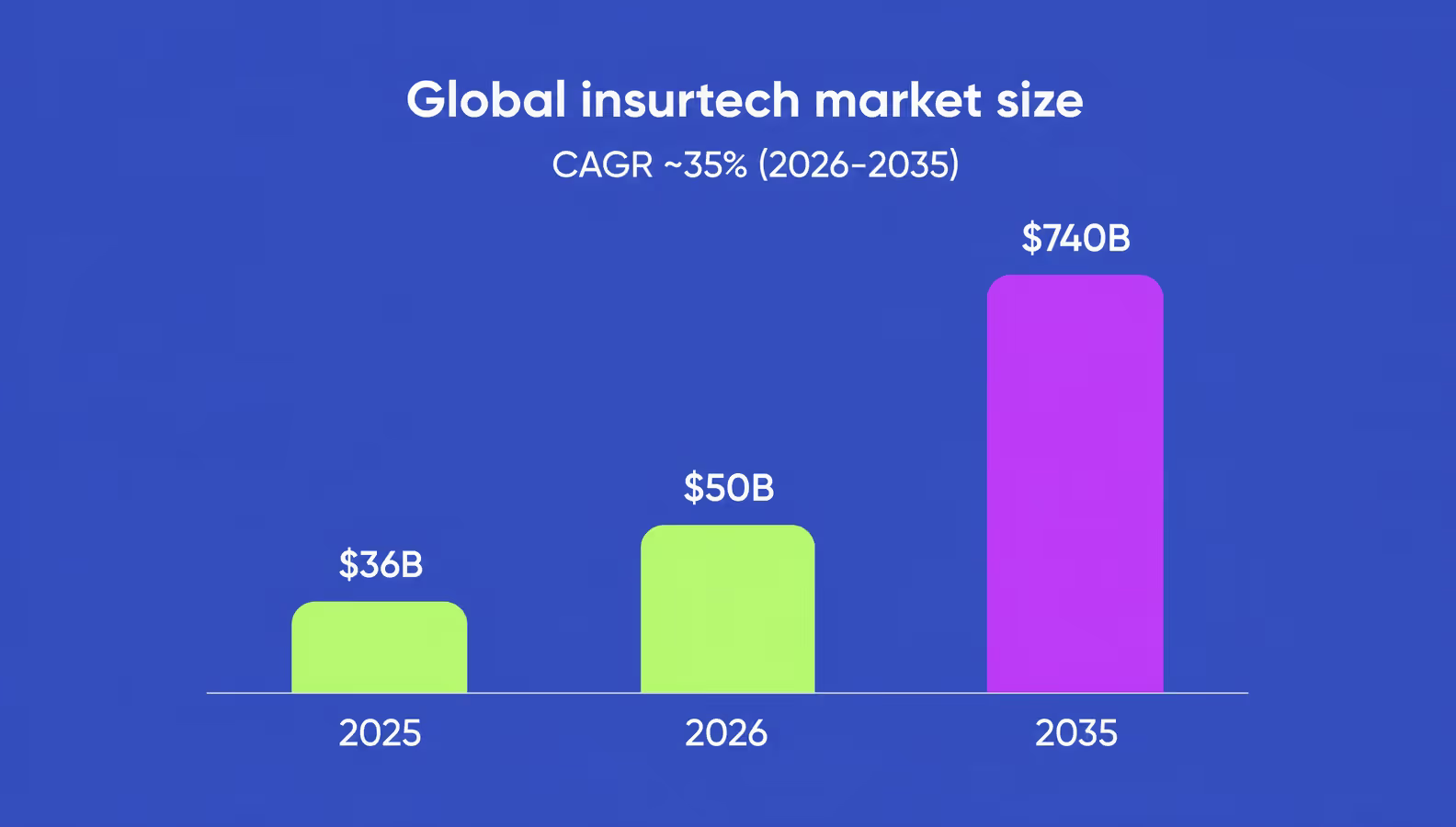
Global insurtech market size, 2025–2035 (Precedence Research)
We didn't rank vendors by size or marketing budget. We looked at the traits that actually predict whether a development partner can ship an insurance software solution that works in production, passes an audit, and holds up across a real insurance operation. Use the same seven criteria as your own checklist when you shortlist insurance providers.
| Criterion | What to look for |
| Domain expertise in insurance | Insurance-specific projects, not "we build software for any industry." A team with real expertise in the insurance sector already knows the edge cases — proration, endorsements, reserving — that sink generalist builds. Genuine expertise in insurance software development shows up in the questions a vendor asks, not the logos it shows. |
| Compliance and security | Regulatory compliance is not optional. Health insurance work triggers HIPAA. Almost everything touches SOC 2 and GDPR, and any payment flow adds PCI DSS. Requirements differ by line — P&C and life carry state filing and rate regulation, while health adds protected-health-information handling. Ask which frameworks the vendor has actually delivered against. |
| Integration expertise | Insurance systems rarely live alone. Your partner should have connected products to core platforms, payment gateways, data providers, CRM, and enterprise resource planning (ERP) tools. Interoperability between them, without re-keying data, is the real test. |
| Technology stack and architecture | A scalable insurance architecture built on cloud computing and API-first design won't need a rewrite when volume grows. Scalability, reliability, auditability, and clean data flows are non-negotiable, and scalable software here means graceful behavior under load, not just more servers. |
| Proven track record | Real cases and references beat claims. Named insurance carriers, measurable outcomes, and insurance case studies — not just adjacent fintech — show the team has done this before. |
| Engagement model and team composition | Fixed price, time-and-materials, or a dedicated development team, each fitting a different project. Check who is actually on the team: seniors, a project manager, QA, not just headcount. |
| Transparency and governance | Regular reporting, clear communication, and visible progress. If you can't see how the work is tracked during the sales conversation, you won't see it during delivery either. |
No single vendor tops every category, which is why the list below labels each company with a "best for" — the situation where its strengths matter most. The strongest insurance software development companies deliver tailored insurance software solutions, customized insurance software shaped around your lines rather than generic templates. The same discipline runs through any financial software development project. Match the partner to the problem, not to the pitch.
One clarification before the list. This is a roundup of custom development partners, the software developers you hire to build software around your processes. It deliberately excludes enterprise product suites like Guidewire, Duck Creek, Sapiens, and Vertafore, which are licensed core systems you configure, not shops that write custom code for you.
Choose a suite when you want a proven, configurable platform and can adapt to it. Choose a custom insurance software development company when your product or workflow needs software built around it. The companies below do the latter. After Purrweb they appear as a set of other notable insurance firms rather than a strict 1-to-9 ranking, because the right choice depends on your situation more than on any single order.

Purrweb builds insurance MVPs and custom insurance platforms for startups and product teams that need to launch fast. The model is design and development in one team, most often on React with a Node.js and Python backend, delivered fixed-price after a discovery sprint.
Typical work spans policyholder portals, claims management, underwriting automation, quoting software, and ML-based fraud detection. HIPAA, SOC 2, and GDPR are handled in the architecture from the start, so the insurance application ships audit-ready rather than patched later. A focused MVP commonly reaches real users in about four months.
With 550+ projects and 10+ years behind it, the team fits when speed and a single accountable partner matter more than a large enterprise rollout. See its custom insurance software development services for scope and cases.
We shipped KEM, a peer-to-peer payment app for the Kuwaiti market. That's fintech rather than insurance, but the delivery constraints rhyme with an insurtech MVP: the founders needed a fully working demo for investors before they had access to real banking rails.
Our fix was an API layer backed by simulated bank data that behaved exactly like the real thing. Every transfer ran end to end in front of investors, and once the client secured real bank access, the team could switch the API over to live data without rebuilding the app. That demo-ready MVP, delivered on a fixed budget, helped the founders close a $1M seed round, the same speed-to-proof a new insurance product needs to win its first backers.
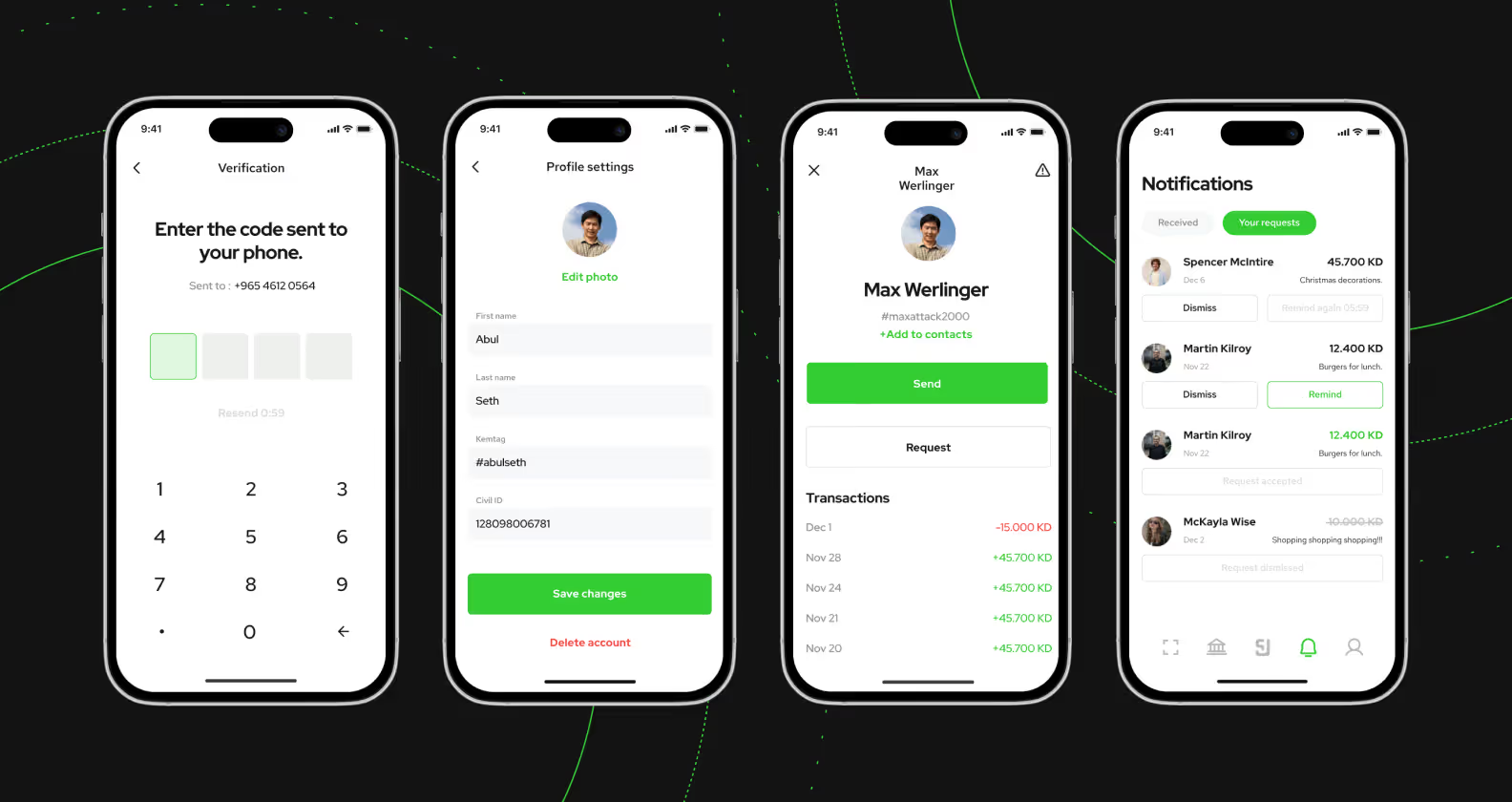
KEM — a P2P payment MVP we shipped for the Kuwaiti market
Best for: startups and product teams building an insurance MVP or custom insurance platform.
Itexus is a fintech-focused software developer that extends its custom development into insurtech. Its insurance projects cover policy administration, claims management, underwriting and risk assessment, and customer portals, with AI features layered in where they earn their place.
The financial technology background shows up in how the team handles payments, data, and integrations. That makes it a practical custom solution when your insurance product sits close to banking or embedded finance.
Best for: fintech-adjacent insurtech products that need AI features.
Working in insurance since 2011, DICEUS builds core-heavy platforms and specializes in wiring them into everything a carrier already runs. Its portfolio spans policy administration, an AI-based underwriting workbench, group and individual insurance management, insurance broker portals, reinsurance, and general-ledger platforms.
Integration is the standout. It connects products to core insurance systems, data warehouses, EMR/EHR, billing, CRM, and payment gateways, and names insurance carriers such as UNIQA and Vienna Insurance Group among its clients. Sub-domains cover health, life, P&C, captive, and auto.
Best for: mid-size to enterprise carriers that need deep core-system integration.

ScienceSoft has run custom insurance software development since 2012 and brings enterprise weight to it. Providing insurance software development services across many lines, it pairs professional insurance software development with enterprise scale, and its catalog is broad: core automation, underwriting, policy administration, claims processing, billing, analytics, actuarial, a document management system, and fraud detection.
The team is 350+ engineers with half at senior or lead level, and it holds ISO 9001 and ISO 27001 alongside Microsoft and AWS partnerships. Named cases include Brush Claims and a global aviation insurer, and its work covers life, health, auto, commercial, workers' comp, and specialty insurance business.
Best for: large insurers modernizing across many lines at once.
With 25+ years in software development, Itransition covers the full insurance stack: claims, underwriting, policy administration, insurance quoting, agency management, portals, and BI. It leans hard on data, with analytics, automated risk scoring, RPA, the Internet of Things (IoT), and blockchain all in play.
Cases include US CHIP health-insurance programs and an insurtech telematics app, and one quoting build reportedly handled 400+ new quotes and 20+ purchases per minute. Its enterprise resource planning (ERP) and distribution work suits carriers that want insurance distribution and back-office processes modernized together.
Best for: carriers wanting analytics-heavy modernization and automation.

Chetu is a large custom-software vendor with a dedicated insurance practice. Its focus is niche insurance modules and integrations: the specialized pieces that plug into an existing policy, claims, or quoting setup rather than replacing it.
That makes it a fit when you already run core systems and need extra functionality built and wired into your insurance processes. Its custom software solutions tend to extend what you have rather than force a rip-and-replace.
Best for: carriers needing niche modules and integrations into existing systems.

TechMagic is a product-development shop that builds insurance technology end to end: claims and policy management, a document management system, risk management software, quoting, and system modernization. Cloud, big data, real-time processing, and AI feature across its work.
An AWS Partner with 12+ years behind it, 400+ specialists, and a 92%+ client NPS, it runs the full cycle from discovery and prototyping through design, DevOps, QA, and security. That makes end-to-end insurance software development services its natural fit.
Best for: product teams building an insurtech product end to end.

OSP concentrates on health-adjacent insurance and claims-heavy workflows. It builds claim management, insurance data analytics, document management, risk management, insurance CRM, and policy management software.
Its claims tooling automates the flow from work assignment through investigation to settlement, and its risk features include fraud prediction. Sub-domains cover life, health, property, and casualty insurance claims, with a clear health emphasis.
Best for: health insurers and claims-heavy operations.

Stratoflow builds high-performance financial and insurance systems where throughput matters. It covers policy and claims management, underwriting, quoting, agency management, portals, and embedded insurance, on a Java, Spring, Kafka, and Hazelcast stack tuned for load.
With 20 years of custom development, it points to cases like a system handling one billion financial transactions in an hour, plus named clients Barclays and GetResponse. Its scalable software also suits legacy insurance platforms that have outgrown their original design. Sub-domains span life, healthcare, aviation, marine, and automotive.
Best for: high-load, performance-critical insurance systems.
Founded in 2004, Belitsoft focuses on custom insurance development and the modernization of insurance legacy software, often through staff augmentation. Its work covers medical claims case management, P&C underwriting tools and broker portals, policyholder apps, AI chatbots, and fraud analytics on a .NET and Azure stack.
Named cases include a John Hancock policyholder-notification system projected to save over $1M a year, and the Insly global insurance SaaS platform. For teams that value reliable custom insurance software development with flexible staffing, it is a steady pick across health, life, and P&C.
Best for: legacy modernization and flexible team augmentation.
The list narrows fast once you match a company to your actual situation. Three questions do most of the work, and each one turns the evaluation criteria above into a concrete decision.
Are you a startup or an established carrier? A startup or product team building a first product wants speed, a fixed budget, and design plus development under one roof, the profile Purrweb and other product shops fit. A large carrier replacing or extending core systems wants enterprise depth, integration muscle, and many-line coverage, which points to ScienceSoft, DICEUS, or Itransition.
Is this a new MVP or a modernization? Building insurance app development from scratch rewards a team that ships quickly and validates with real users. Modernizing legacy systems rewards one that has untangled old code before, like Belitsoft, and can migrate data without breaking what already runs.
Which line of insurance is it? Health work brings HIPAA and protected-health-information handling, so favor a partner with health cases, such as OSP. P&C and life carry state filing and rate rules. Performance-critical products with heavy transaction volume favor a high-load specialist like Stratoflow.
To choose an insurance software development partner with confidence, pressure-test the shortlist with concrete questions. Which insurance projects have you shipped in my line? Which compliance frameworks have you delivered against, and can you show it? How do you handle integration with my core systems and data providers? Who is on the team, and what is the engagement model? What does the cost of insurance software development look like for a project like mine, and what drives the pricing up or down?
The right answers are specific and backed by cases. Vague ones are a signal to keep looking. Good decision-making here comes from evidence, not from the loudest sales deck.
The right insurance software development company is the one that fits your line, your stage, and your compliance needs, not the one with the longest logo wall. Whether you need a full platform or a few insurance software development solutions added to what you already run, the goal is the same: insurance products that fit your business rather than off-the-shelf software products. Use the criteria and the shortlist above to narrow the field, then talk to two or three teams with real cases in your area.
If you are weighing a fintech-heavy build, our related guide to banking software companies covers adjacent ground. And if you want to sketch out an insurance MVP or platform, the Purrweb team is happy to talk it through.
They handle custom software development around a carrier's core processes instead of selling a fixed product. That usually means underwriting and risk assessment, policy administration, claims management, and quoting software, plus the portals and integrations that tie them together. A good partner also handles compliance and connects the new software to the systems you already run, so data moves without manual re-keying.
It depends more on scope than on the vendor. A focused MVP sits in the low-to-mid five figures, while a full platform with several integrations and strict compliance runs well into six or seven figures. The main cost drivers are the number of insurance lines, integrations with core and data systems, compliance requirements like HIPAA, and your team model. Ask for pricing tied to your specific scope, not a headline number.
A focused MVP commonly ships in about three to four months. A full custom platform typically takes six to twelve months, depending on how many integrations and compliance checks it carries. Legacy modernization can run longer because data migration and testing against old systems add time. Fixed-scope MVPs are the fastest way to put something real in front of users and investors.
Match the company to your situation. Weigh insurance domain expertise in your line, proven compliance delivery, integration experience, a track record of real cases, and an engagement model that fits your budget. Then pressure-test the shortlist with specific questions about projects they have shipped in your line and the frameworks they have delivered against. Specific, case-backed answers separate a real partner from a generalist.
Choose off-the-shelf when a licensed product covers your processes and you can adapt to it, since it is faster to stand up and cheaper upfront. Choose a custom insurance solution when your product or workflow is a differentiator, or when no product fits without heavy compromise. Many carriers do both, running a core suite while building custom software around the edges where they need to stand apart.
It depends on your line and region. Health insurance work requires HIPAA and careful protected-health-information handling. Most projects also need SOC 2 and, for EU data, GDPR, while any payment flow adds PCI DSS. In the US, state-level rules coordinated through the National Association of Insurance Commissioners (NAIC) shape P&C and life products. Ask the vendor to show where they have delivered against each standard, not just name them.


.svg)