Explore

Need help with your project?

Oops! Something went wrong while submitting the form.
Healthcare SaaS is cloud-based medical software delivered through a subscription. The provider hosts the application, while healthcare organizations use it online instead of maintaining on-premises installations. Products include EHR platforms, telemedicine, and practice management. For a founder, compliance, integrations, tenant architecture, and recurring costs are part of the product decision.

This guide follows the decision from product model and regulatory boundaries through build-versus-buy and development. It also explains cost and the trends shaping healthcare SaaS in 2026.
Healthcare SaaS applies software as a service to health care through a subscription model. The vendor hosts the software-as-a-service product, so hospitals and clinics avoid maintaining separate systems.
The term describes how cloud-based software is delivered, not what clinical job it performs. An electronic health record, scheduling system, or patient portal counts as healthcare software because of its function. The same healthcare product becomes SaaS software when the provider hosts one maintained platform for multiple organizations. Each customer’s users, settings, and data stay in a separate tenant.
On-premises software reverses that responsibility. A hospital or clinic runs the application on infrastructure it controls, plans upgrades, and maintains the operating environment. This approach gives the organization more direct control, but every deployment becomes its own technical project.
A SaaS application centralizes releases through cloud computing and reduces duplicated IT infrastructure while turning access into recurring revenue. It does not remove the customer’s compliance duties or make the vendor’s architecture secure by default. For founders, a SaaS solution’s commercial model and responsibility split matter as much as the product category.
Healthcare SaaS platforms and solutions support clinical and administrative work across modern healthcare services. These SaaS products solve different jobs, from storing medical records to running virtual visits and managing revenue.
In the healthcare SaaS market, healthcare companies evaluating SaaS product development first need a narrow buyer and workflow. A product for a private practice has different integration, permission, and onboarding requirements from software sold across the healthcare industry.
| SaaS type | What it does | Typical user |
| EHR/EMR platform | Stores patient records and supports clinical documentation | Health professionals in clinics and hospitals |
| Telemedicine | Handles remote consultations, communication, and e-prescriptions | Healthcare providers and patients |
| Practice management | Helps streamline operations across scheduling, billing, and administrative workflow | Medical staff in private practices |
| Patient engagement | Provides portals, reminders, forms, and education | Patient-facing teams |
| Analytics and RCM | Tracks performance, reporting, and revenue-cycle work | Administrators and payers |
Electronic health record (EHR) and electronic medical record (EMR) platforms often become systems of record. That raises the cost of migration and makes interoperability central to the sales process. Telemedicine and patient-engagement products sit closer to the patient experience. Practice-management and revenue-cycle management (RCM) software focuses on operational work.
SaaS for healthcare uses a subscription business model similar to fintech SaaS, but carries different data, integration, and regulatory constraints. The product type determines which constraints become part of the first release.
The benefits of SaaS in healthcare start with a lower infrastructure burden for each customer. One maintained product can serve many organizations through recurring subscriptions.
For a founder, the advantages of SaaS appear in four places:
We built Medico, a SaaS platform for oncology departments, with a mobile app for patients and a dashboard for doctors.
Doctors assign recurring health surveys and review uploaded test results. Patients report their condition between appointments instead of waiting for the next in-person visit.
The main constraint was timing. Oncologists spent valuable appointments on routine checks, while abnormal indicators could surface too late.
We made surveys the core workflow and configured the dashboard to highlight out-of-range results. The project started in June 2021, reached release readiness in December 2022 after legal-document delays, and launched in the app stores in January 2023.

Remote monitoring becomes valuable when it filters routine data and draws attention to changes that require a clinician
The model pays off when centralized delivery removes work that customers would otherwise repeat. A generic cloud copy of an existing process offers less value.
A strong product changes the workflow itself, such as collecting patient data between appointments or showing clinicians only the indicators that require attention. That distinction affects retention because customers renew software that becomes part of daily operations, not software that merely moves their servers elsewhere. This is the difference between a hosting decision and a product decision.
A healthcare SaaS product needs six foundations: tenant isolation, role permissions, integrations, audit history, useful analytics, and secure patient-data handling.
For a healthcare SaaS platform, this list is less about feature count than business risk. Each foundation protects the platform from a failure that becomes expensive after multiple healthcare organizations depend on it.
A single-tenant pilot can work when the data model and authorization design already account for later organizations. After SaaS adoption, retrofitting tenant isolation often changes the database, permissions, testing strategy, and support tools at once.
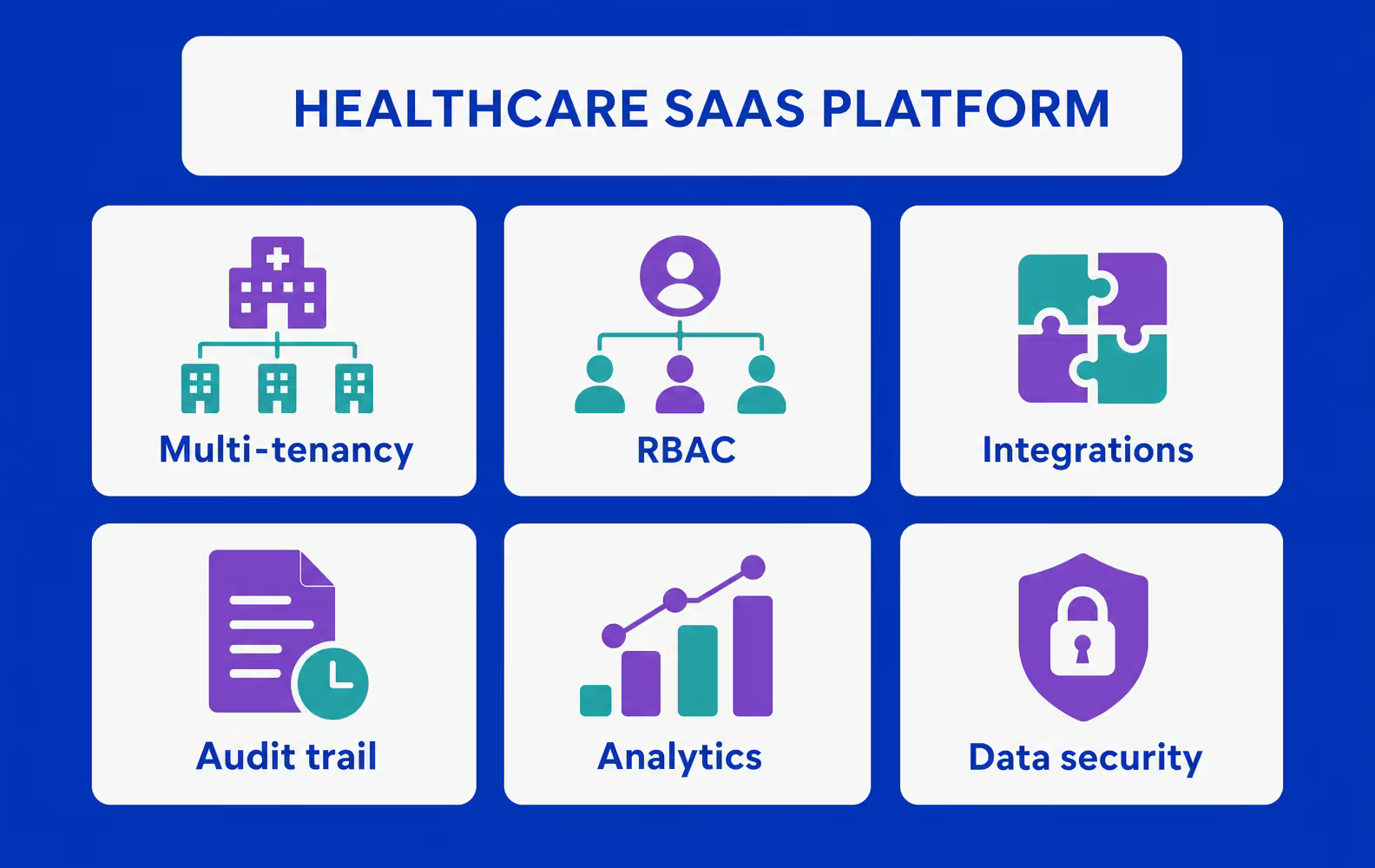
The product becomes harder to scale when tenant boundaries and auditability are postponed until after the first customer
Healthcare SaaS is not automatically HIPAA-compliant. HIPAA compliance comes from the contract, architecture, security and privacy controls, and operating processes used by both the vendor and the healthcare organization.
The Health Insurance Portability and Accountability Act (HIPAA) treats a cloud provider handling electronic protected health information as a business associate. HHS cloud-computing guidance applies this rule to vendors that create, receive, maintain, or transmit the data.
That remains true when the data is encrypted and the provider does not hold the key. The parties need a business associate agreement (BAA), and the healthcare organization still performs its own risk analysis.
| Regulation | Applies to | Product implications |
| HIPAA | US protected health information | BAA, access controls, encryption, audit logs, incident processes |
| GDPR | Personal data connected to people in the EU | Lawful basis, data minimization, user rights, retention, deletion |
| FDA SaMD | Software functions regulated as medical devices | Intended-use assessment, risk classification, validation, evidence |
GDPR changes both product behavior and internal operations. The platform needs a reason to collect each data field, a retention policy, and a way to handle access or deletion requests. Multi-tenant architecture also has to respect regional storage and customer-specific processing terms.
FDA oversight depends on what the software does, not whether it runs in the cloud. The FDA clinical decision support guidance separates certain non-device functions from software functions that remain regulated as devices. A product that analyzes data to drive clinical decisions needs an intended-use review before the team treats it as an ordinary analytics feature.
Regulatory compliance therefore starts during discovery. Data flows, vendors, permissions, audit requirements, and incident responsibilities shape the first architecture rather than a checklist added before launch.
Buying fits a standard workflow and a short launch window. Custom development fits products whose clinical process, integrations, data model, or intellectual property creates the differentiation.
Within common SaaS business models, white-label software sits between those choices. It provides a maintained core that the vendor rebrands and configures, while the underlying roadmap and technical boundaries remain outside the customer’s control.
| Approach | Best fit | Main trade-off |
| Buy existing SaaS | Standard workflow and urgent rollout | Fast access, but limited differentiation and vendor dependency |
| White-label | Standard core with custom branding or configuration | More control over presentation, but constrained product logic |
| Build custom | Proprietary workflow, deep integration, or owned IP | Higher initial investment, but control over roadmap and economics |
The decision becomes clearer when the team identifies what has to be unique. A custom interface alone rarely justifies a new healthcare product. A workflow that changes how providers collect data, coordinate care, or make decisions creates a stronger case. Teams can test that assumption through a focused healthcare MVP before funding the complete SaaS product.
The founders of Lytic Health, then called Clearstep, came to us with a healthcare chatbot concept and a $1,500 design budget.
They wanted to attract investment, so a complete product would have spent money before the core patient flow had been validated.
We proposed a clickable prototype that showed how patients entered symptoms, answered follow-up questions, and moved toward relevant care. The prototype stage took about 1.5 weeks.
The founders later raised $400,000. The case shows that choosing custom development does not require building the entire platform first. The first custom deliverable can test the workflow investors and users need to understand.

A focused prototype can test the product’s differentiating workflow before the full compliance and integration budget is committed
Developing a healthcare SaaS product follows six stages. The team defines the buyer, maps data and compliance, scopes the MVP, designs tenant boundaries, integrates systems, and validates the product. Each stage reduces a different commercial or regulatory risk before it reaches production.
Start with one expensive or slow workflow and the organization willing to pay for a better version. Name the daily users, decision-maker, and result the product changes.
Document where patient data enters, which cloud services store it, which vendors process it, and who can access it. This map reveals BAA, consent, retention, regional-storage, and audit requirements.
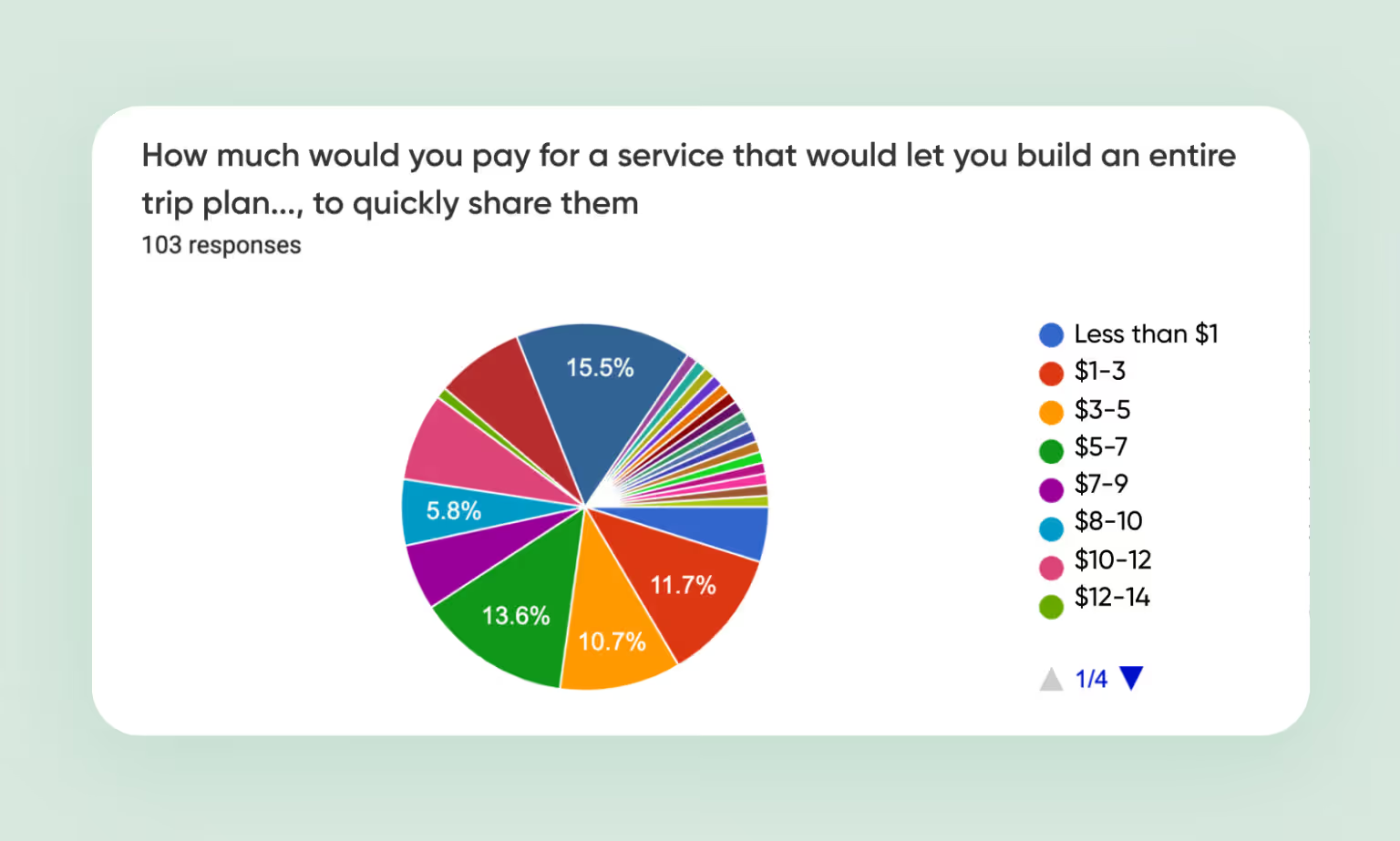
Discovery turns product assumptions into a testable scope before architecture and compliance decisions become expensive
A focused MVP proves one end-to-end workflow. It usually includes the core user roles, administration, audit events, and only the integrations required for the pilot.
Define how organizations, locations, users, and records relate before implementation. Tenant isolation and role permissions belong in the data model, API authorization, tests, backups, and support tools.
FHIR reduces some integration variance, but providers still use proprietary APIs and older HL7 interfaces. The wider medical software development plan needs time for vendor access, mapping, and test data.
Test clinical and administrative workflows with representative roles. After launch, audit logs, error monitoring, onboarding data, and support requests show where the product creates friction or risk.
Web products often use React or Next.js, while mobile teams may use React Native. A Node.js backend with PostgreSQL supports many MVPs. The technology behind modern healthcare infrastructure matters more than a fashionable stack.
Healthcare SaaS costs split into an initial product build and recurring operating expense. A focused MVP starts lower, while integrations, multi-tenancy, and mature compliance controls move a production platform into six figures.
| Scope | What is included | Ballpark cost |
| Focused MVP | Core workflow, essential roles, audit events, and one or two integrations | $40,000–$80,000 |
| Full product | Multiple organizations, EHR/FHIR integrations, analytics, and mature security controls | $100,000–$300,000+ |
| Ongoing operation | Cloud usage, monitoring, security work, support, and updates | Usage-based cloud bill plus roughly 15%–25% of the initial build per year for maintenance |
The first build is only the capital side of the model. A SaaS subscription also carries maintenance costs through cloud usage, support load, security reviews, legal work, and external integrations. A product with low hosting costs can still carry high operating expense when every customer requires a custom interface or manual onboarding.
The largest budget drivers are compliance depth, data migration, number of user roles, and integration quality. A broader healthcare app development cost estimate helps with mobile and clinical-product benchmarks. The SaaS forecast then adds tenant administration, recurring infrastructure, and customer operations.
We built FitnessApp as a web platform for coaches and a mobile app for their clients. It is an adjacent wellness product rather than a regulated healthcare SaaS case.
The initial MVP estimate was 1,200 hours. A deeper technical review showed that the desired scope was closer to 2,000 hours.
The constraint was fixed time and budget. We split the experience by role and moved nonessential features out of the first release instead of hiding the larger estimate.
The team shipped the reduced MVP in three months and stayed within the 1,200-hour frame. The case shows why SaaS budgets need technical review before the roadmap becomes a commercial promise.
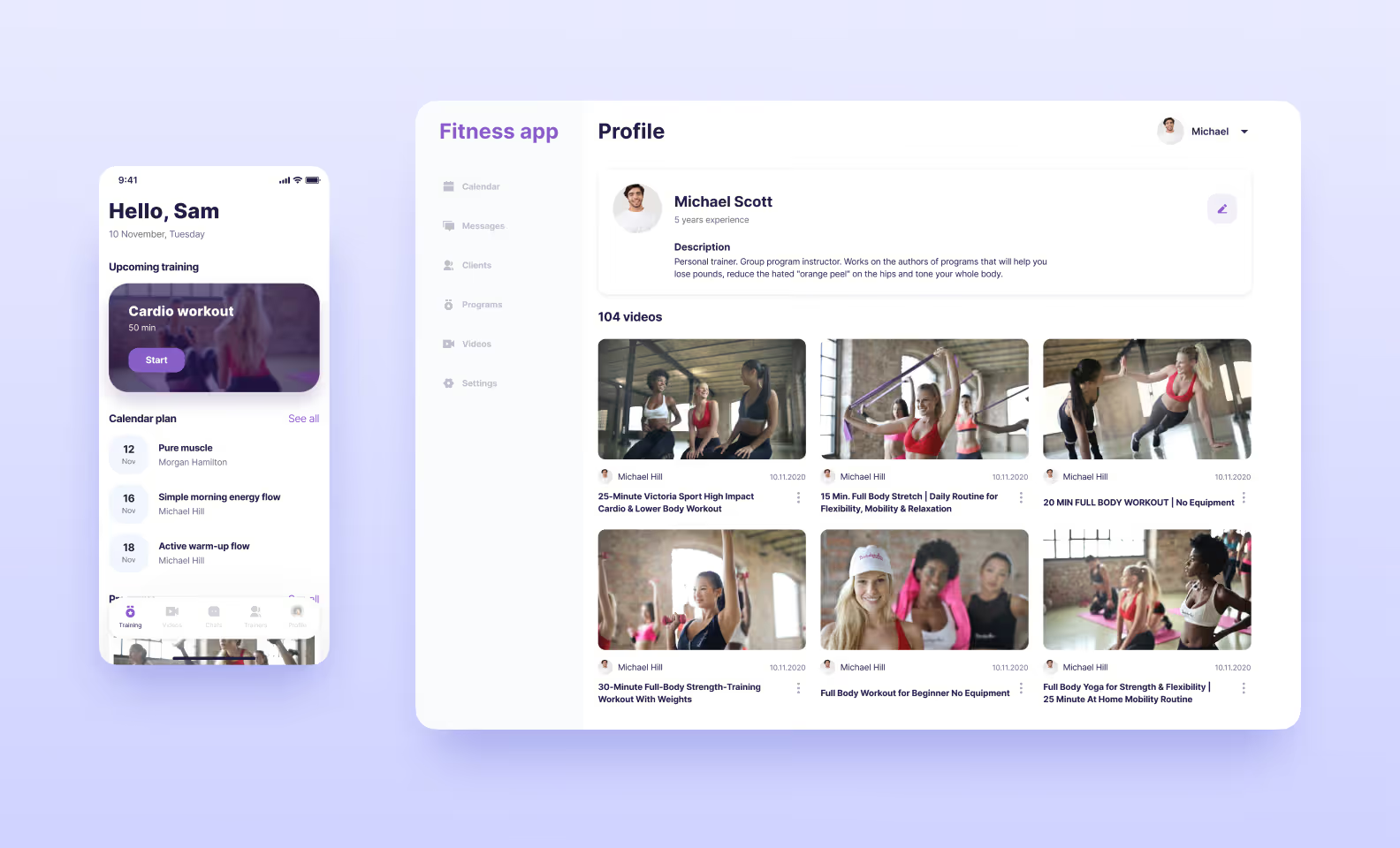
Scope control protects the launch date only when the team removes work rather than compressing the same work into fewer hours
The main SaaS trends in healthcare in 2026 are interoperable data exchange and narrower AI use cases. Remote-care workflows and analytics also matter more when they trigger clear action.
The healthcare SaaS market is mature enough that providers expect connectivity, but fragmented enough that integration remains a delivery risk. In 2024, about 90% of US hospitals enabled patient access through an API. Standards-based FHIR exchange is growing, while many organizations still depend on proprietary APIs and older HL7 interfaces.
Four trends carry the most weight for product decisions:
Digital transformation raises the value of good data architecture. They also punish products that add AI or integrations without a clear workflow, accountable owner, or operating process.
The strongest starting point is one healthcare workflow with a clear buyer and measurable operating cost. The team can then map patient data, compliance responsibility, tenant boundaries, and required integrations. Those constraints guide the choice between an existing platform, white-label product, and custom build.
A focused MVP tests the commercial assumption without pretending that compliance and interoperability can wait until later. The result is a smaller first release with fewer hidden architecture changes after customers arrive.
➡️ Planning a healthcare SaaS product? Tell us what you are building, and we’ll prepare a free project estimate within 48 hours.
SaaS in healthcare is medical software that a vendor hosts and maintains in the cloud. Healthcare organizations access it online through a subscription instead of installing a separate system on their own infrastructure. Common examples include EHR platforms, telemedicine, practice management, patient portals, and healthcare analytics.
Healthcare SaaS is not automatically HIPAA compliant. Compliance depends on how the vendor and healthcare organization handle protected health information. The arrangement normally requires a business associate agreement, encryption, role-based access, audit logging, incident procedures, and risk analysis. Both parties retain responsibilities under HIPAA.
A focused MVP often costs $40,000–$80,000. A multi-tenant product with EHR or FHIR integrations, analytics, and mature compliance controls often reaches $100,000–$300,000+. Cloud hosting, support, security work, and integration maintenance add recurring operating expense after launch.
A focused healthcare SaaS MVP usually takes a few months. The schedule depends on the number of roles, integration access, data migration, and the depth of compliance work. EHR integration and legal review often control the timeline more than interface development does.
Buying fits standard workflows and urgent rollouts. White-label software fits a standard core that needs branding or configuration. Custom development makes more sense when a proprietary clinical workflow or deep integration creates differentiation. It also fits teams that need to own the data model and long-term unit economics.
The core foundation includes tenant isolation, role-based access, EHR or EMR integrations, audit trails, useful analytics, and secure patient-data handling. The first release also needs administration, monitoring, recovery processes, and the controls required by its compliance model.


.svg)