Explore

Need help with your project?

Oops! Something went wrong while submitting the form.
IoT app development companies build the IoT apps that make smart devices useful: mobile and web companion apps, device-to-cloud connectivity, dashboards, and sensor-data processing. Some also handle firmware and the hardware side. That software layer increasingly decides whether a connected product succeeds or stalls — flawless hardware still fails if the app can’t hold a steady connection.

The vendors behind it vary widely, though. Some specialize in enterprise IoT platforms, others in a companion app for a single gadget. This guide compares ten of the top IoT app development companies worth considering in 2026: what each is best at, their tech stack, and delivery model. It also lays out how to match a partner to your own product.
Roughly 21.1 billion connected IoT devices were in use by the end of 2025, up 14% year over year, per IoT Analytics. Demand for the IoT apps behind them keeps climbing. An IoT app development company builds the IoT application that sits between a physical device and its user.
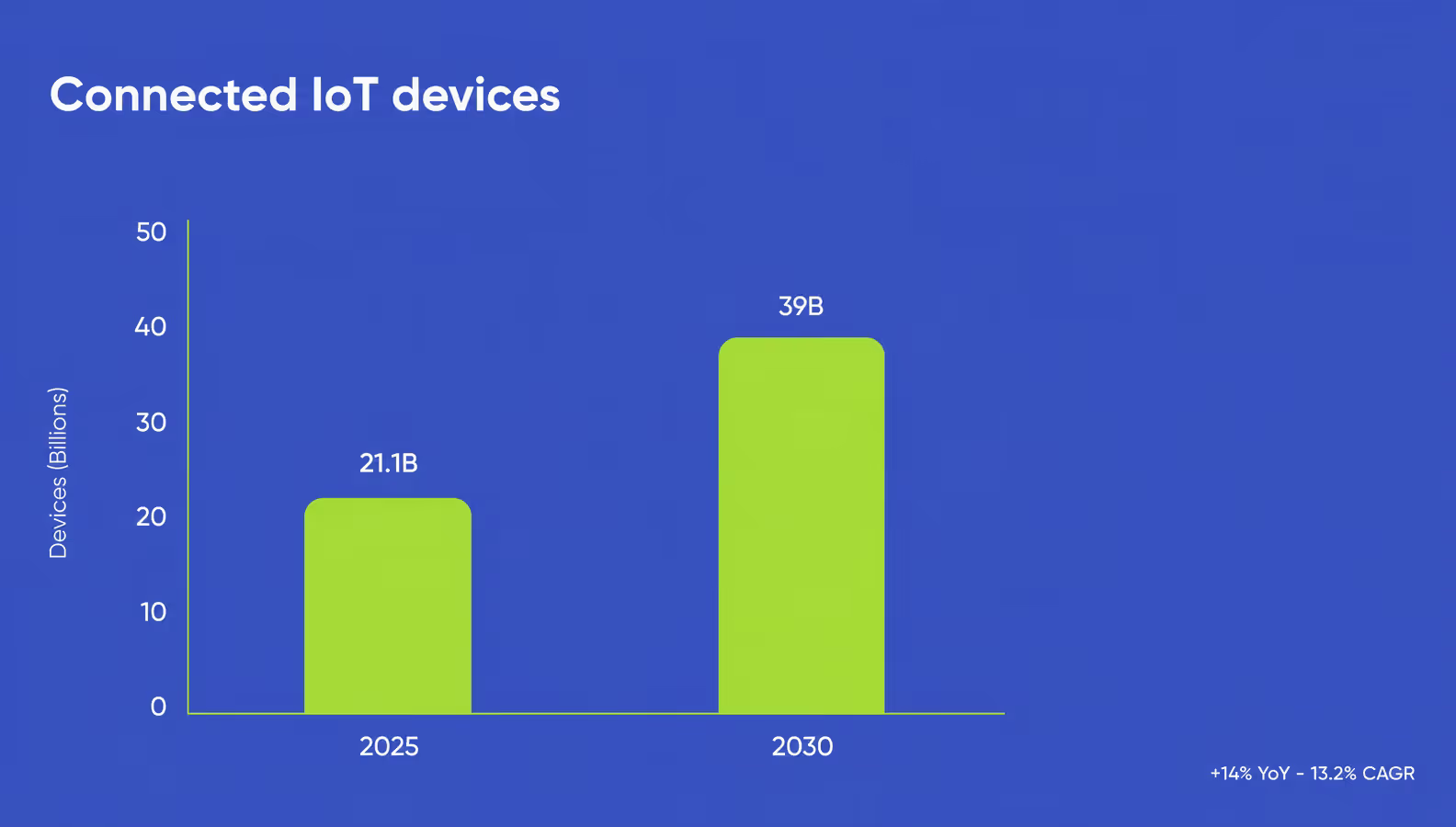
The installed base of connected IoT devices is set to nearly double between 2025 and 2030. Source: IoT Analytics.
Behind the buzzword, the Internet of Things is just physical objects that send and receive data. Turning that data into an IoT solution blends mobile app development, cloud computing, and increasingly artificial intelligence. In practice, IoT application development spans four things: companion mobile and web apps, device-to-cloud connectivity, dashboards, and processing the data streaming off sensors. You’ll see it labeled custom IoT app development, IoT mobile app development, or simply IoT software development, but it comes down to the same layers — mobile apps, connectivity, and cloud.
The companion app is the part most people picture — the mobile application that pairs with a smart lock, a fitness band, or a thermostat and lets you control it. Underneath, the harder work is connectivity. A device has to reach the cloud reliably over protocols like Bluetooth Low Energy (BLE), MQTT, or Zigbee, and keep that link when the hardware drops offline. These mobile apps have to stay in sync with the hardware in real time.
A dashboard then turns raw sensor readings into something a person or an operations team can act on. Behind it, a data pipeline stores, cleans, and analyzes the numbers. Good IoT apps also keep that data secure and make it simple to integrate IoT devices into an existing IoT system.
Most vendors also handle the parts that are easy to underestimate. Security and compliance matter the moment a device touches personal or medical data. Cloud integration ties the IoT solution into a platform such as AWS IoT, Azure IoT, or Google Cloud IoT, so the backend scales as the device fleet grows.
Some firms stop at software. Others go deeper into firmware, hardware, and IoT software development, covering the full IoT ecosystem from the chip to the app.
The scope you need depends on the product. A startup shipping one connected gadget wants tight IoT apps and clean connectivity. An enterprise rolling out thousands of industrial sensors needs analytics, device management, and edge computing. If you’re earlier in the process, our guide on how to develop an IoT app breaks down the build itself.
Picking a partner for a connected product isn’t like hiring a generic mobile app development company. The failure points are specific to IoT, so weigh IoT app development companies against criteria that actually predict how the build will go.
IoT experience and real cases. Look for shipped IoT apps and connected products, not a services page that lists “IoT” among twenty other keywords. Ask which protocols their IoT app developers have debugged and which devices they’ve paired with in production.
Hardware-to-app expertise. The messy part of any IoT app is the boundary between firmware and software. A partner who can sit with your hardware engineers — or who writes firmware themselves — saves weeks of finger-pointing when a device won’t connect.
Tech stack and cloud. Confirm they work with your protocols (BLE, MQTT, Zigbee, Wi-Fi) and your cloud IoT hub — AWS IoT, Azure IoT, or Google Cloud IoT. A mismatched stack means rework later.
Security and compliance. Connected devices are an attack surface. If your product touches health or payment data, secure IoT design and compliance (HIPAA, GDPR) can’t be an afterthought.
Delivery model and support. Fixed-scope MVP or an ongoing development team? And who owns the development process after launch, patching firmware and pushing OTA updates? A device you can’t update in the field is a liability.
AIoT expertise. New for 2026. Enterprise IoT spending is recovering after a slow 2024, and growth is shifting toward software and AI. Cloud IoT services now grow over 20% a year, per IoT Analytics.
More products want AI running on the device itself — anomaly detection, computer vision, predictive maintenance at the edge. A partner who can build AI into an IoT product, not just wire up sensors, is worth more in 2026 than a year ago.
Beyond the checklist, look at how a partner runs IoT development end to end — from strategy and prototyping to a secure, scalable IoT solution and post-launch support for your IoT apps. The right IoT development partner is the one whose IoT development services line up with your product, not the one with the longest client list.
Our own angle sits at the startup end: mobile-first companion apps in React Native, shipped as a fixed-scope MVP so a connected product reaches users fast. If that matches your situation, here are our IoT app development services.
The ten IoT development companies below all build IoT apps, but they solve different problems. Some are hardware-deep embedded shops, others mobile-first companion-app teams, a few enterprise platforms. Purrweb is first because this is our blog. The rest sit in no strict rank order, since the right choice depends on your product, not a scoreboard.
| Company | Best for | Delivery model | Key specialization |
| Purrweb | Startups & smart-device MVPs | Fixed-scope MVP | Mobile-first IoT companion apps, React Native |
| TechAhead | Enterprise IoT + cloud | Dedicated team | Connected apps, cloud/AWS, Edge AI |
| Appinventiv | Large IoT programs | End-to-end program | Full-stack IoT, IIoT, IoMT |
| Stormotion | Companion apps for hardware | Dedicated team | Hardware companion apps, BLE/Matter |
| Softeq | Hardware + software together | Full-stack one-stop | Embedded, firmware, IoT platforms |
| Intellectsoft | Industrial / enterprise IoT | Dedicated team | Industrial IoT, device management, digital twins |
| ScienceSoft | Data-heavy IoT | Consulting + full-cycle | IoT analytics, edge-to-cloud pipelines |
| Dogtown Media | Health / connected hardware | Project-based | mHealth, BLE medical apps |
| Sidekick Interactive | Native IoT mobile | In-house dedicated | Native companion apps, Bluetooth mesh |
| Oxagile | Video/streaming + IoT | Dedicated team | IoT + video analytics, computer vision |
Here’s each company in more depth, starting with ours.
Purrweb builds mobile-first companion apps for connected products, working mostly with startups and teams shipping a smart-device MVP. The angle is speed: a fixed-scope MVP in React Native, with a set timeline and budget. That gets a connected product to real users instead of stalling in an open-ended build.
It’s a fit for founders who have the hardware side handled, in-house or through a manufacturer, and need the app, connectivity, and UX built fast. The team covers UI/UX, the mobile app, and the device-to-cloud layer on a React Native / Node.js stack. That includes the connectivity work IoT turns on: BLE pairing, QR and deep-link flows, and payment or RFID integration where the product needs it.
We built the React Native companion app for Vendify, a startup putting smart fridges of fresh food into offices and hotels. The app had to nail one flow end to end: walk up, scan a QR code, unlock the fridge, and get charged for exactly what you took.
The hard part was trust without a cashier. We linked bank cards through Stripe, then added an RFID anti-theft layer — a 300-second timer that reconciles what leaves the fridge against what the customer actually paid for, with deep links handling the QR-to-app hand-off. The whole build shipped in six weeks.
Read the Vendify smart-fridge case study →
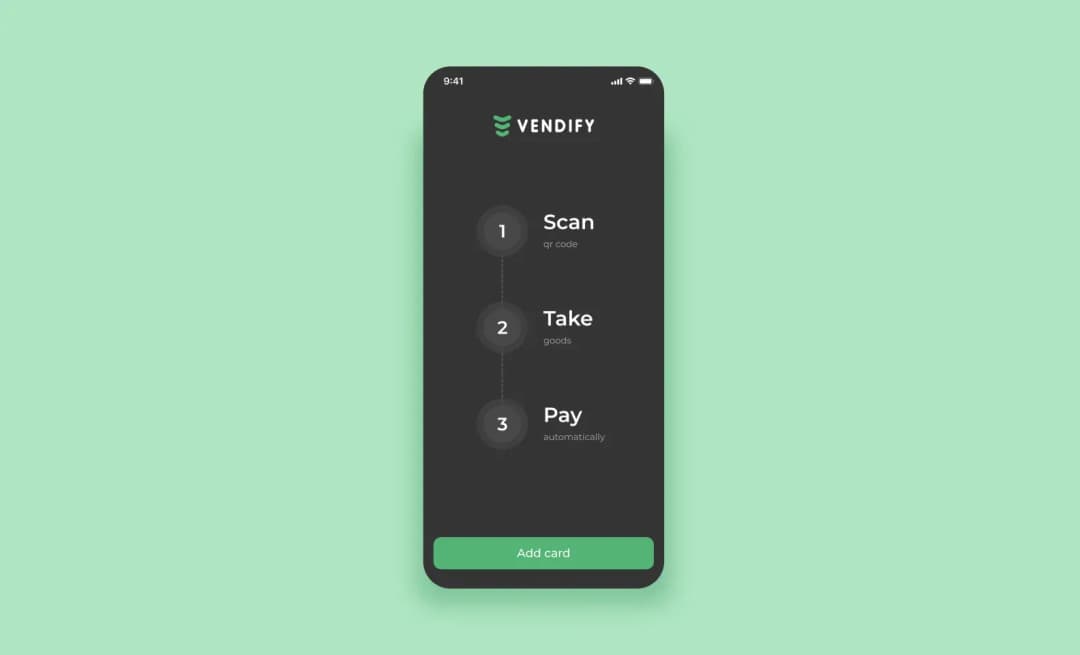
Vendify’s companion app: QR-scan fridge unlock and card-linked checkout, built in React Native
Beyond smart fridges, our first IoT project pushed the same playbook further. That power-bank rental network ran on Chinese-made stations and needed three separate apps — for renters, advertising, and maintenance. It also meant reverse-engineering undocumented firmware before the stations would come online.
TechAhead is an enterprise-focused app and software company that has leaned hard into AI-native and connected systems. For IoT, that means full IoT platform builds, industrial IoT, and Edge AI — intelligence that runs on the device rather than in the cloud. It also builds companion apps for wearables and smart TVs.
It’s best for larger organizations and enterprise programs — health and wellness, proptech, manufacturing, energy. In those, the app is one piece of a bigger connected-operations rollout. The team pairs React Native on the front end with cloud work as an AWS Advanced Tier partner and on Azure, so telemetry and analytics scale as the device fleet grows.
Its connected-product portfolio includes Human Touch, a wellness platform spanning a large base of connected devices. Others are Boxlty for smart real-estate access and Heatmiser for smart-home heating control. The through-line is enterprise-grade IoT, where cloud, analytics, and increasingly AI matter as much as the mobile app itself.
Appinventiv is a digital product engineering and consulting firm that runs IoT as a full practice rather than a side offering. It covers IoT consulting, custom IoT app development, and the layers around them: wearables, industrial IoT, the Internet of Medical Things, and IoT data analytics.
It’s best for enterprises and established brands rolling out high-device-density products where compliance and scale are non-negotiable. The tech stack is one of the broadest on this list.
On protocols, it runs from BLE and Zigbee to LoRaWAN, NB-IoT, Modbus, and OPC UA. Cloud IoT sits on AWS IoT Greengrass, Azure IoT Hub, or Google Cloud IoT Core, with data tooling like Kafka, Kinesis, and InfluxDB. Apps ship in React Native, Flutter, or native Swift and Kotlin.
Representative work includes ActiDrive, a touch-free driver-assistant app that reads vehicle sensor data through gestures. Another is ILITY, a property platform with IoT-connected building systems. The pattern is end-to-end IoT programs — consulting through data pipeline — for companies that need the whole stack under one roof.
Stormotion is a specialist that builds companion apps for connected hardware, and says so plainly. It works directly with a client’s hardware engineers rather than acting as a general mobile shop.
That focus shows up in the unglamorous parts of IoT — protocol discovery and validation, real-device testing, and support for many hardware revisions. It also means holding a stable connection and shipping OTA updates.
It’s best for startups and smaller companies with a physical product — connected fitness, e-mobility, energy and battery systems, remote health monitoring, kiosks. The stack is React Native with Expo and a NestJS backend, plus native Kotlin and Swift where needed. Protocol coverage is broad: BLE, Zigbee, Matter, Thread, Serial, LoRaWAN, and Wi-Fi, with AWS or GCP behind them.
Named projects map to that hardware range. STEPR is a home stair-climber on a serial connection. Norsk Guardian is a marine battery monitor on BLE, Egret a line of e-scooters, and Milence an app for EV-charging terminals.
Softeq is one of the few companies here that can build the whole connected product in-house. That covers hardware, firmware, embedded software, mobile and web apps, and the cloud behind them. If a project needs a custom PCB, an enclosure, sensor middleware, and a companion app, Softeq treats that as one scope rather than three separate vendors.
It’s best for hardware-anchored and embedded-heavy IoT, from startups to enterprise. The work spans industrial IoT — predictive maintenance, machine vision, robotics — plus consumer devices like wearables and pet trackers, and healthcare IoT.
On the stack, that means embedded and RTOS work at the low level, AOSP for custom Android devices, and connectivity over NFC, Wi-Fi, BLE, and RFID. Cloud IoT runs on AWS IoT Greengrass, Azure IoT Hub, or Google Cloud IoT Core, with dashboards and HMIs on top.
A representative build is the SNOO Smart Bassinet. Softeq handled the app, backend, and firmware together, including the sound sensors that detect a baby’s cry and respond. That full-stack reach is the reason to pick them: fewer handoffs between the chip and the app.
Intellectsoft is a custom software and AI engineering firm that treats IoT as a dedicated R&D practice — it runs several innovation labs, one of them focused on IoT. The offering leans toward enterprise operations: IoT integration, device management, IoT security, and turning collected data into useful analytics.
It’s best for industrial and enterprise IoT: asset and inventory tracking, digital twins, and operations optimization. Verticals span manufacturing, healthcare, construction, logistics, and retail.
Unusually, the IoT lab also offers turnkey hardware design, from prototype to custom Android firmware. A client without a hardware team can still get a connected product built. On connectivity, the stack centers on RFID and Bluetooth, extended by Wi-Fi, cellular, Zigbee, and NFC, with Azure IoT on the cloud side.
One documented example is a smart-fridge solution for a vending manufacturer: an Android app paired with RFID for remote monitoring of stock and machine status. The consistent theme is enterprise digital transformation — IoT as a way to instrument and optimize existing operations, not just ship a consumer gadget.

ScienceSoft is an IT consulting and full-cycle development firm with a long track record. Its IoT practice is built around data, moving it cleanly from the edge to the cloud.
That starts before any code, with IoT strategy and hardware-selection consulting. From there it covers edge computing and machine-learning setup, plus device-control and end-user apps across web, mobile, AR, and voice. App management and security round it out.
It’s best for data-heavy, analytics-driven IoT — healthcare monitoring, manufacturing, smart cities, supply chain. The value is in what the sensor data tells you.
The stack reflects that: AWS IoT Core and Greengrass, Azure IoT Hub and Central, plus IoT platforms like ThingsBoard and ThingSpeak. Big-data tooling — Kafka, Spark, Cassandra, Hadoop — sits behind apps in .NET, Java, Python, Node.js, or React Native. A documented project is AKLOS Health, an IoT physiotherapy MVP delivered in about six months, using motion-capture to track a patient’s exercises.
Dogtown Media is a mobile app studio working across AI, AR, IoT, and — most distinctively — connected health. Its IoT work is almost entirely mHealth: Bluetooth-connected medical and wearable apps, remote patient monitoring, and digital therapeutics. It also handles the HIPAA-compliant plumbing that healthcare apps legally require.
It’s best for health and mHealth companies, from VC-funded startups to established providers, that need a connected device paired with a compliant mobile app. The stack is native iOS and Android plus HTML5, with BLE for device connectivity. Prototyping hardware like Raspberry Pi and Arduino wires to a backend and API — enough to stand up a connected-health proof of concept end to end.
A documented example is an app built for the Minneapolis Heart Institute that gives physicians cardiovascular emergency protocols on mobile. For teams building where a medical device meets a phone — and who can’t treat compliance as optional — that health focus is the reason to shortlist them.

Sidekick Interactive is a custom app and software agency that keeps development in-house rather than outsourcing. It positions itself as a mobile specialist for connected devices. Its IoT work centers on the pairing-and-control layer: Bluetooth and Bluetooth mesh, device pairing flows, Wi-Fi provisioning, and real-time control from the app.
It’s best for hardware and connected-device products, with a healthcare and enterprise lean. The team wants native performance and direct control over the codebase. That shows in the stack: native iOS in Swift and Android in Kotlin, with React Native and Flutter available. The backend is AWS and Azure with .NET, and BLE plus Bluetooth mesh handles multi-device setups. AR/VR and EV-charging integrations round it out.
Named projects include a Bluetooth Mesh device-manager app for ABB and an IoT pairing, alerts, and dashboard app for Aerofoam USA. Others are a native BLE connection for Sembit’s EV chargers and a device-paired clinical-trial app for Factually Health. If you want native code and mesh networking rather than a cross-platform shortcut, that’s the niche.
Oxagile is a software development company best known for online video: OTT platforms, live streaming, and real-time communication. A secondary practice pairs IoT with computer vision and machine learning. That combination is its distinguishing angle: not just collecting sensor data, but running video and AI analytics on top of it.
It’s best for video- and data-heavy projects where IoT feeds into analytics rather than a simple companion app. Reported IoT work spans industrial IoT, automotive sensor-to-AI dashboards, agriculture, healthcare, and smart parking. It generally combines device data with computer-vision analysis.
Oxagile’s public site is harder to access than most, so its exact IoT protocol stack and named client cases are less visible than others here. If it looks like a fit on paper, ask directly about connectivity protocols, cloud IoT platforms, and comparable connected projects before you shortlist. Where it stands out is the overlap of IoT with video and vision AI, a niche few others here focus on.
There’s no one-size-fits-all winner here. The right IoT app development company depends on what your product actually needs. A consumer gadget calls for a companion-app specialist or a mobile-first team. Instrumenting a factory points to an industrial or data-heavy partner. Needing hardware and firmware under one roof means a full-stack shop.
Match the vendor to your hardest problem — connectivity, compliance, analytics, or speed to MVP — rather than to a ranking. If you want to go deeper on where the field is heading, our breakdown of IoT development trends covers what’s changing in 2026.
➡ Ready to get your IoT app off the ground? Tell us about your device and get a free project estimate within 48 hours.
They design and build software for smart devices: companion mobile and web apps, device-to-cloud connectivity, dashboards, sensor-data processing, and security. Some also handle hardware and firmware.
It depends on hardware complexity, the number of platforms and the scope of integrations. An MVP costs less, while an enterprise program costs several times more. It’s better to scope the work feature by feature than to price it by an hourly rate.
Look at their IoT case studies, hardware-to-app expertise, tech stack and cloud, security and compliance approach, delivery model, and post-release support.
Mobile (React Native or native), backend, cloud IoT hubs (AWS IoT, Azure IoT, Google Cloud IoT), protocols like MQTT, BLE, and Zigbee, plus analytics and edge computing.
A companion MVP can take from a few weeks to a couple of months. A full platform with hardware and integrations takes longer. Device complexity and the number of integrations drive the timeline.