Explore

Need help with your project?

Oops! Something went wrong while submitting the form.
Running a successful business is now impossible without establishing a strong online presence. If a company isn’t on the Internet, it simply doesn’t exist — at least for the younger audiences. Creating a web portal solves this problem and gives you a neat tool to streamline some of your business processes. And if you don’t want to build it by yourself, you can always outsource this task.
In this article, we’ll be looking at some of the best digital agencies in the market — the perfect choices for web portal development.
Quick answer
Web portal development is the process of building a secure web application that gives a defined group of users — customers, partners, employees, patients or vendors — a single access point to data and workflows. Modern portals centralize processes from separate systems (CRM, ERP, intranet, learning management system), improve user experience through role-based navigation, and scale with the business. The 10 top web portal development companies in 2026 work across healthcare (patient portals), fintech, e-commerce and supply chain.
| Company | Services |
| Purrweb | web development, mobile app development, UI/UX design, QA testing, project management, analytics, DevOps |
| AMP Agency | mobile & web development, SEO, analytics, integrated marketing, strategic planning, content creation, social media management |
| SmartSites | web development, PPC advertising, SEO, email & SMS marketing, social media marketing |
| Integral Vision | web design & development, post-launch support |
| PopArt Studio | web design & development, graphic design, internet marketing |
| WebFX | web design & development, internet marketing, social media advertising, SEO, infographics & motion graphics |
| Imaginary Cloud | web development, mobile app development, data science, AI, UI/UX design, UI audit, core audit |
| The Software House | web development, mobile app development, quality assurance, cloud engineering, data engineering, software architecture, DevOps |
| CSI Media | web development, mobile app development, software development, UI/UX design, branding, marketing, graphic design |
| Celadon | web development, mobile app development, software development, UI/UX design, MVP, quality assurance, consulting, DevOps |
⚙️ Services: web development, mobile app development, UI/UX design, QA testing, project management, analytics, DevOps
🔎 Website: https://www.purrweb.com
🖤 Rating on Clutch: 4.9
Purrweb is a custom software development company with a flexible, UX-driven approach to creating digital products. It boasts a team of 200 specialists with diverse stacks and skill sets: there are developers, UI/UX designers, testers, managers, analysts, and DevOps. The company uses Scrum principles to provide maximum transparency, minimize technical debt and quickly adapt to the requirements of any particular project. The company also has a special love for startups, developing minimum viable products (MVPs) that help test business hypotheses.
Since 2014, Purrweb has implemented more than 300 projects in fintech, foodtech, healthcare, transportation, e-commerce, and many other segments. Whatever your niche, they’ve most likely already worked with it — and if not, the cross-industry experience will help them quickly catch up to speed.
⚙️ Services: mobile & web development, SEO, analytics, integrated marketing, strategic planning, content creation, social media management
🔎 Website: https://www.ampagency.com
🖤 Rating on Clutch: 4.7
AMP is a full-cycle digital agency that creates corporate ecosystems. Specializing in consumer electronics, gaming, fashion, travel, CPG, and entertainment. They offer a wide range of services aimed at establishing your brand’s online presence, which includes everything from strategic planning and analytics to portal development services and integrated marketing.
AMP Agency boasts a diverse palette of long-term customers, which features the likes of XBOX, Playstation, Nike, Patagonia, ASUS, and Garnier. At one point, it even helped Riot Games build an esports platform for League of Legends, an immensely popular MOBA title. The company also won several Hatch Awards for its achievements in digital marketing.
⚙️ Services: web development, PPC advertising, SEO, email & SMS marketing, social media marketing
🔎 Website: https://www.smartsites.com
🖤 Rating on Clutch: 5.0

SmartSites focuses on web development and digital marketing. It’s the perfect choice if you need a reliable, secure, and easy-to-manage web portal with SEO optimization and fast load times. On top of that, the company employs certified PPC experts who will help you identify your target audience and build an effective marketing strategy. You can also outsource social media management and strengthen your brand’s identity with personalized content and graphics.
SmartSites has worked with many lesser-known US brands, small businesses, and even non-profit organizations — for example, Everything Koi, ACL Testing, Agile Data Sites, Anexio, Arcarius, and Community Blood Services.
⚙️ Services: web design & development, post-launch support
🔎 Website: https://integralvision.eu/en
🖤 Rating on Clutch: 5.0
Integral Vision is a web development agency that plans, designs, and develops websites using open-source technologies — primarily Drupal, Node.js, Vue.js, and Solr. The company values autonomy, transparency, and responsibility, while investing in forming flexible and efficient teams. The people who work here also welcome innovation: in the past few years, they launched two scripts, Ingrid and Ivan, that generate reports, oversee upgrades and handle repetitive tasks.
Integral Vision works in an impressive array of business segments: it has implemented projects in culture, civil infrastructure, healthcare, energetics, transportation, education, and catering.
⚙️ Services: web design & development, graphic design, internet marketing
🔎 Website: https://www.popwebdesign.net
🖤 Rating on Clutch: 5.0
A self-proclaimed “boutique of digital art,” PopArt Studio is a full-cycle agency that covers the needs of both startups and established companies. It uses Javascript, ReactJS, PHP, MySQL, Laravel, Symfony, and WordPress to build unique and highly-functional business solutions. An in-house team of experienced designers will help you create a corporate identity and outstanding visuals, while the digital marketing department will bring in more traffic and increase conversion.
PopArt Studio has worked with a wide range of both local and international brands. Here are some examples: Avocado Systems, Luqrum, Corserva, BeatGate, and Keplertek. A while back, the company even designed the web portal of Serbia’s Ministry of Finance — talk about recognition.
⚙️ Services: web design & development, internet marketing, social media advertising, SEO, infographics & motion graphics
🔎 Website: https://www.webfx.com
🖤 Rating on Clutch: 4.9
WebFX is an agency that specializes in digital marketing and web development. It’s the go-to place for those who are looking for a one-stop solution: the development company will not only build a web portal but also promote it and help with lead generation. In addition to this, WebFX runs its very own custom-built platform called MarketingCloudFX, which helps clients increase sales, leads, and organic traffic by unifying and analyzing various data sources.
To date, WebFX has cooperated with brands such as Hilton, Fujifilm, Subway, Peapod, and Verizon, as well as with countless small businesses — from record stores to pediatric dentists. All of this makes for an impressive portfolio with many successful projects.
⚙️ Services: web development, mobile app development, data science, AI, UI/UX design, UI audit, core audit
🔎 Website: https://web.imaginarycloud.com
🖤 Rating on Clutch: 5.0
Imaginary Cloud is yet another full-cycle agency that will take your project all the way from concept and MVP, to post-launch audits and support. And if you need to outsource web portal development, this company will create a responsive and user-centric solution using the principles of the Agile Development Process — it helps reduce technical debt and time to market (TTM). Imaginary Cloud’s stack includes React, Angular, Vue, and Webflow for the front-end, combined with Node.js, Python, Ruby on Rails, and Django for the back-end.
The agency has implemented projects in many business segments — including construction, healthcare, education, and finance, just to name a few. It has also worked with several renowned brands, such as Nokia, Sage, and RE/MAX, and it offers web portal development services.
⚙️ Services: web development, mobile app development, quality assurance, cloud engineering, data engineering, software architecture, DevOps
🔎 Website: https://tsh.io
🖤 Rating on Clutch: 4.8
The Software House builds complex cloud-based solutions for businesses of any scale. Its stack includes pretty much everything you need for solid front-end and back-end development: Node.js, React, Vue.js, Next.js, Symfony, and Laravel. The company also has expertise in DevOps, software architecture, and cloud engineering, so you can really go deep if you want to — all with the help of more than 170 specialists. TSH follows the principles of the Agile methodology, which is ideal for eliminating unnecessary costs and speeding up the whole process.
Fintech, private banking, real estate, e-commerce, logistics, event management — TSH has plenty of experience with almost every major sector, so the teams here boast an impressive cross-industry knowledge.
⚙️ Services: web development, mobile app development, software development, UI/UX design, branding, marketing, graphic design
🔎 Website: https://www.csimedia.net
🖤 Rating on Clutch: 4.8
CSI Media has 25 years of experience in building custom web portals with rich functionality, sophisticated architecture, and user-friendly interfaces. This development company is a reliable partner if you need either a B2C or B2B portal for e-commerce, logistics, resources management, or pretty much any other purposes. In addition to web development, CSI can help you with branding and marketing, making it a great one-stop choice for virtually any business.
CSI Media has established itself as one of the leading web development agencies in the UK. Some time ago, it was even tasked with creating a new portal for the Commonwealth Parliamentary Association — an organization that supports good governance, democracy, and human rights all across the world.
By the way, if you're considering hiring a team in UK, you can check out the app development cost to better understand the local market rates.
⚙️ Services: web development, mobile app development, software development, UI/UX design, MVP, quality assurance, consulting, DevOps
🔎 Website: https://celadonsoft.com
🖤 Rating on Clutch: 5.0
Celadon is a software development company building custom-tailored web solutions — web portals included. Its team utilizes an impressive stack, featuring more than 15 multifaceted technologies from JavaScript and Python to MySQL and TensorFlow. Celadon also conducts several types of testing and audits, creates MVPs, designs web portals, and offers DevOps services.
The company has amassed a notable portfolio of projects across agriculture, education, entertainment, real estate, e-commerce, logistics, and even the music industry.
Now let’s cover the theory behind web portals: what these are and why people need them.
In the most basic sense, a web portal is a web application that receives information from multiple sources and centralizes it in a clear and coherent way for a specific group of users. But usually, there’s more to it. Many web portals also house interactive services and sometimes even unite disparate websites, creating solidified multifunctional platforms.
The aim of a typical web portal is to consolidate as many services as possible in order to attract a large number of leads (Google) or to streamline the inner processes of a business or an organization (basically any corporate system). An intranet is one specific kind of web portal that delivers a unified user experience for a single role — usually the employees of a company.
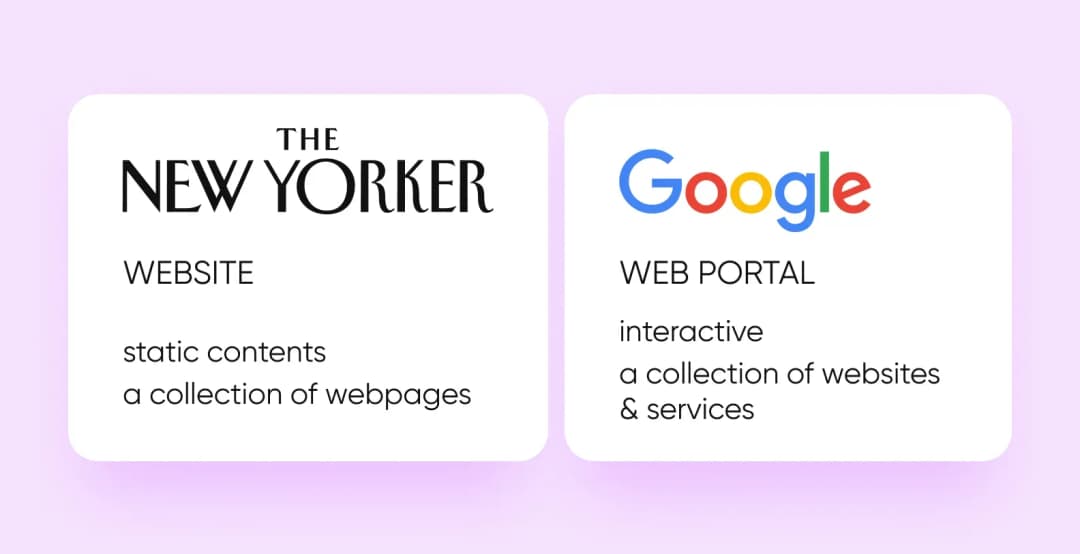
A website is a collection of thematically related web pages with static information. You can see their contents, but can’t really interact with them — apart from performing basic actions like logging in/out or buying a subscription. For example, The New Yorker, is a website, like most of the other news media are.
A web portal is a much more sophisticated system. You can think of it as an interactive superstructure that contains both websites and web applications, thus handling multiple tasks simultaneously. Some web portals require mandatory authentication, but that’s not always the case. All of this may sound a bit obscure, but you actually interact with web portals on a daily basis — every search engine, from Google to Yahoo, is a web portal. Every online store, too.
Two practical differences stand out. Portals provide role-based navigation, while websites usually have open navigation that anyone can browse. Portals also execute workflows — submitting forms, approving requests, pulling reports — while websites primarily deliver static content. The web-app layer underneath relies on custom web application development patterns that the surrounding portal orchestrates under one access point.
Modern web portal development covers many types of web portals, and which one fits depends on who logs in and what they do. The most common ones are:
Two older categorical splits are still worth knowing, since they describe how portals behave rather than who uses them.
Public portals. Search engines, marketplaces, forums, social media, and e-mail services are all public portals. Anybody can easily access them via the Internet by clicking on a link, but in some cases, you’ll have to sign in to perform any actions — for example, unauthorized users usually can’t post on certain forums. These portals aim to attract as many leads as possible because traffic is important for their revenue.
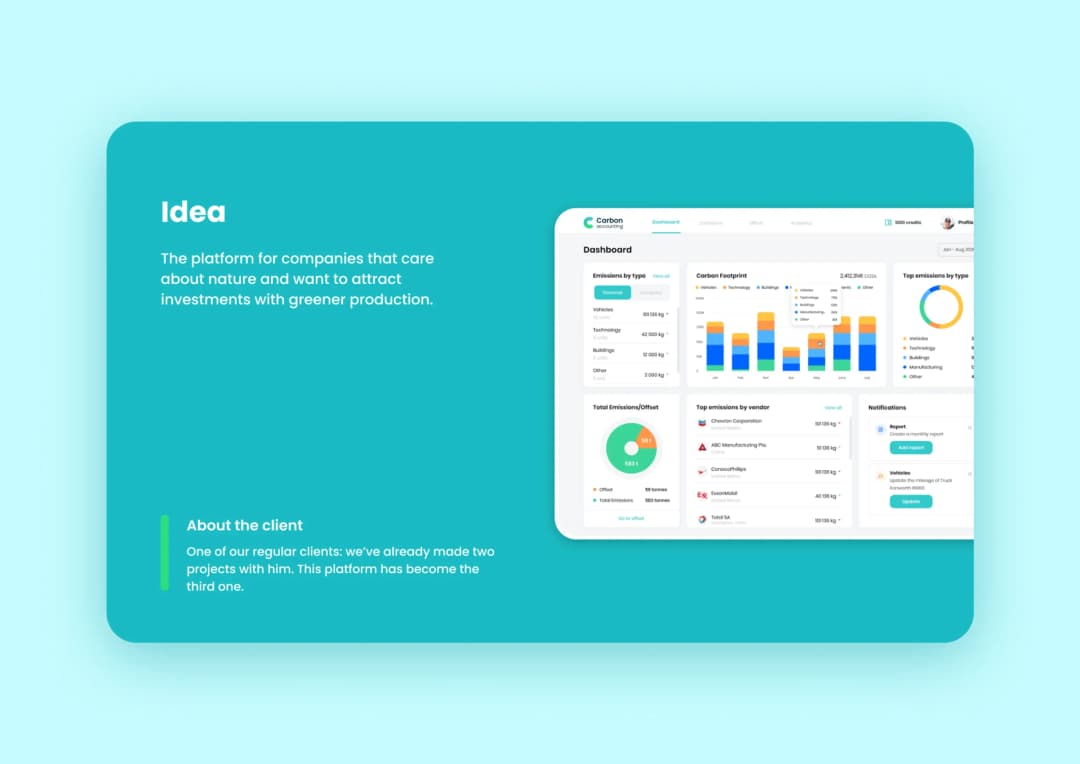
Corporate portals. Enterprises use corporate portals to build internal networks for sharing important information, streamlining business processes, and managing personnel. Such networks usually feature a central access point that separates the portal from the rest of the web — you can get past it only if you have relevant permission and login credentials from the admin. Once inside, you find an intricate hierarchy of access levels that separates ordinary workers from CEOs and upper management.
Carbon Accounting Platform is an enterprise portal that helps companies keep track of their emissions. An eco-consultant, if you wish. Our client came up with this idea to make it easier for businesses to go green and increase their chances of raising funds in the EU and USA. In its current form, the portal analyzes data about emissions that the company feeds it to give estimates about how much it’ll cost to offset the negative impact.
Vertical portals. Also known as niche portals, these platforms are dedicated to a specific business segment, community, or topic. Any web portal of this type strives to become the go-to place for anybody interested in this particular niche, trying to amass as much information and relevant services as possible. LinkedIn is a prime example of a vertical portal.
Horizontal portals. Instead of limiting themselves to one particular topic, horizontal portals try to cover everything there is and offer as many disparate services as possible. While also giving it a sprinkle of content and entertainment — like YouTube, for instance, or its counterparts Vimeo and Dailymotion.
Healthcare. A hospital launches a patient portal that lets patients see lab results, book appointments and message clinicians directly, replacing phone trees and paper records. Clinics also run CRM-style portals so intake teams can prioritize leads and improve conversion, often layered on the same authentication backbone as the patient-facing app.
Human resources. HR portals facilitate communication between management and personnel by removing unnecessary bureaucracy and bottlenecks. Here, employees can easily access important information about their department, receive tasks, and keep track of everything relevant to their life within the company.
Supply chain. Manufacturers and large retailers run a vendor portal so suppliers can submit invoices, respond to RFQs and track POs without phone or e-mail back-and-forth. Procurement teams see a real-time view of inbound delivery dates and quality issues, while suppliers get faster payment cycles and clearer requirements.
E-commerce. Well, this one is pretty obvious. Every online shop is an e-commerce portal with a standardized set of features, which includes a catalog, a shopping cart, an integrated payment system, and a separate screen for tracking orders.
Education. Universities run web portals, often built on a learning management system, so students can track grades, see timetables, communicate with professors and submit homework. Professors get one tool to manage dozens of students at once. The same pattern applies to corporate training and any educational platform that delivers structured courses.
Regardless of portal type, modern web portals share a common set of features that centralize data, secure access and ensure scalability — the baseline a vendor should deliver out of the box. These features are also what separates a custom portal from off-the-shelf SaaS development tools: SaaS gives you everything pre-built, while a custom build lets you fit the exact roles, workflows and integrations your business actually needs.
These features form the baseline. Specific user needs and industry constraints determine the final scope.
We believe that the best approach to bringing a new concept to life is to first create a minimum viable product (MVP). An MVP is a barebones version of an app or a portal designed to showcase its main functionality. It’s perfect for gauging the market, testing the viability of your idea, and raising funds. And it helps reduce expenses, too.
In other words, it’s a perfect fit for any startup, and this is exactly what we start with here at Purrweb. Let’s break down the whole process into six steps.
Every business starts with market research. Before starting the process of web portal development, get familiar with the sector you’ll be working in. Analyze rival products to define their advantages and disadvantages, and use this information to flesh out your concept. Map out the user needs of every role that will log in — customers, employees, partners or suppliers — and run a light workflow analysis to see which existing processes the portal will absorb.
Decide what features you want to implement. There are two equally important factors to consider: the results of the market analysis and the specifics of your niche. To make your future web portal stand out, choose a killer feature, a.k.a. a unique selling point — the one thing that will eclipse the products of your competitors. Don’t skip non-functional features either: scalability targets and the list of third-party services the portal will plug into (CRM, ERP, payment processors, identity providers) shape the architecture more than any single feature.
This is when web portal development finally enters its active phase. The first thing you need is a straightforward customer journey. Once you’ve outlined the general flow of the portal, it’s time to start making things look pretty. User experience here is more than aesthetics — clear role-based navigation, scoped dashboards and predictable transitions decide whether the portal gets adopted or quietly abandoned.
Keep in mind that the design should be attractive, but not overwhelming. In business, function comes before aesthetics. A team of qualified designers will take all these considerations into account.
Make sure to employ a development team that consists of experienced professionals who know what they’re doing: users won’t put up with bugs, painfully long loading times, and other symptoms of clumsy coding. Be sure to conduct testing at all stages of the process, especially before launch.
When your customers want to suggest an improvement, give them the opportunity to do so. However, it’s important to carefully filter incoming messages — some will inevitably be less helpful, and trying to satisfy every single complaint is counterproductive. Instead, focus on the most popular trends. Pair this with the best practices of post-launch testing — regression suites, accessibility checks and synthetic monitoring — so issues surface in dashboards before real users report them.
The web portal development process doesn’t really stop until you decide to shut it down. Add other features from the backlog, scale, and simply bring your app to perfection, all the while maintaining proper communication with your target audience. Watch scalability as the user base and data volume grow — add modules, expand integrations and tighten security as the portal evolves.
Web portal development cost in 2026 typically ranges from $30,000 for a basic customer portal MVP to $200,000+ for an enterprise B2B portal with CRM and ERP integration. The final price depends on portal type, number of user roles, integrations with third-party services, security requirements (HIPAA, GDPR) and scalability targets.
At Purrweb, web portal development usually costs from $45 000 to $55 000 and takes between 3 and 5 months. This is where these numbers come from:
| Process | Duration (avg) | Final cost (avg) |
| Project estimation | 8 hours | Free at Purrweb ☺️ |
| UI/UX | 90 hours | $4 050 |
| Development | 700 hours | $31 500 |
| Testing | 280 hours | $5 600 |
| Project management | Throughout the entire cycle | $4 050 |
Please bear in mind that these are approximate calculations. The numbers may differ, for each individual project.
Choosing the right vendor is the single biggest decision in any web portal project. It shapes scope, timeline, and how the platform evolves after launch. If you need a partner that can take an idea through discovery, UX/UI design and full-stack development, explore Purrweb’s custom web portal development services or book a free consultation with our team.
➡️ Tell us about your portal idea and get a free 48-hour project estimate from a team of 200+ experts that has shipped 300+ projects.
Evaluate a company on five criteria: (1) a portfolio of shipped portals in your vertical — not generic websites; (2) demonstrated experience with role-based access control, SSO, and third-party API integrations, since these are the features where portals break most often; (3) a discovery or scoping process that produces a written specification before any code is written; (4) post-launch SLA terms that cover bug fixes and performance monitoring; (5) transparent pricing that separates design, backend, and QA line items. Agencies that quote a single blended price without a written spec sheet are a red flag for scope creep.
Custom web portal development typically costs between $30,000 and $250,000 depending on scope. A B2C customer-facing portal with standard authentication and a dashboard runs $30,000–$60,000. A B2B partner or supplier portal with ERP/CRM integrations, role-based permissions, and analytics sits in the $60,000–$150,000 range. Enterprise portals with multi-tenant architecture, SSO, compliance requirements, and custom reporting can exceed $200,000. The largest cost drivers are third-party integrations, security audit requirements, and the number of distinct user roles that need separate permission sets.
A web portal development company specialises in multi-user platforms that authenticate users, display personalised data, and integrate with back-end systems such as ERPs, CRMs, or payment processors. A general web agency focuses on marketing sites that are the same for every visitor. The practical difference shows up in the tech stack: portal-focused companies are proficient in identity providers (Auth0, Okta, Keycloak), REST and GraphQL APIs, and data security standards such as SOC 2 or ISO 27001. If a candidate agency's portfolio is dominated by landing pages and e-commerce storefronts with no authenticated user area, they are unlikely to handle the access-control complexity a portal requires.
A straightforward customer or employee portal with one user role and no legacy integrations typically takes 3–5 months from signed contract to production launch. A B2B partner portal with two or three user roles and one ERP integration adds 6–9 months. Enterprise portals with multi-tenant architecture, compliance audits, and data migration from legacy systems commonly require 10–18 months. Timeline risk is highest in the integration phase: delays in receiving API documentation or test credentials from third-party vendors account for the majority of overruns in portal projects.
Most professional portal companies in 2026 use a React or Next.js front end for its component model and server-side rendering support, paired with a Node.js, Python/Django, or .NET Core back end. Authentication is handled through established identity providers (Auth0, Okta, AWS Cognito) rather than custom auth code, which reduces security risk. PostgreSQL or cloud-managed databases (AWS RDS, Google Cloud SQL) are standard for relational data. For real-time features such as notifications or live dashboards, WebSocket or server-sent events are added on top. Avoid vendors who propose building their own authentication layer from scratch — this is a significant security and maintenance liability.
Yes, but verify compliance credentials before engaging. For financial services portals, the company should have prior work that is PCI DSS-compliant and demonstrate familiarity with data encryption at rest and in transit, audit logging, and RBAC at the field level. For healthcare portals in the US, HIPAA compliance is mandatory: confirm the company will sign a Business Associate Agreement and that their infrastructure meets the required administrative, physical, and technical safeguards. Ask for a named compliance officer or a third-party audit report (SOC 2 Type II is the most common). Companies without documented compliance experience in your sector should not be shortlisted for regulated workloads.
Nearshore and offshore vendors can reduce hourly rates by 40–70% compared to North American or Western European rates. The primary trade-off is communication overhead: time zone gaps of more than 5–6 hours make synchronous collaboration difficult during the integration and QA phases, which are the most coordination-intensive parts of a portal project. A hybrid model — a local project manager or solution architect paired with an offshore delivery team — captures most of the cost benefit while maintaining oversight. Regardless of location, require weekly written status reports, access to the staging environment at all times, and a contract clause requiring source code escrow or repository access so you retain your codebase if the relationship ends.
Yes. Web portals dominate scenarios with multi-role access, deep CRM/ERP integration, regulatory compliance (HIPAA, GDPR) or unique workflows that off-the-shelf SaaS tools cannot model.
An intranet is one specific type of web portal — an internal portal for employees, with company resources, HR, documents and internal communication. Same architecture, different audience.
Five layers: encrypted data in transit and at rest, role-based access control with SSO and MFA, regular security audits, compliance frameworks (HIPAA, GDPR, SOC 2) and ongoing monitoring through SIEM tools.


.svg)