Explore

Need help with your project?

Oops! Something went wrong while submitting the form.
Knowing where a vehicle is doesn't tell a dispatcher whether its next delivery will arrive on time. AI in transportation uses machine learning to combine trip history with live traffic and predict arrival times. The product challenge is turning that forecast into information staff can act on.
In this article, we'll look at how transport teams use those predictions in daily work and how you can assess whether they improve operational decisions.
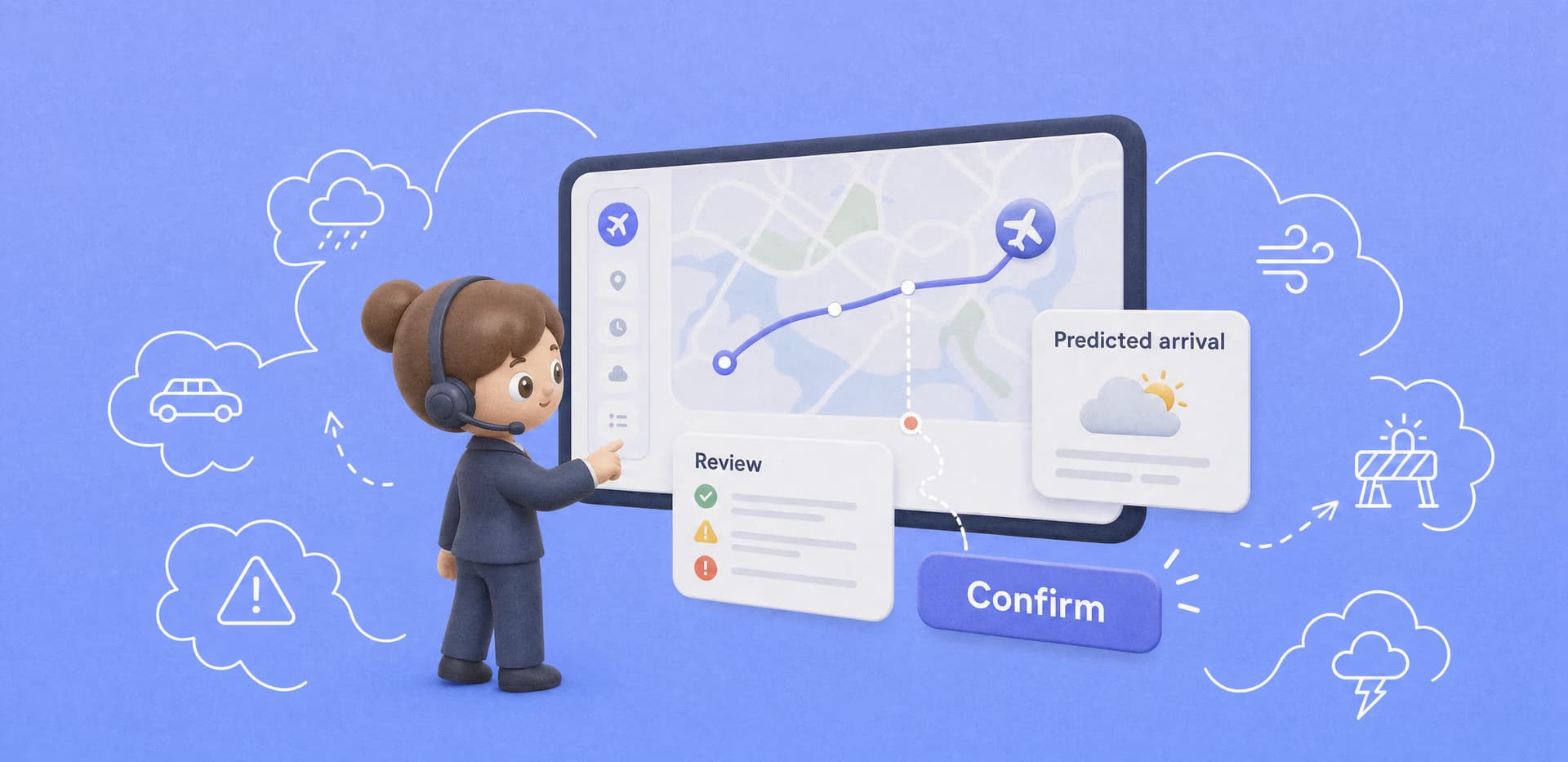
Artificial intelligence in transportation includes machine-learning applications that use models trained on data to produce predictions for operational decisions in the transportation sector. These AI applications in transportation and logistics form the predictive analytics layer of intelligent transportation systems. Google Maps, for example, combines historical traffic patterns with live conditions through machine learning to predict travel times.
The infrastructure supplies inputs for AI and machine learning, while a journey planner uses the resulting forecast to compare travel options.
GPS tracking and telematics collect location and vehicle telemetry, such as sensor readings. That collection layer connects AI with IoT, but collecting data is not itself learning. Fixed rules trigger predefined actions. Calling a product AI-driven doesn’t change that distinction. Comparing AI technologies means distinguishing AI algorithms that learn from examples from rules that only apply predefined instructions. Mathematical optimization respects vehicle capacities and delivery windows, but that alone doesn't demonstrate learning.
Connecting those inputs and learned predictions to your dispatch workflow is part of logistics software development services. The role of AI in logistics is narrower than managing the whole supply chain: here, it supports transport decisions.
Transport operators retain control when each AI forecast has an accountable owner and a defined fallback. The table connects six workflows to the actions they support and the measurements you can track, rather than promising savings or universal safety improvements. These applications of AI in transportation require different safeguards.
| Use case | Required input | Decision or action | Outcome metric | Control / fallback |
| Routes and ETAs (estimated times of arrival) | Trips, GPS, traffic | Update ETA and suggest route | ETA error and on-time rate | Dispatcher override |
| Maintenance | Telemetry, service history | Prioritize inspection | Unplanned downtime and false alerts | Technician review |
| Road traffic | Sensors, camera events | Adjust signal recommendations | Queue length and travel time | Safe signal plan |
| Public transit | Ridership, service history | Adjust capacity or schedules | Wait time and service coverage | Planner approval |
| Driver assistance / autonomy | Vehicle sensors, road context | Warn or control within validated scope | Safety-event rate | Defined operating limits |
| Dispatcher assistance | Verified status and documents | Draft responses and summarize exceptions | Handling time and factual error rate | Human approval |
Dispatchers decide whether a delayed vehicle needs a new route, not the ETA model. Historical trips and live traffic feed a learned arrival-time prediction. For logistics providers, AI helps estimate arrival times before a truck completes its route.
A separate optimizer tests routes against vehicle capacity and delivery windows. That optimizer isn't necessarily machine learning.
When you scope fleet management software development services, the dispatcher's override belongs in the workflow. Forecasts need validation on unfamiliar routes, and changing traffic patterns can cause drift, making predictions less reliable.
We designed Cargo's delivery interface around driver workflows, including barcode loading with manual entry when scanning fails. Drivers also get controls to pause or resume a run and mark it undelivered.
These controls capture changes in delivery status, potential inputs for future arrival forecasts. The published case documents interface design but does not document an implemented prediction model: the connection here concerns collecting usable events.

The driver can check pickup and drop-off time windows before starting the trip
Maintenance teams decide which vehicle to inspect, rather than treating a failure score as a diagnosis. Telemetry and service records feed failure-risk scores that help prioritize inspections. The collection layer is covered in automotive IoT and vehicle data, where IoT means Internet of Things.
Training records need fault labels identifying confirmed failures, not just repair dates. Failure patterns differ with operating conditions and component age, so technicians review alerts and track false alarms alongside downtime.
Traffic controllers retain authority over signal changes in traffic management systems. Sensor flows and camera-detected incidents inform queue forecasts and timing recommendations. Cameras alone aren't AI. AI-driven traffic management systems use these forecasts to assess traffic congestion across a transportation network.
Federal Highway Administration guidance describes a user-specified fallback when detector failures exceed a threshold. Operators specify a safe signal plan for that switch. Video retention and access rules also depend on local privacy regulation.
In transportation planning, planners choose service changes after ridership forecasts flag likely demand. Boarding records and service history help estimate passenger loads, but sparsely observed neighborhoods can disappear from the averages.
Higher occupancy isn't proof of better access. This use of AI in public transportation links demand to service coverage. Planner approval keeps minimum service coverage in the decision alongside waiting time.
At Level 2, ADAS (advanced driver-assistance systems) leaves drivers responsible for monitoring the road and staying actively engaged. Driverless systems perform the driving task within validated operating conditions. A self-driving car still operates within that tested scope.
Rare events still need testing. An interface covered by automotive application development isn't itself a driving system.
In Waymo’s May 2025 safety study, Waymo reported 96% fewer injury-involving intersection crashes versus the study's human benchmarks, regardless of fault. The comparison covers 56.7 million miles. That result covers this dataset and operating context, not every autonomous vehicle or transport AI system.
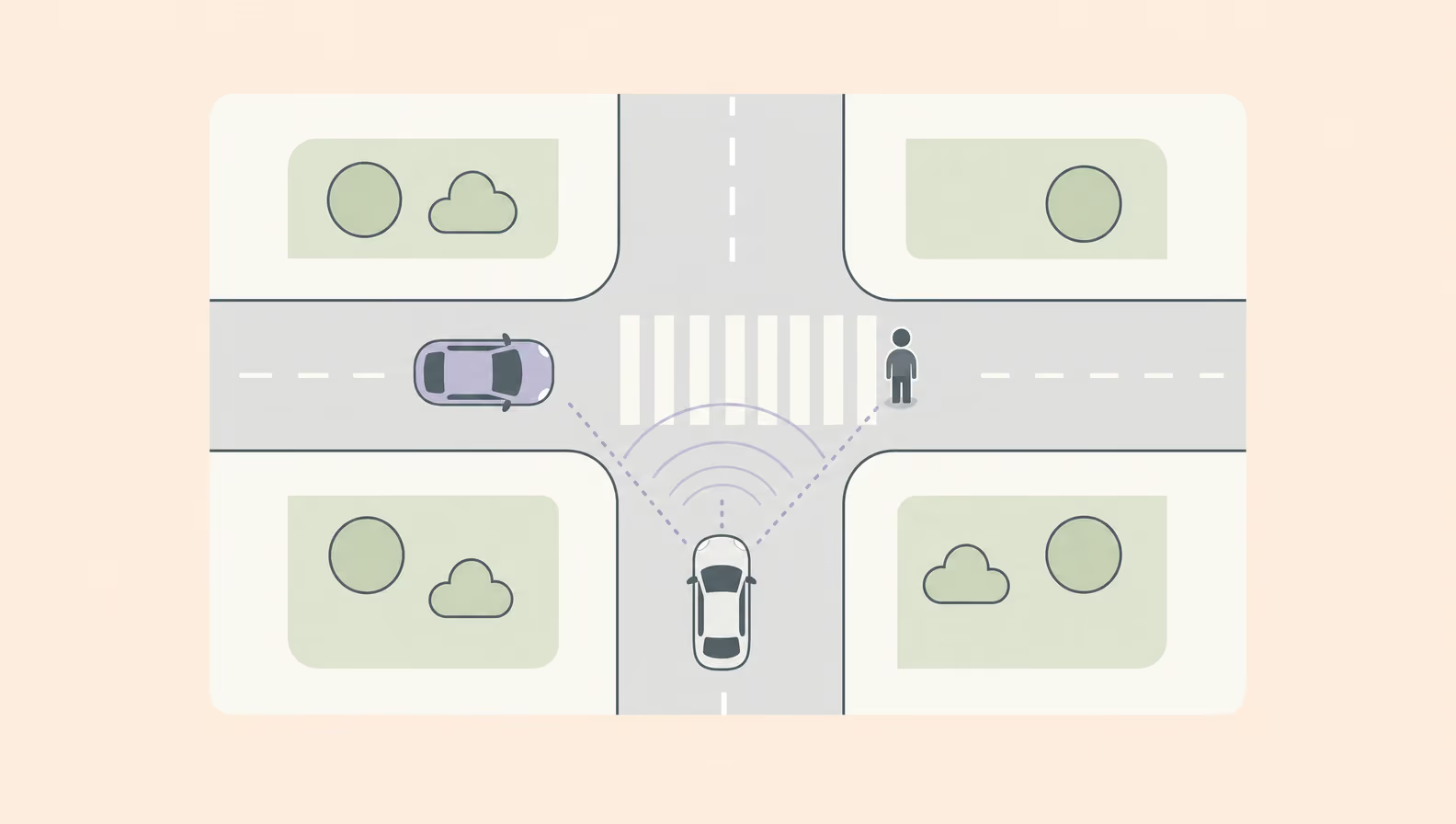
Crossing traffic and pedestrians illustrate the intersection context, not every driving scenario
Human approval keeps support replies under staff control before passengers receive them. A generative AI assistant draws on verified trip or shipment status and documents to draft answers or summarize exceptions. Missing information calls for escalation, not an invented ETA. Checking drafts against known facts exposes errors. Reply generation grants no permission to instruct drivers or control vehicles.
Measurable benefits of AI for the transportation industry come from comparing operational results against an existing workflow, not from an AI model score alone. Your evaluation pairs prediction error with delivery outcomes (including customer satisfaction) and the extra work created by incorrect recommendations.
Tests of AI solutions distinguish efficiency and safety: fewer late deliveries don't establish that a system will improve safety. The benefits of implementing AI depend on those separate measurements, not a single performance score.
For an arrival forecast, a useful baseline records prediction error in minutes alongside the share of deliveries arriving on time. Better predictions aren't proof of better service. Dispatchers still have to act on them, and that review time belongs in the effort to improve efficiency.
Maintenance evaluation pairs vehicle downtime with false alerts and unnecessary inspections. This is a reliability engineering question as well as a modeling one. Fuel-per-trip comparisons for sustainability assessments account for load and completed deliveries, so fewer trips don't masquerade as operational efficiency. The comparison uses similar routes, seasons, and workloads. A simple before-and-after change doesn't establish causation.
The National Institute of Standards and Technology's AI Risk Management Framework calls for evaluation under deployment-like conditions in transportation operations. Historical accuracy alone doesn't prove a service improvement.
Traffic flow evaluation similarly pairs queue forecasts with measured queue length and travel time.
For the implementation side, our separate guide covers logistics app development cost factors.
Incomplete data: incompatible parcel timestamps undermine delay predictions. An audit checks that parcel events mean the same thing across systems. Predictions are then tested on records from comparable operations that were not used for training.
For AI adoption, the audit establishes which events the model can interpret consistently. The introduction of AI also adds a handoff to the workflow: who receives an alert and decides whether to act.
⭐ Our experience
We developed PonyExpress’s Android parcel-management app with React Native for dispatchers at pickup points. Scanning a parcel barcode records receipt, updates its status, and notifies the customer.
At handover, staff scan the barcode or enter the order number manually. Recording both receipt and pickup makes the parcel’s progress explicit, while manual entry keeps confirmation available when scanning fails.

Reception and delivery are separate actions, so staff select the handover they are recording
Drift and rare events: a road closure changes the conditions behind an arrival estimate. Monitoring compares predictions with actual arrivals and flags deteriorating accuracy for reassessment. Dispatchers revert to manual planning outside tested conditions.
Privacy: identifiable camera footage calls for restricted access and collection minimization. Retention follows a documented purpose and deletion policy, not a universal duration. These controls don't guarantee regulatory compliance.
Integration and responsibility: a support assistant’s wrong pickup instruction calls for staff review before sending. Unsafe vehicle control requires separate safety validation and operating limits. A named owner controls override or deactivation when performance falls outside intended limits and logs those decisions.
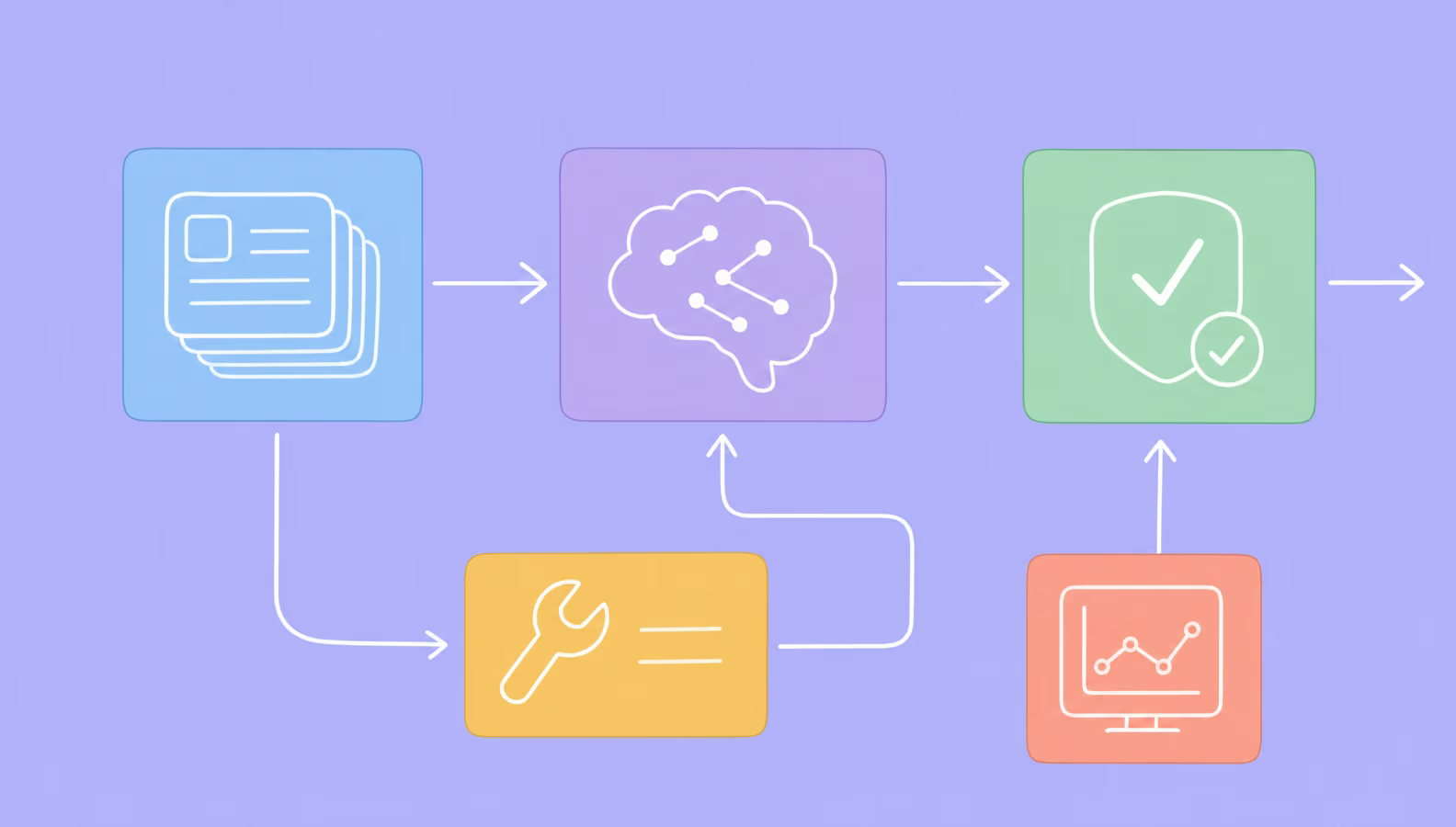
Monitoring links prediction errors to operational outcomes, while an accountable owner controls fallback and restart
Future transport AI features are candidates for evaluation, not evidence of wider adoption. Multimodal sensing combines camera and lidar signals, with lidar measuring distance using laser light.
Evaluating such a feature includes choosing whether to run predictions on a local device (edge processing). Simulation tests responses in a virtual setting. Computer hardware constrains what can run locally, so the deployment choice belongs in the feature evaluation.
Simulation provides a way to assess the future of AI in transportation before a proposed feature affects live operations.
AI agents with limited permissions could draft a charging reservation but require human approval before confirmation. Operating limits define when they stop and which manual fallback takes over.
A named owner disengages an agent outside those limits. That's a product boundary, not a vehicle-control capability.
⭐ Our experience
We redesigned EVTrip’s station-search and booking flow after UX research showed that its main task took five steps. Drivers needed to find a nearby charger and reserve it, so those actions became the focus.
The mobile app used React Native for registration and authorization, with WebView displaying the other screens. The work connected station discovery with booking, providing an existing user flow that a future assistant would need to support.

The station card sits below the map, with route and QR-scanning controls beside each other
A useful pilot for an AI strategy tests one transport workflow against its current baseline, such as dispatch handling time. A named owner documents the results and decides whether to stop the test or expand it. The test ties the potential of AI to a decision the owner can accept or reject. For transportation companies, AI projects need that comparison before a wider rollout.
Transport AI's value comes from operational results against a baseline, not predictions alone. That depends on usable data and clearly defined operating limits. For logistics companies comparing AI tools, the work of reviewing predictions belongs in the evaluation too.
During shadow testing, operators observe predictions without letting the model act automatically. A named owner reviews errors and decides whether testing can continue.
➡️ Planning an AI-assisted transport product? Our logistics software development services cover the workflow around predictions. Fill in the form to discuss data sources and operator review, and get a free project estimate within 48 hours.
AI supports route planning, arrival predictions, predictive maintenance, traffic control, and passenger demand forecasting. Computer vision also supports driver assistance and automated driving within defined operating conditions. Each application needs suitable data and a measurable operational objective. A defined review process handles uncertain or incorrect outputs.
No. Route optimization can use fixed rules or mathematical optimization without machine learning. AI adds learned predictions, such as travel times or delivery delays, which an optimizer can use. GPS tracking supplies location data. It does not, by itself, make a transport platform intelligent.
Useful inputs include vehicle telemetry, diagnostic codes, maintenance records, and reliably labeled failures. Data must be consistent across vehicles and linked to actual service outcomes. Without enough relevant failure examples, an operator may need condition monitoring or rule-based alerts before attempting a predictive model.
Not as a general rule. Driver assistance, automated driving, and dispatcher support have different capabilities and responsibilities. People still handle exceptions and supervise recommendations, with responsibility for safety. Reducing human involvement depends on validated performance and applicable requirements, with a defined fallback process.
Poor data, changing operating conditions, privacy concerns, and overreliance on automated recommendations can undermine results. Evaluation compares model results against the existing workflow, with ongoing error monitoring and restricted access to sensitive data. A named operator handles overrides. Safety-critical decisions require stronger assurance than administrative assistance.