Explore

Need help with your project?

Oops! Something went wrong while submitting the form.
Machine learning (ML) outsourcing means hiring an external team for defined work, from preparing data to training a model. Your team still owns the product goal and decides whether the results are acceptable. Turning that model into a usable system also means agreeing who handles deployment and monitors performance afterward.
In this article, we’ll explain how to divide these responsibilities with a provider and judge their deliverables, so you can choose a partner without mistaking a promising model for a finished product.
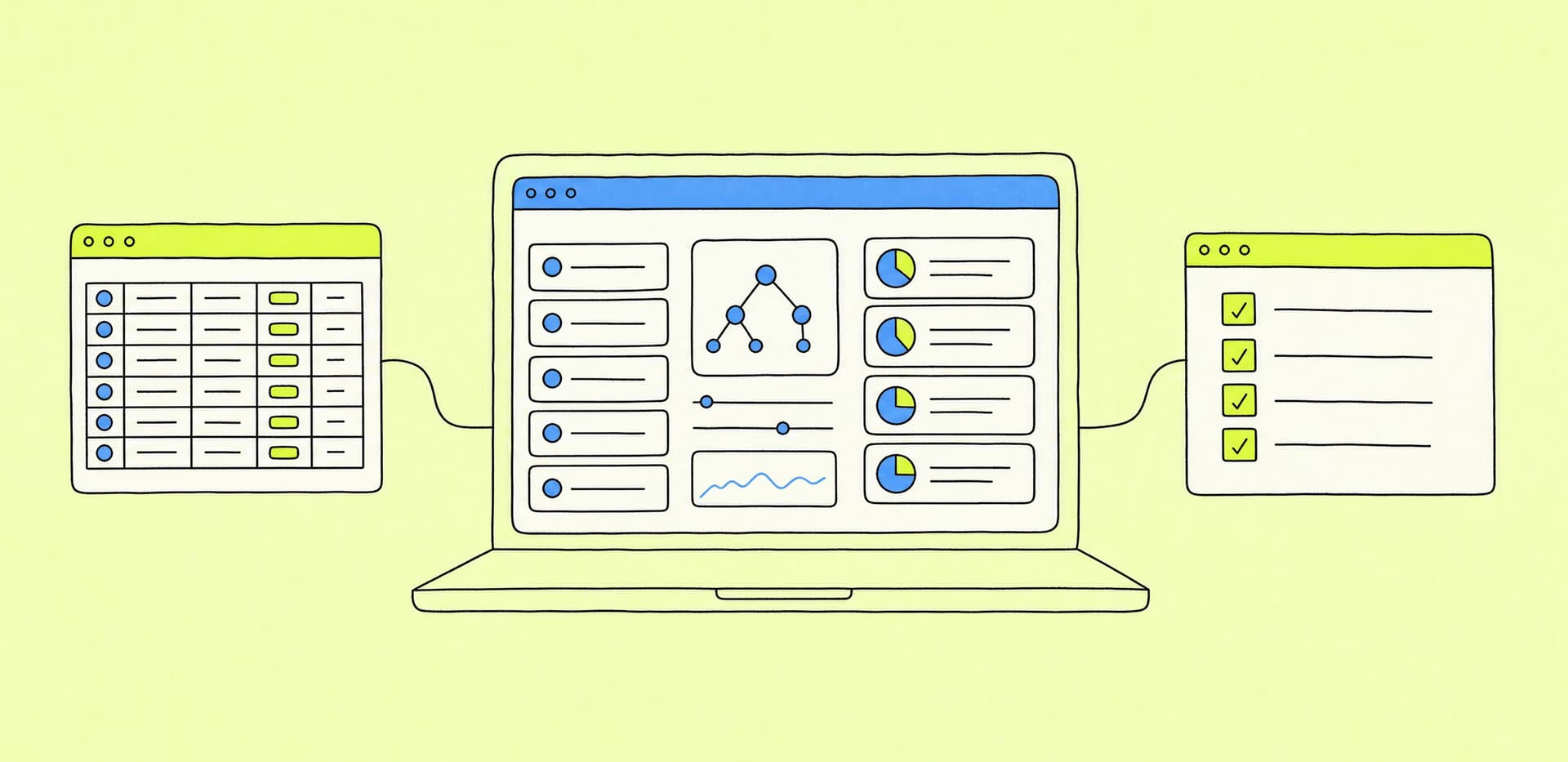
You can outsource individual workstreams to data engineers and ML specialists through machine learning development services while retaining approval of business results. Training alone isn't delivery of a production system. These four workstreams separate vendor outputs from your approvals.
Deployment introduces a separate responsibility. MLOps covers the work of deploying and operating machine learning models.
| ML workstream | Vendor deliverable | Client owner or approval |
| Data preparation and data labeling | Dataset with data validation results and labeling rules | Domain owner approves labels |
| Model training and evaluation | Baseline, isolated test set, and segment metrics | Product owner approves baseline comparison and segment results |
| MLOps and deployment | Versioned models and serving configuration | Operating owner approves launch |
| Monitoring and retraining | Checks and retraining plan with validation before release | Named monitoring/retraining owner |
Artificial intelligence (AI) supports customer relationship management (CRM) through AI-powered CRM use cases such as lead scoring. For example, a vendor could evaluate predictions while you define which missed prospects matter. A broad request for AI and machine learning does not make generative AI a requirement for this prediction task.
The choice is between bringing in a missing ML skill and building the capacity to improve a core model. Monitoring continues after delivery. Adding headcount helps only if the specialists bring the missing ML competency.
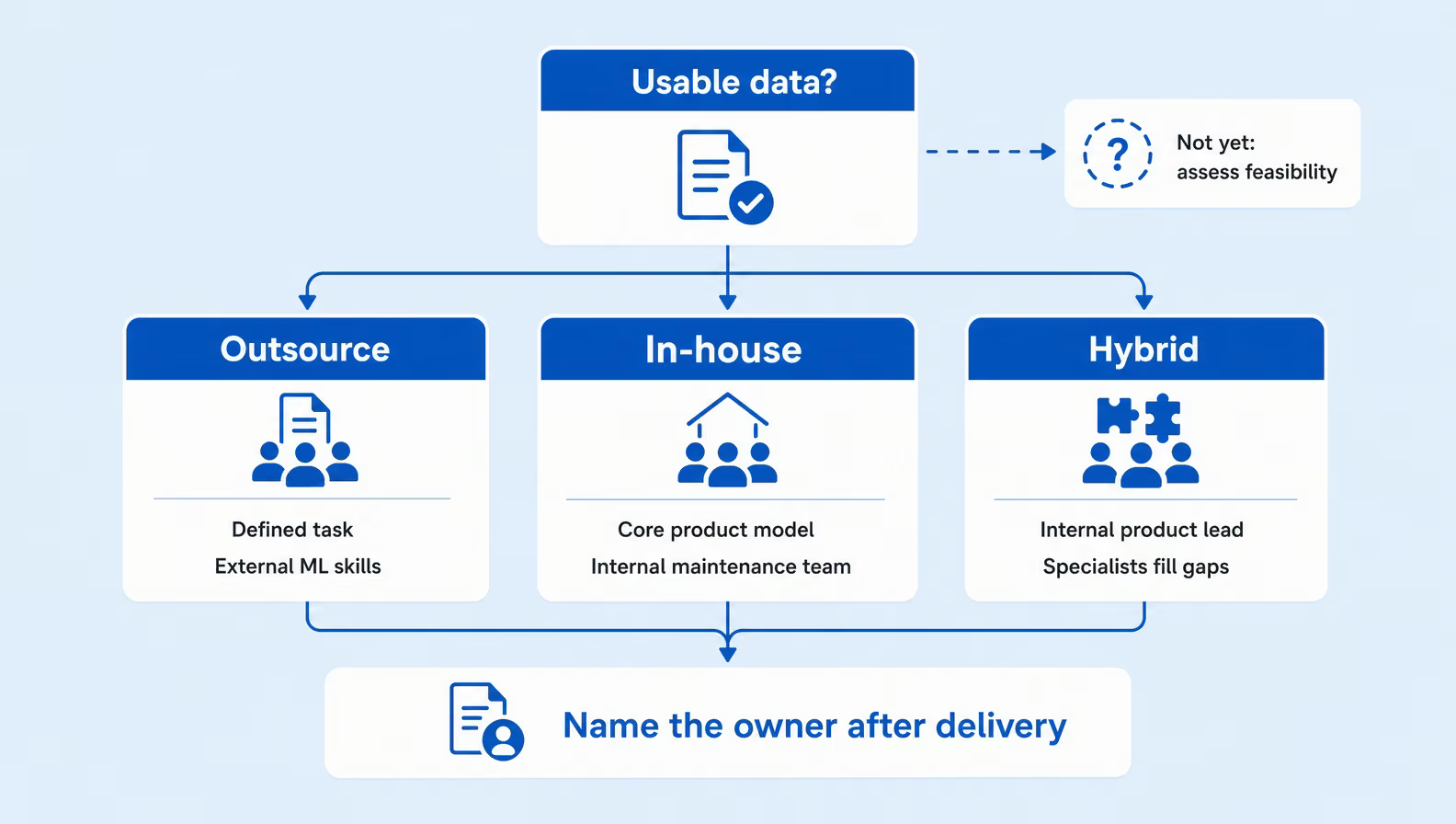
The staffing choice depends on usable data and who will maintain the model after delivery
Fraud scoring shows why domain expertise stays with the client even when implementation is outsourced. As discussed in AI in fintech, a model can inform automated transaction decisions, but your domain experts still define which risks and errors are acceptable. An external team works against those criteria rather than taking over responsibility for them.
Stanford’s 2026 AI Index Report puts organizational AI adoption at 88%. That figure describes the use of AI, not the share of projects outsourced or the returns a vendor delivers. It provides context for the interest in ML, but the staffing decision still rests on usable data and the skills missing from your team.
An engagement model determines who directs the day-to-day work and who reviews the result. With specialists or staff augmentation, your ML lead coordinates the software engineering work. In managed delivery, the vendor coordinates delivery against agreed outcomes, while your product owner retains approval of the results and handover.
The table compares these responsibilities so you can match outsourcing services to your internal leadership capacity. Outsourcing ML still requires coordination between software developers and model specialists.
| Model | Who manages day-to-day work | Best-fit scope | Main trade-off |
| Freelancer or specialist | Your technical lead | A bounded evaluation task | You coordinate integration and review |
| Staff augmentation | Your internal ML lead | ML engineers joining your team | You retain project management |
| Project-based managed delivery | Vendor delivery lead | Agreed model-to-product deliverables | Your product owner retains acceptance |
A dedicated team stays assigned to your project, whether you or the vendor manages it. Nearshore/offshore describes geography. Fixed price and time and materials describe payment terms, not responsibility.
For a scalable team arrangement, the proposal also explains who reviews additional specialists’ ML work.
A partner review has two different questions to answer: has this machine learning development company delivered comparable work, and how will it work with your data? Production records address the first question. A scoped pilot addresses the second, with acceptance criteria agreed before either team decides whether to continue.
Unlike an outsourcing directory, a request for proposal (RFP) collects delivery evidence for comparison. The RFP vendor shortlist reflects those checks.
Client references are useful when they identify the work the supplier actually performed. Deployment records then show who built the data pipelines and handled post-launch issues, while reproducible evaluation code lets your team examine how predictions were tested. When several suppliers share a software project, comparable track records depend on knowing which one owned deployment and support.
Together, these give you more to vet than a notebook demo, which does not establish that a model has been deployed or operated.
⭐ Our experience
We designed BaseballCloud to bring player performance data into one place, where players, coaches, and scouts could view and compare results. The work addressed how people read analytics, rather than how a model learns from the data.
For an ML shortlist, that distinction matters: an analytics interface demonstrates design work, but it does not establish model-training or deployment experience. Those parts of an assignment need their own production evidence.

The player profile places pitching metrics and recent events alongside personal information for review
A pilot agreement starts with a defined task and the data available to solve it. Before work begins, both teams choose a baseline to benchmark the model and agree which errors matter to the business, rather than relying on overall accuracy alone.
In an agile development process, demonstrations provide review points rather than replace the agreed acceptance test. Test data stays separate from training and model selection. This lets the team evaluate predictions on examples it has not already used to shape the model.
With those checks defined in advance, both teams know which results end the pilot and which justify further work. Passing the pilot supports that continuation decision, but does not by itself establish that the system is ready for production.
Before sharing data, both teams agree who may use it, where it may be processed, and who owns the resulting work. A nondisclosure agreement (NDA) protects confidentiality, but does not enforce access restrictions or establish regulatory compliance. Each written requirement therefore needs a corresponding control and evidence that the control is being followed.
An audit compares these access records with the permissions agreed for the ML models, including any authorized subcontractors.
⭐ Our experience
We designed and developed the Carbon Accounting Platform with emissions calculations and role-specific functionality. That work brings data processing and different user responsibilities into the same application, although the case reports demo mode rather than a live ML system.
For a vendor review, role-specific screens help explain what different users are intended to do. They do not prove that access controls operate as agreed, so a review of those controls needs evidence beyond the interface.
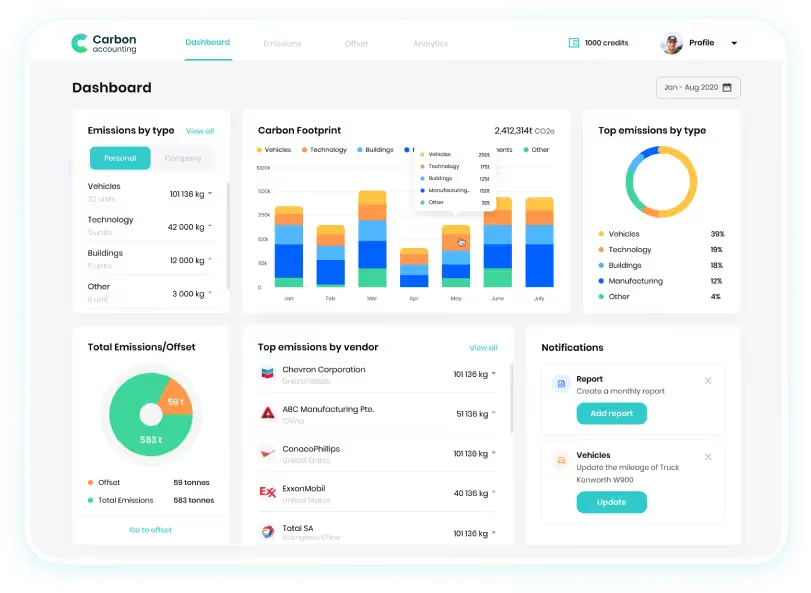
The dashboard groups emissions by type and vendor alongside the carbon footprint and offset balance
Explicit ownership terms matter because payment alone does not establish every rights transfer. Their legal effect also depends on the jurisdiction and the data involved, so the agreement needs to address the circumstances of the project rather than promise blanket compliance.
Once the delivery responsibilities are defined, the calculator below provides an initial estimate for the application work. It is not a fixed quote for data preparation, model training, or ongoing ML operations. The next section explains how to account for those costs when comparing proposals.
There is no universal ML outsourcing price because training the model is only part of the assignment. Preparing data, connecting the model to a product, and operating it after deployment involve different work and responsibilities. A useful proposal makes those boundaries visible so you can compare the total scope, not just the training cost.
When outsourcing machine learning development and outsourcing software development appear in separate proposals, both need to name who covers integration. A feature estimate can look complete while leaving out the work needed to connect it to an existing product. The same gap appears in web development, where authentication and third-party integrations affect delivery effort:

To compare two proposals fairly, ask whether their totals cover the same work and leave the same responsibilities with your team. The breakdown needs to make three things clear:
A lower rate does not mean a lower total if another proposal includes work it leaves out. Post-launch support is also a separately scoped service, not an automatic part of development. For a closer look at the application side of the estimate, see AI app development cost factors.
Production acceptance checks whether the receiving team can reproduce the evaluation and operate the deployed model without depending on the supplier’s notebook. The acceptance record provides the evidence for that decision. Assigning an owner to each operational task then establishes who takes responsibility for production system maintenance after the transfer.
Before testing, both teams agree what result the business will accept and which baseline the model must be compared against. They use an isolated test data set so the evaluation is separate from model development.
The acceptance record then captures errors across relevant segments, response time under load, operating-cost limits for ML systems, and compatibility with the application. Reviewing these together shows whether the model meets the agreed conditions, rather than treating one accuracy figure as proof of readiness.
⭐ Our experience
Our Cargo UI/UX design included a way to continue parcel loading when a barcode could not be read: the courier could enter the code manually. The designed workflow therefore covered both the normal scan and its fallback.
For an ML acceptance plan, the useful lesson is to specify what happens when the main flow cannot proceed, not just what a successful demonstration looks like. Cargo illustrates that design decision, rather than an implemented ML service.
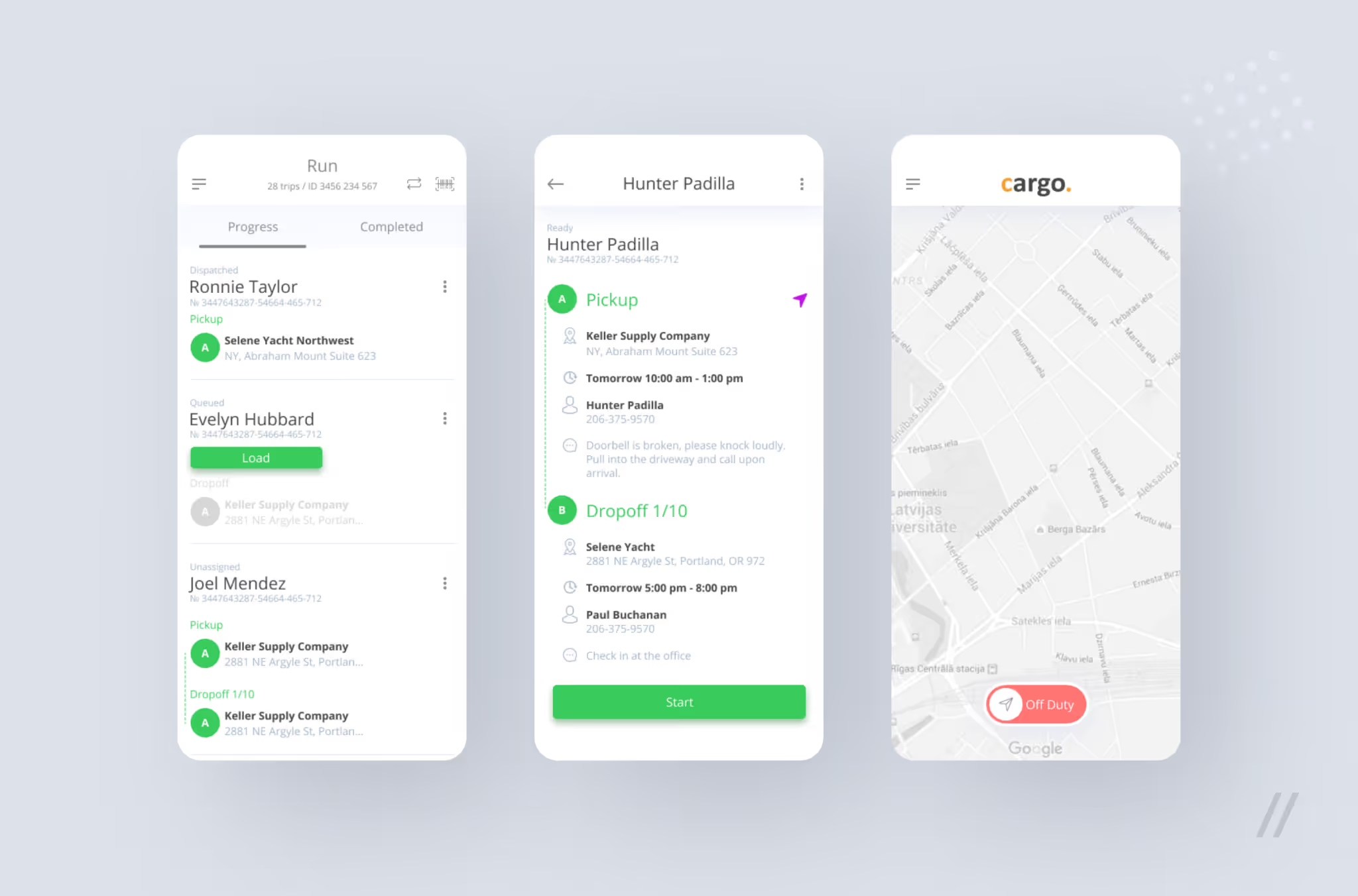
The run list, pickup details, and navigation appear as separate screens in the courier workflow
Receiving files does not establish that your team can repeat the vendor’s work. At handover, the receiving team reruns the agreed pipeline with the supplied materials and checks that the recorded results are reproducible. That requires:
The receiving team also needs access to the environments it will operate, without making private data public or putting credentials in handover documents. If post-launch support is contracted separately, its owner is identified alongside the monitoring and retraining responsibilities so those duties do not become an assumed part of development.
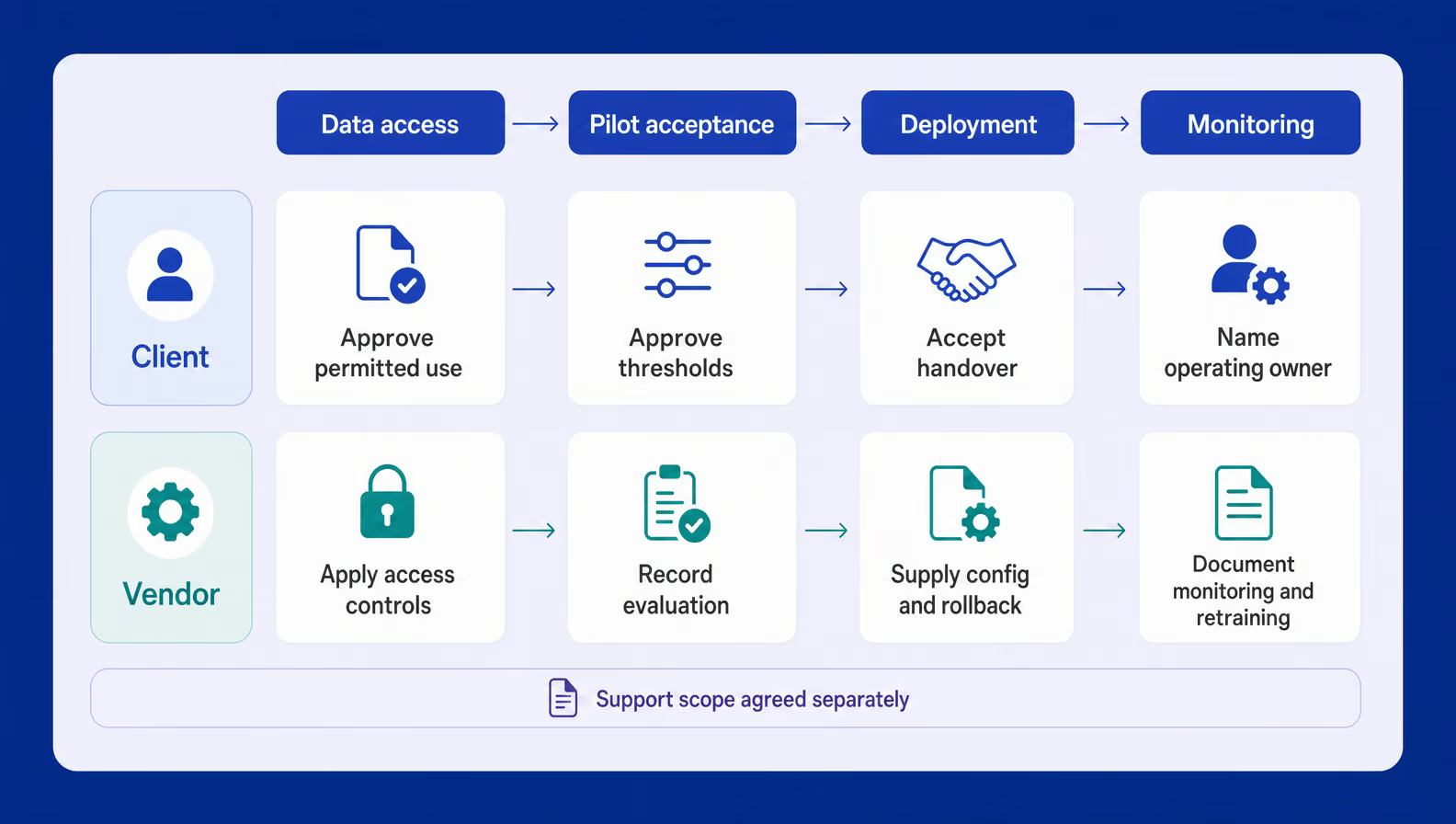
A handover transfers operating responsibility only when the receiving team can reproduce the agreed workflow
The outsourcing decision is less about handing over a model than agreeing who will build it, judge it, and keep it working. Usable data and agreed acceptance criteria make the delivery scope testable, while reproducible code and operating instructions let the receiving team take over without depending on the supplier's notebook. The arrangement still depends on your internal skills and available data, and a successful pilot does not remove the need for an owner after deployment.
➡️ Planning an ML project? We can discuss the scope and the evidence needed to accept the result. Fill in the form for a free project estimate within 48 hours.
There is no universal price for machine learning outsourcing. A useful estimate separates data preparation, model development, evaluation, integration, and ongoing operations. Ask each provider to state assumptions, exclusions, team responsibilities, and recurring cloud or support charges. Compare proposals against the same deliverables and acceptance criteria, rather than choosing the lowest hourly rate or treating an application calculator as a fixed ML quote.
Yes. You can outsource a defined workstream, such as data labeling, model evaluation, or deployment, while keeping product ownership and other engineering work in-house. Agree on inputs, outputs, interfaces, and approval responsibilities before work begins. Partial outsourcing works best when someone on your team can review the deliverables and coordinate dependencies with the people responsible for the rest of the system.
Define who may access each dataset, where it can be processed, and when copies must be returned or deleted. Put ownership and licensing terms for code, model artifacts, annotations, and third-party components in writing. Use access controls alongside appropriate confidentiality and data-processing agreements. Confirm subcontractor access and permitted data uses; an NDA alone does not establish security or regulatory compliance.
Agree on evaluation before model development starts. Define a business baseline, a separate test dataset, relevant error measures, and practical constraints such as response time or operating cost. Review performance across important user or data segments, not just an average accuracy figure. Record limitations and acceptance decisions so a promising demonstration is not mistaken for evidence that the system is ready for production.
Require the agreed code, model versions, evaluation results, dependency and licensing inventory, deployment configuration, and operating documentation. Include a rollback procedure, monitoring guidance, and a named owner for support and retraining decisions. Check that your team can reproduce the relevant workflow and access the environments it owns. Handover should transfer operational knowledge as well as files, without exposing credentials in documents.