Explore

Need help with your project?

Oops! Something went wrong while submitting the form.
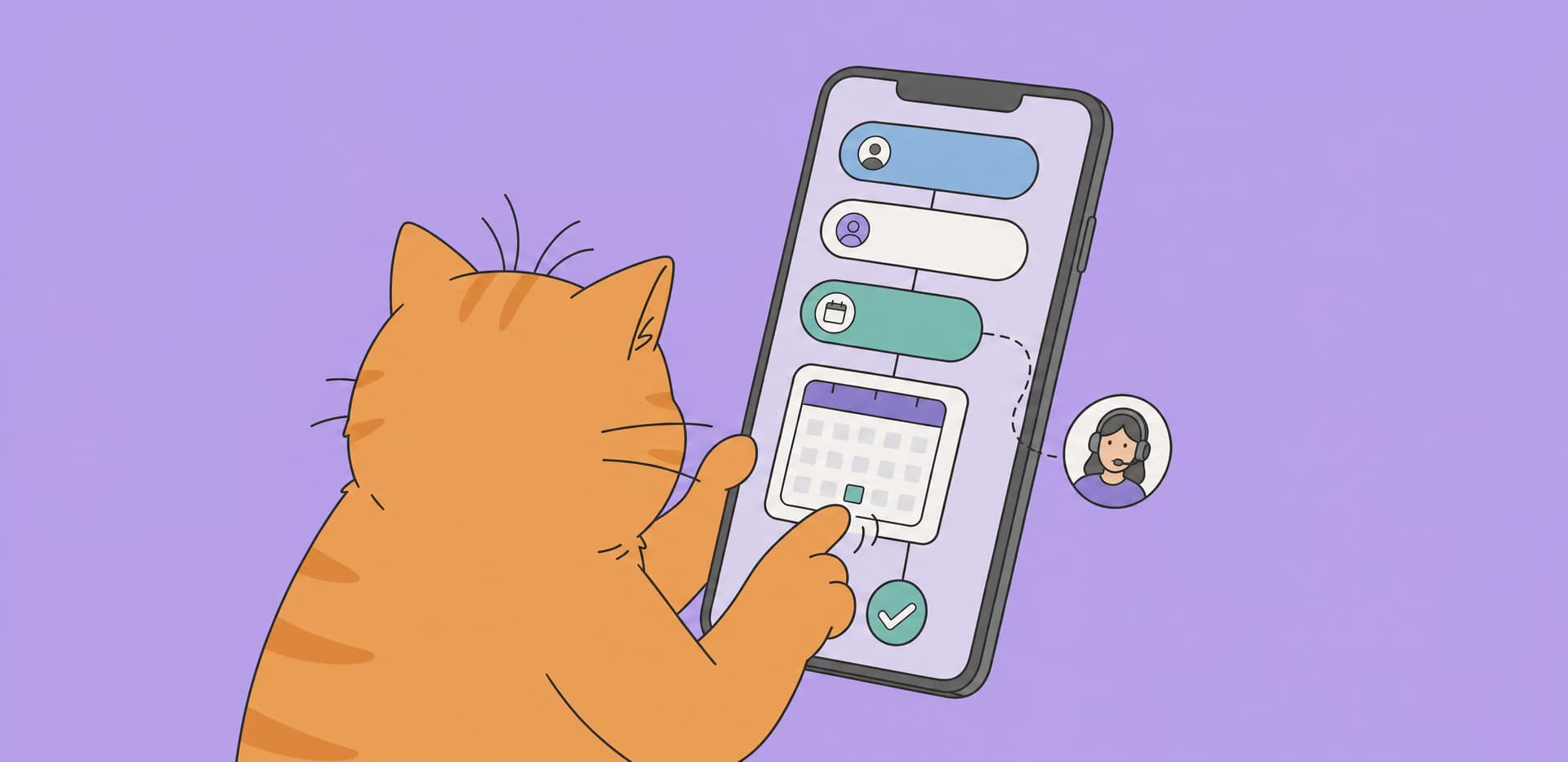
When your customer asks to reschedule an appointment, they expect a new booking, not just an explanation of how to change it. An assistant that carries out the request needs access to the schedule, permission to make the change, and confirmation that the new time was saved.
In this article, we’ll examine 8 conversational AI trends through customer tasks and show how to assess their value for customer experience. The examples connect each capability to the data, approvals, and human support needed to complete the task.
Conversational AI systems (conversational artificial intelligence systems) let a customer describe a request in everyday language instead of choosing from a chatbot’s fixed menu. These conversational interfaces use natural language processing to interpret the request, while generative AI produces a response beyond a preset script. AI chatbots handle that exchange, but an AI agent also has tools for carrying out the task.
When someone asks to reschedule an appointment, explaining the available times is different from changing the booking, even with the same conversational AI technologies. The assistant needs access to the relevant business record and permission to update it through the conversational AI platform, regardless of how well it understands the request.
For that reason, scoping chatbot development services for these conversational AI capabilities starts with a boundary between discussing an action and executing it. Your product defines which steps the assistant handles and which wait for an authorized person’s approval before a business record changes.
The conversational AI trends for 2026 below change both how customers make a request and what happens after they make it. Asking about a return and actually submitting one require different permissions and checks on the result. The hypothetical scenarios connect each capability to a customer task, so you can see what your product needs to verify before treating that task as complete.
Agentic AI lets an AI agent carry out approved steps rather than only describe them. In a return scenario, the agent retrieves the order and prepares a return request in the connected business system. Its authority remains limited even for AI systems that understand the request: a consequential or irreversible change waits for confirmation.
Coordinating these steps across systems is called orchestration. When you use conversational AI, permission to read an order doesn’t automatically include permission to issue a refund or change a delivery address. AI integration services connect the assistant to business data and permitted operations, with an owner accountable for each action.
To evaluate the result, we distinguish a successful tool call from a confirmed return record and a useful outcome for the customer. The system might accept the request while the customer still lacks usable return instructions. Tracking those outcomes separately shows whether your automation completes the job or leaves the customer with more work.
Voice AI supports back-and-forth service conversations, including interruptions rather than fixed spoken menus. Suppose a caller changes an appointment time while the AI assistant is still describing availability. The product has to stop playback and retain the correction, without treating unheard words as information already delivered.
Understanding that correction takes more than recognizing the caller’s words. Speech recognition produces a transcript, but the appointment change still depends on interpreting what the caller now wants. Tests with background noise and overlapping speech show when the conversation needs a text alternative or transfer to human support.
Those tests also need to follow the request through to the booking record. For your product, response delay is useful alongside completed appointment changes, repeat requests, and transfers. Together, these measures distinguish a voice channel that resolves the request from one that makes callers repeat themselves or switch channels to finish.
⭐ Our experience.
A lab-test service brings together two decisions: which laboratory offer to choose and how to arrange the visit. The interface needs to carry that choice into an order with the right patient details, including when someone books for another person.
We designed the website UX/UI for a lab-test booking service, including mobile adaptations and a UI kit. Its nurse-visit flow collects a time and preferred contact method, with visible confirmation states.
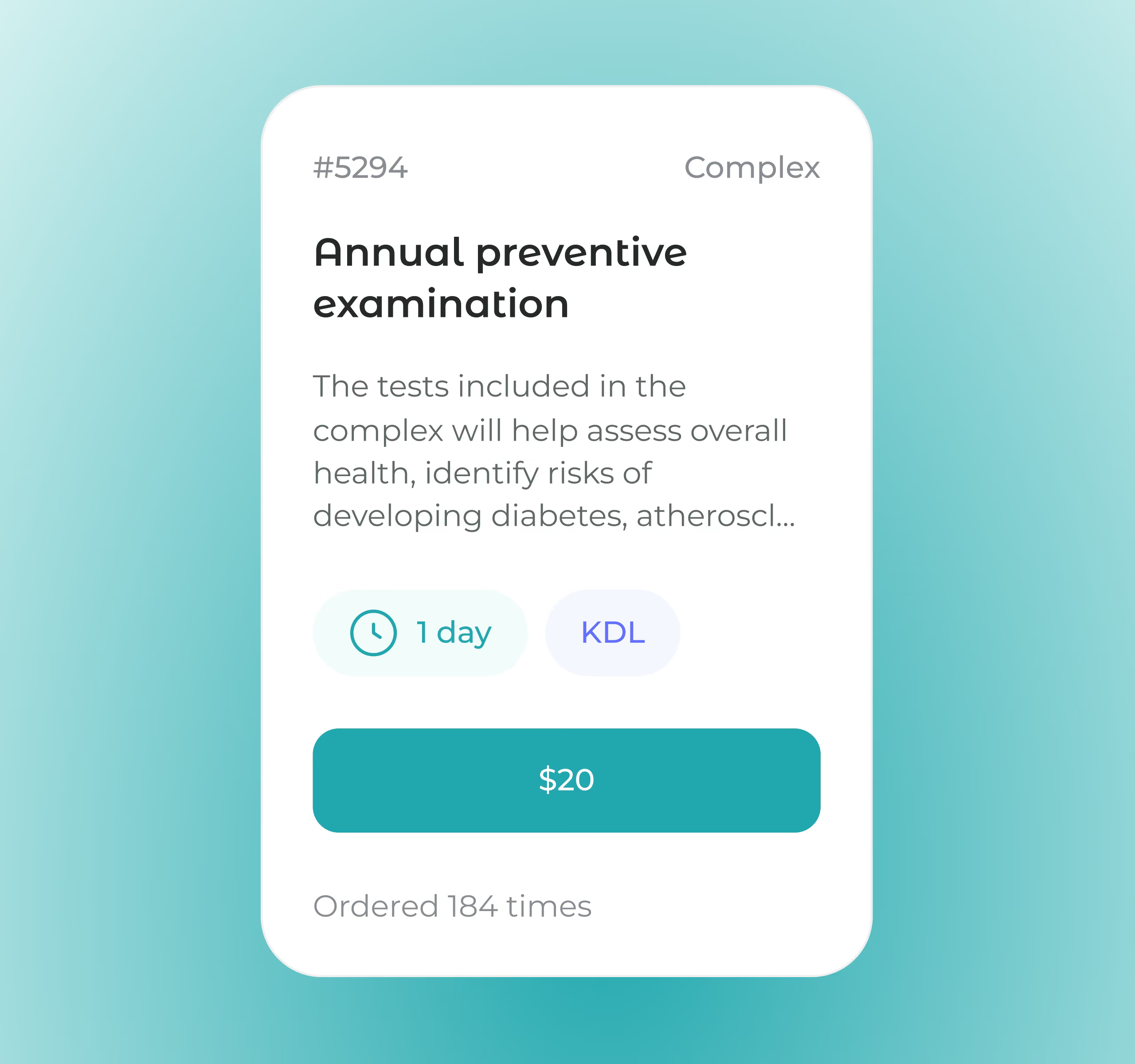
The test-package card groups the description, result timing, laboratory, and price so the visitor can compare the offer before booking
This was booking-interface design, not a voice agent. The lesson for your workflow is to distinguish the requested change from the confirmed booking.
Multimodal interaction connects different kinds of input to the same request. A customer reporting damaged packaging might describe the problem by voice and attach a photo from their mobile device. The assistant uses the description and image together, so the customer doesn’t have to start a separate conversation about the photo.
For your product, the benefit of these conversational experiences comes from preserving that relationship between inputs, not simply adding an upload button. Because image interpretation still makes mistakes, a text alternative lets the customer explain details the assistant missed. That explanation stays with the original request rather than becoming another account of the problem.
Combining inputs doesn’t expand the assistant’s authority to act. If the image is unclear, the request goes to a person instead of triggering a refund. Evaluation therefore checks both whether customers finish without retelling the problem and whether the assistant misreads the image or attempts an action outside its permissions.
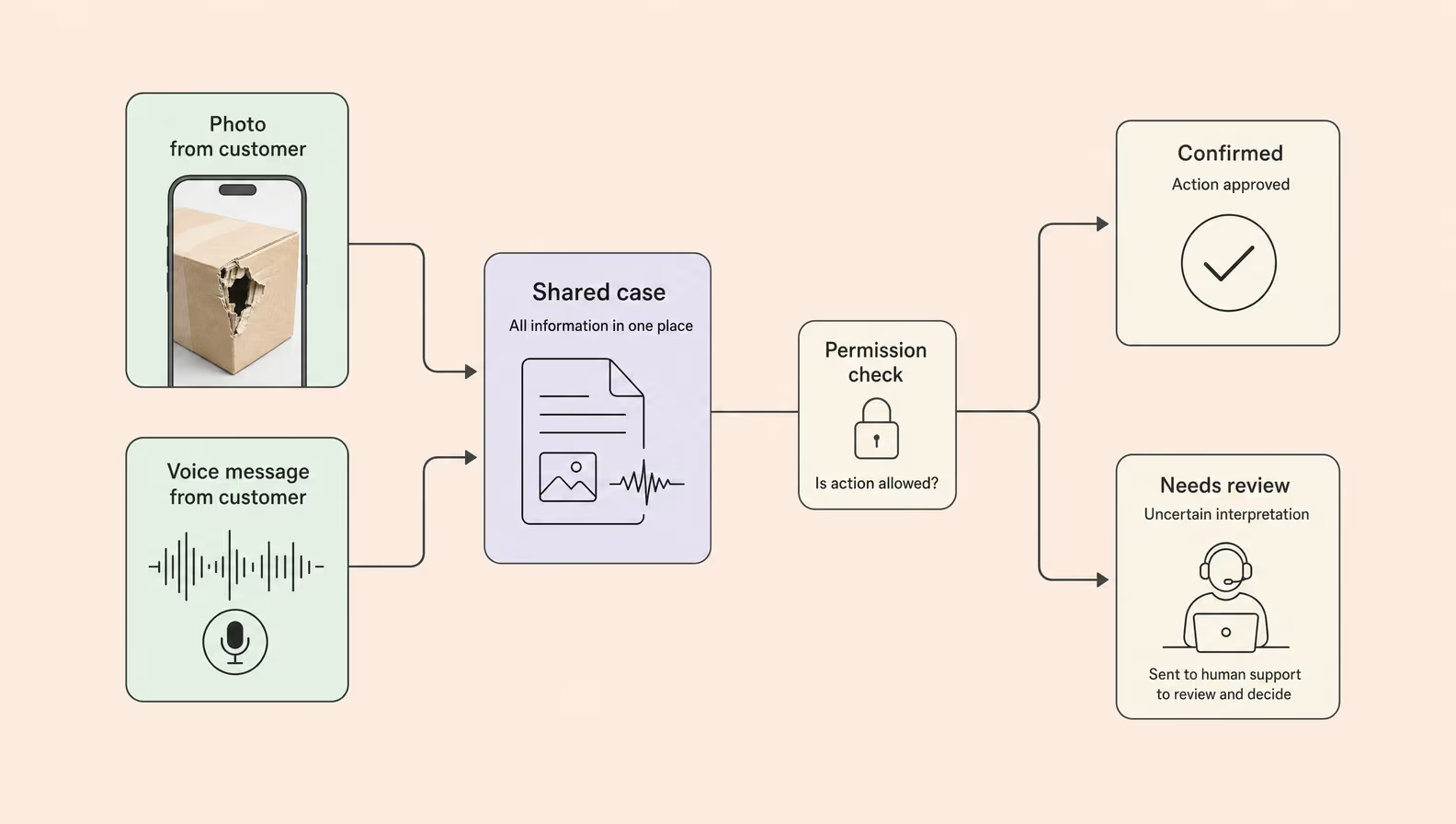
Combining a photo with a voice request doesn’t authorize a refund. Uncertain interpretation still goes to human support
Persistent context lets a customer continue an earlier request across connected channels. Someone who starts an exchange in chat and follows up by phone can pick up the same case, rather than reconstructing the conversation. For that omnichannel experience to work, your system has to retrieve the relevant case details without exposing another customer’s information.
Stored messages alone, even in enterprise conversational AI, don’t establish that right of access. The product first checks the caller’s identity and current permissions, then carries forward only the information covered by consent. Retention rules also limit how long that information remains available, so continuity doesn’t become indefinite storage of every exchange.
These conditions shape how the customer experience is evaluated. Tests check whether the assistant retrieves the correct details and avoids repeated questions, but also whether information crosses between customer accounts. Your product needs both kinds of evidence: a shorter conversation isn’t an improvement if it relies on context the caller wasn’t allowed to see.
⭐ Our experience.
For an agricultural equipment client, we designed a mobile CRM interface, built its frontend, and connected it to the client’s backend. Managers record customer interactions offline, then queued changes synchronize after reconnection.
Sales managers needed to update customer and deal records during field visits, even without an internet connection. Their existing CRM worked on desktop computers, so the task was to bring its familiar terminology and working logic to a mobile interface.
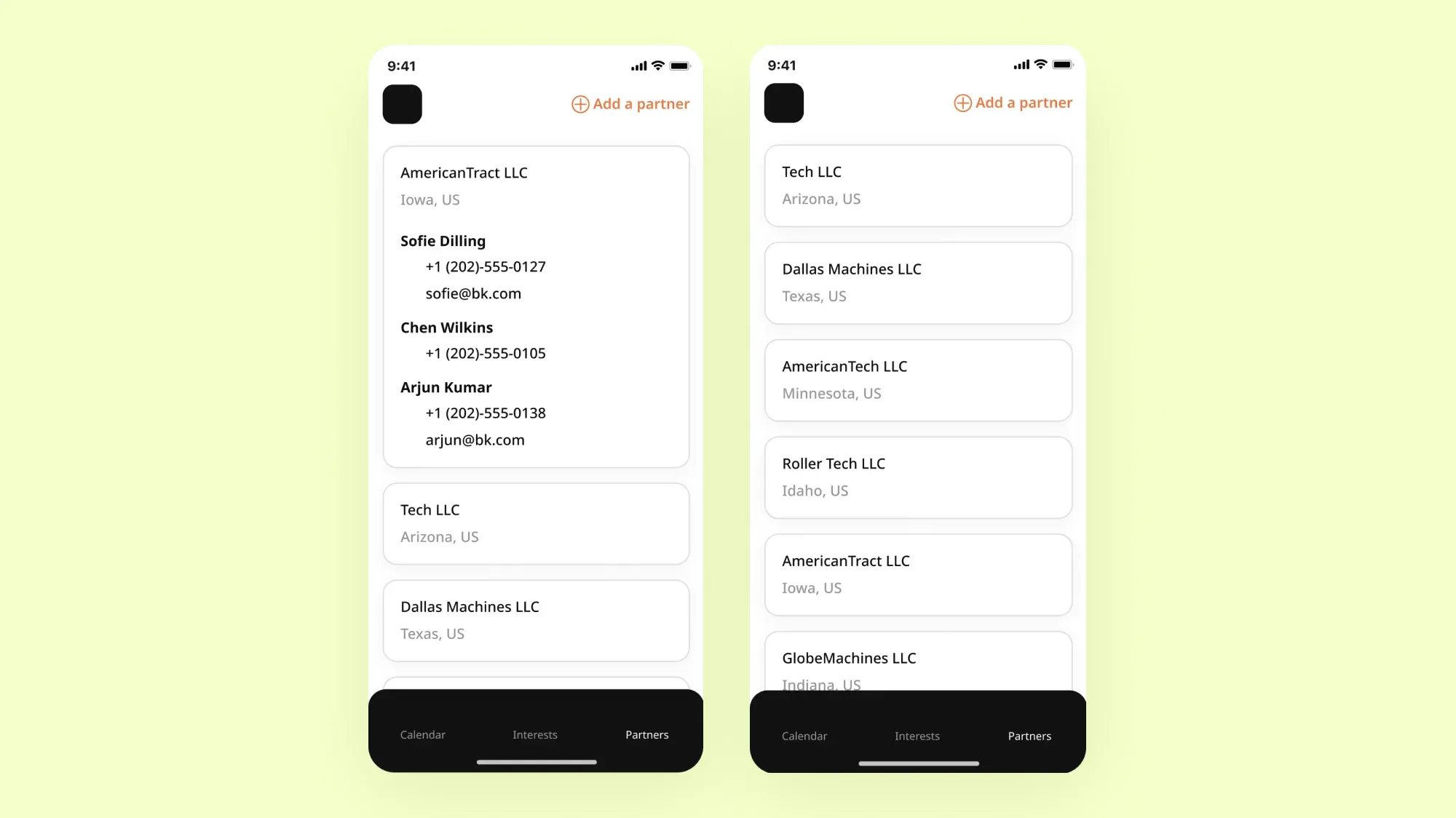
The expanded partner card shows contact details alongside the customer list, helping the manager find whom to contact during a visit
Once the changes synchronize, the manager can return to the interaction in the customer’s record. The same history could help an assistant continue the conversation within its permissions.
Grounded conversational AI applications retrieve approved business knowledge before composing a response, rather than relying only on what an AI model learned during training. This approach, used for knowledge-driven decision support, is called retrieval-augmented generation. In a return scenario, the assistant looks up the current policy for the customer’s order instead of applying a general idea of how retail returns work.
The next decision is whether the request needs an answer or an action. Task-specific AI agents route a policy question differently from a request to change an order, while your knowledge owner maintains the approved sources and their access rules. Questions those sources don’t support need a route to a person rather than a guessed answer.
Retrieval reduces some errors, but a citation doesn’t prove the response is correct. Evaluation checks whether the answer actually follows the applicable source, including whether an outdated policy was retrieved. It also checks whether the assistant escalates unsupported questions instead of answering them with unwarranted confidence.
Conversational commerce lets shoppers refine a purchase through dialogue using generative AI. Someone comparing bags might explain what they carry, then ask why a recommendation fits. Your assistant's answer depends on current catalog details, with live prices and stock checked before checkout.
Adobe's March 2025 companion survey covered more than 5,000 US respondents. Of those surveyed, 39% reported having used generative AI for online shopping. That's self-reported use, not evidence of autonomous purchases or chatbot-driven conversion gains.
Discovery ends where purchase authorization begins. Payment still requires the shopper's confirmation. Evaluation compares recommendation usefulness and assisted conversion with a baseline. Longer conversations alone don’t prove successful customer engagement.
Adobe’s survey measures self-reported shopping use, not conversion gains or evidence of autonomous purchases
Human–AI collaboration uses the assistant to prepare a case while leaving disputed decisions with an accountable person. For a contested refund, the assistant might summarize the customer’s request and identify the unresolved question. The human agent can then review the evidence and decide what happens next, rather than first rebuilding the conversation.
That division of work depends on how the transfer is designed. Giving a customer contact details leaves them to start another conversation, whereas a connected handoff passes the request and relevant history to the receiving person. The summary also needs to show the pending decision and let that person correct anything the assistant got wrong.
We evaluate this automation by following what happens after the transfer: whether the handoff completes, how much correction it requires, how AI helps the receiving person, and whether the customer contacts support again. These measures show whether your service actually reduces the effort of resuming a conversation. Fewer human interactions alone don’t establish that the customer reached an acceptable resolution.
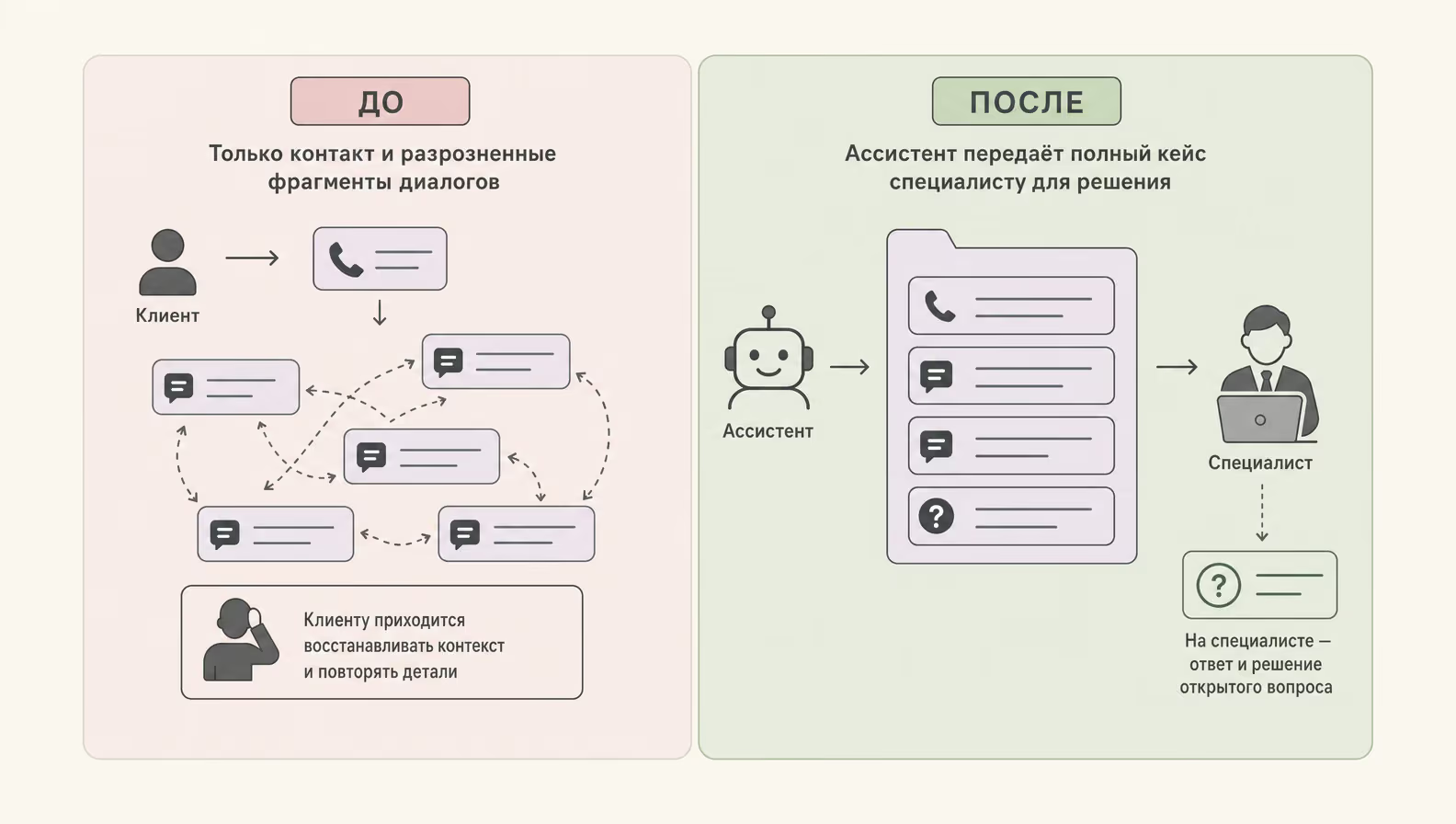
A phone number leaves the customer to restart. A connected transfer gives the receiving specialist context and a pending decision
Governance turns the limits agreed for an assistant into controls that apply during operation as adoption of conversational AI expands. These guardrails define which records it retrieves, which actions it executes, and when a request goes to a person. Testing them requires more than ordinary questions: an attempt to retrieve another customer’s record or make an unapproved account change shows whether the boundary holds.
A passing test blocks unauthorized access and leaves an action log that explains what the system attempted and how it responded. Unsafe requests also need an expected response and an escalation route, so reviewers can distinguish correct handling from an error. That gives your team a basis for investigating failures rather than relying on whether an answer sounds reasonable.
When a model or instruction changes, evaluation repeats representative requests against the same criteria for task completion, incorrect actions, and escalation. The new version has to demonstrate that it still respects those limits. Choosing a model alone doesn’t establish compliance or remove the operational responsibility of the people running the service.
A conversational AI pilot is easier to assess when it targets a specific customer task rather than the use of AI in general: resolving a support request, booking an appointment, or finding a suitable product. Each has a different useful outcome, so your comparison starts with the existing process rather than the quality of the dialogue alone.
The table connects these three conversational AI use cases to measures of customer experience and the decisions that remain with people. The measures are directions for evaluation, not achieved client results. CRM stands for customer relationship management.
| Workflow | Relevant shift | Measure against a baseline | Keep under human control |
| Support request inside a CRM | Persistent context and grounded responses | Resolved requests without repeat contact | Access rights and exception handling |
| Patient appointment support | Task-focused dialogue and human handoff | Completed bookings and correct routing | Clinical questions and urgent concerns |
| Product discovery in retail | Multimodal shopping assistance | Useful recommendations and assisted conversion | Product claims and purchase confirmation |
For conversational AI in CRM, your baseline tracks resolved requests alongside repeat contacts in the existing process. Using the same definition of a resolved request before and during the pilot keeps a change in counting from looking like a service improvement. This tests conversational AI for customer service against resolution rather than message volume.
Among healthcare chatbot use cases, appointment support in health care stays separate from clinical advice, even when teams use conversational AI to handle scheduling. Completed bookings and correct routing matter together.
With generative AI in retail, useful discovery doesn’t authorize purchases. Recommendation usefulness and assisted conversion measure different benefits of conversational AI: finding a suitable item and reaching a purchase.
The comparison keeps consumer behavior during discovery separate from completed transactions when evaluating conversational AI in the retail industry.
⭐ Our experience.
We designed the UX/UI and visual identity for a visual-shopping app that helps people find products they notice in TV series. Viewers start with what they see on screen rather than a product name.
They point their phone camera at the scene and browse product cards in the app. When they find something they want to buy, they continue to a marketplace to complete the purchase.

Product cards support selection, while the documented purchase step takes place on a marketplace
Our documented work covers the interface, not the recognition engine or a conversational agent. The lesson for your product is to keep discovery separate from the purchase step.
Expansion depends on whether your conversational AI solution completes the agreed task and how it handles errors within that workflow. The number of AI capabilities doesn’t settle that decision. Your pilot’s governance checklist covers:
Comparing conversational AI service providers on the same requests makes the evaluation about task outcomes rather than a platform demonstration.
Unauthorized actions, cross-user context leakage, or misrouted risky requests stop expansion. The team fixes the cause, then reruns the same requests against the agreed outcomes before considering further AI adoption.
These limits apply to cloud conversational AI technologies as well as locally deployed conversational AI software.
Conversational AI trends are useful when they help customers finish a task within agreed permissions. For your product, the future of conversational AI depends on available data and approval rules. Those constraints, together with measured completion and correct human handoffs, determine which AI solutions are worth expanding. Conversational AI market forecasts don’t answer that question for an individual product.
➡️ Exploring a conversational workflow? We’ll discuss permitted actions and evaluation criteria for a specific task. Fill out the form to discuss your project.
The main shifts are task-focused agents, real-time voice, multimodal interactions, persistent context, grounded responses, conversational commerce, human–AI collaboration, and stronger governance. Their value depends on the workflow. A useful pilot connects one shift to a measurable customer outcome, with clear permissions, reliable business data, and a defined route to human support.
A traditional chatbot typically answers questions or follows predefined dialogue paths. An agentic system can plan and execute approved steps through connected tools. That does not mean unrestricted autonomy: teams still need permission boundaries, confirmation for consequential actions, logging, and escalation when the request falls outside the system’s authorized scope.
Voice AI adds another way to complete a task. It does not make text support obsolete. Users may prefer text for privacy, accessibility, or reviewing details. A practical product lets people switch channels without losing permitted context and offers human support when recognition, understanding, or task completion breaks down.
Start with one defined workflow and record its current performance. Then measure useful task completion, incorrect answers or actions, repeat contacts, and the quality of human handoffs. Review results alongside data-access and safety incidents. Expand only when the evidence supports the next scope, rather than relying on a polished demonstration.
Conversational AI can handle bounded routine work and help human agents retrieve context or prepare responses. Complex, sensitive, or disputed cases still require accountable people. Evaluate the combined service experience, including escalation and correction, rather than treating fewer human interactions as proof that customers received a better or safer outcome.