Explore

Need help with your project?

Oops! Something went wrong while submitting the form.
Your learning platform already records lesson progress and quiz answers. Machine learning (ML) uses patterns in that data to suggest what a learner practices next or flag when they may need help. The product question is whether those suggestions help students learn, with educators still making the decisions that affect them.
In this article, we explain how to match an ML feature to a learning problem and evaluate whether it works.
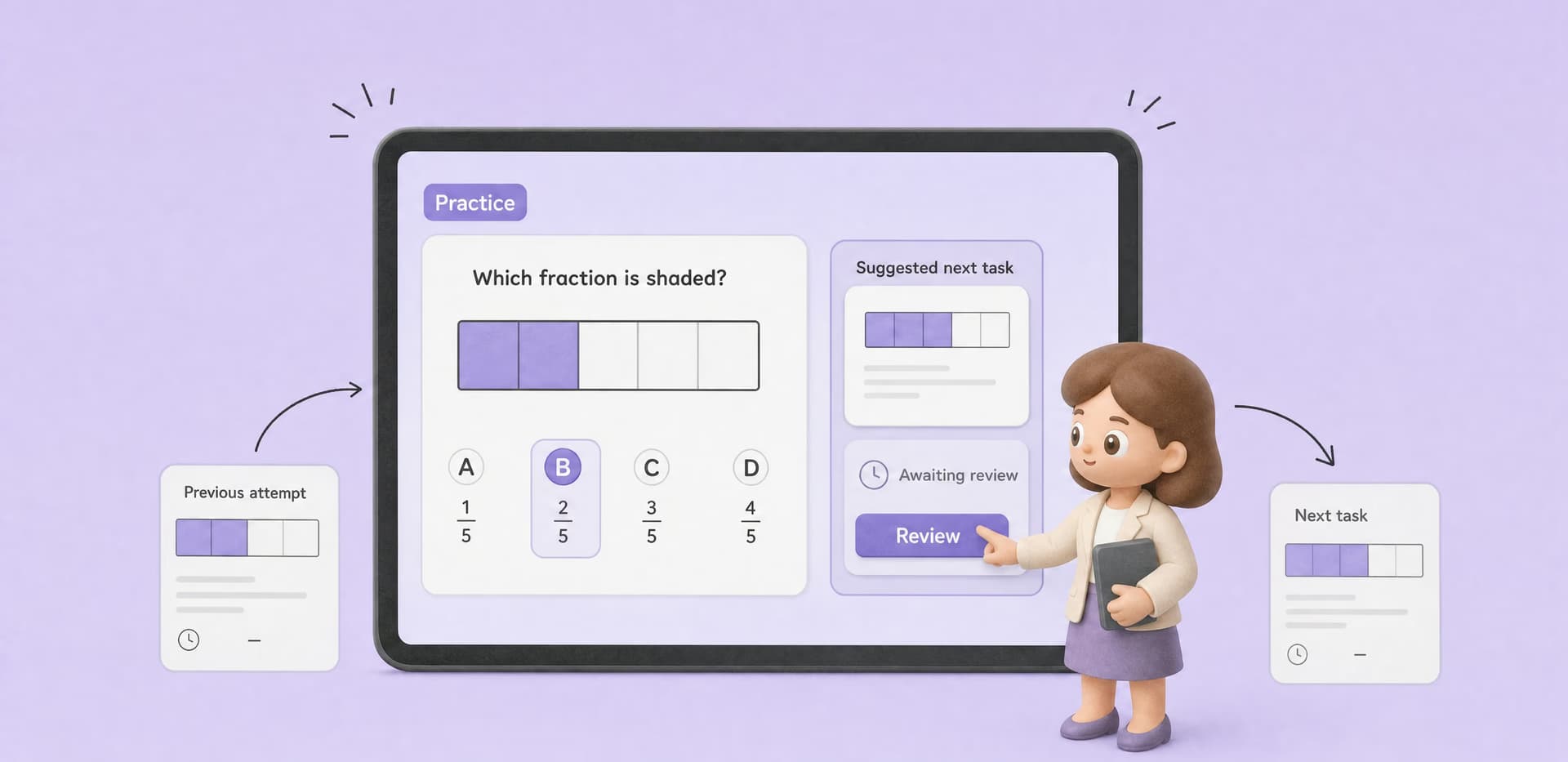
Machine learning in education helps learning tools choose practice based on student data. For example, a model can use earlier answers to estimate when a learner is likely to forget a lesson and suggest when to revisit it.
That differs from unlocking the next lesson after a passing score, which follows a fixed rule. Machine learning algorithms learn patterns from examples instead. In the practice example, the scheduling algorithm uses those patterns to suggest a review time.
With supervised machine learning, training examples include known outcomes, such as whether a learner later recalled an item.
Artificial intelligence (AI) is the broader category. Generative AI produces a new explanation, while a predictive model estimates when practice is needed. Neither takes over the teacher's role: educators still need to inspect recommendations and override them when they don't fit the learner.
Deep learning uses a neural network with multiple layers. That architecture alone says nothing about whether the resulting learning experiences suit the learner.
Building that review into an educational product is part of the work covered by our education software development services. Teams use machine learning when examples inform a choice that fixed rules cannot resolve adequately.
Our machine learning development services cover models and their integration into a learning platform. For education teams, that work starts with a practical question: what will a learner or teacher do differently because of the prediction?
In language learning, remembering a word today doesn't mean remembering it next week. Adaptive learning systems use earlier answers, demonstrated skills, and time since practice to estimate recall. The estimate helps select what material returns and when.
On adaptive learning platforms, personalized learning changes the practice sequence for an individual student without necessarily changing the skill being taught.
Teachers approve the learning path. Personalized practice is one of the e-learning app features that needs a learning measure, not just an engagement measure. A learner who opens every suggested exercise may still struggle with a new task.
Comparing a fresh skill check with an earlier one tests whether the learner has improved. This keeps learning outcomes separate from time spent in the app. Fixed learning styles aren't an established basis for choosing practice.
The table connects each use case with the data it needs, a way to assess it, and the person who checks the result.
| Application | Required data | Success metric | Human checkpoint |
| Adaptive practice | Answers and demonstrated skills | Improvement on new tasks | Teacher approves the learning path |
| Early support | Attendance, assignments, and grades | Precision, recall, and help delivered | Staff investigate and choose support |
| Assessment | Rubric and reviewed examples | Agreement with teacher judgments | Educator reviews scores and appeals |
| Recommendations | Skill gaps and learning history | Mastery after using the material | Teacher checks whether it fits |
| Accessible materials | Audio and source text | Caption errors and usability | Editor checks terminology and meaning |
| Routine work | Approved teaching materials | Time saved after corrections | Educator approves the draft |
Missed assignments can prompt a teacher to check whether a student needs help. Predictive analytics could combine attendance, assignment activity, and grades to identify students at risk of dropping out. Those records suggest where to look, but don't explain why someone's academic performance has changed.
Before testing the model, the team defines the outcome it predicts, such as course dropout, and checks the labels in its evaluation data.
Precision is the share of flagged learners who meet that condition in the evaluation data. Recall is the share of learners with that condition who were flagged.
Both measures matter in learning analytics, alongside whether flagged students actually receive support. Staff still investigate each student's circumstances and decide what help fits. A correct prediction is useful only if someone can act on it.
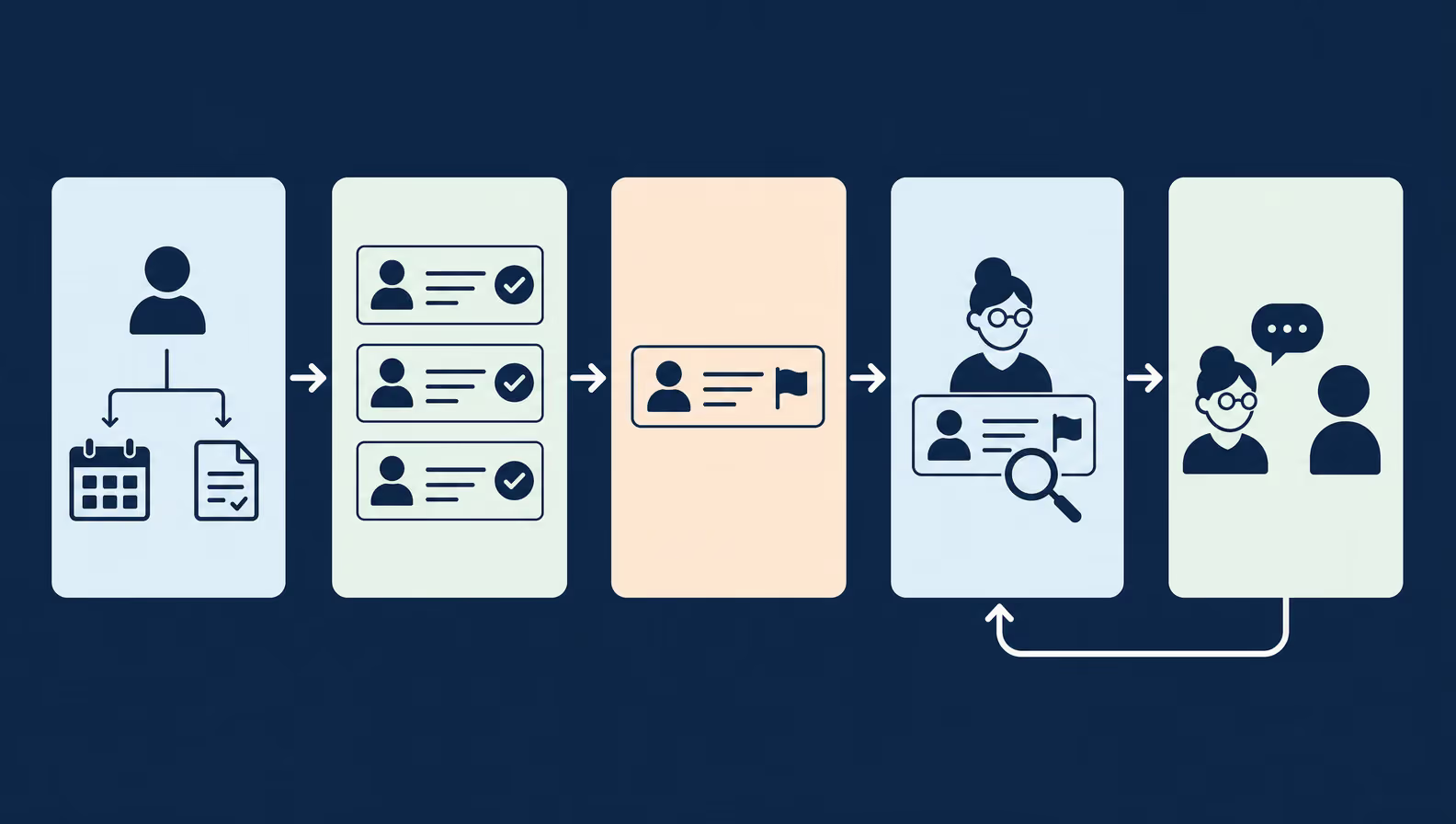
Evaluation checks support delivered, not just prediction accuracy
A quiz with an answer key can be checked with fixed rules. An essay needs a different approach: a model uses a rubric and reviewed examples to propose a score or draft feedback. That gives educators something to review rather than a final grade to accept automatically.
A pilot compares the model's judgments with teachers' judgments to see where they agree and disagree. Assessment specialists also check for bias. Educators approve scores that affect learners, and students retain a way to appeal an educational assessment.
A learner stuck on fractions needs material that addresses the missing skill. Content recommendation uses skill gaps and learning history to select a resource. The teacher checks whether that resource suits the student's needs.
Educational content must match the skill being assessed, whether it comes from a textbook or an online learning resource.
Tutoring does a different job. A structured tutor guides the learner through a worked solution, while a generative AI chat writes a new response. Generated answers need correctness checks and clear limits on what the tutor will answer.
The test for either approach is what happens next: can the learner solve a new problem without help? Opening a recommendation or reading an explanation doesn't establish that they've understood it.
For Zeroney, we designed a learning dashboard and a course catalog with separate areas for purchased and recommended courses. This keeps the courses a learner already has apart from suggestions for what to study next.
We handed the interface designs to the client's developers. This was design work, not an ML implementation: showing a recommendation clearly and testing whether it helps someone learn are separate tasks.
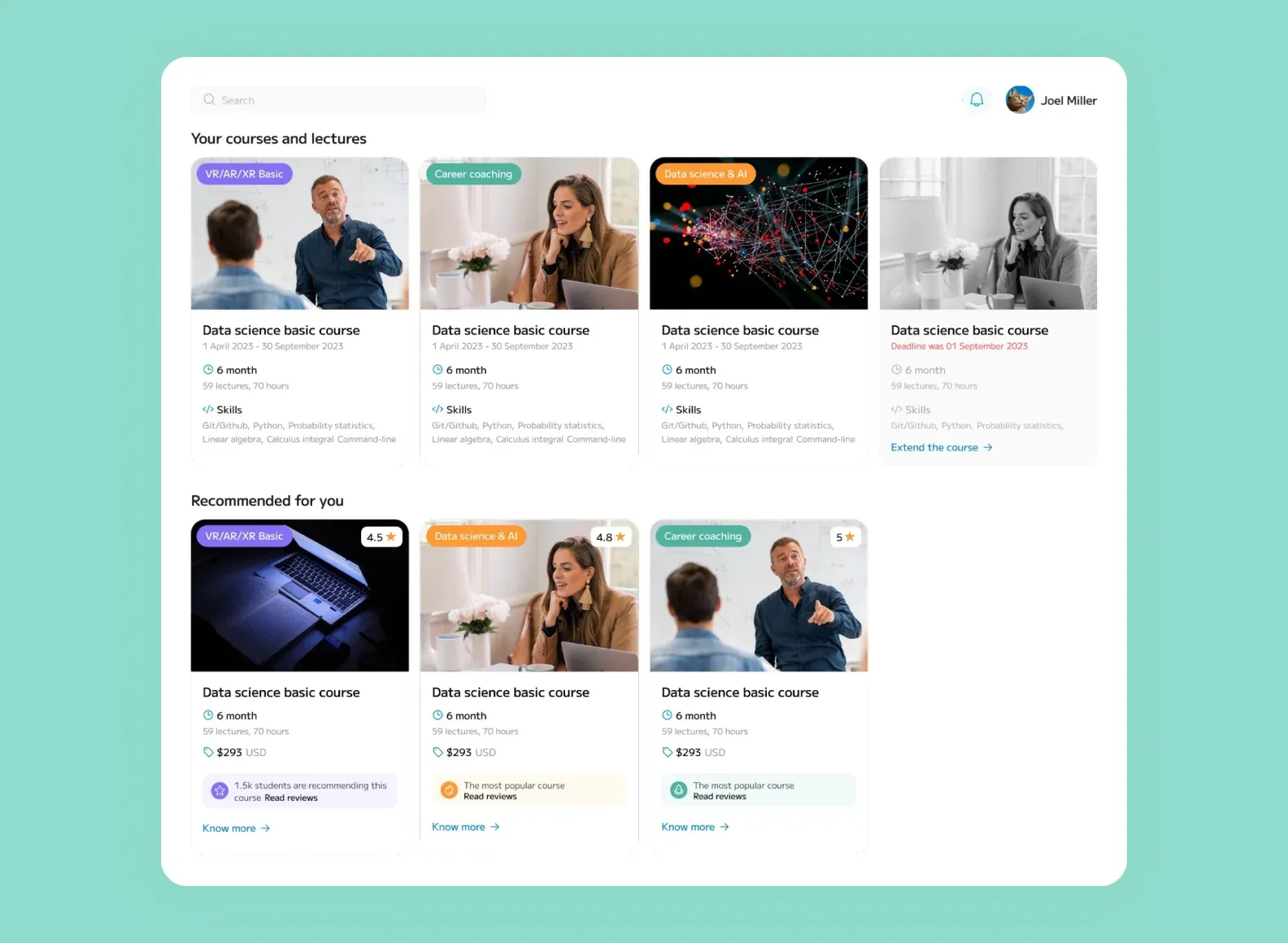
Purchased courses sit above recommendations, separating current study from new options
A student who can't hear a lecture needs captions that preserve its meaning. Speech recognition turns the audio into timed text, and translation makes the source material available in another language. These features give learners another way to access the lesson.
An editor checks terminology and corrects errors before publication. Testing also covers caption mistakes and usability across languages and accents, since quality may differ. A missing negation, for example, changes what the lesson says rather than just how it's spelled.
Finding a reusable worksheet takes time away from teaching. A model can help automate the grouping of teaching materials by topic, so educators have less sorting to do. A generative tool has a different role: preparing a draft from approved learning content.
The benefit is easier preparation, not a claim to improve learning.
Educators still interpret suggestions, check the draft, and approve what reaches learners. Time saved after those checks and corrections is the useful measure, not how quickly a draft appears. Scheduling that follows fixed rules is ordinary automation and doesn't necessarily need machine learning.
Reducing routine work could give teachers more time for teaching, which makes time saved worth measuring in a pilot. In a 2025 Gallup–Walton Family Foundation survey of U.S. public K–12 teachers, weekly AI users estimated saving an average of 5.9 hours per week.
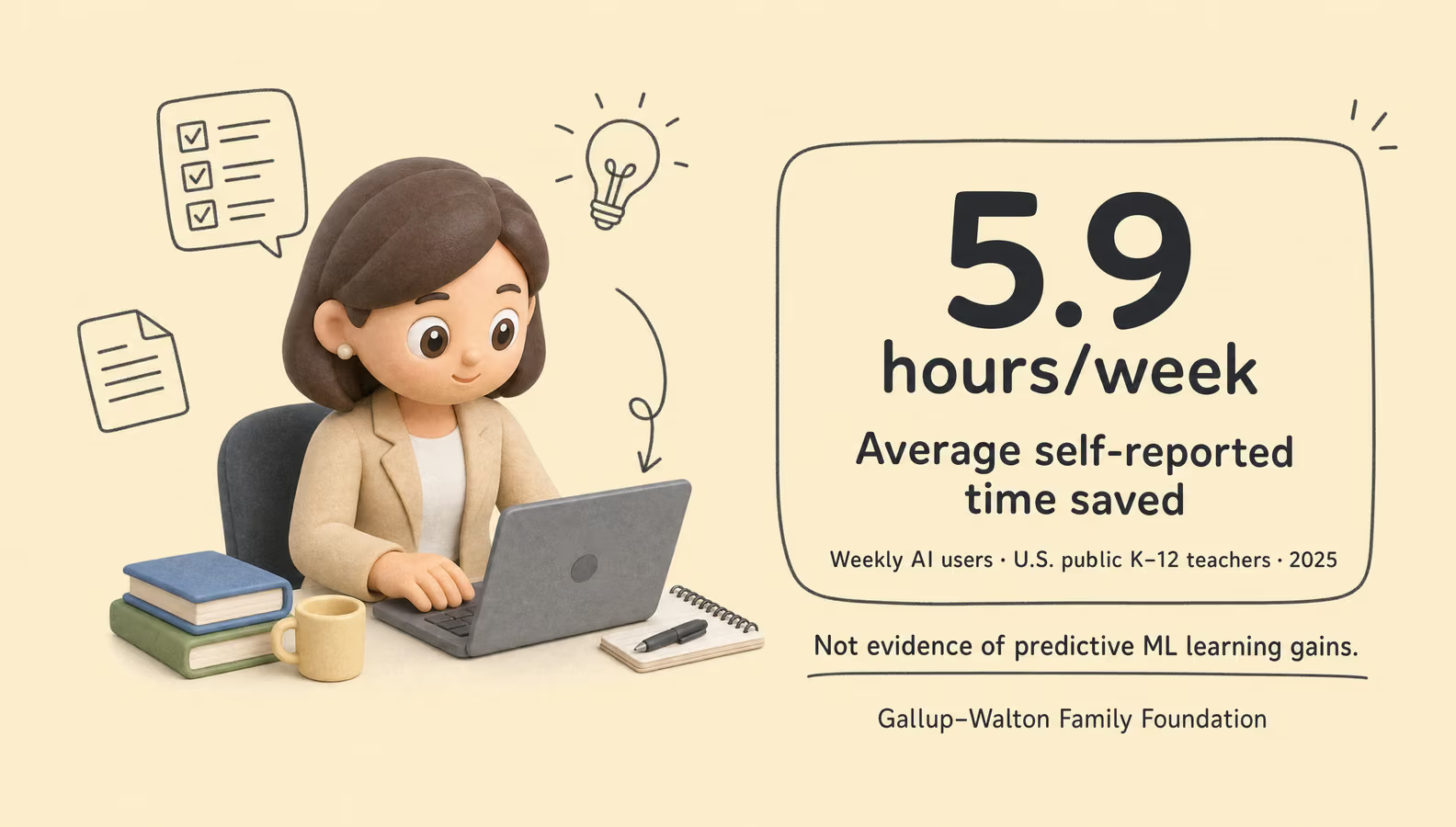
Checking and correction time belongs in workload evaluation
That figure comes from teachers' own estimates of time saved with AI tools. It doesn't establish that predictive ML causes better learning outcomes. The benefits of machine learning depend on student needs, not the novelty of the education technology. For an educational product, the benefits need to be checked separately for the people using it:
In iZumator, we built workflows for creating and taking courses. When a student uploaded homework, the platform opened a discussion thread for questions about the task. Users could also switch roles.
The learning environment determines who can act on a recommendation and what support is available.
Higher education institutions face the same distinction when evaluating technology in education.
Student engagement measures participation, while a new task tests student learning.
Support in this project came through discussion between people, not ML recommendations. Connecting an assignment with its discussion gives learners a place to ask for help. Whether that improves learning still needs to be measured separately.

Lessons and homework share a course page, with mentors and assistants shown alongside
A model needs suitable data, justified access to it, and educators who can review decisions that affect learners. Four areas need attention before and after launch.
A dataset with missing learner groups or inconsistent grades gives the model an unreliable picture of the people it will serve. Teams check both the records and who those records represent. More sophisticated data analysis cannot repair missing records simply by processing larger amounts of data.
Student data and teacher records need defined access rights and deletion dates. Collection is kept to a minimum, especially for minors. Depending on the context, the Family Educational Rights and Privacy Act (FERPA) and General Data Protection Regulation (GDPR) may apply.
Ethics also covers how a child or guardian can question a decision made using those records.
Using lawfully available data, teams compare errors across relevant learner groups and document what they find. This checks for bias without claiming the model is fair. Educational data mining can reveal patterns without establishing their causes.
Explainable artificial intelligence helps educators see why a recommendation appeared. For educational assessment, that explanation supports a human review of disputed grades. The reviewer needs authority to override the model, not just read its reasoning.
Changes in course content or learner populations can weaken predictions. Named owners monitor errors and update the model when needed. That ongoing work helps educators judge whether they can continue to trust its suggestions.
ML pilot evaluation compares applying machine learning to one decision with a no-ML baseline. Our learning management system development guide covers foundational platform work instead.
Existing machine learning models come before custom development unless testing exposes a gap. Machine learning techniques, from a decision tree to a more complex model, face the same baseline comparison.
Data-driven decision making still needs a person responsible for the choice.
Training, validation, and test data sets serve different purposes. Training teaches patterns, validation guides model choices, and untouched test data checks performance on representative new examples. Results don't establish performance for untested learner groups or courses.
Educational research, including a paper or meta-analysis, informs a pilot but cannot replace evaluation in its intended setting.
For Fitforce, we worked on tools that let trainers schedule sessions and update personal fitness programs. The app sent trainers and clients reminders before their sessions.
A trainer updating a personal program isn't the same as a model selecting it. Fitforce is a fitness-coaching example rather than an education ML project, but the distinction applies to a learning platform too. A pilot tests whether a model adds value beyond scheduling and human-written plans.
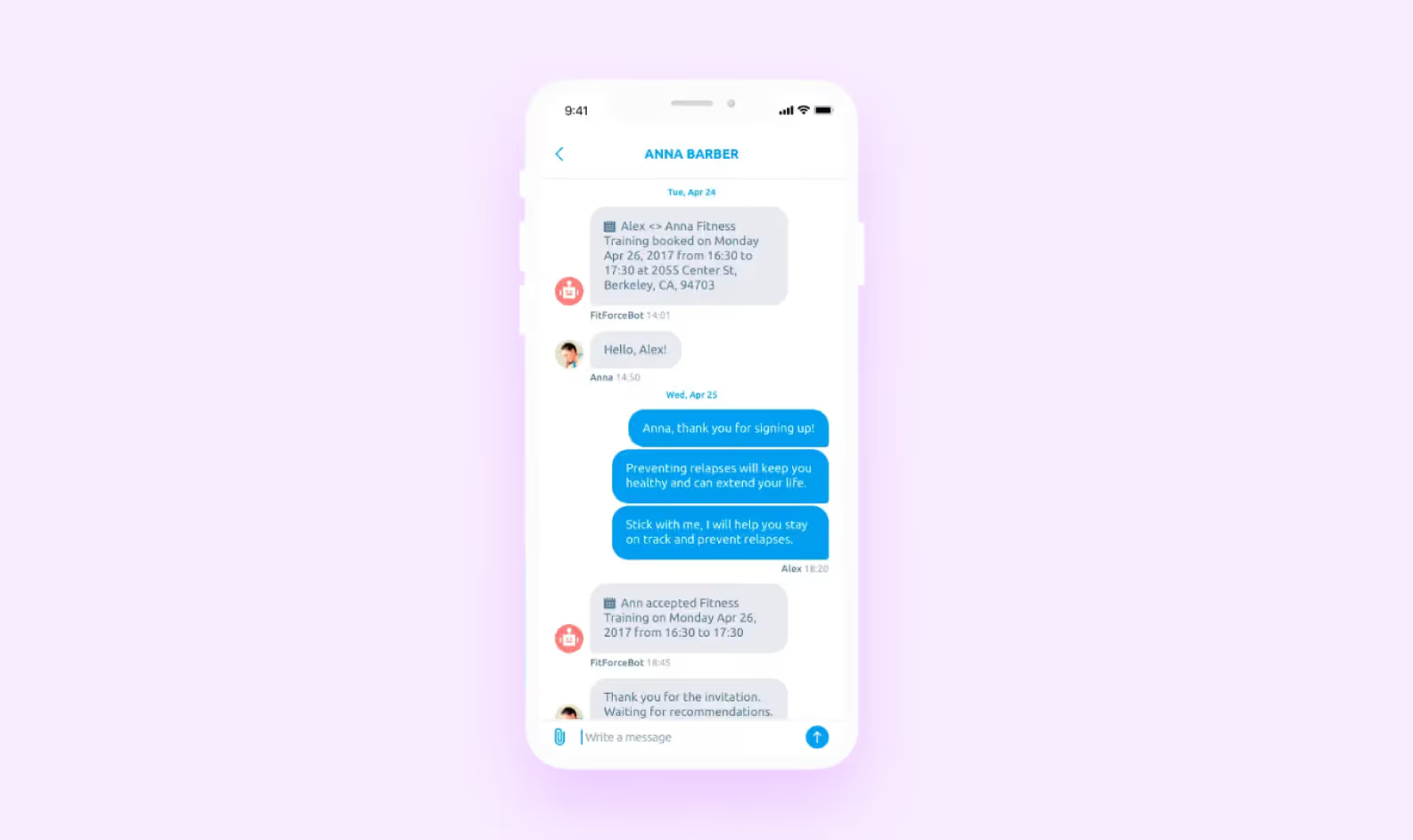
Session notices appear in the same conversation as the trainer's messages
Expansion depends on demonstrated improvement and educator review. Keeping rules and collecting better evidence remains valid when data is sparse or a model offers no baseline improvement. The same applies when educators cannot inspect and override a decision that affects a learner.
Teams integrate machine learning tools only when that comparison justifies changing the existing workflow.
A pilot connects one learning decision to measurable learning outcomes. It requires lawfully usable data and an educator accountable for decisions through human review. If a model doesn't improve on rules, keeping them remains valid.
➡️ Have an ML feature in mind for your learning platform? Let's discuss what it will do for learners and how teachers will review its suggestions. Fill out the form for a free project estimate within 48 hours.
Machine learning in education uses models that learn patterns from educational data to support decisions. These include selecting practice activities or identifying students who may need help.
Unlike a fixed rule, a model estimates an outcome from examples. Educators still define learning goals, review recommendations, and remain responsible for consequential decisions.
A rule-based system follows instructions written in advance, such as unlocking a lesson after a passing score. A machine learning model learns patterns from examples and can estimate which activity may help next. Neither approach is automatically better: choose the simplest system that meets the learning objective and can be evaluated reliably.
An adaptive learning feature may use answers, demonstrated skills, task difficulty, and progress over time. The exact dataset depends on the decision being supported.
Teams need permission to use those records, consistent definitions, and suitable evaluation data. Sensitive attributes should not be collected simply because a model might use them.
Machine learning can assist with practice recommendations, routine feedback, and signals that a student may need support. It cannot take responsibility for a learner's welfare, interpret every classroom situation, or decide what education should achieve. Teachers should remain able to inspect recommendations, correct errors, and choose when not to follow them.
Start with one learning or operational objective and measure a baseline without the new model. Assess model quality alongside the real outcome, such as skill mastery or time spent on routine work. Review errors across relevant student groups, include educator feedback, and expand only when benefits and safeguards hold in practice.