Explore

Need help with your project?

Oops! Something went wrong while submitting the form.
Blockchain app development cost usually runs from about $30,000 for a simple MVP. An enterprise build can reach $300,000+. The spread is wide because blockchain app development carries costs a regular app never does. That's what makes the cost to build a blockchain app a scope-driven number, not a flat quote.

A blockchain app pays for a few things upfront that a standard mobile app skips. The network type, smart contract complexity, and a mandatory security audit each move the total.
This guide breaks down what actually drives that number in 2026. You get ranges by app type, a stage-by-stage breakdown, developer rates by region, and the ongoing costs most estimates leave out.
Here's the short version before we get into detail. Most projects land between a simple MVP and a full enterprise platform. The table below shows the typical blockchain app cost and timeline for each. For a detailed NFT marketplace cost breakdown, see our separate guide.
| App type | Typical cost | Timeline |
| Simple dApp / MVP | $30,000–$70,000 | 2–4 months |
| Crypto exchange / trading app | $90,000–$200,000 | 5–9 months |
| Supply-chain / traceability | $60,000–$150,000 | 4–8 months |
| Enterprise blockchain solution | $150,000–$300,000+ | 7–12+ months |
| Custom blockchain network | $200,000–$500,000+ | 9–18 months |
Read these as average cost bands tied to scope, not fixed quotes. Demand backs the numbers up: the blockchain market is projected to reach $2.38 trillion by 2035, so most teams are shipping real products.
A blockchain application still needs the same software development and mobile app development work as any product, plus the blockchain technology layer on top. That extra layer, not the app itself, is what separates a startup's blockchain budget from a regular one. The rest of this cost breakdown explains what moves a project up or down its range.
Two blockchain apps with the same feature list can quote very differently. Seven factors do most of that work, and the table below maps each one to its cost impact.
| Cost driver | How it moves the price | Example |
| Network type | Public chains need more security work; private and permissioned ones add infrastructure setup | A public Ethereum app vs a permissioned enterprise network |
| Consensus mechanism | Proof-of-work chains need heavier infrastructure; proof-of-stake and proof-of-authority are cheaper to run | Mining-based setup vs a validator config |
| Smart contract complexity | More contract logic means more development time plus a longer audit | A basic token vs a multi-step DeFi protocol |
| Chain choice | Each chain has its own tooling, gas model, and developer rates | Ethereum vs Solana vs Polygon |
| Integrations and APIs | Every external data source or wallet connection adds build and testing time | Price feeds, identity checks, node APIs |
| UI/UX scope | Wallet flows, onboarding, and key management screens take real design work | One-click onboarding vs manual seed-phrase setup |
| Security and compliance | Audits, penetration testing, and regulatory checks are not optional | A smart contract audit plus identity and anti-fraud rules |
A few of these carry more weight than the rest. The network type sets the tone. A public chain means you inherit its gas fees and its security exposure. A permissioned setup trades that for infrastructure you host yourself.
The consensus mechanism, meaning the rule that decides which transactions are valid, changes how much backend work the app needs. A smart contract audit, a paid security review of the on-chain code, is a fixed line rather than a nice-to-have. Teams often outsource these skills as blockchain app development services instead of hiring them in-house.
Consensus is worth a closer look, because it drives both cost and scalability. A proof of work chain like Bitcoin secures itself through mining, which is energy-heavy and slower to scale. A proof of stake chain like today's Ethereum replaces mining with validators, which lowers infrastructure cost and improves scalability. The lighter the consensus, the less your budget spends on backend and hosting.
Regulatory compliance is the other quiet line. An app that touches payments or user identity inherits verification and anti-fraud rules, and that review work lands in the estimate before launch. Skipping it is not really an option, since a non-compliant product can be pulled from app stores or fined later.
When a client from Japan asked us to build a crypto wallet, most of the budget pressure came from one architectural decision. To keep user data anonymous, the app stores everything on the device and runs with no custom backend.
Instead of building and hosting one, our team pulled on-chain data straight from nodes. They combined several free third-party APIs and metered requests per device to stay inside the free limits. An API is just the programming interface an app uses to talk to an outside service.
A team of five shipped the MVP in 1,268 hours. Skipping the backend removed a cost center a naive estimate would have billed for.
Read the full crypto wallet case.
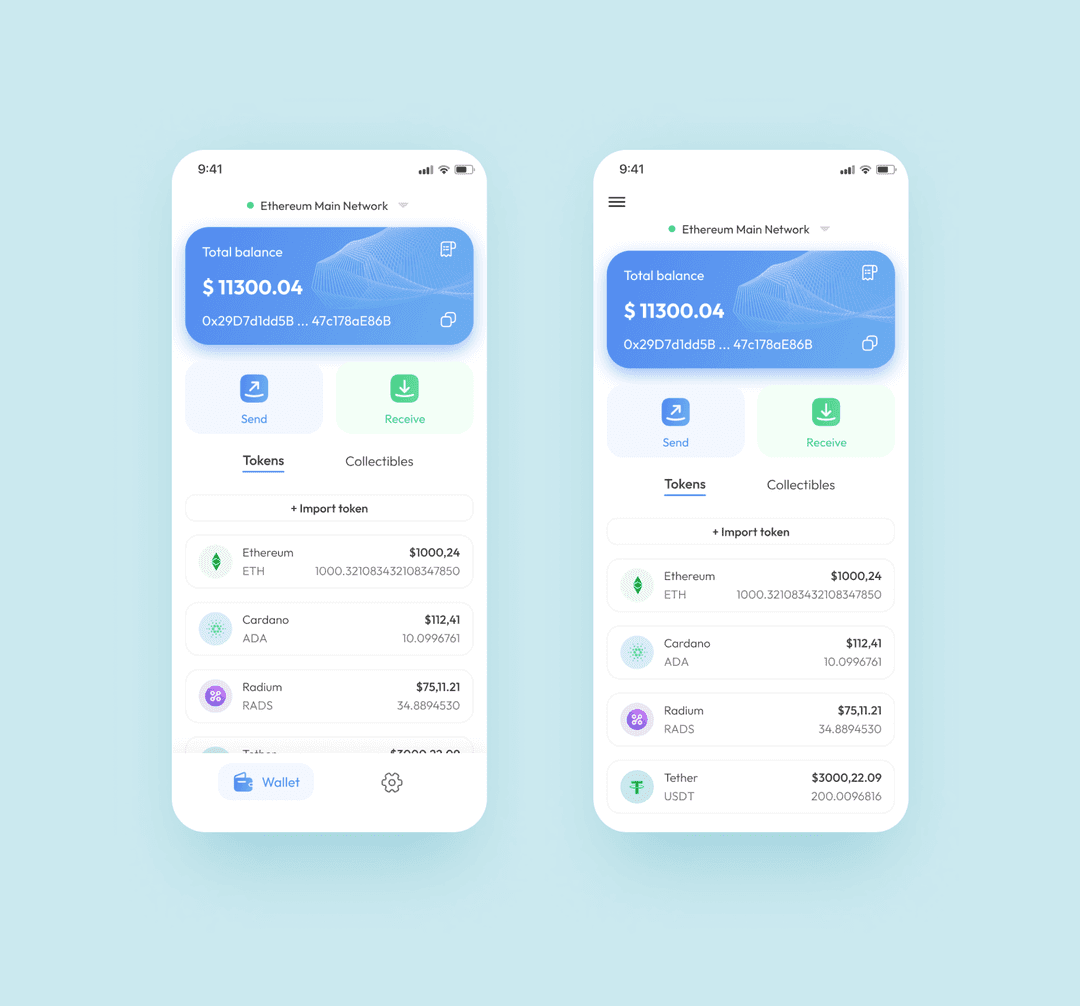
Skipping a custom backend cut a full cost center out of the wallet's budget
Not every blockchain app costs the same, because "blockchain app" covers a wide range of products. Here are the common types of blockchain apps and where each one tends to land.
A simple dApp is the cheapest entry point: a basic decentralized application with a wallet connection and a few smart contracts, usually shipped as an MVP.
Crypto exchanges and trading apps sit near the top of the range, since order matching, custody, and liquidity all add weight.
Supply-chain and traceability apps fall in between, and their cost scales with how many parties the on-chain records have to cover.
Identity and KYC apps store verifiable credentials on-chain and carry heavy compliance work into the budget.
Enterprise blockchain projects run permissioned networks for internal use. Our guide to enterprise blockchain solutions shows where that budget goes.
To put rough numbers on it, a simple dApp often lands in the $30,000 to $70,000 band, while a crypto exchange or a custom network can pass $200,000. The cost varies with scope far more than with the label you give the app, so two products in the same category can sit at opposite ends of the range.
The industry shapes the build as much as the type does. A healthcare records app leans on compliance and on the transparency that a shared ledger gives every party. A supply-chain tracker leans on integrations instead. Some projects also raise money through an initial coin offering, which adds a token and its own compliance work to the budget.
A few product types deserve a deep dive rather than a paragraph here. DeFi platforms, non-fungible token (NFT) marketplaces, cryptocurrency wallets, and decentralized autonomous organizations (DAOs) all fall in this group. Each carries its own cost profile as a blockchain solution. If a decentralized finance product is your goal, start with DeFi app development and price the type of blockchain app development from there.
A blockchain build moves through six stages, and each one takes a fairly predictable slice of the budget. Knowing the split shows where the money actually goes, and where the mandatory smart contract audit sits in the plan.
The discovery stage looks cheap on paper, but skipping it is where budgets break. An hour spent choosing the right chain and mapping the contracts up front saves days of rework once code is live and expensive to change.
Those shares shift with scope, but the order rarely does. A good development team plans the audit into the timeline from day one rather than treating it as a surprise at the end. For the full development process instead of the money side, see how to build a blockchain app.
Smart contract development is its own budget line, and it is the part most generic estimates skip. A smart contract is the on-chain code that runs your app's core logic, so its price tracks how much logic it holds.
Simple contracts like a token or a basic escrow run a few thousand dollars. Mid-complexity contracts with staking or multi-step transfers land around $10,000–$30,000. Complex protocols built on DeFi logic or on-chain governance start at $30,000 and climb from there.
On top of development, budget for a security audit. A smart contract audit typically adds $5,000–$50,000+, and it is not a line you skip, because deployed code is public and hard to fix.
Why does the audit cost so much? A smart contract is immutable once deployed, so a bug cannot be quietly patched the way a server-side fix can. Auditors read every line, model attacks, and often re-check after the fixes land. The more value the contract holds, the more that review is worth, which is why complex protocols pay at the top of the range.
Two more costs are easy to miss. Gas, the fee the blockchain network charges to deploy and run a contract, adds up at launch. The platform itself matters too, since deploying on Ethereum mainnet costs far more than on a cheaper Layer 2 network.
Team location is one of the biggest levers on the final bill, because the same blockchain app costs very different amounts depending on who builds it. Blockchain developers are a scarce, well-paid group, and the market average rate sits around $81–100 an hour. Where your development team is based moves that number up or down.
| Region | Blockchain developer rate | Example MVP cost |
| North America | $100–200/hr | $100,000–$200,000 |
| Western Europe | $70–120/hr | $70,000–$120,000 |
| Eastern Europe | $40–80/hr | $40,000–$80,000 |
| South Asia | $20–50/hr | $20,000–$50,000 |
The example column assumes the same roughly 1,000-hour MVP, so identical scope swings from about $20,000 to $200,000 on rate alone. That is why hiring blockchain developers, or picking development companies, in a given region is a budget decision as much as a hiring one. A common middle path is a nearshore or offshore team that keeps senior quality without North American rates.
Rate is not the whole story, though. A distant timezone can slow decisions, and thin communication can quietly erase the saving a low rate promised. The practical goal is a team whose hours overlap yours enough to keep the project moving, at a rate the budget can actually carry.
The build cost is not the whole bill. A blockchain app keeps spending money after launch, and these ongoing costs rarely show up in a first estimate.
The biggest recurring line is infrastructure. Running or renting nodes, the servers that keep a copy of the blockchain, is a monthly cost that scales with traffic. On top of that, every on-chain action pays gas, so a busy app carries real transaction fees month to month.
Security does not stop at launch either. Any update to a smart contract needs a fresh audit, because the old one only covered the old code. Add routine maintenance, monitoring, and key management, meaning the secure handling of the private keys that control funds and contracts. Together these can add a real share of the total cost of ownership in the first year.
Maintenance cost is easy to forget because it looks small each month, yet it compounds across a full year of ownership. Gas is the least predictable line, since fees rise and fall with network traffic. A launch during a busy stretch on Ethereum can cost far more per transaction than the same launch a week later. Budgeting a buffer for that swing, rather than one fixed figure, keeps the first year from surprising you.
"Blockchain app" and "web3 app" get used as if they mean the same thing, and that confusion shows up in the budget. Web3 is the umbrella term. It covers decentralized finance platforms, NFT marketplaces, DAOs, and decentralized exchanges. A blockchain app is usually one product on a chain, which makes it a narrower and more predictable build.
| Parameter | Blockchain app | Web3 app |
| Scope | One product on a chain | Umbrella for DeFi, NFT, DAO, and DEX products |
| Typical build | Wallet, smart contracts, integrations | Often a full protocol or ecosystem |
| Main cost drivers | Network, contracts, audit | Tokenomics, governance, liquidity |
| Typical range | $30,000–$300,000+ | Wider, and often higher |
The practical cost difference comes down to scope. A single blockchain solution has a bounded feature set, while a broad web3 platform layers on tokens, governance, and liquidity that each carry their own budget. If your project sits closer to that web3 end, our breakdown of web3 development costs covers the wider scope in detail.
The takeaway for budgeting is simple. If you can describe your product in one sentence without the word ecosystem, you are probably pricing a blockchain app, and the ranges in this guide apply. If you cannot, you are closer to a full web3 platform, and the number climbs from there.
You can bring a blockchain budget down without cutting corners on security. A few choices do most of the work.
Start with an MVP. Ship the smallest version that proves the idea, then add features once real users are on it. Picking a cost-effective blockchain platform helps just as much. A Layer 2 network like Polygon settles transactions for a fraction of Ethereum mainnet's gas, with the same underlying security.
Reuse beats rebuild. Audited open-source contracts and libraries save development time and a chunk of the audit bill, since well-known code needs less review. Storing heavy data off-chain, and keeping only the essential records on the blockchain, cuts gas and storage costs further. A nearshore or offshore team can optimize blockchain app development spend without dropping senior-level quality.
None of this means shipping a weaker product. It means sequencing the spend so the first release proves demand before the expensive parts, like a full audit on complex logic, are paid for. A phased roadmap turns one large blockchain development cost into a series of smaller, justified ones.
A studio in Singapore came to us for a crypto wallet plus design for its Web3 games. The budget risk was scope creep, so we built around one clear job: getting non-crypto users in without friction.
That focus paid off. The client attracted investment and its first users just two months into the project, instead of waiting on a full feature set.
Read the crypto wallet design case.
Tight scope got the client to investment in two months, not a full build
Every number in this guide is a range, because a real estimate needs your actual scope. That is how we work. A short discovery phase turns your idea into a defined feature set. From there we give a fixed cost estimate tied to that scope, not an open-ended hourly promise. Across hundreds of development projects, that pattern holds: the estimate starts with what you are building, not a price list.
As a blockchain development company that has shipped crypto wallets and web3 products, our estimate reflects the blockchain-specific lines other teams miss. That means the audit, node infrastructure, and ongoing gas. If you want a real number for your project, our blockchain app development services start with exactly that discovery step.
The honest answer to the cost to develop a blockchain app is the same as the development price for any serious product. It depends on scope, and a good partner tells you that before quoting a number.
➡️ Tell us what you are building, and we will send a scoped estimate within 48 hours. No obligation, just a clear number to plan around.
Blockchain app development typically ranges from about $30,000 for a simple MVP to $300,000 or more for an enterprise-grade solution. The final cost depends on the network type, smart contract complexity, the mandatory security audit, integrations, and the development team's rates.
Blockchain developer rates vary widely by region. They run roughly $100–200 an hour in North America, $70–120 in Western Europe, $40–80 in Eastern Europe, and $20–50 in South Asia. Market averages sit around $81–100 an hour, so team location is one of the biggest levers on total cost.
The biggest cost drivers are the network type, the consensus mechanism, and smart contract complexity. The chosen chain, the mandatory security audit, integrations, and UI/UX scope round out the list, and app complexity ties them all together.
Smart contract development usually costs from a few thousand dollars for a simple contract to tens of thousands for complex logic. On top of that, a security audit typically adds $5,000–$50,000 or more. Treat it as a mandatory budget line, not an optional extra.
Blockchain apps carry extra costs a regular app does not. Those include a mandatory smart contract audit, consensus and node infrastructure, gas fees, and a smaller, higher-paid pool of blockchain developers. These blockchain-specific lines push the total above a comparable non-blockchain app.
Start with an MVP and build on a low-fee chain or Layer 2 like Polygon instead of Ethereum mainnet. Reuse audited open-source contracts, store heavy data off-chain, and consider a nearshore or offshore team to lower hourly rates without sacrificing quality.
After launch you keep paying for node infrastructure, gas fees, monitoring and maintenance, key management, and re-audits whenever smart contracts change. These ongoing costs can add a meaningful share of the initial budget over the first year.


.svg)