Explore

Need help with your project?

Oops! Something went wrong while submitting the form.
Healthcare app development companies build secure, HIPAA- and GDPR-compliant mobile and web apps for patients, clinics, and digital-health products. They cover telemedicine, remote patient monitoring, EHR integrations, and clinical tools, with compliance built in from the first sprint. The hard part isn't finding a vendor. It's choosing among hundreds that all claim healthcare experience, when the wrong pick can mean a failed audit or a rebuild six months in.

This guide ranks 10 healthcare app development companies worth a shortlist in 2026, from enterprise engineering firms to mobile app development companies and product studios. You'll get a side-by-side comparison, an objective profile of each, the criteria that actually separate them, and a simple way to match a partner to your stage and budget.
Healthcare app development companies design, build, and maintain the healthcare applications and healthcare software that connect patients, clinicians, and health data. Their application development services span the full build, from a first prototype to a maintained product. The types of healthcare apps they build split into two broad buckets.
The first is patient-facing healthcare apps: telemedicine and telehealth visits, remote patient monitoring, mental-health and wellness tools, medication trackers, and fitness apps. The second is clinical and provider software — EHR/EMR (electronic health record and electronic medical record) systems, patient portals, appointment scheduling, secure messaging, and the analytics dashboards care teams use behind the scenes. Across the healthcare industry, these products serve patients and healthcare providers alike, widening access to healthcare services. Most vendors also handle healthcare mobile app development end to end and broader medical software development, from discovery and UX through release and support. That end-to-end healthcare application development is what separates product partners from plain coding shops.
What sets the category apart is regulatory compliance. Any app that touches protected health information has to meet privacy and security rules: HIPAA (the Health Insurance Portability and Accountability Act) in the United States, the General Data Protection Regulation (GDPR) in Europe, and Food and Drug Administration (FDA) clearance for anything that qualifies as a medical device. Strong vendors design for that from day one instead of retrofitting it later. Demand keeps climbing, too. The mHealth apps market reached about $37.5 billion in 2024 and is projected to hit $86.4 billion by 2030, a 14.8% compound annual growth rate.
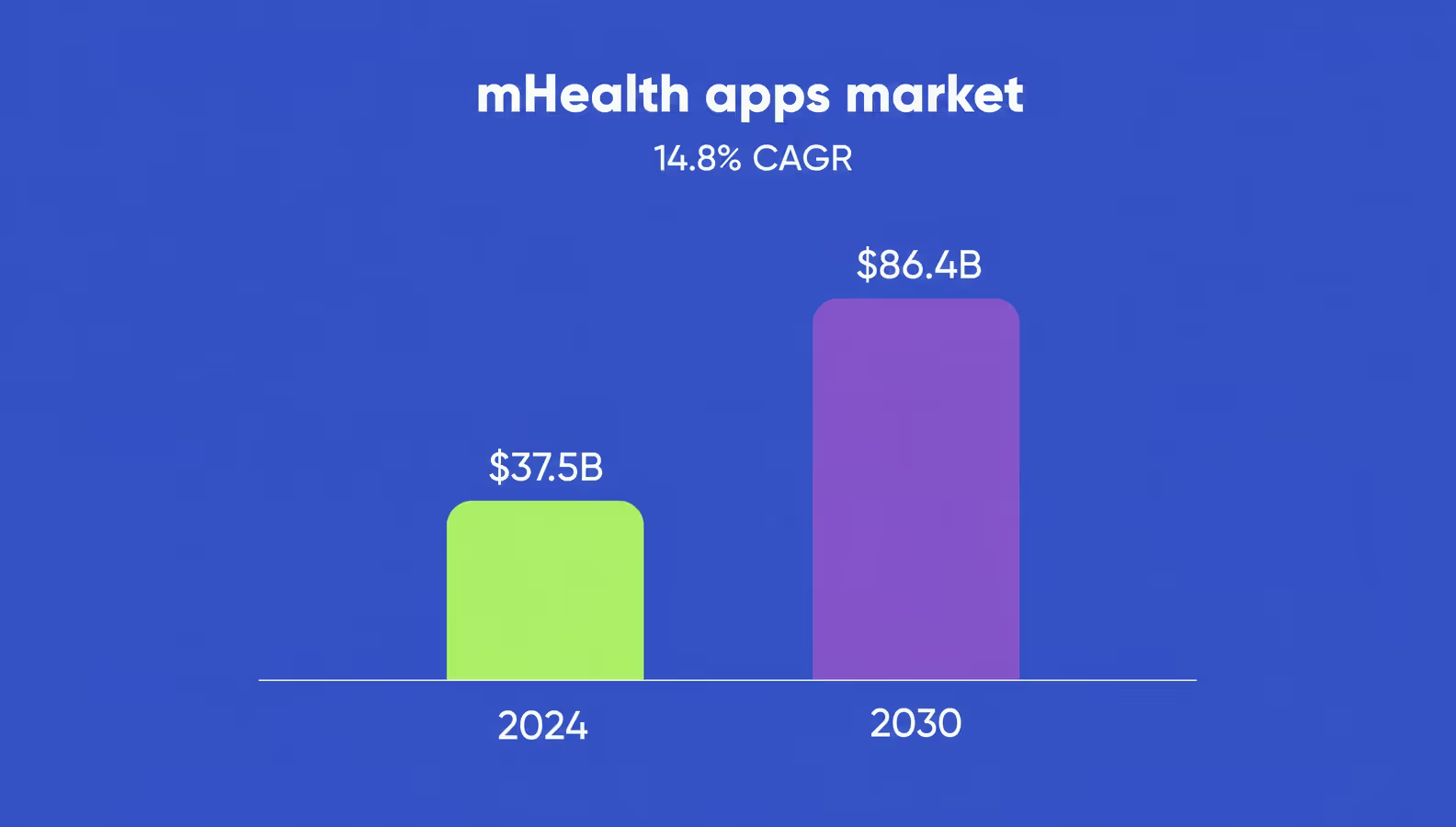
Market projections put mHealth apps on track to more than double between 2024 and 2030
Most healthcare app developers look alike on a landing page. Six things separate a safe pick from an expensive mistake.
| Criteria | What to look for |
Healthcare & HIPAA experience | Shipped medical apps, named health clients, a real compliance track record |
Compliance process | How they handle protected health data, encryption, access control, and audits, not just “we can do HIPAA” |
Tech stack & cross-platform | React Native or native, cloud, and hands-on HL7/FHIR and EHR integration experience |
Delivery model | A fixed-scope development team versus staff augmentation |
Cost & transparency | An upfront estimate covering scope, timeline, and team, not open-ended hourly billing |
Post-release support | Maintenance, monitoring, and iteration after go-live |
The right healthcare solution depends on which of these you weight most. Two of these carry the most weight. Compliance can't be bolted on later. If protected-data handling, encryption, and audit logging aren't in the architecture from the start, a later review can force a costly rebuild. The delivery model decides who owns the outcome: a fixed-scope product team commits to shipping a defined app, while staff augmentation hands you engineers and leaves project management on your side.
Healthcare app development costs track scope, integrations, and compliance depth far more than any hourly rate, so check a detailed breakdown of how much a healthcare app costs before you set a budget. If you want a HIPAA-ready build with a fixed estimate up front, that is the core of Purrweb's healthcare app development services.
Below are ten healthcare app development companies worth a shortlist in 2026. Purrweb sits at the top of this list, but the ranking is a starting point, not a verdict. The right partner depends on your stage, your budget, and how much compliance and integration work your product needs. Scan the table first, then read the profiles below for the detail behind each pick.
| Company | Best for | Delivery model | Key specialization |
Purrweb | Digital-health startups & MVPs | Fixed-scope product team | Mobile-first React Native, HIPAA-ready MVPs |
ScienceSoft | Enterprise healthcare & big integrations | Dedicated team, fixed-price or time-based | Enterprise mHealth, EHR/EMR, HL7/FHIR |
Topflight Apps | Product strategy + patient apps | Product / dedicated team | Healthcare product design, RPM, FHIR |
Appinventiv | Scale-ups & AI-driven mHealth | Dedicated team / staff augmentation | HIPAA-compliant AI, large platforms |
Arkenea | Healthcare-only development | Dedicated team | Exclusively healthcare, EHR, telemedicine |
Intellectsoft | Digital-health transformation | Dedicated team / staff augmentation | Enterprise digital health, connected devices |
Sidebench | Boutique, design-first builds | Product / venture studio | UX-led digital health, EHR integration |
TechAhead | RPM & IoT medical devices | Dedicated / managed team | mHealth, connected devices, EHR integration |
Kanda Software | Trusted long-term partner | Dedicated team / staff augmentation | Healthcare engineering, QA, compliance |
Orangesoft | Custom medical & consumer apps | Fixed-scope / dedicated team | Mobile + web, medical-grade apps |
Purrweb is a mobile-first product studio that builds cross-platform healthcare mobile apps and MVPs on React Native. The team focuses on digital-health startups that need a HIPAA-ready product shipped on a fixed budget and timeline rather than an open-ended engagement. A typical healthcare MVP runs on a fixed-scope estimate that covers cost, timeline, team, and stack up front, with an average go-live of three to six months.
Its work spans telemedicine, remote patient monitoring, medication trackers, doctor-patient messaging and video, and wearable integrations with devices like Apple Watch and OURA. Purrweb states that its healthcare builds are designed to meet HIPAA, HITECH, and ISO 13485 healthcare standards. With 550+ projects shipped over 10+ years, it suits founders who value speed and predictable scope over enterprise scale.
We built Medico, a remote patient monitoring platform for oncology care, with a web app for oncologists and a mobile app for chemotherapy patients. Oncologists set up custom side-effect surveys tied to each patient's medication, and patients get scheduled reminders to complete them and upload test results.
The hard part was catching problems between appointments, when a chemo side effect can escalate unseen. We solved it with automated alerts that fire the moment a result falls outside safe ranges, plus timezone-aware scheduling so reminders land at the right local time. The backend runs on Nest.js, the apps on React Native, and it shipped on the App Store and Google Play.
Read the full Medico case.

ScienceSoft runs an enterprise software business with a healthcare practice that dates back to 2005. It fits hospitals, academic medical centers, pharma, and device makers that need large, integration-heavy systems rather than a single medical app. The team builds custom EHR/EMR platforms and healthcare software solutions, from telemedicine and remote patient monitoring to medical device software and healthcare data analytics.
Interoperability is a core strength. Engineers work with clinical data standards like HL7, FHIR, and DICOM (the standard for medical imaging) to connect healthcare mobile applications with hospital systems. With 750+ specialists, 150+ healthcare projects delivered, and ISO 13485 and 27001 certifications, ScienceSoft suits organizations that value scale and a mature compliance process over startup speed.

Topflight Apps is a health app development company that has built products since 2016, with a strong focus on product strategy and patient-facing healthcare apps. It works with everyone from early-stage startups to large healthcare systems and is a good fit when you need help shaping an MVP as much as building it. Its medical app development spans telemedicine, remote patient monitoring, device companion apps, and EHR integration.
The team leans into interoperability and AI, with hands-on experience connecting apps to Epic, a major EHR system, through FHIR. Its compliance stack covers HIPAA, IEC 62304 (the standard for medical device software), and SOC 2 Type 2. Named healthcare clients include Cedars-Sinai and Cleveland Clinic, which signals comfort with demanding provider environments.
Appinventiv is a large software development company with a broad healthcare portfolio, best suited to scale-ups and enterprises that want AI baked into their products. It builds EHR/EMR systems, telemedicine and remote patient monitoring platforms, patient-engagement apps, and hospital and pharmacy management software.
Scale is the headline here. With 1,600+ developers and 500+ healthcare platforms delivered, the team can staff big, multi-track builds and lean on data tooling for analytics-heavy products. Compliance covers HIPAA, SOC 2, and FDA requirements, backed by ISO 27001 certification. Appinventiv is a fit when your roadmap is ambitious and you need a partner that can grow the team as the product does.

Arkenea is unusual in that it builds healthcare software and nothing else. That exclusive focus, held for 15+ years, makes it a natural fit for healthcare startups from pre-seed to Series C, physician entrepreneurs, and B2B health SaaS teams. The work covers custom healthcare app development across web and mobile, custom EHR/EMR builds, telemedicine, and, more recently, generative-AI healthcare tools.
Because the whole company is oriented around one industry, HIPAA architecture and clinical workflows are the default rather than a specialty bolted onto general dev work. Arkenea has earned industry recognition for its healthcare software several years running, and its client list includes names like Novo Nordisk. It suits founders who want a partner already fluent in healthcare development from day one.

Intellectsoft is a digital-transformation firm that has worked in healthcare since 2007. It's aimed at established healthcare organizations, from hospitals to insurers and pharma companies, that want to modernize legacy systems rather than launch a first product. Its healthcare solutions include EHR/EMR and hospital information systems, mobile health apps, telemedicine, and healthcare analytics.
The team also works with connected medical devices and AI-driven tools, and offers dedicated teams for longer engagements. Compliance covers HIPAA and GDPR, which matters for organizations operating on both sides of the Atlantic. Client work includes healthcare products like Fleet Nurse and Transplant Hero. Intellectsoft fits enterprises that need a consulting-led partner to guide a broader digital-health shift.

Sidebench is a boutique product studio that leads with design and strategy. It's a fit for hospitals, enterprises, and funded health startups that care about patient experience as much as engineering and want a partner to shape a complex product from discovery onward. Work spans digital-health design and development, custom software, and Health IT integration with EHR systems like Epic and Athena.
The studio has run since 2012 and lists 60+ healthcare implementations, along with HIPAA compliance and named clients such as the American Heart Association. Project examples include NOCD, an OCD treatment app, and Cortica, which handles scheduling for neurological care. Sidebench suits teams where UX quality is a first-class requirement, not an afterthought.
TechAhead builds mobile and enterprise software with a healthcare practice centered on remote patient monitoring and connected devices. It's a fit for healthcare and wellness companies that need to pull data from hardware, such as glucose monitors, blood-pressure cuffs, pulse oximeters, and wearables, into a single platform. The team also handles telemedicine and EHR integration with systems like Epic and Cerner.
Its compliance credentials are among the strongest on this list: SOC 2 Type II, ISO 27001, and ISO 42001 for AI governance, plus HIPAA-compliant cloud infrastructure. TechAhead reports 240+ healthcare consultants, and its case work includes The Healthy Mummy, a wellness app scaled to roughly 2 million users. It suits device-driven healthcare apps where hardware and app have to work as one.
Kanda Software brings one of the longest track records on this list, with custom software work dating back to 1992 and a dedicated healthcare and life-sciences practice. As a trusted healthcare partner, it's built for healthcare, pharma, and life-sciences organizations that want mature, compliance-focused engineering and strong QA rather than a fast MVP shop. Services cover healthcare software development, cloud engineering, QA, and DevOps.
The team leans on decades of process maturity, ISO 27001 certification, and cloud partnerships across AWS, Google Cloud, and Microsoft. Named healthcare and pharma clients include Janssen, City of Hope, and Brigham and Women's Hospital. Kanda suits long-term engagements where reliability and precision-medicine-grade rigor matter more than raw speed.
Orangesoft is a full-cycle mobile and web development company that has built apps since 2011, spanning both medical-grade and consumer health products. It fits startups and mid-market companies that want one partner for discovery, UI/UX, MVP, QA, and ongoing support. The team ships cross-platform apps on React Native and Flutter alongside web products, covering mobile application development end to end.
Its medical mobile app development covers telemedicine, mental health, remote patient monitoring, and medical device software, backed by a broad compliance stack that includes HIPAA, ISO 13485, and IEC 62304 for medical device software. Orangesoft reports 300+ products delivered, and its case work includes an FDA-compliant stroke app with telemedicine. It suits teams that want medical-grade rigor without an enterprise price tag.
Four shifts in healthcare technology are shaping what these healthcare app development companies build in 2026.
Artificial intelligence (AI) is moving from buzzword to feature. Diagnostic support, symptom triage, and clinical assistants are showing up in shipping healthcare apps, taking first-pass work off clinicians so healthcare professionals can focus on judgment calls. The best vendors treat AI as a tool inside a regulated workflow, not a bolt-on demo.
Remote patient monitoring and wearable technology keep spreading beyond chronic-care pilots. Continuous data from watches, patches, and home Internet of Things (IoT) devices is becoming a standard input for care rather than a novelty, which raises the bar for how healthcare apps handle real-time streams.
Interoperability is the quiet priority. FHIR and EHR integration decide whether an app fits into a clinician's day or becomes another disconnected login. Vendors that handle this cleanly tend to win the enterprise deals.
Privacy and security expectations are rising in step. As healthcare apps collect more sensitive health data, data security is becoming a selling point: encryption, access control, and audit trails are shifting from compliance checkboxes toward product differentiators. The money follows all of this: the digital health market is on track to reach roughly $1.83 trillion by 2033, which keeps pulling talent and vendors into the space.
Picking a healthcare app development company comes down to matching a partner to your stage. Enterprises with heavy integration needs lean toward firms like ScienceSoft or Kanda. Startups that need a HIPAA-ready MVP shipped fast are better served by a mobile-first studio. Whatever the size, the non-negotiables stay the same: real healthcare experience, compliance built into the architecture, and a transparent scope you can hold a vendor to.
If HIPAA is in scope, plan for it from the first sprint rather than after launch, and read our guide to HIPAA-compliant development before you write a line of code.
➡️ Ready to scope your healthcare app? Contact Purrweb for a free estimate within 48 hours.
It designs and builds mobile and web applications for healthcare — patient apps (telemedicine, remote patient monitoring, mental health), provider and clinical apps, and EHR/EMR integrations — while meeting HIPAA/GDPR requirements and data-security standards.
It depends on scope, integrations and compliance. An MVP typically starts lower, while a full product with EHR/EMR integrations and advanced features costs more. See our detailed healthcare app development cost breakdown for current figures.
Look for proven healthcare experience and case studies, a mature compliance process (HIPAA/GDPR), a relevant and cross-platform tech stack, a transparent delivery model and estimate, and post-release support.
If your app handles protected health information (PHI) in the US, yes. Compliance should be built into the architecture from the start rather than added later, covering access control, encryption and audit logging.
An MVP usually takes a few months depending on features and integrations. A fixed-scope approach and ready-made compliance patterns speed up the path to go-live.


.svg)