Explore

Need help with your project?

Oops! Something went wrong while submitting the form.
New technologies transform the way we exist in the cities: smart traffic lights that prevent jams, parking spaces that tell you which ones are free, energy-saving buildings, and security systems that stay connected 24/7. All of this is powered by the Internet of Things (IoT), a technology that helps cities run better and solve problems. Yet, these opportunities come with their fair share of challenges, such as data security risks, privacy concerns, and the demand for reliable infrastructure.In this article, we’ll explore all the ways smart cities can use IoT technology to improve urban living: learn about real-world examples, key application opportunities, challenges, and future trends.

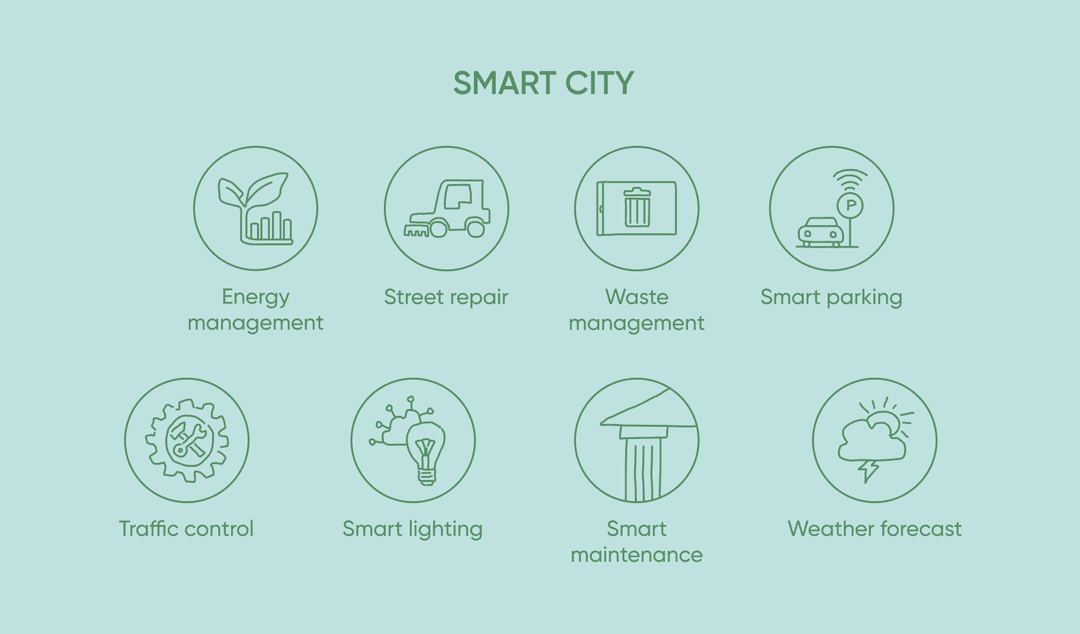
In short, a smart city is a city where a mix of IoT technology and data-driven initiatives helps create a more sustainable, efficient, and comfortable place to live. These cities gather data from various sensors or connected devices to control operations in the area and respond to residents’ needs. Examples of smart city initiatives are apps that monitor the condition of roads or bridges and alert street maintenance crews.
IoT smart cities can integrate data-driven initiatives into public transportation, parking, energy usage, or public safety.
The Internet of Things (IoT) is a network of devices, such as sensors, cameras, or smart appliances that are connected to the Internet and can share information with each other.
This data gets analyzed and transformed into actions that run automatically or with the user’s input. IoT is also widely popular in smart homes. For example, IoT devices can turn on lights when someone enters a room or send an alert about a water leak. IoT makes many everyday tasks easier and helps systems run more efficiently.
On a city scale, IoT can smooth many aspects of living in an active urban area. For instance, we once developed Energo, a city-wide IoT app that helps metro riders rent a power bank when their phone battery is running low. They can just grab a portable charger at a station, commute home, and return it at the point of destination. All is possible because of IoT-powered stations.
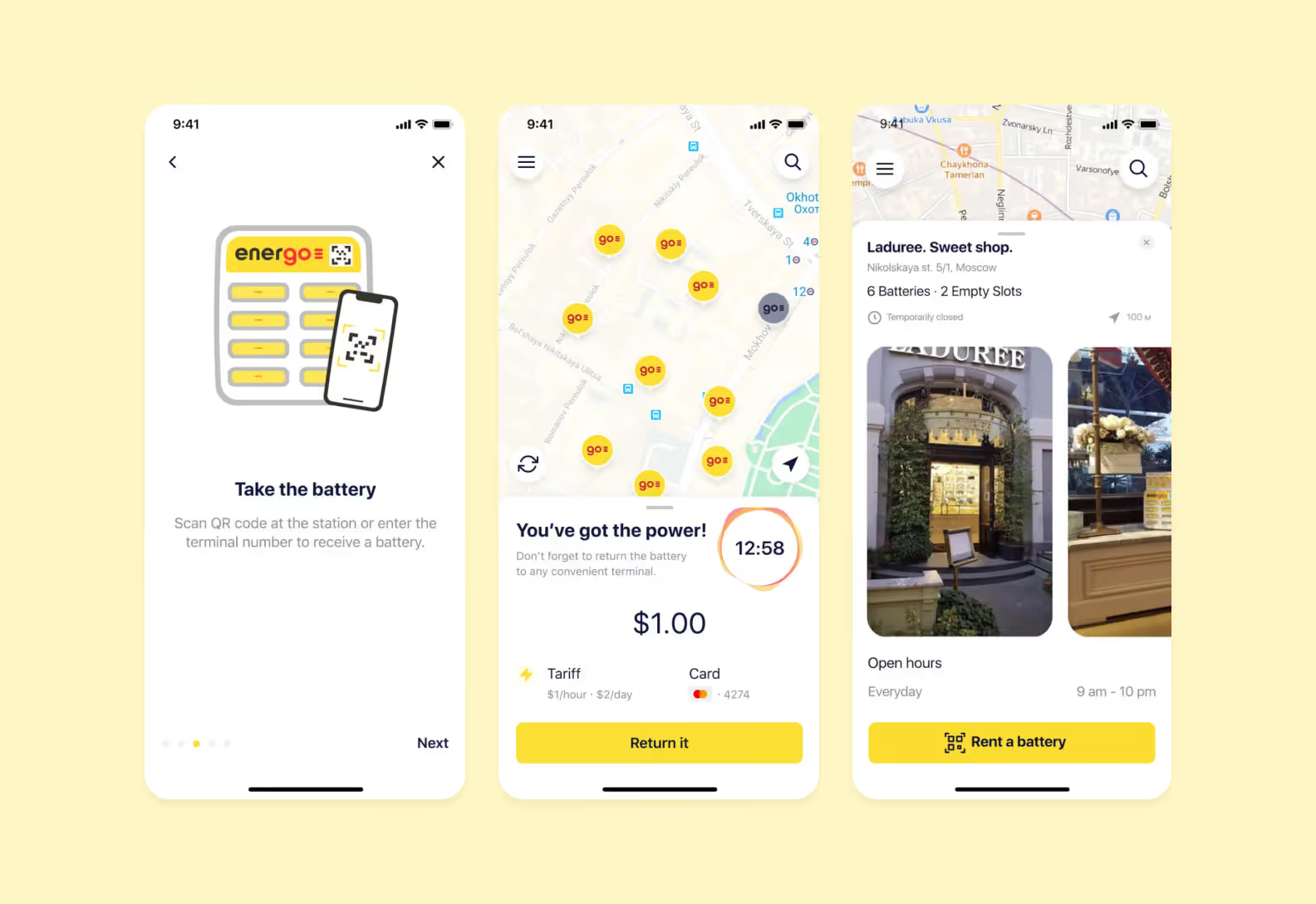
Integration with IoT devices is crucial for modern and comfortable cities that care about the residents and their comfort. Here are three ways in which IoT in smart cities improves urban life.
IoT helps cities manage operations in several different ways. For example, it monitors traffic, spots accidents and adjusts traffic light timing. This ultimately reduces congestion on the roads and saves time for commuters.
Another use case for a city is a smart waste management system. This system uses sensors in trash bins to signal when they need to be emptied, optimizes garbage collection routes, and cuts maintenance costs.
All of this leads to efficiency — any city faces routine issues such as traffic jams or overflowing trash bins that can be prevented with the help of IoT.
With the help of IoT devices and the data they gather, smart cities can surveil neighborhoods, develop algorithms that detect unusual activity, and alert authorities immediately. This quick response can help prevent crimes or address emergencies faster, ultimately leading to safer streets for the residents.
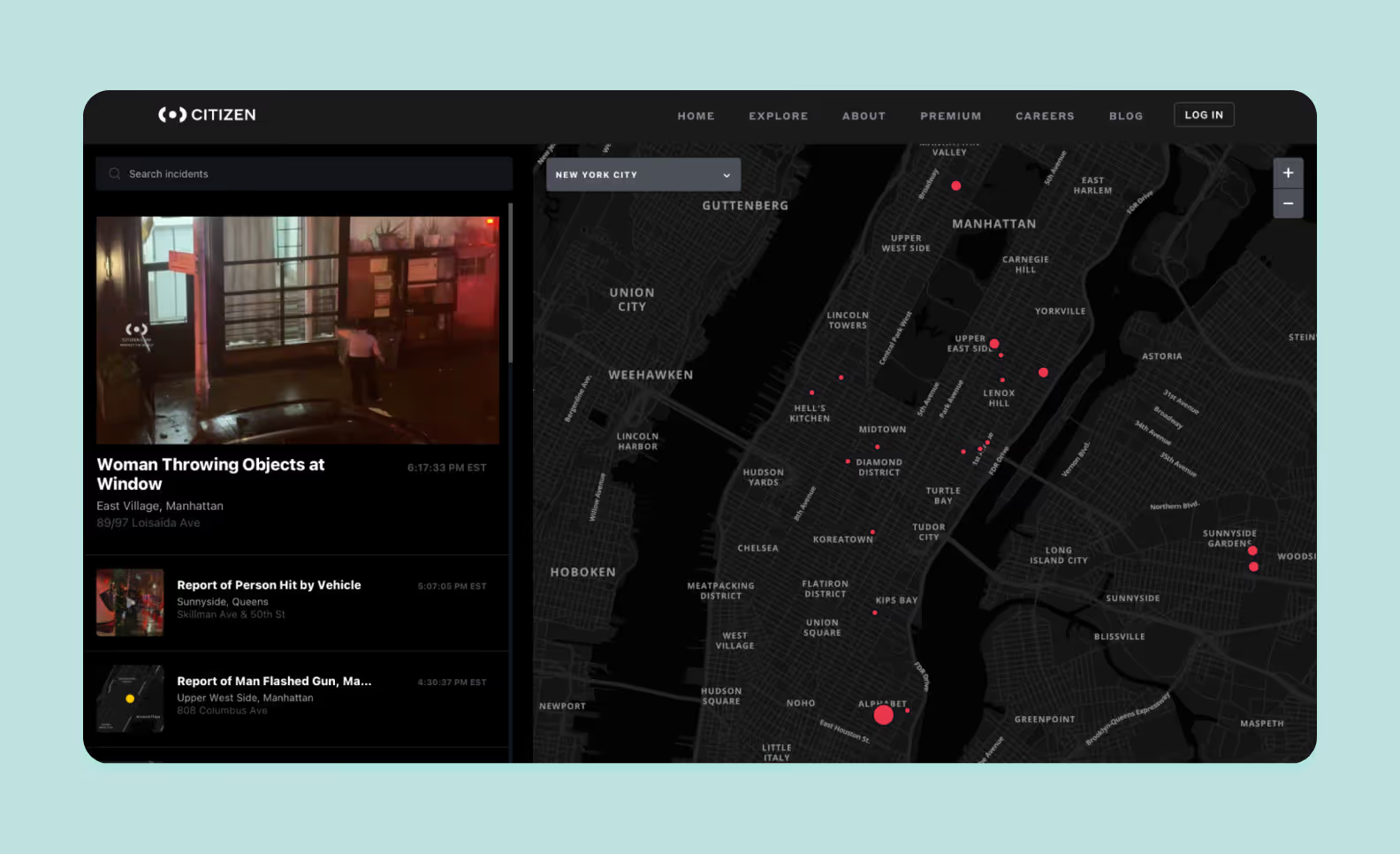
Overall, IoT in smart cities enhances the quality of life in the area. Residents can benefit from a clean, well-functioning, safe, maintained, and prosperous place where innovations make everyday routine simpler and more convenient.
Basically, smart city initiatives can be applied to almost any part of urban life. If you imagine the average day of a metropolitan area resident, every step of it — from morning commute to work and evening stroll around the neighborhood to air quality and electricity bill — can be improved through IoT-powered solutions.
Below, we selected the five most common use cases for IoT in smart cities.
Think of smart sensors and cameras that adjust traffic lights in real time, reducing congestion and wait times when needed. The technology is nothing new — smart cities like Pittsburgh have cut down travel time by a quarter and traffic jams by 40% by implementing the system years ago.
Smart waste management systems and grids optimize energy distribution and city resources. For instance, using IoT sensors, Barcelona officials monitor the fill level of bins in real time across the city and send information to the central office of street maintenance crews.
Smart cities implement real-time bus or train tracking and route optimization to make resident commutes more efficient. Many urban areas now offer an app where residents can see the schedule, check the location of the transport, and estimate the arrival time.
Advanced surveillance systems help smart cities detect unusual activities, recognize potential security risks, and instantly alert authorities. Ultimately, IoT solutions with video cameras and facial recognition can deter potential criminals and lead to safer neighborhoods.
Smart city IoT solutions use sensors to track air quality, pollution levels, and environmental changes. This helps city planners recognize when to take action and make data-driven decisions about the environment.
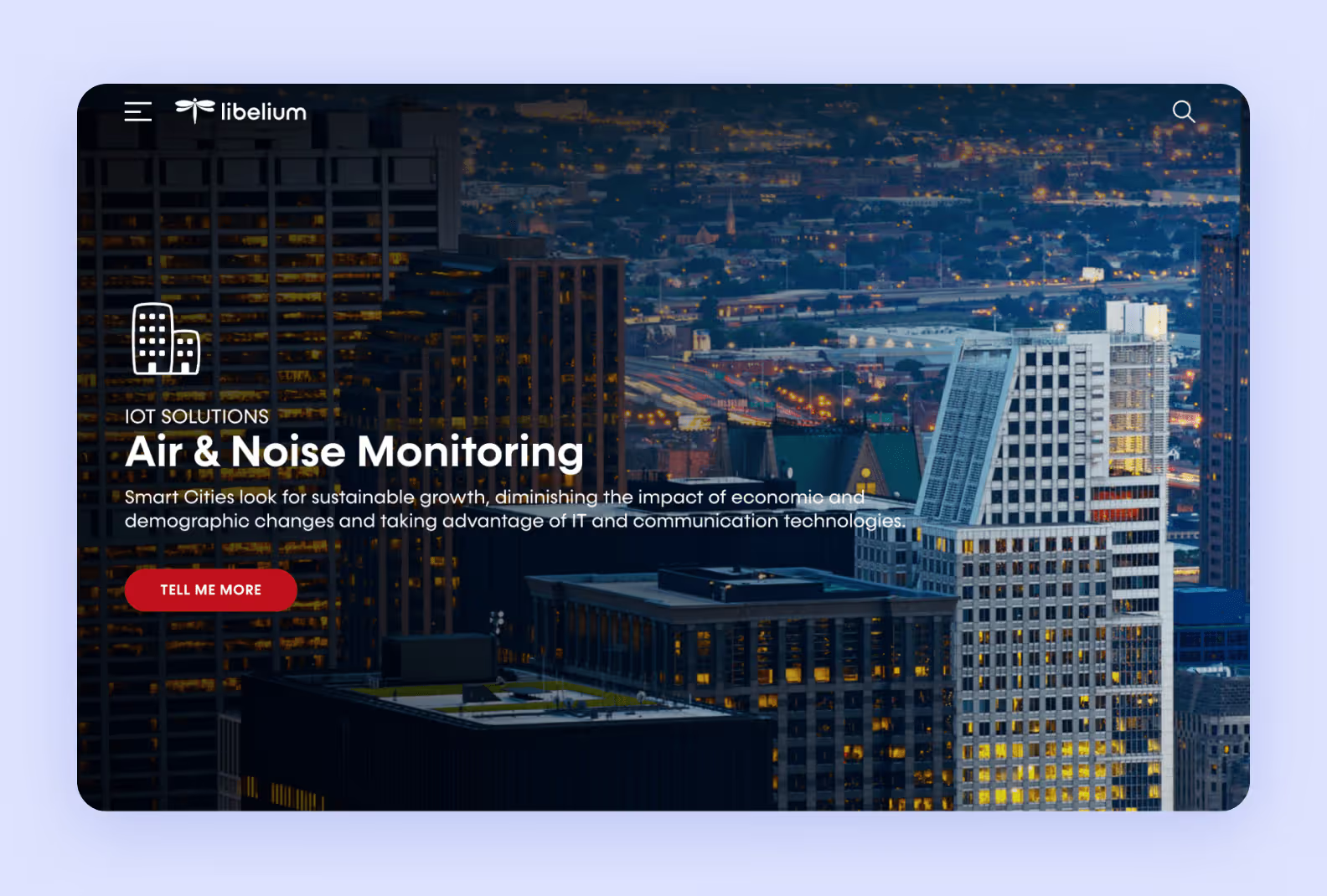
To better illustrate how smart cities implement urban changes with the help of IoT-driven initiatives, we gathered four examples of real-world use cases that significantly improved the way Dallas, Singapore, Boston, and New York operate.

Dallas received recognition for its transformative smart city initiative, Red Cloud, which enhanced the quality of life in the Red Cloud neighborhood and fundamentally altered the city’s operations. The project was rolled out in a community with a high crime rate, and IoT was used to make quality-of-life improvements. Some of the changes were:
🎯 Results: The city tackled two problems at once — public safety and connectivity in the area — which gave a neighborhood a 180 and created a safer, more welcoming space for Dallas residents.

In 2024, Singapore was ranked 5th out of 142 smart cities globally, while other ratings claim it is “the smartest city in the world.” The reason for this is a number of city-wide initiatives that use advanced digital technologies like IoT.
In 2014, the Singaporean government launched the Smart Nation initiative to provide citizens with a one-stop platform to access all city services. This included mobile apps that send live updates on traffic jams, help residents rent bikes, buy public transport tickets, or even access their health records.
🎯 Results: The smart city’s initiative has created an effective and sustainable infrastructure for residents, while Singapore’s digital economy contributed 17.3% of its Gross Domestic Product (GDP). In 2024, the government announced Smart Nation 2.0, an update to the initiative that includes the use of AI and focuses on community and trust rather than infrastructure building.

Boston 2030 ReVisioned is a city-wide project focused on transportation — improving safety, expanding bus and metro access, and reducing emissions. With the help of resident surveys and IoT-sourced data, the administration hopes to install smart traffic signals, create opportunities for accessible biking or walking, and create a reliable schedule for buses and trains in the city.
🎯 Results: The project is still ongoing, but so far, the Boston City administration has reported a decrease in carbon emissions and an improvement in safety and transport access for many residents.

NYC uses AI technology to monitor and manage over 12,000 traffic signals around the city, detect incidents, and reroute traffic as needed. With the help of IoT devices — radio frequency identification (RFID) readers, microwave sensors, and KLD’s adaptive control modules — the Department of Transportation aims to significantly improve traffic flow in one of the busiest cities in the world.
🎯 Results: NYC’s initiative will serve as a model for many other smart cities around the globe that plan to improve their traffic control system through the use of IoT, AI, and other advanced technologies.
Using IoT in smart city operations can bring both positive changes for the residents and potential challenges for urban managers and product owners.
Now that we’ve looked at opportunities and challenges for smart city IoT solutions, let’s get into the most relevant market trends.
Artificial Intelligence (AI) can radically extend the capabilities of IoT hardware, especially when it comes to data analytics. AI allows devices to learn from experience and external data sources and then make predictions. Using AI, a smart city can analyze weather patterns and accurately predict environmental changes.
5G is the next, faster generation of mobile internet. While this technology was introduced a while ago, some regions are still catching up and switching from LTE to 5G only now. Here are the main benefits 5G offers to IoT platforms in smart cities:
Edge computing is an alternative to cloud storage that allows devices to perform some actions locally. This leads to faster data collection and autonomous operations. As an example, consider a camera that monitors car traffic in smart cities. They need to quickly process data in real time to pinpoint traffic jams and analyze potential dangers on the road. Instead of sending all of its recorded data to a cloud server for analysis, the camera processes most of it locally.
Many smart cities have shifted their focus to pollution control, connectivity, and low road pollution emissions to create a healthy future and improve the residents’ quality of life.
This approach includes smart city apps and initiatives designed with the residents in mind. In contrast to the techno-centric view popular in the past, citizen-centric approaches focus on prioritizing the needs of residents over technology to improve their experience in a city.
The Internet of Things offers many opportunities for smart cities and startups to create innovative solutions in various niches. These include sectors like traffic control, environmental protection, energy management, public healthcare, and other areas where smart city apps are in demand. While some companies wonder what IoT is, others have already generated ideas and come up with new smart cities solutions and initiatives.
At Purrweb, we help entrepreneurs with the vision to create and launch their apps. We have successfully released 300+ projects, working with clients from the USA, UAE, Japan, Germany, and other countries.

➡️ If you have an idea and are interested in IoT app development — contact us. Purrweb has extensive experience creating IoT-powered apps, from custom solutions for your work processes to white-label apps you can sell to others.
IoT acts as the nervous system of a smart city: sensors and connected devices collect real-time data from infrastructure — roads, buildings, utilities, transit — and transmit it to centralized platforms that trigger automated actions or surface insights for city operators. Without IoT, a city collects static snapshots; with it, city managers can respond to events as they happen, reducing waste and improving services for residents.
The five most widely deployed IoT applications in smart cities are: adaptive traffic management that adjusts signal timing based on live vehicle flow; smart utility metering for electricity, water, and gas that cuts overconsumption; connected public transit tracking that gives passengers real-time arrival data; environmental sensor networks that measure air quality, noise, and flooding risk; and public safety systems including smart streetlights and gunshot-detection sensors. Pittsburgh’s IoT-powered traffic signals reduced travel times by 25% and traffic jams by 40%.
Three challenges consistently block or slow smart city IoT projects: data security (large sensor networks expand the attack surface for cyber threats), infrastructure cost (deploying and maintaining thousands of devices across a city requires sustained capital and skilled operations teams), and interoperability (devices from different vendors often use incompatible protocols, making city-wide integration complex). Privacy concerns — specifically around continuous surveillance of public spaces — add a political and regulatory layer that purely technical solutions cannot solve.
IoT shifts city management from reactive to data-driven. Operators gain live visibility into utility load, traffic density, air quality, and crowd movement, letting them allocate resources before problems escalate. Smart waste bins with fill-level sensors allow cities to schedule collection routes dynamically, cutting truck mileage. Predictive maintenance systems on bridges and water pipes flag deterioration before failure — avoiding costly emergency repairs and enabling faster, more evidence-based decisions by city administrators.
5G provides the low-latency, high-bandwidth wireless backbone that makes latency-sensitive IoT applications viable at city scale. Older networks — 4G or Wi-Fi — cannot reliably handle thousands of concurrent sensor transmissions with sub-10ms response times. With 5G, applications like autonomous vehicle corridors, real-time emergency dispatch routing, and drone-based infrastructure inspection become feasible. Cities that have begun 5G rollouts — including Singapore and New York — are already piloting use cases that were impractical on earlier networks.
Singapore is the most comprehensive example: ranked 5th globally among smart cities, its digital economy contributes 17.3% of GDP, and the city-state runs IoT-connected systems across transport, water management, and public health monitoring. In the US, Boston uses connected infrastructure to reduce energy consumption in city buildings, and New York monitors over 12,000 traffic signals through an IoT network. Dallas’s Red Cloud project connected 52 IoT devices to extend Wi-Fi to approximately 190 underserved households — showing smart city infrastructure can address equity gaps alongside efficiency.


.svg)