Explore

Need help with your project?

Oops! Something went wrong while submitting the form.
Choosing an AI development company in the United States is a high-stakes decision. These firms build products powered by artificial intelligence, from machine learning models to generative artificial intelligence, and ship them into real software.

The market is crowded with vendors that demo an impressive model but then struggle to turn it into an AI solution your users can actually rely on. The partners worth your budget close the gap between a research demo and production-grade AI.
This guide ranks 10 US-based AI development companies by AI expertise, delivery speed, and real shipped results. A side-by-side table lets you scan the field first, then each profile explains the reasoning behind its spot. Further down you'll find a hiring checklist and honest cost ranges. That holds whether you're a startup founder shipping a first AI MVP or a CTO adding AI features to a live product.
We built this list around what actually predicts a successful AI solution in artificial intelligence development, not brand recognition. The United States is the world's AI innovation hub, and most organizations now treat artificial intelligence as core technology infrastructure.
US private AI investment reached $109.1 billion in 2024, nearly 12 times China's, and 78% of organizations reported using AI that year, up from 55% in 2023.
That depth is exactly why the hiring bar is high. We scored every AI development company against six things that separate a real partner from a vendor riding the hype. The core test is whether a team can turn a prototype into reliable, production-grade AI systems, the kind of scalable AI you can trust.
One note on method. This is an editorial pick based on public information and our own read of the market, not a paid ranking. No company bought its spot. We lead with our own studio, AI development services from Purrweb, because that's the work we can vouch for firsthand. You can hold every other name, from big-name AI development companies to smaller AI developers, to the same six criteria.
Before the detailed profiles, here's the whole field at a glance. This scan of the top AI development companies in the USA lists the same 10 AI companies in the same order as the write-ups below. Compare them fast here, then read the reasoning in each profile that follows.
| Company | Best for | AI focus | Model | Location |
| 1. Purrweb | AI MVPs and product AI features for startups | Generative AI, LLMs, chatbots, computer vision, MLOps | In-house | International |
| 2. Simform | Cloud and data-heavy product engineering | Agentic AI, data engineering, cloud | Hybrid | Sunnyvale, CA |
| 3. LeewayHertz | Enterprise generative-AI consulting | Generative AI, AI agents, LLMs | In-house | Reno, NV |
| 4. Azumo | Scaling an AI team fast | AI-native app development, data | Nearshore | Chicago, IL |
| 5. HatchWorks AI | AI-native builds plus staff augmentation | Generative-driven development, agentic pods | Hybrid | Atlanta, GA |
| 6. Markovate | Generative and agentic AI products | Generative AI, AI agents | In-house | US |
| 7. Intellectsoft | Enterprise AI across the software lifecycle | AI-first software engineering | Hybrid | Palo Alto, CA |
| 8. InData Labs | Data science and custom ML systems | NLP, computer vision, predictive analytics, LLMs | In-house | Miami, FL |
| 9. Netguru | Full-cycle product development with AI | Machine learning, data engineering, AI agents | In-house | Global |
| 10. Uptech | Product studios adding AI features | Generative AI, chatbots, computer vision | In-house | Miami, FL |
Each profile below covers what the company is known for in AI and ML, the kind of clients it fits, and where it does its strongest work. They run in ranked order, starting with the studio we know best.
Purrweb is a product studio that builds AI features into mobile and web apps, with a focus on getting startups to a working, testable release fast. It scopes each AI solution as part of a shippable product, not an open-ended research engagement, and covers AI agent development end to end.
That covers LLM and generative-AI features, conversational AI and chatbot development, computer vision, and AI integration into existing software. Behind it sits the end-to-end AI engineering and MLOps that keep a model reliable after launch. The product-first angle fits founders and product owners who need real users touching an AI feature, not a prototype gathering dust.
Under the hood, Purrweb handles the full path from AI strategy and a data-readiness check to a production backend. That includes retrieval-augmented generation over your own data, model development, and evaluation.
Over 10 years the studio has released 550-plus products with an in-house team of 200-plus, and it can scope a proof of concept in 3 to 5 weeks. Teams building something net-new can move from an AI prototype to focused AI MVP development rather than a full-scale program.
A good example of that product-first approach is BioGeek, a health app we built that lets people keep all their lab tests in one place and understand what each result means. The hard part was the input. Users upload lab-result PDFs, and the app has to read the indicators, values, and units off wildly inconsistent form layouts.
Off-the-shelf OCR was the obvious route, and it failed us. The mainstream engines we tested, from Microsoft Azure to AWS Textract to Google Cloud Vision, either couldn't parse the forms reliably or cost far more than an early-stage product could carry.
So we treated engine selection as its own mini-project. Over about three weeks we benchmarked four OCR tools against real lab forms and settled on ABBYY, the only one that held up across the layouts and languages we needed. BioGeek shipped in 2022 and the client stayed on for support.
See how the BioGeek app came together
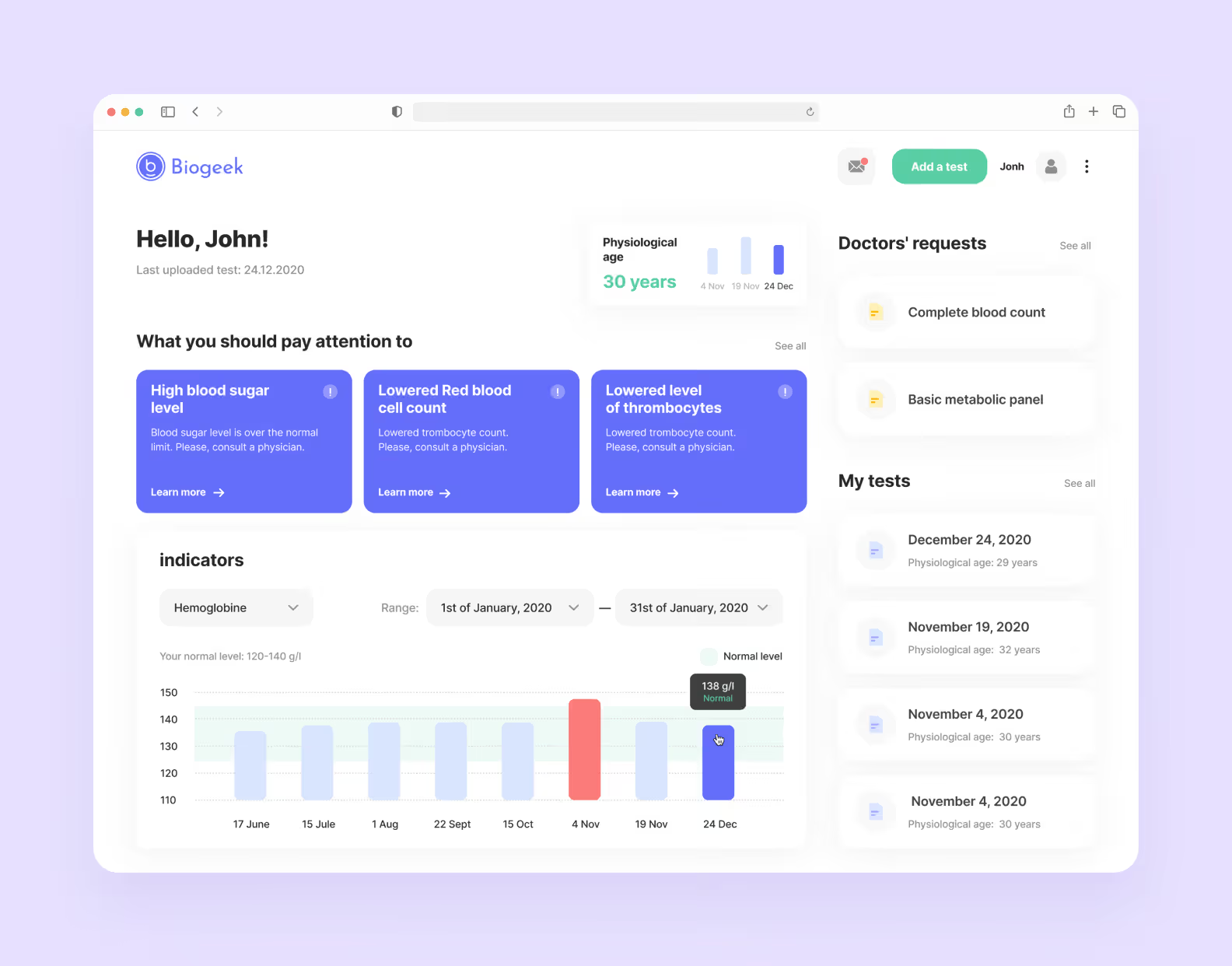
Picking the right OCR engine mattered more than any model choice — the data pipeline is where most AI products quietly break
Simform is a product-engineering firm that leans hard on engineering discipline across cloud, data, and AI work. Its recent positioning centers on agentic AI, where software agents carry out multi-step tasks. That sits on the data engineering and DevOps foundations that give such systems real scalability.
The result fits companies that already run serious cloud infrastructure and want AI folded into it rather than bolted on. Across data-heavy builds and modernization work, Simform is a reasonable pick when the bottleneck is a complex existing stack, not a single model.
LeewayHertz is one of the more established AI specialists on this list, with roughly 15 years in the field and a recent acquisition by The Hackett Group behind it. Its work spans generative AI, custom LLM development, and AI agents. Projects usually start from strategy consulting and move through to a custom build and integration.
Because the practice covers the arc from advisory to delivery, it suits enterprises that want a partner to shape an AI roadmap, not just code to a spec. That fits organizations weighing where AI belongs before they commit to a specific product.
Azumo is a nearshore software developer that has been shipping production AI systems since 2016, a long runway in this space. Its pitch is speed through AI-native engineering, with teams that build using AI tooling to deliver intelligent applications faster across data, web, and mobile.
For a company that needs to scale an AI-capable team quickly without a fully offshore handoff, the nearshore model is the draw. Operational details like SOC 2 certification matter too when you're handing over sensitive data. Azumo works well for scale-ups that value time-zone overlap and a track record over the newest branding.
HatchWorks AI is built around a proprietary method it calls Generative-Driven Development. Generative AI is woven into how the software gets built, not just what gets shipped.
Alongside full product work, it offers staff augmentation through embedded engineers and agentic-AI pods. That lets you add AI capacity to an existing team instead of outsourcing a whole project. Its Atlanta base, with delivery centers across the Americas, keeps collaboration in convenient time zones.
That flexibility, whole-product or extra hands, makes HatchWorks a fit for teams that already have engineering muscle and want AI-native reinforcement.
Markovate is a product studio built specifically around generative and agentic AI, so its work tends to start from a workflow problem rather than a generic app spec. The team focuses on custom AI solutions tied to a specific industry process. That suits companies that know the outcome they want but need a partner to turn it into a working AI product.
If you're still shaping the idea, our own guide on how to build your own AI product covers the groundwork any studio will expect you to have thought through. Markovate is a strong option when generative AI is the core of the product, not a side feature.
Intellectsoft positions itself around AI-first software engineering, meaning AI runs through the whole build rather than sitting in one feature. It pairs that with the usual custom software development, mobile, and dedicated-team services. As an AI development partner, it works with both large enterprises and startups.
That range fits when you want an established custom software development company that also delivers enterprise-grade AI in an existing product portfolio. Companies that need governance, security, and a broad delivery bench tend to land here rather than with a boutique specialist.
InData Labs comes at AI from the data science side. That shows in its focus on custom machine learning, natural language processing, computer vision, and predictive analytics, alongside generative AI and data engineering. It's a natural fit for companies sitting on a lot of data that want custom AI software and scalable AI solutions built on top of it rather than a generic chatbot.
If your project leans heavily on custom models, scope dedicated machine learning development services early. The modeling work drives most of the timeline. InData Labs suits data-rich products where accuracy and the pipeline behind it matter most.
Netguru is a full-cycle product company with a well-developed AI practice covering machine learning, data engineering, and AI agents. It works with US companies across product strategy, cross-platform mobile, and website development.
Its strength is breadth. If you need design, product, and AI under one roof for a longer build, Netguru can staff the whole arc rather than just the model. That makes it a fit for scale-ups running a multi-quarter roadmap where AI is one workstream among several.
Uptech is the closest profile on this list to our own. It's a product-development studio that adds AI and ML features across mobile development and full-cycle web development. Think generative AI, chatbots, and computer vision.
It's a good fit for founders who want a design-led team that treats AI as part of the product experience, not a standalone science project. For an early-stage company weighing a first AI feature against a full build, Uptech's product framing is easy to work with.
Once you've shortlisted a few names, the choice comes down to how you test them, not just what they claim. The criteria we ranked on tell you what to look for. The moves below are how to pressure-test a partner before you sign, followed by the warning signs that should end a conversation early.
Start by asking for AI work that actually shipped. A real partner can point to a live feature and explain the data behind it, not just a demo reel. Push on data and MLOps maturity too, since most AI projects stall on messy data and models that drift after launch, not on the initial build.
Then test the relationship on something small. A short paid pilot tells you more about a development team's delivery speed, communication, and development process than any sales call. Ask directly about post-launch support, because a model needs monitoring and retraining long after version one ships. The right development partner accelerates AI adoption instead of leaving you with a science project.
Decide whether you want a dedicated AI development service, a specialist development firm, or just extra hands on your own team. If you're weighing that trade-off, our roundup of top software outsourcing companies breaks down the in-house-versus-outsource call.
Industry fit matters as well. A team that also works as a fintech development company already knows the compliance and data-sensitivity rules a regulated product has to meet. The same logic applies whether you're hiring for AI or picking the best mobile app development company in the US.
A few signals should make you walk away. None of them are subtle once you know to look for them.
There's no single sticker price for AI development, because AI development costs track the shape of the work more than the vendor. Three things move the number most: how large the scope is, how ready your data is, and what kind of AI model you need.
Scope is the obvious one. A narrow proof of concept is a different budget from a full AI system in production with monitoring and support. At Purrweb, a proof of concept typically runs $3,000 to $15,000 and takes three to five weeks, a common starting point before you commit to a full build.
Data readiness is the quiet cost driver. If your data is clean and labeled, a team can move straight to modeling. If it isn't, budget for a data-preparation phase first, which can add weeks before any model training starts.
Model type matters too. Wiring up an existing large language model through an API costs far less than custom AI development that trains a model from scratch on your own data. US firms also price higher than nearshore or offshore teams, so location and engagement model feed into the final number.
For a full breakdown by project type, see our guide on how much AI app development costs.
The right AI development company depends on what you're building and which AI technologies your software solutions actually need. A data-heavy product points you toward a data-science specialist. A startup shipping its first AI feature is better served by a product studio that treats AI as part of the experience.
Run every name on this list through the same criteria. Ask to see work that shipped, and test the relationship on something small before you commit to the full build.
➡️ Thinking about building an AI product? Tell us what you have in mind, and we'll come back with a free estimate within 48 hours.
It depends on scope, data readiness, and model type more than on the vendor. A proof of concept can start in the low five figures, while a full production system with ongoing support runs much higher. Wiring up an existing model is cheaper than training a custom AI solution from scratch. For a detailed breakdown by project type, see our guide on how much AI app development costs.
Timelines vary with complexity. A proof of concept often takes three to five weeks, and a first production-ready AI MVP usually lands in about eight to fourteen weeks. A large custom model trained on your own data takes longer, especially when the data needs cleaning and labeling before training can even begin.
The strongest AI software development companies point to AI features that actually shipped, not demos. Check the team's data and MLOps experience alongside its broader AI capabilities, AI services, and AI software development services. Most projects stall on data quality and model drift rather than the initial build. Test the relationship with a small paid pilot, and confirm there's a post-launch plan for monitoring and retraining the AI solution.
The common ones are health care, fintech, e-commerce, logistics, and retail, sectors that use AI for automation and better operational efficiency. Many firms also cover manufacturing and supply chain. The strongest partners have shipped in a regulated space. That experience shows they can handle compliance, risk management, and sensitive data for a large organization.
Both. Plenty of firms, including product studios like Purrweb, focus specifically on startups building an AI MVP or a first AI feature. Others lean enterprise. What matters is finding a team whose typical project size and pace match yours, so you aren't the smallest or the largest client on their books.
The range covers machine learning and deep learning, natural language processing, generative AI, and computer vision that reads images and handles object detection. It also includes AI agents that carry out multi-step tasks, the intelligent automation behind a multi-agent system. Many teams also build conversational AI, AI chatbots, and forecasting or predictive analytics on a shared AI platform. The right mix depends on your product, anything from a recommendation engine to a document-reading feature.
That's common, and a good partner plans for it. Expect a data-readiness assessment first, followed by a data-preparation phase to clean, label, and structure what you have. It adds time upfront, but skipping it is the fastest way to end up with an unreliable model.
Traditional software follows explicit rules a developer writes. AI software learns patterns from data through algorithms, whether that's supervised learning on labeled examples, unsupervised learning, or reinforcement learning. Its behavior depends on the data it trains on, so accuracy hinges on the training, validation, and test data sets behind it. That's why AI projects add steps traditional ones don't: data preparation, model training and evaluation, and ongoing monitoring after launch.


.svg)