Explore

Need help with your project?

Oops! Something went wrong while submitting the form.
Picking a web design agency in Toronto is harder than it should be. Boutique studios, full-service agencies, and remote product teams all describe their work in nearly the same language. The real differences only surface after you've signed. What separates them is narrower than the marketing suggests: what they build best, how they price it, and whether you end up with a site or a product.

This guide ranks the web design companies in Toronto worth knowing in 2026 and shows what each one is genuinely built for. Every profile sticks to what a studio actually ships and which clients it fits. The comparison table lays out delivery models side by side, and the pricing section covers what a Toronto build realistically costs before anyone sends you a quote.
Toronto carries the densest concentration of tech and creative talent in the country, and the web design market reflects that. Web design agencies here range from two-person branding shops to full-service firms with in-house video teams. Most have spent a decade or more serving the same downtown client base of professional services firms, real estate developers, and business-to-business manufacturers.
That depth is useful, but it also makes the choice harder. There were over 1.38 billion websites in existence at the end of 2025, with a new website launching roughly every three seconds. A website design that looked current three years ago now competes against a much larger field for the same attention. That's why so much of the work Toronto studios sell is redesign rather than first builds.
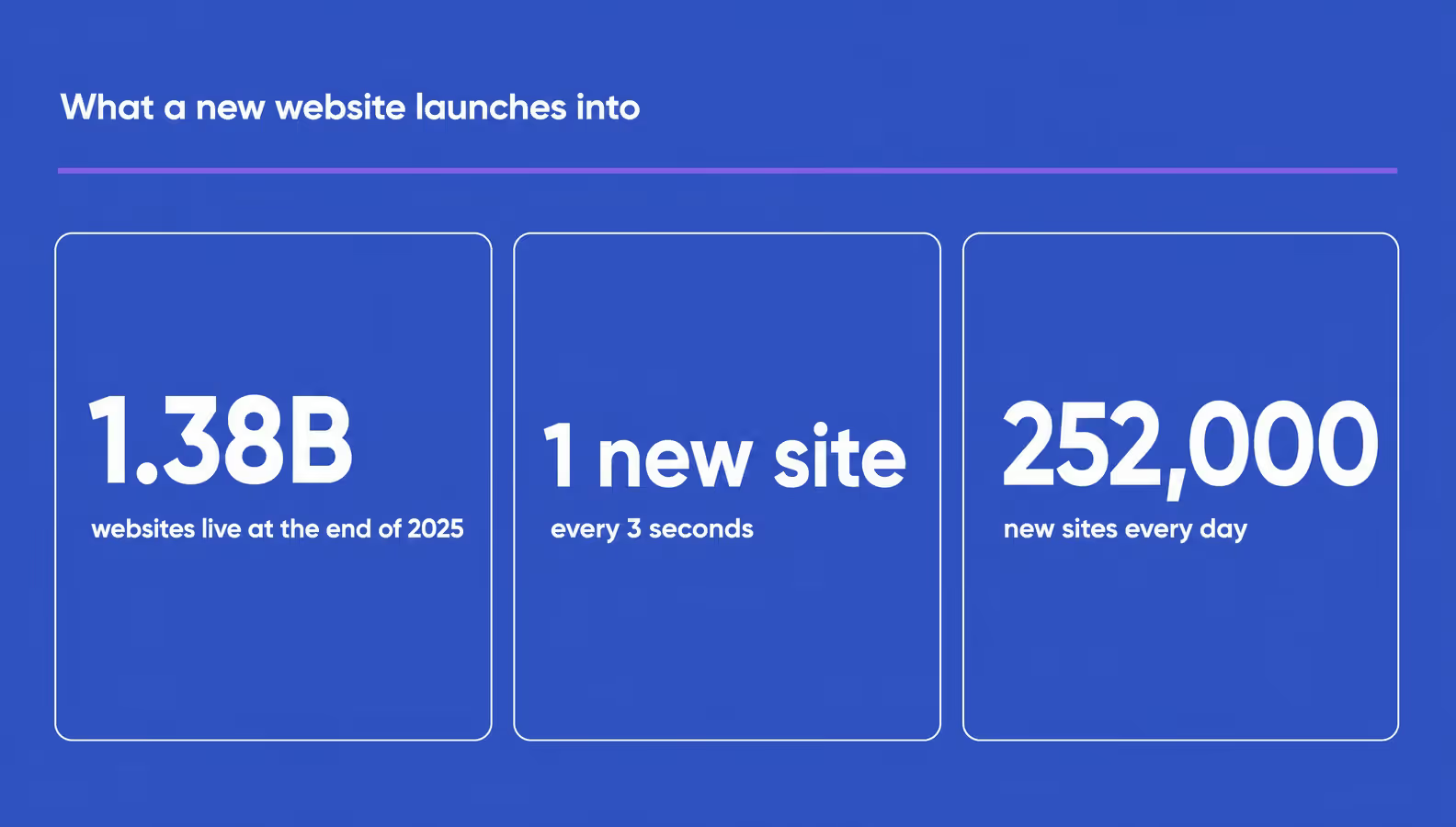
Volume alone explains why most Toronto studios sell redesigns rather than first builds
Who actually needs an agency in Toronto tends to fall into two camps. One needs a marketing site that establishes credibility and generates inbound leads, and a local web design agency handles that well. The other needs a product with logins, dashboards, and business logic behind it. That's a different discipline, and it often points toward a web development company rather than a design shop.
Knowing which camp you're in narrows the list before you open a single portfolio.
Here are the ten web design agencies in Toronto worth knowing this year. Purrweb sits at the top with an honest caveat attached. It's an international product studio working with clients worldwide, Toronto included, not a company based in Toronto. The other nine are established local design agencies.
The table gives you a fast side-by-side, and each profile below sticks to what the studio actually builds, drawn from its own site.
| Company | Best for | Model | Key specialization | Platforms |
Purrweb | Custom products, MVPs, web apps | Remote / global | UI/UX plus web development services | Custom (React, React Native) |
Parachute Design Group | Custom marketing sites and branding | Local | WordPress design, development, and SEO | WordPress, WooCommerce |
Brand Vision | B2B corporate sites and identity | Local | Branding, web design, and SEO under one roof | WordPress, Webflow, Shopify, custom JS |
Makra Digital | Conversion-focused SMB sites | Local | Custom web design plus mobile apps | Custom, React Native, Swift, Kotlin |
Pixelcarve | Medium-to-large organizations | Local | Web design paired with cinematic video | WordPress, custom |
ThrillX | Redesigns aimed at conversion | Local | CRO-driven web design and UX/UI | Webflow, WordPress |
Shift8 Web | Custom builds and integrations | Local | Full-lifecycle web development and hosting | WordPress, Laravel, Drupal, React |
Blue Flamingo Solutions | Web plus custom software | Local | Digital enablement, fractional development | WordPress, custom |
Envy Design Co. | Boutique branding and web | Local | Brand identity, web design, print and packaging | WordPress |
morphsites | Bespoke web apps and integrations | Local + UK | Web development with in-house marketing | Shopify, custom |

Purrweb is an international product studio rather than a web design agency based in Toronto, and that's the honest caveat behind its top spot. It works with founders worldwide, Toronto included, on custom products instead of brochure sites. The team covers user interface and user experience design (UI/UX design) alongside web and mobile development. Interface work and engineering stay with the same people.
The default build is a mobile-first web app or an MVP on a custom stack of React and React Native. Every screen is built as responsive web design, so the same product holds up on a phone and a desktop.
Engagements run as fixed-scope delivery or a dedicated team, which suits a startup company that needs a product shipped rather than a five-page site refreshed. Best for a founder or product owner who needs logins, dashboards, and business logic behind the interface.
Zeroney runs online courses in Data Science and AR/VR for students in Japan and Myanmar. The platform had launched successfully, but conversion from cold leads kept sliding. The client's own analysis pointed at the design: it had aged into something that contradicted the product, since a school for modern professions looked dated, and trust went with it.
We took on two pieces at once — a new platform design and a landing page to feed it. The constraint we were solving was that a learning interface has to stay legible during long sessions while still reading as modern. We answered it with bright but restrained color (green and blue with orange accents), Roboto for body text so nothing competes with course content, and progress bars and reward badges to keep students moving. The landing page went the other way: black and white with sharp accents and a 3D animation on the first screen, built so the layout wouldn't break when English text is swapped for Japanese.
We handed the design to the client's in-house development team in two months, ahead of the promised date, and used the spare capacity to add animations that weren't in the original scope.
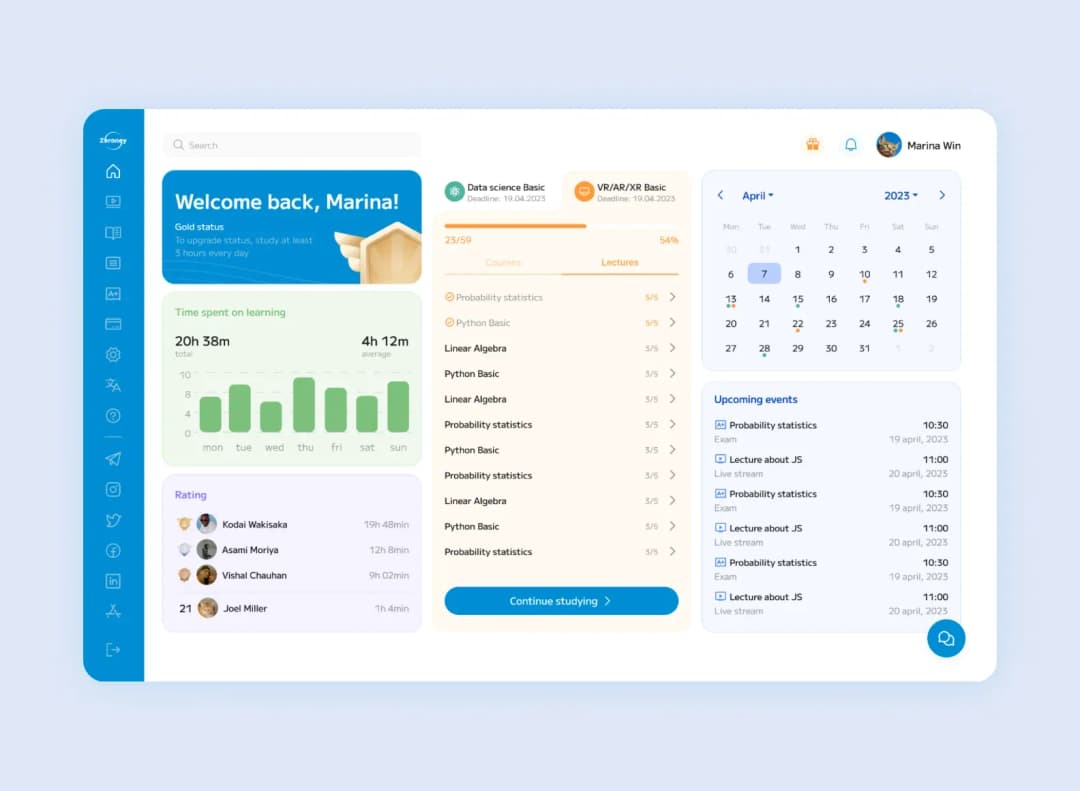
The dashboard carries schedule, covered material, and achievements without any of them shouting over the course itself
Parachute has been hand-crafting custom website design and branding since 2003, and it publishes more about how it works than most agencies do. The production team is six web designers and eight developers, all working remotely since 2009. Everything is built custom on WordPress with WooCommerce for e-commerce, and the studio states plainly that its designers don't use templates or purchased themes.
It's equally clear about what it won't take on: no Shopify, no ad campaigns, no mobile app builds, and no repairs to sites another agency built. Pricing is published in tiers, from $15,000 microsites to $80,000-plus portals and membership sites.
Best for a business-to-business or professional services organization that wants custom web design, logo design, and search engine optimization (SEO) from one team.
Brand Vision is a web design and development agency built around a senior team of 15-plus specialists. Each engagement gets a creative director and dedicated project management. Its work spans corporate sites, product marketing pages, and e-commerce, backed by brand research and messaging frameworks rather than design alone.
The platform range is unusually wide for an agency this size, covering WordPress, Webflow, Shopify, and custom builds in React or Vue. The client roster leans enterprise and institutional, with names like McGill University and First Horizon Bank.
Best for an organization that wants brand strategy, website design and development, and SEO from one agency instead of three vendors. Web projects run six weeks to five months.
Makra builds custom websites for local businesses that need the site to convert rather than just exist. The portfolio runs to restaurants, schools, nonprofits, moving companies, and personal brands. The studio reports 5.0 from over 30 Google reviews and, for one restaurant client, 72% of orders now arriving through the website.
Unlike most studios on this list, Makra also ships mobile apps in Swift, Kotlin, React Native, and Flutter, claiming 50-plus apps built. Custom website development happens in code rather than on a template CMS. Quotes come back within one business day, and the pitch is transparent pricing with no hidden fees.
Best for an SMB owner who wants a conversion-focused website and direct access to the web developer building it.

Pixelcarve has been producing digital projects for over 25 years, and its distinguishing feature is a full in-house production capability. Alongside website design and build, the agency runs cinematic video production with its own writers, art directors, animators, and photographers. It then works as a marketing agency on top of that, feeding both into inbound campaigns and SEO.
The work skews toward architecture, real estate development, law firms, and hospitality, with clients like RioCan Living, Greybrook, and Adamson & Associates Architects. A page on the site targets medium-to-large enterprises directly, and the agency says it thrives in long-term engagements rather than one-off projects.
Best for an established organization that wants high-production visual content and a website treated as one connected program.
ThrillX opens its pitch by disqualifying half its market: if you only want a pretty website, it says outright you'll find someone cheaper. The agency sells conversion instead, backing it with a reported 134% average lift and $30M in incremental client revenue. Work happens on Webflow and WordPress, spanning web design, CRO, and one-time UX audits that come back as a report with actionable mockups.
Client range is unusually wide, from companies pulling 400,000-plus monthly visitors to businesses just getting off the ground, across more than 80 industries. The design process starts with data on how the current site behaves rather than with a moodboard.
Best for a company whose website already gets traffic but converts below what that traffic is worth. Lower-scope projects run five to six weeks, custom builds twelve to fourteen.
Shift8 has been launching and supporting websites since 2008 and covers the full lifecycle. That runs from strategy and UX through website development, integrations, infrastructure, and managed web hosting. It calls itself platform-agnostic and means it, building on WordPress, Laravel, Drupal, and React depending on what the requirements ask for.
The client list is heavier than the agency's profile suggests, including Harvard Medical School, Suzuki Canada, and Covenant House Toronto. Shift8 is SOC 2 Type II certified, which matters if procurement asks about operational controls before it asks about design.
Best for an organization outgrowing a template site, particularly one that needs custom integrations, a migration off a proprietary system, or ongoing managed support.
Blue Flamingo has operated as a digital agency for 25 years and calls what it does digital enablement. In practice that means the deliverable isn't assumed to be a website. A project can land as a site, custom software, an artificial intelligence build, or a campaign run by its SEO agency arm.
The portfolio reflects that spread, with case studies for SurePay, Volaris Group, and IPSX across payments, aviation, and finance, and 250-plus projects claimed overall. Fractional development and fractional marketing are offered for companies that want senior capability without hiring full-time.
Best for an established business that needs design and engineering from one partner and isn't sure yet which half weighs more.
Envy is a boutique studio founded by a husband-and-wife team. Michael Vince runs delivery as the client's single point of contact, and Natashya Vince oversees design. Nearly two decades in, the team works as distributed specialists brought in per project, which keeps the operation small without capping what it can take on.
The service mix goes wider than web, covering brand identity plus graphic design for print, presentations, and packaging. The website usually arrives as one piece of a larger brand rollout. Client work ranges from local practices to Visa and Deloitte's internal teams.
Best for a business that needs branding and web design built together rather than a site bolted onto an identity that no longer fits.

morphsites works as a web design and development agency with an in-house digital marketing agency attached. Its case studies lean toward the complicated end: ERP-integrated ordering portals, custom case management software, and SaaS catalogue tools rather than brochure sites. The differentiator it claims is development, design, and marketing under one roof instead of split across vendors.
Reported client outcomes are substantial, including a 400% increase in quote requests for one fleet client within six months of launch. An e-commerce website runs on Shopify, with everything else built bespoke, and website maintenance is sold as an ongoing retainer.
Best for an established business whose requirements include functionality no off-the-shelf platform covers, and that wants the marketing to launch alongside the build.
The local-versus-remote question gets framed as a cost decision, which is the least interesting thing about it. What actually differs is what each model is organized to produce, and the mismatch shows up months in rather than at the quote stage.
A local web design firm earns its place when:
A remote product team fits when:
The practical test is what happens after launch. If the web presence mostly needs content updates and seasonal refreshes, a local agency with a website maintenance plan is the cleaner arrangement. If it needs a feature roadmap, a product team is what you're actually shopping for. Teams working through this the first time often find the mechanics of how to outsource web design matter more than the choice of vendor.
Most Toronto agencies quote on request, so published numbers are rare. Parachute is the exception and its tiers are a usable benchmark for what custom work costs at the design-agency end of the market.
| What you're buying | Typical range | What drives the number |
Microsite, 3–5 pages | $15,000–$25,000 | Page count, custom design versus adapted template |
B2B or marketing site | $40,000–$80,000+ | Content volume, CRM integration, SEO scope |
Custom e-commerce | from $50,000 | Catalog size, checkout logic, payment and shipping integrations |
Portal, membership, or web app | from $80,000 | User roles, business logic, third-party APIs |
Brand identity alongside the build | $5,000–$15,000+ | Refresh versus new logo suite and brand manual |
Three engagement models cover almost everything on offer:
Two costs regularly get left out of the first estimate. Content, since somebody has to write the copy and source the photography, and post-launch support, which is a separate line item almost everywhere. For a fuller breakdown of what drives the total, our guides on website redesign cost and UI/UX design cost go deeper on both.
Three shifts are visible in what Toronto studios are actually selling this year, and each one changes what a quote covers.
The first is that demand keeps coming from the bottom of the market rather than the top. Small businesses make up 98.2% of all employer businesses across the country, which is where the volume of web design work sits. That target audience rarely commissions a bespoke build. So agencies now publish tiered pricing and productized web design services instead of quoting every project from scratch.
The second is AI showing up on both sides of the engagement. Agencies use it to compress production, and clients increasingly ask whether the site will be found by AI assistants rather than only by search engines. Parachute now sells generative engine optimization as a service line, pitched around the idea that buyers ask AI tools which firms to hire. That category didn't exist two years ago.
The third is maintenance moving from an afterthought to a contract term. Security patching, uptime monitoring, and content updates are sold as care plans across most of the studios above. A website is treated as software that needs upkeep rather than a project that finishes.
The ten studios above cover most of what the Toronto market offers, and they don't compete with each other as directly as the category name suggests. Parachute and Envy sit closest to brand-led custom design. Shift8, Blue Flamingo, and morphsites go furthest into engineering.
Pixelcarve and Brand Vision fit organizations that want production and strategy alongside the build. ThrillX and Makra are the ones to call when the site already exists and underperforms.
The decision that actually matters comes before the list. A marketing site that carries a brand and generates inbound is a job Toronto agencies do well, and the choice among them is a matter of fit and budget.
A product with accounts, permissions, and business logic is a different build. Picking a design shop for it costs more in rework than it saves in day rates. Teams staffing that kind of project usually start by mapping out what building a web development team actually requires before they compare vendors.
If the thing you're building is closer to a product than a website, tell us about it and get a free estimate within 48 hours.
A 3–5 page microsite typically runs $15,000 to $25,000, a B2B or marketing site $40,000 to $80,000 and up, and custom e-commerce starts around $50,000. Portals, membership sites, and web applications begin near $80,000, since user roles and business logic add engineering rather than pages.
What moves the number most is how much is custom versus adapted, how many integrations the site needs, and whether content and photography are billed separately.
Start with portfolio fit in your niche rather than overall polish. A website design company that has built for law firms understands a different set of problems than one that builds online stores. Then match the project type: a marketing site and a product with logins are different disciplines.
After that, compare engagement models and check whether post-launch support is included. Reviews on Clutch or Google show how an agency behaves when a project runs long.
A Toronto web design company brings market familiarity and in-person work, which matters for brand sessions, shoots, and stakeholder workshops. It's the stronger choice when the deliverable is a marketing site that carries a brand.
A remote product team is organized around engineering, so it fits builds with accounts, dashboards, and business logic where web design and development move together. Budgets often go further per engineer, and timezone spread stops mattering once the work is product development.
Yes, and most of the top web design agencies listed here take startup work. The distinction worth making is what the startup needs. If it's a site that explains the product and captures leads, web design in Toronto handles that quickly and affordably.
If it's the product itself, a full-cycle product studio is usually the better fit. An MVP with real users needs engineering decisions made alongside the interface rather than after it.
It depends on what the site has to do. For a simple web presence with a few pages and no custom functionality, website builders are genuinely good enough now.
An agency earns its fee when the site is a real entry point for customers, when the brand has to hold up against competitors, or when the build needs integrations. At that point the cost of a weak site exceeds what a professional web design team charges.


.svg)