Explore

Need help with your project?

Oops! Something went wrong while submitting the form.
A smart contract development company writes, audits, and deploys smart contracts: the self-executing code that moves real money on-chain. That makes the choice unforgiving. Once a contract ships its logic is effectively immutable, so one overlooked flaw can drain a protocol in a single transaction, and the market is crowded with vendors of wildly different depth.

This overview ranks nine smart contract development companies for 2026, separates genuine development teams from the audit specialists you'd bring in for security, and ends with a checklist for vetting a partner, so you leave with a shortlist you can defend.
Below is our ranked list of smart contract development companies for 2026. It leans toward full-cycle product teams (shops that can carry a project from design through smart contract development, testing, and deployment) rather than single-service vendors, whether you need a single token or a full platform built on smart contracts. The stakes are rising with the market: smart contracts were worth about $2.6 billion in 2025 and are projected to grow around 20.6% a year to roughly $6.7 billion by 2030, so the vendor pool is expanding as fast as demand across the wider blockchain ecosystem. If you're still scoping the wider build, our guide on how to build a blockchain application covers the groundwork worth settling first.
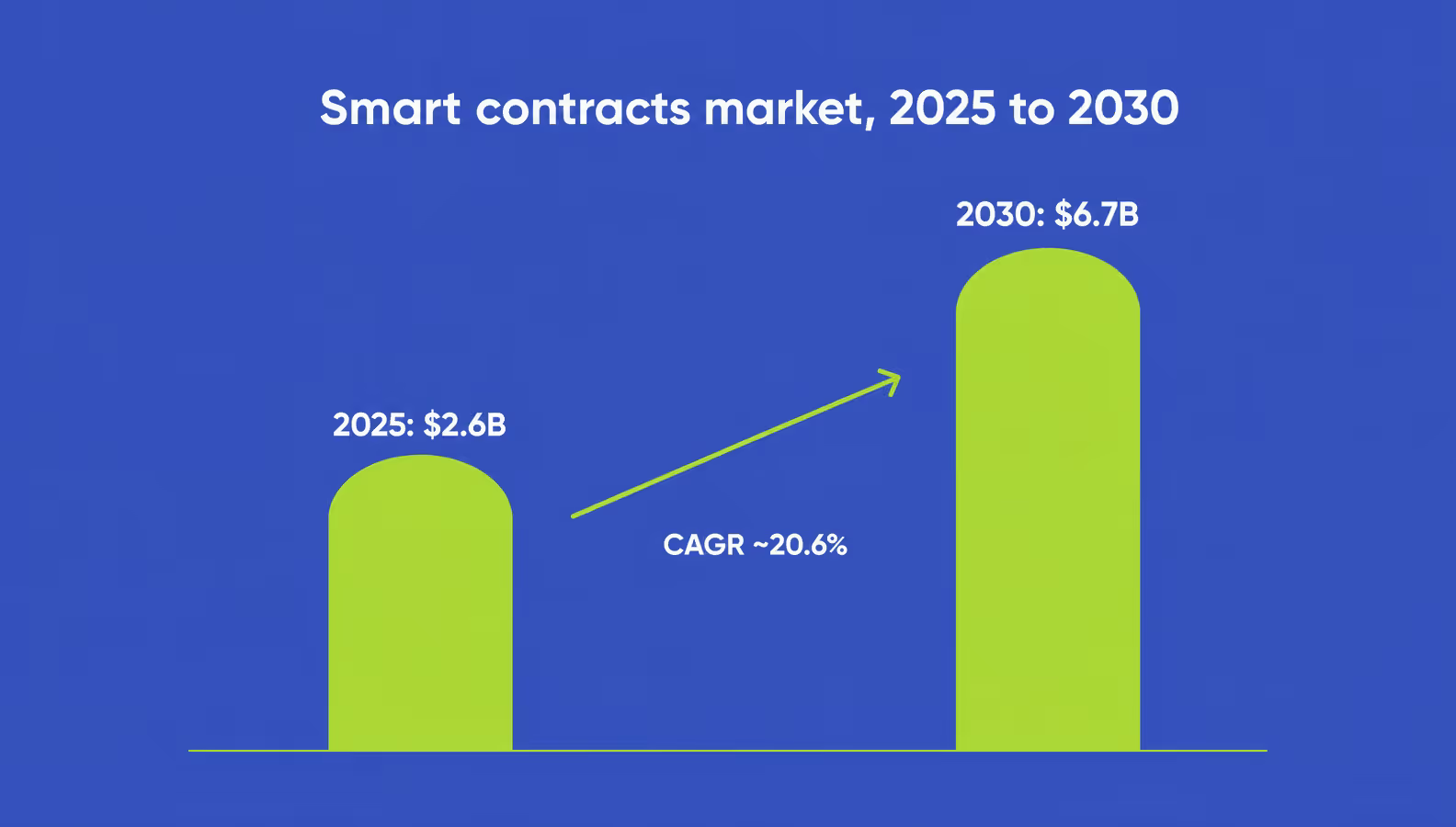
The smart contracts market is on track to more than double by 2030 — Mordor Intelligence.
| Company | HQ | Focus | Supported networks |
| Purrweb | UAE / USA | Development | Ethereum, EVM chains |
| Antier | India (+ UK, UAE, US) | Development + audits | Ethereum, Solana, BNB Chain, Polkadot, Avalanche |
| Webisoft | Canada | Development | Ethereum, Solana, custom |
| Altoros | USA | Development | Enterprise / multiple |
| Innowise | Poland | Development | Multiple |
| Codiste | India | Development | Multiple |
| PixelPlex | USA / UK | Development | Ethereum, Solana, Hyperledger, Cardano, Polkadot, Flow |
| Nadcab Labs | India | Development | Ethereum, Solana, Polygon, BNB Chain, TON |
| MoogleLabs | India | Development | Multiple |
Purrweb is a full-cycle product studio that pairs React Native mobile development with blockchain and smart contract development: design, contract code, audit-ready delivery, and deployment under one roof. That end-to-end model suits founders who want a single team from prototype to on-chain launch rather than a contract-only vendor, and its software development work extends to custom smart contract development across EVM chains, from single token contracts to a full platform.
We built a MetaMask-style crypto wallet for a founder team that wanted a lighter alternative to the incumbents. It runs on a React Native stack with no backend at all. The app talks directly to Ethereum and uses independent APIs for transactions and token prices, so there's no server to maintain or secure. The constraint we had to solve was trust without custody: users needed full control of their funds, so we implemented seed-phrase wallet creation and wallet import, letting people restore a wallet anywhere, plus viewing of imported NFT collections. We shipped it as TestFlight and Android APK builds so the team could demo to investors before a public release.
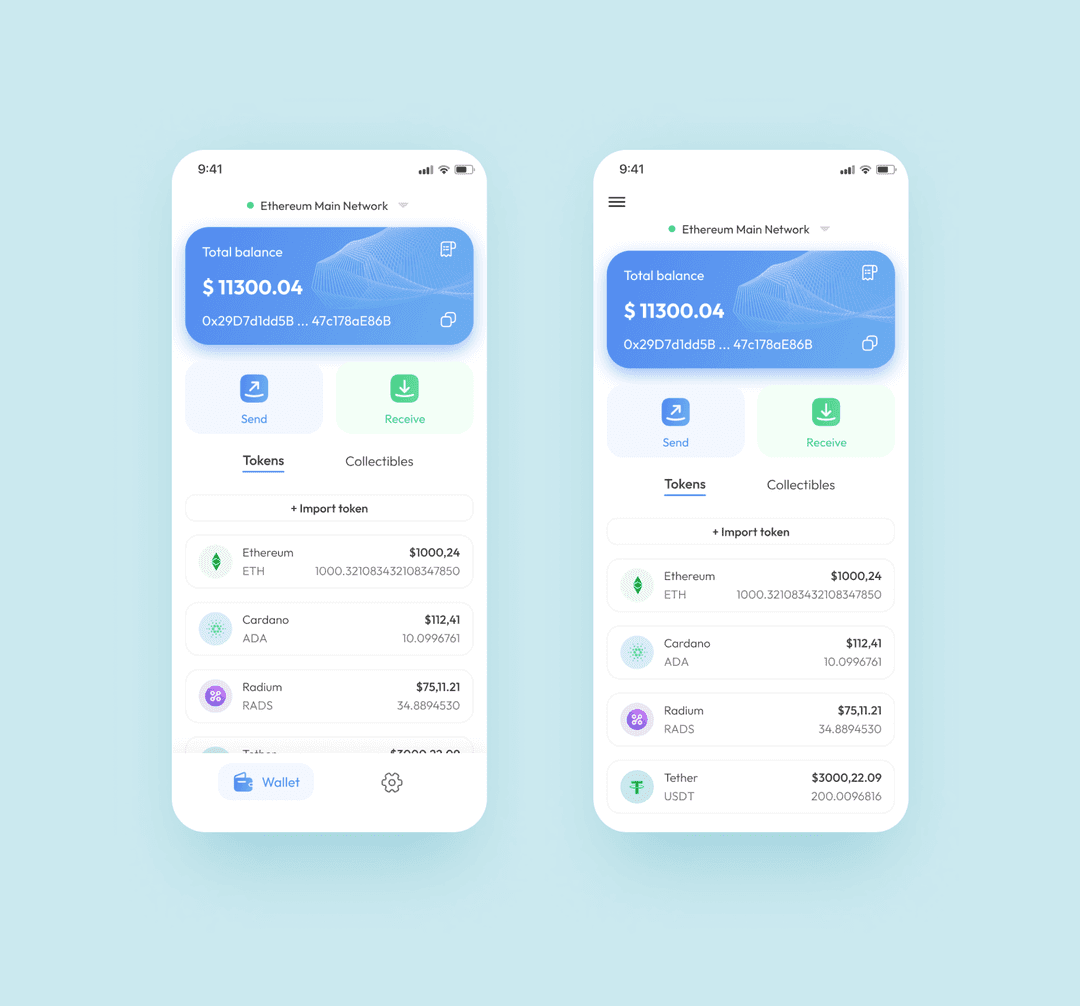
The crypto wallet Purrweb designed and built in React Native.
Antier is an enterprise Web3 firm headquartered in India, with offices across the UK, UAE, and US. It's one of the larger players here, stating a team of 700+ engineers and architects spanning blockchain and AI. The company both builds and audits smart contracts, and its smart contract solutions automate transaction logic across DeFi platforms, real-world-asset tokenization, NFT marketplaces, and crypto exchanges (CEX and DEX). It supports a broad set of networks, including Ethereum, Solana, BNB Chain, Polkadot, and Avalanche, which makes it a fit for teams that want infrastructure-level breadth rather than a single-chain build.
Webisoft is a Montreal-based Web3 and product development company founded in 2016. Its smart contract work leans technical, spanning tokenomics design, zero-knowledge-proof implementations, and Layer 1/Layer 2 protocol development, alongside broader MVP and SaaS builds. For buyers who weigh process credentials, Webisoft is an AWS Partner, states SOC 2 Type II and HIPAA compliance, and shows a 4.9/5 Clutch rating. It's a reasonable shortlist entry when your project needs deeper cryptographic engineering than standard smart contracts.
Altoros has been building software since 2003 and brings an enterprise, cloud-native pedigree to blockchain work. Its Web3 offering is lighter than its core business: Web2/Web3 integration, on-chain lending, blockchain consulting, and white-label solutions rather than a smart-contract-first practice. That profile fits larger organizations already running significant cloud infrastructure that want a long-established vendor to bridge into blockchain, rather than startups after a dedicated smart contracts team. Worth a conversation if enterprise integration matters more to you than pure Web3 specialization.
Innowise is a large custom software house (founded 2007) whose blockchain practice sits inside a much broader services menu that spans web and mobile, cloud, QA, AI/ML, and IoT. On the blockchain side it covers custom blockchain solutions, tokenization, smart contracts, crypto wallets, dApps, and both centralized and decentralized exchanges. The company cites 1,600+ delivered projects and ISO 9001, 13485, and 27001 certifications. It's a fit when you want a big, process-mature outsourcer that can staff a blockchain project alongside the rest of a product, rather than a boutique specialist.

Codiste is an India-based studio (with US and South Africa operations) that pairs blockchain development with a strong AI/ML practice. Its smart contracts and Web3 work center on decentralized applications, supply chain transparency, and tokenization, and it can integrate smart contracts with AI features in the same product. The dual AI-and-blockchain positioning can be an advantage if you want to tailor on-chain features and machine-learning components into one platform. Codiste displays Clutch top-company badges across AI, blockchain, and ML categories. Consider it when you want one partner comfortable at the intersection of smart contracts and AI rather than blockchain alone.
PixelPlex is a blockchain and Web3 development company with offices in New York, London, Switzerland, Dubai, and Tokyo. Its company page cites 17 years in the field, 450+ delivered projects, and 130+ specialists. The portfolio spans smart contracts, NFT and marketplace platforms, DeFi tooling, metaverse, and dApps, and it lists support for Ethereum, Solana, Hyperledger, Cardano, Polkadot, and Flow. That mix of multi-chain reach and a long track record makes PixelPlex a solid option for teams that value breadth and an established delivery history over a niche focus.
Nadcab Labs is a Hyderabad-based blockchain studio focused specifically on smart contracts, from design to deployment, plus dApps, tokenization, crypto wallets, and scalable DeFi/NFT development. Founded in 2017, it positions itself as blockchain-first rather than a generalist software shop, and supports a wide range of networks including Ethereum, Solana, Polygon, BNB Chain, Avalanche, Cosmos, Polkadot, and TON. The company shows a 5.0/5 Clutch rating. It's worth a look when you want a dedicated smart contract developer team across many chains and value recent, verifiable client feedback.

MoogleLabs is primarily an enterprise AI/ML company that also offers blockchain development (smart contracts, crypto tokens, and NFT marketplaces) as a secondary line. Its core strength is generative and agentic AI, computer vision, and predictive analytics, with industry experience across healthcare, fintech, insurance, logistics, and real estate. That makes MoogleLabs a candidate when smart contracts are one part of an AI-heavy product rather than the main event. As with any AI-first shop, confirm the depth of its dedicated blockchain team before committing a contract-critical build.
Not every smart contract vendor writes code — some specialize in breaking it on purpose, before attackers do. The two names below are the industry's best-known audit specialists, and they sit in a separate category from the development agencies above: you hire them to review the smart contracts a dev team has already written, not to create smart contracts or build your product.
OpenZeppelin is close to an industry standard. Its open-source libraries for blockchain smart contracts underpin a large share of production Ethereum projects, and its audit practice states it has secured around $250B in total value and flagged 700+ critical or high-severity vulnerabilities across its reviews.
ConsenSys Diligence is the security arm of Consensys, the team behind MetaMask and Infura. It combines manual smart contract audits with automated tooling such as Diligence Fuzzing, the Scribble specification language, and MythX, which pairs fuzzing, symbolic execution, and static analysis.
Treat these as complementary to the builders above, not substitutes: a strong setup often has one company write your contracts and an independent specialist audit them before deployment.
A shortlist is only the start. The names above tell you who's credible, and the checklist below tells you how to compare them against your own project. Work through these six factors before you commission any smart contracts.
On-chain code handles real money and can't be quietly patched after launch, so a vendor's security discipline matters more than its portfolio gloss. Ask how they handle smart contract creation end to end, how they test (unit tests, fuzzing, formal verification), and whether a scalable smart contract goes through an independent audit before deployment. Depth of expertise is worth probing directly: the Solidity Developer Survey 2025 found that while about 70% of respondents write smart contracts, roughly half have two years or less of Solidity experience. A team that can point to secure smart contract development practices, a sound smart contract architecture, and a real smart contract audit history is a safer bet than one that treats security as an afterthought.
A DeFi protocol, an NFT platform, and an enterprise supply chain tool demand very different contract patterns, so match the vendor to your niche rather than picking the biggest name. If you're building in decentralized finance, look for demonstrable DeFi smart contract development experience, and our overview of DeFi application development covers what that entails. For non-fungible token projects, prior NFT smart contract development and marketplace experience matters, so see our guide to building an NFT marketplace. Vendors that specialize tend to reuse battle-tested code, which lowers both cost and risk.
Your target network shapes everything downstream: language, tooling, gas costs, and audit availability. Ethereum remains the default for DeFi and NFTs, but Solana, BNB Chain (Binance Smart Chain), and other blockchain technologies each carry trade-offs in speed and fees, so pick the blockchain network that matches how your smart contracts will actually be used. Confirm a vendor has real deployments on your chosen chain, not just a logo on their homepage, and check that they can decentralize your logic while meeting any regulatory compliance your market requires. If cross-chain support or a smooth end-user experience matters, factor in design too, since designing blockchain products is its own discipline.
Marketing claims are cheap. Shipped work isn't. Ask for live addresses of deployed smart contracts, public repositories, or verifiable case studies rather than a slide of logos. A vendor that can walk you through a real project (what they built, which constraints they solved, and how the contracts behaved after launch) tells you far more than one that only shares testimonials.
Smart contract development cost varies widely with complexity, the target network, and the depth of auditing you need. A single standard token contract is a different line item from a multi-contract DeFi protocol with a formal audit. Be wary of quotes that ignore those variables. For grounded numbers, our breakdowns of web3 development cost and DeFi app development costs walk through the factors that move a budget, so you can sanity-check a proposal instead of guessing.
A skilled freelancer can handle a small, well-defined set of smart contracts, but a professional company earns its keep on everything around the code: security review, post-deployment support, and the ability to keep a project moving if one person leaves. For anything that holds user funds, the redundancy and accountability of a dedicated development partner usually outweigh the lower rate of a solo hire. If you do decide to hire a smart contract developer directly, budget for a separate independent audit.
The right smart contract development company is the one that fits your project, not the one with the flashiest homepage. Anchor your decision on a proven security and audit track record, genuine specialization in your niche, real deployments on your target network, and a portfolio you can verify.
Weigh cost against the complexity of what you're building, and lean toward a full-service partner offering end-to-end blockchain development services when user funds and high-value transactions are on the line. Compare each candidate's grasp of modern blockchain technologies, run every serious one of the top blockchain development companies through the same checklist, and the shortlist narrows itself.
When you're ready to scope a build, our smart contract development services team is happy to talk through your requirements.
Start with security and specialization. Confirm the company runs independent audits and can show secure smart contract practices, then check that it has shipped work in your niche, whether DeFi, NFT, or enterprise. Review real portfolios rather than logo walls, verify the blockchain networks it actually deploys on, and weigh a full-service agency against a freelancer based on how much post-launch support your project needs.
It depends on complexity, the target blockchain, and how much auditing you need. A single standard token contract sits at the low end, while a multi-contract DeFi platform with a formal audit costs far more. Network choice affects gas and tooling, and an independent security audit is a separate line item. Ask any vendor to break a quote down by contract scope and audit depth rather than accepting one lump figure.
A simple contract, like a basic token or a straightforward escrow, can take a couple of weeks including testing. A complex DeFi or NFT platform with multiple interacting smart contracts, integrations, and a formal audit can run several months. The audit and testing phases often take as long as writing the code itself, so build them into the timeline rather than treating them as an afterthought.
Security comes from process, not luck. Insist on thorough testing (unit tests and fuzzing), an independent third-party audit before deployment, and use of well-reviewed standard libraries instead of hand-rolled code for common patterns. Bug bounties and post-launch monitoring add another layer. Because a deployed contract is hard to change, catching issues before launch is far cheaper than fixing them after.
By default a deployed smart contract is immutable, and you can't edit its code. Teams work around this with upgradeable patterns, most commonly a proxy contract that points to a separate logic contract you can swap out. That flexibility adds complexity and its own risks, so it needs careful design and auditing. If upgradeability matters for your project, raise it with your vendor before development starts.
Blockchain development is the broader discipline: building the networks, nodes, protocols, and applications that make up a blockchain system. Smart contract development is a specialized slice of it: writing, testing, auditing, and deploying the self-executing code that runs on a chain like Ethereum. Smart contracts automate agreements and decentralize the business logic that used to sit on a company's servers, extending the wider blockchain ecosystem. Every smart contract project is blockchain development, but plenty of blockchain work (infrastructure, wallets, integrations) involves no smart contracts at all.