Explore

Need help with your project?

Oops! Something went wrong while submitting the form.
A SaaS development company builds cloud-based, multi-tenant products sold on a subscription model and takes them from an early concept to a product that scales. Choosing the right one is a high-stakes decision that shapes whether your product ships on time, holds up under real usage, and grows without an expensive rebuild. The catch is that the market is crowded and uneven, so a trustworthy company list is hard to build on your own.

This guide profiles 10 SaaS development companies to watch in 2026 and shows where each one fits best. You'll get a side-by-side comparison and a practical way to weigh SaaS development services against your own needs, so you can shortlist the firms that match your product stage instead of sifting through dozens.
A SaaS development company handles the full lifecycle of a software-as-a-service product, not just the code. Work usually starts with discovery: clarifying who the SaaS solution serves, which problems it solves, and how it will earn money.
From there the team designs the multitenancy that lets many customers share one secure codebase on cloud computing infrastructure, then builds the SaaS applications, connects them to outside systems through API development, tests them, and ships them. After launch, most partners stay on for support, monitoring, and modernization as the SaaS platform grows.
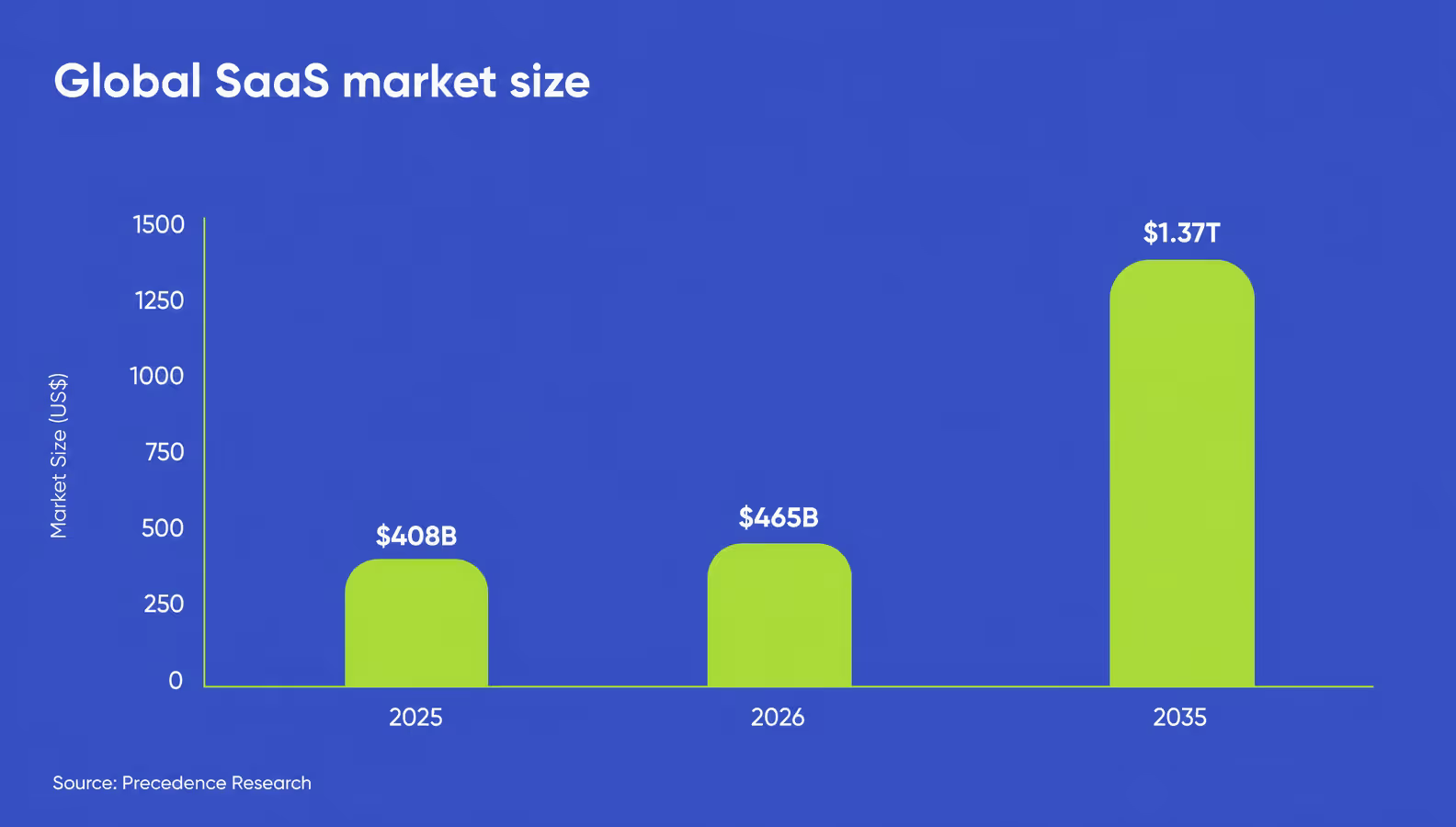
That scope is why the market is worth taking seriously. The global SaaS market reached about $408.21 billion in 2025, according to Precedence Research, and products at that scale rarely succeed as one-off builds.
Where companies differ is the engagement model. A product studio owns outcomes end to end, offering end-to-end services from strategy through delivery, and suits founders who want one partner to run SaaS product development.
Staff augmentation, a lighter form of outsourcing, instead plugs vetted engineers into your existing development team, which fits companies that already have a development process but need extra capacity. Full-cycle development sits close to the studio model, while a custom SaaS application development agency focuses on tailoring the SaaS solution to one industry or workflow.
Which model fits depends on how much of the build you want to own. Teams working on something adjacent, like a custom web application development project, often start with a studio and move to augmentation as the product matures.
The right partner matches your product stage, not the one with the longest client list. Weigh candidates against a few criteria that actually predict fit:
One factor cuts across all of them: an agile development process. A SaaS product changes shape as real users arrive, so a partner whose agile software development iterates beats one locked into a rigid fixed-scope contract.
Our own angle shapes who we fit. We build mobile-first, so a startup that needs a React Native app and a web dashboard from one team moves faster than stitching two vendors together. For founders, MVP development speed matters more than headcount, and a SaaS development partner that ships in months rather than quarters gives you runway to test the market.
To go deeper, see our guide to choosing a development partner and the scope of our SaaS development services.

.svg)
The ten companies below are our pick of the top SaaS development companies in 2026, and they all build SaaS products, but they don't chase the same projects. Some are enterprise engineering shops with thousands of staff, others are lean studios built for startups shipping a first version. The table gives you the fast version of who each firm fits, how it engages, and what it specializes in, so you can scan for a match before reading the full profiles.
One note on order. Purrweb sits first because this is our list, and the ranking is not a scoreboard. Each profile is written from the company's own site, and the right pick depends on your stage, budget, and how much of the build you want to hand over. Read the two or three profiles closest to your situation rather than going top to bottom.
| Company | Best for | Delivery model | Key specialization |
| Purrweb | Startups, MVP → scale | Full-cycle (design + dev) | Mobile-first SaaS, React Native |
| ScienceSoft | Enterprise & startups | Full-cycle | AI + software engineering, healthcare/fintech |
| Intellias | Enterprise | Full-cycle, dedicated teams | AI-enabled product engineering |
| Itransition | Enterprise, mid-market | Full-cycle + QA | Digital transformation, ERP/CRM |
| N-iX | Enterprise | Dedicated teams, staff aug | Cloud-native, AI engineering |
| Netguru | Enterprise, brands | Product studio | Design-first, AI commerce |
| Blackthorn Vision | Startups & enterprise | Full-cycle | .NET/Microsoft product engineering |
| Iflexion | Enterprise, mid-market | Full-cycle, dedicated teams | Enterprise custom software |
| Scopic | SMB, mid-market | Distributed full-cycle | Custom software + AI |
| Softermii | Startups → enterprise | Full-cycle, nearshore | SaaS MVP, web/mobile, WebRTC |
Purrweb is a mobile-first product studio that designs and builds SaaS products for startups and founders, then helps them scale. The team works full-cycle, pairing UI/UX design with development so one group owns the product from first wireframe to release.
Its core stack is React Native for cross-platform mobile, with React and Node.js on the web. That suits teams that want a single app codebase across iOS, Android, and browser.
Purrweb works to fixed timelines, typically shipping an MVP in three to six months, and reports 550+ released projects over more than a decade. Best fit: a startup that needs design and engineering from one partner and wants to reach the market fast rather than staff a full in-house team.
We worked with Clearstep (now Lytic Health), a healthcare startup founded by two people with little more than an idea and a $1,500 budget. They needed something fundable fast, on a budget that ruled out a full build.
So we kept discovery to a short call, delivered a design concept in two days, and built a complete clickable prototype in a week and a half. The concept pairs a patient app for symptom checks and booking with a doctor dashboard that highlights critical data so urgent cases surface first. The founders used the prototype to raise $400,000.
See the full story: healthcare app design that brought $400k
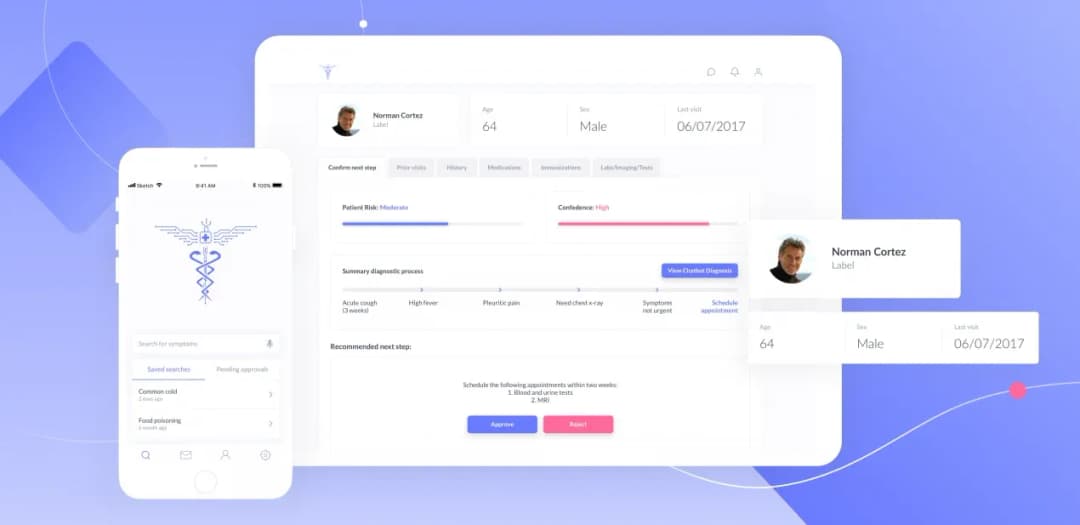
Clearstep's patient app and doctor dashboard, designed by Purrweb
ScienceSoft is a full-cycle software and IT consulting firm that has built enterprise products since 1989. It covers the whole SaaS lifecycle, from SaaS consulting and architecture through development, QA, and support, and pairs that with growing AI capability across its stack.
Depth in healthcare and financial services is its calling card, along with the process maturity that large, regulated products demand. The stack runs wide, spanning .NET, Java, Python, and the major clouds.
Sample project: ScienceSoft built an award-winning loan management system for Atlas Credit, later extending it with lending AI agents. Ideal for enterprises and funded startups that need a partner comfortable with compliance, scale, and long product lifecycles rather than a quick MVP.
Intellias is an AI-enabled product engineering company that works with large organizations across mobility, financial services, healthcare, retail, and software platforms.
It runs delivery through dedicated teams and full-cycle engagement, and its scale of more than 3,000 engineers fits multi-year programs rather than one-off builds. The firm leans into applied AI and data work, from demand forecasting to machine-learning pipelines.
Sample project: Intellias built AI-powered supply chain forecasting for Rooms To Go, using two years of sales history and off-the-shelf ML models in a proof of concept completed in about three and a half weeks. A strong match for established companies that need serious engineering capacity and data or AI expertise wired into an existing product.
Itransition is a full-cycle software engineering company that has run digital transformation programs for more than 25 years.
Its work spans custom development, data and BI, AI solutions, and application services, with strong QA baked in, and it is comfortable across ERP and CRM (customer relationship management) ecosystems like Microsoft Dynamics and Salesforce. That makes it a fit for mid-market and enterprise teams modernizing or extending an existing platform.
Sample project: Itransition built a corporate learning portal for PayPal on Moodle, integrated with PayPal's network through single sign-on and delivered on time and on budget. Works well for companies that want a broad engineering partner with deep testing and platform-integration muscle rather than a mobile-first studio.
N-iX is a global engineering firm that serves enterprise clients across finance, retail, healthcare, manufacturing, and energy. It frames delivery around pragmatic, measurable AI engineering and staffs work through dedicated teams and staff augmentation, which suits organizations that need to scale capacity quickly. Cloud is a core strength, backed by partnerships across the major providers.
Sample project: N-iX helped WorkWave move from no AI usage to 28 percent AI-generated code within six weeks across a 250-engineer team. Suited to large companies that want to extend an in-house group with cloud-native and AI-focused engineers, or hand a complex, long-running program to a partner with enterprise delivery experience.
Netguru is a product design and software company that builds AI-driven platforms and commerce experiences for established brands. Design is central to how it works, alongside product strategy, engineering, and machine learning, which fits companies that treat user experience as a competitive edge. Its stack is broad, from React and Next.js on the front end to commerce platforms like commercetools and Shopify Plus.
Sample project: Netguru worked with Żabka on the architecture behind its autonomous stores, part of a client roster that includes Vinted GO and OLX. A good fit for mid-size and enterprise teams that want strong design and product thinking wrapped around the engineering, rather than a pure code shop.
Blackthorn Vision is a product engineering partner built on deep Microsoft and .NET expertise, now paired with AI capabilities. It builds secure, compliant products across web, mobile, desktop, and cloud, with a focus on healthcare, fintech, and energy, where regulation and reliability matter most. The stack centers on .NET and Azure, extending to iOS, Android, and Flutter for mobile.
Sample project: the team built Sensia, a web-based IoT platform for monitoring oil and gas equipment. A solid choice for startups and enterprises in regulated industries that want a Microsoft-centric partner comfortable with compliance and long-lived systems rather than throwaway prototypes.
Iflexion is a full-cycle software development and IT consulting company that has served enterprises since 1999. It covers custom development, web and mobile apps, UX design, QA, and system integration, and its multi-industry experience spans healthcare, retail, logistics, and finance. The stack is broad, from Java and .NET to React Native and the major clouds, which lets it take on complex, integration-heavy builds.
Sample project: Iflexion upgraded and tested an intelligent omni-platform fitness suite for adidas, aggregating and syncing data across smart devices, web, and mobile. A fit for mid-market and enterprise teams that need a versatile partner for a large custom platform rather than a lean startup MVP.
Scopic is a distributed software company that combines custom development with AI across a globally remote team. It builds web, desktop, and cloud applications for clients in more than a dozen industries, from healthcare to fitness and finance, and increasingly wires AI into those products. Its project stack includes AWS, Laravel, Vue.js, and modern AI models.
Sample project: Scopic built Mediphany, radiology imaging software that turns MRI and CT scans into personalized video reports with 3D models so patients can understand their results. A good match for small and mid-market companies that want a flexible, cost-aware partner for a custom product, especially one with an AI or imaging angle.
Softermii is a software development company that builds SaaS software across web and mobile, with particular depth in real-time communication through its own WebRTC engine. It works across communication, real estate, healthcare, fintech, and logistics, and offers nearshore teams that scale from an MVP toward a full platform. The stack runs from React and React Native to Node.js and cloud services, with growing AI and chatbot work.
Sample project: Softermii built Rently, a platform that brings IoT into the property rental industry. A fit for startups and growing companies that want a partner for a SaaS MVP or a communication-heavy product and expect to expand the team as the product matures.
The market backdrop is growth. The global SaaS market is projected to rise from $370.4 billion in 2025 to $435.41 billion in 2026, according to Mordor Intelligence, and four shifts are shaping how new products get built.
AI-native SaaS. Artificial intelligence has moved from a bolt-on feature to a starting assumption. New products design workflows around models from day one, whether that means an embedded copilot, analytics and automated data work, or agents that take actions for the user. That raises the bar on data quality and on how carefully a team handles model costs at scale.
Vertical SaaS. Broad horizontal tools are giving ground to products built for one industry. A customized SaaS platform tuned to dental clinics or freight brokers can speak its users' language and cover niche compliance that generic SaaS tools skip, which makes vertical products easier to sell and harder to displace.
Usage-based pricing. Flat per-seat plans are giving way to models that charge for what customers actually consume. It aligns cost with value, but it also pushes teams to build accurate metering and billing into scalable SaaS products from the start rather than bolting it on later.
Security and compliance. As buyers get stricter, certifications and clean audits have become table stakes. That is also driving a wave of SaaS modernization, as older multi-tenant SaaS platforms get re-architected to meet current data-isolation and privacy standards.
The ten companies here don't compete for the same work, which is the point. An enterprise modernizing a regulated platform needs a different partner than a founder shipping a first version on a tight budget. Match the shortlist to your stage, your industry, and how much of the build you want to own, then read case studies for products like yours before you talk to anyone.
If your product leans mobile, our roundup of the best mobile app development companies in the USA is a useful next step.
A company that designs, builds, and maintains cloud-based, subscription (multi-tenant) products: discovery, architecture, development, integrations, QA, deployment, and ongoing modernization.
It varies: a SaaS MVP typically starts around $30,000–$50,000, while a full platform can run $80,000–$200,000 or more, depending on features, integrations, security requirements, and the team model.
Evaluate domain expertise, tech stack, engagement model (full-cycle vs staff augmentation), security and compliance, portfolio, and reviews. A match with your product stage (MVP vs scale) matters more than company size.
Usually 3 to 6 months for an MVP with an agile approach. Timelines depend on feature scope and how ready your requirements are.
There is no single best stack: SaaS products typically use cloud (AWS, GCP, or Azure), a multi-tenant architecture, a modern frontend such as React, and cross-platform mobile such as React Native. The choice depends on product needs.